A Reformed Baptist Perspective on Public Theology – The Prophet Amos

In the last blog, we examined the public theology of John the Baptist who was the last Old Testament prophet. A question that we asked concerning our discussion was: Did John the Baptist operate according to the principles outlined for us in these days? In other words, are John the Baptist’s actions in the gospel accounts normative for the Church? In our article, we argued that there was much that we, as the Church, can learn from John the Baptist’s interaction with the religious leaders and the Roman leaders of his day. In this blog, we are going to examine another Old Testament prophet who dealt with numerous matters of social injustice in his time – the prophet Amos. This blog will primarily answer three questions: (1) How did Amos respond to the culture in his day? (2) Is his response to the culture normative to the church?

A Word of Caution

We must first start this discussion with a statement of caution. With regards to Amos, we must keep in mind that Amos is writing in a time when Israel was still supposed to function as a theocracy within its borders, both geographical and ethnic. In other words, Israel was still formally under the Mosaic covenant as the moral law and the law of the land. This fact governs our interpretation and application of the prophet Amos. This point is discussed in Chapter 19, Paragraphs 3-5 in the 1689 London Baptist Confession:

  1. Besides this law, commonly called moral, God was pleased to give to the people of Israel ceremonial laws, containing several typical ordinances, partly of worship, prefiguring Christ, his graces, actions, sufferings, and benefits; and partly holding forth divers instructions of moral duties, all which ceremonial laws being appointed only to the time of reformation, are, by Jesus Christ the true Messiah and only law-giver, who was furnished with power from the Father for that end abrogated and taken away. (Hebrews 10:1; Colossians 2:17; 1 Corinthians 5:7; Colossians 2:14, 16, 17; Ephesians 2:14, 16 )

  2. To them also he gave sundry judicial laws, which expired together with the state of that people, not obliging any now by virtue of that institution; their general equity only being of moral use. (1 Corinthians 9:8-10)

  3. The moral law doth for ever bind all, as well justified persons as others, to the obedience thereof, and that not only in regard of the matter contained in it, but also in respect of the authority of God the Creator, who gave it; neither doth Christ in the Gospel any way dissolve, but much strengthen this obligation.

Paragraph 4 is most relevant to our discussion. Based its scriptural justification, Paragraph 4 suggests that the general equity of the civil and ceremonial law applies most pointedly to the covenant community of the church, not unbelieving civil magistrates, since Christ’s first advent. However, Paragraph 5 states that moral law binds all persons, whether it is the church or unbelieving magistrates. Whatever principles we apply from the prophet Amos to the culture at large must keep these considerations in mind.

The Background

Amos was a shepherd from a rural area in Judah whom God called to preach at Israel’s royal sanctuary. His prophesying took place during the reign of Jeroboam II and lasted only a few days. Amos found in Israel great social extremes of comfortable prosperity and abject poverty. His message was against the wealthy. The poor were being exploited and cheated. Merchants were greedy and dishonest. The judicial system was corrupt. There was religious arrogance, as well, and even the attempt to corrupt some of the religious leaders. In essence, affluence had lulled the wealthy into such apathy that they refused to recognize the sickness of their society. Amos’ warning to the worshipers at Bethel was that, because of their sins, destruction was coming upon them from both Egypt and Assyria, a prophecy all the more bold because the international scene was relatively quiet, and Assyria was still in a period of decline. Amaziah, the priest of Bethel, made it clear to Amos that he was not welcome and that he should go home to his own country. Amos refused to back down, explaining that he was not a professional prophet, but he was there solely because God had sent him.

The Judgments on the Nations

Before addressing the sins of the covenant community, Amos delivers a series of six oracles from God, showing that no one can escape the consequences of his action. Hence, the major theme of the nations is the universal justice of God.

Amos pronounces his first oracle to Damascus in 1:3-4. In using the picture of separating grain kernels from their hulls, Amos says that Syria has treated the people of Gilead as though they were nothing but a pile of grain, crushing them to the ground. For this ill-treatment and extreme cruelty of the people, the Syrians were being sent back to where they started (Kir) with nothing to show for the intervening years.

The next three oracles deals with how the surrounding nations dealt with the capture and sale of Israelites during the reign of Jehoram (2 Chronicles 21:16-17). Amos pronounces his second oracle to the Philistines in 1:6-8. The Philistines are condemned for selling a whole population of Israelites into slavery. In his third oracle, Tyre is accused of the same inhumanity as the Philistines in 1:9-10, but it is considered more heinous because they repudiated the covenant of brotherhood with Israel. In his fourth oracle in 1:11-12, Edom is judged for their perpetual and implacable anger, which extended at least as far back as Israel’s journey from the wilderness to the plains of Moab.

The next two oracles demonstrate the fact that the judgments on the nation is not due to ethnicity, but on the basis of the universal judgment of God. In the fifth oracle, the Ammonites are accused of a horrific human rights atrocity – they have “ripped open pregnant women in Gilead that they might enlarge their border”. This particular atrocity was also practiced by Hazael of Syria (2 Kings 8:12), Menahem of Israel (2 Kings 15:16), and Assyria (Hosea 13:16) with the intended goal of eliminating descendants who might try to reclaim the land. In the sixth oracle, Moab is accused of burning the bones of the King of Edom, which seems to be a sign of special contempt for the Edomites.

In all of these oracles, God brings judgment through the Assyrians via exile or death. From the prophet Amos, the picture is abundantly clear – no person, king, or nation escapes the judgment of God.

The Judgments on the Covenant Community

At this point, one can imagine that Amos’s Israelite hearers were very pleased with his message since he was reinforcing exactly what they believed. The “Day of the Lord” was coming to the godless nations. However, the last, and by far the longest opening oracle is addressed to Israel. Israel is guilty of gross social injustice and sexual immorality.

First, Israel is accused of “selling the righteous for silver and the need for a pair of sandals.” This appears to be a direct reference to the corruption of Israel’s judicial system in which judges are willing to convict the innocent upon payment of a bribe. In the Law, the Lord placed a special concern for needy so that their basic rights are protected (Exodus 23:6; Jeremiah 5:28). However, because of the corruption of the judicial system, the needy are being sold into slavery even for insignificant debts (i.e. “a pair of sandals”). The point here is that Israel committed the same sort of social injustice as the surrounding neighbors and as a consequence, they will also be judged.

Second, Amos decries unbridled sexual immorality in Israel. In Israel, a “man and his father go into the same girl, so that my holy name is profaned.” Such behavior is contrary to the sexual ethics defined in the moral law (Genesis 2:21-24; Matthew 19:4-6) and would be otherwise forbidden through the Mosaic law (Leviticus 18:6-18). Their sins of sexual immorality are compounded in that they have slept on clothing taken as pledges for loans to the poor (Amos 2:8). According to the Mosaic Law, such garments are not to be kept overnight (Exodus 22:26; Deuteronomy 24:12-13).

After addressing Israel’s guilt and punishment, Amos turns his indictments to the wealthy citizens of Israel. Amos provides an extensive cataloging of their sins, which includes

  • The matrons of the wealthy Samaritans oppressing the poor and crushing the needy (Amos 4:1).
  • Trampling on the poor and exacting taxes of grain from them to build the own houses of luxury (Amos 5:7, 11).
  • Taking a bribe to afflict the righteous and turning aside the needy in the gate (Amos 5:12).
  • Living in luxurious ease without concern for sin and evil in the land (Amos 6:4-6).
  • Using false balances to unjustly profit from the poor (Amos 8:4-6).

It’s important to note that although each of these social injustices is definitely addressed within the Law of Moses, these sins are not peculiar to the nation of Israel (unlike the sins described towards Judah in Amos 2:4-5) – rather these are basic sins against humanity. These sins are violations of God’s moral law and thus are applicable to all peoples at all times. In particular, it is sinful for any judge to use their position of authority for self-aggrandizement and for their own glory, ease, profit, or pleasure. It is required that we should all act truthfully, faithfully, and justly in our contractual and business relationships with our fellow human beings so that we give to all what they deserve, rather than exploiting them. Moreover, we are to make restitution for anything we have unlawfully acquired from its rightful owners. Finally, we must do our best, by all just and lawful means, to acquire, preserve, and increase our own and others’ possessions.

Our Response

Many of the social injustices described in Amos occur within our American society and in our world in general. The basic question is: how should Christians respond to this? I think we can learn much about how we should respond by examining how Amos responded to these things. Amos did not simply call for judgment, but he pleaded with the judges and wealthy.

“Seek good, and not evil that you may live; and so the LORD, the God of hosts, will be with you, as you have said. Hate evil, and love good, and establish justice in the gate,” (Amos 5:15).

And again

“Let justice roll down like waters, and righteousness like an ever-flowing stream,” (Amos 5:24).

Amos’ response was to address the sin directly and to call the guilty to repentance. Amos is compelled to directly address this sin – “The Lord GOD has spoken, who can but prophesy?” (Amos 3:8). Even when Amaziah the priest tells Amos that he should go back to his own country (Amos 7:12), Amos remains resolute in his call. This is similar today to the idea that Christians should keep the law of God and the Scriptures out of the public sphere and only speak about them among other Christians in church (i.e. the so-called “freedom to worship” vs. “religious liberty” debate).

Some may say that it is not enough to simply call out the gross sins of our culture and to call them to repentance – there must be tangible social activism attached to it. It is at this point in which we can learn much from Amos. Amos is not a professional prophet, nor is he a wealthy Israelite. Amos was simply “a herdsman and a dresser of sycamore figs” who was called to prophesy to Israel. In dealing with the great social evils around him, Amos realizes that the only weapon that he has is the prophetic Word. He doesn’t have a coalition of faithful Israelites around him who can rally to the cause – all He has is the prophetic Word which he proclaims. Amos reproves the guilty and labors to persuade them of their guilt by the prophetic Word.

The same basic principle applies to the Christians in the public sphere. If we were honest, we would acknowledge that we hold a minority position in our culture. Today, we are not only considered backwards and outdated in our beliefs, but today, our views are considered immoral within our culture. We don’t have tactical allies that we can pull together to change the hearts of people; the weapon that we have is the prophetic Word, which is the written Word. We have the full counsel of God in the written Word – the Law and the Gospel. It is through the Law that we expose the sinfulness of man in the public sphere (such as the social evils that is discussed in Amos); however, it is through the Gospel that we found our deepest motivation to confront our society and that we call men and women out of darkness and into His marvelous light. It is only through the Gospel that lives are transformed by the grace of God. Since Christ is the Great Prophet, the Church is the steward and guardian of both messages and it is His Word that we proclaim, admonishing and warning every man. We confront, exhort, reprove, and persuade every man through His Word, relying on God to accomplish His purposes through it.
A Reformed Baptist Perspective on Public Theology – John the Baptist

Read the first eight posts here, here, here, here, here, herehere, and here.

_________________________________________________________________

It’s been a long road to get here, but now we move into the section of our discussion of Public Theology where we observe pertinent biblical texts. There are several places in Scripture where one might start but, for our purposes, an examination of the life of John the Baptist will help us to understand some of the more important questions to ask as we proceed. The first glimpse that we see of John’s approach to Public Theology can be found in his interactions with those who came to him for baptism.

“So he began saying to the crowds who were going out to be baptized by him, ‘You brood of vipers, who warned you to flee from the wrath to come? Therefore bear fruits in keeping with repentance, and do not begin to say to yourselves, ‘We have Abraham for our father,’ for I say to you that from these stones God is able to raise up children to Abraham. ‘Indeed the axe is already laid at the root of the trees; so every tree that does not bear good fruit is cut down and thrown into the fire.’ And the crowds were questioning him, saying, ‘Then what shall we do?’ And he would answer and say to them, ‘The man who has two tunics is to share with him who has none; and he who has food is to do likewise.’ And some tax collectors also came to be baptized, and they said to him, ‘Teacher, what shall we do?’ And he said to them, ‘Collect no more than what you have been ordered to.’ Some soldiers were questioning him, saying, “And what about us, what shall we do?” And he said to them, ‘Do not take money from anyone by force, or accuse anyone falsely, and be content with your wages.’” (Luke 3:7-14; NASB).

General Depravity

The first thing that we notice is John’s assertion of the universal depravity of mankind. John understood that all men, whether they be Jewish leaders, the Jews themselves, or Greek converts, were a “brood of vipers.” All men are born of Adam. We are all born into the City of Man and, therefore, we all have been blinded by the god of this world. A proper understanding of Public Theology, then, must start with a proper understanding of our inability to reason with a proper, biblical rationality.

John understood that the crowd that was coming to him for baptism—a crowd comprised of all types of men: tax collectors, soldiers, Jewish leaders, etc.—was coming to him with flawed thinking. The first thing they needed to understand was that they were the offspring of Satan, a “brood of vipers.” Only after they rightly understood their spiritual poverty could they rightly assess the riches of Christ. And understanding the riches of Christ, His mercy and His kindness, is what leads us to repentance.

John came preaching a message of repentance: “Repent, for the kingdom of heaven is at hand,” (Mt. 3:2; NASB). Notice also that this is the same message Christ Himself came preaching (Mt. 4:17). However, the repentance they preached was not devoid of specificity. Once the hearts of the people were pierced to the core by the gospel John preached, they naturally wanted to know specifically what repentance looked like for them. John addressed them one-by-one according to the sphere of influence in which they operated. What should be observed here is that John the Baptist directly applies God’s moral law to the sphere of influence of each individual person.

Children of Abraham

For the Jewish leaders, it was important that they not teach a false hope in fleshly inheritance. Christ would prove to be the Seed of Abraham (Gal. 3:16) in Whom all who believe as did Abraham would come to be descendants of Abraham. Thus, for the Jewish leaders to insist that they were the rightful heirs of Abraham’s promises, due to their heredity or the circumcision of their flesh, was to rob Christ of His rightful position as Covenant Head. Therefore, John called for the Jewish leaders to repent of their heresy:

“Therefore bear fruit in keeping with repentance; and do not suppose that you can say to yourselves, ‘We have Abraham for our father’; for I say to you that from these stones God is able to raise up children to Abraham” (Mt. 3:8-9; NASB).

The Faith / Works Principle

Secondly, John addressed the entire group who asked, “Then what shall we do?” He responded, “The man who has two tunics is to share with him who has none; and he who has food is to do likewise,” (Lk. 3:11; NASB). John was not here teaching works-based salvation. Rather, he was demonstrating what true, faith-based repentance looks like. As the apostle James explained, “What use is it, my brethren, if someone says he has faith but he has no works? Can that faith save him? If a brother or sister is without clothing and in need of daily food, and one of you says to them, ‘Go in peace, be warmed and be filled,’ and yet you do not give them what is necessary for their body, what use is that? Even so faith, if it has no works, is dead, being by itself,” (Jas. 2:14-17; NASB).

John wanted the people to understand that mere lip-service to the Savior is not genuine faith. Faith without works is dead. If a man truly has faith in God, true saving faith, it will change the way he lives. He will love God, and he will love his neighbor. He will not merely say to his neighbor in need, “Go. I have faith that God will be with you in your affliction.” Rather, the true Christian, saved by faith alone, will act in love to help his neighbor. This is the evidence that he truly has saving faith.

It’s important to note that John’s message is consistent with the message of previous Old Testament prophets. As Moses instituted, “If among you, one of your brothers should become poor, in any of your towns within your land that the LORD your God is giving you, you shall not harden your heart or shut your hand against your poor brother, but you shall open your hand to him and lend him sufficient for his need, whatever it may be.” (Deuteronomy 15:7-8). Here, we have specific application of the Law given to the crowd.

Tax Collectors

Thirdly, John addressed the tax collectors. Tax collectors were agents for the government who were notorious for exploiting the people. Many of them were Jews themselves and were seen as traitors for the way they took advantage of their fellow countrymen. When John saw these tax collectors coming, he had specific instruction for them as well concerning their repentance: “Collect no more than what you have been ordered to.”

Notice he did not tell them to stop being tax collectors. He did not tell them that a true Christian would have no part in government affairs, so they should find a new job. He did not tell them, as the Jehovah’s Witnesses would, that governments are run by Satan, so they are working for Satan and must repent. Rather, he told them to take only what they were ordered to by the civil magistrates. In other words, one can be a Christian while living and operating in a public office. However, being a Christian means that we will operate according to Christian principles in that particular sphere of life. For tax collectors, this meant that they would not rob their fellow countrymen.

It’s important to note that John the Baptist is holding them accountable to the eighth commandment, even when they are operating in public office. The eighth commandment requires us people to act truthfully, faithfully, and justly in our contractual and business relationships. Previously, these tax collectors violated this trust with the people, but repentant sinners, the entire ethical code for tax collectors should change. Instead of being extortioners, they should be individuals who “love justice” (cf. Mic. 6:8) and refuse to oppress the poor through exploitation (cf. Zech. 7:8-10).  This message should continue to be proclaimed since we live in a day where numerous politicians enrich themselves off of the poor.

Soldiers

Fourthly, John addressed the soldiers that came to him: “Do not take money from anyone by force, or accuse anyone falsely, and be content with your wages.” Now, it might be observed that these principles are universal principles to be observed by all Christians. However, they have specific significance for the particular groups John was addressing.

It could be noted that soldiers in a land of occupation have a unique vantage point from which they can exploit the people being occupied. If a soldier is not content with his wages, he might be prone to take the possessions of those under occupation, either by force or by false accusation. This was likely a very common practice in John’s day, so he instructed these men to love their occupied neighbors with integrity rather than with wicked hearts.

Unbelieving Magistrates

Now, it might be observed that John is here instructing people who had come to him for repentance, so we as Christians might seek to instruct Christians in similar positions in a similar way. However, since John was talking to converts and instructing them on how they should repent, it would be improper to talk to our pagan neighbors who have yet to repent in a similar way. Rather, we should speak only the gospel to our unconverted neighbors. At first glance, this seems a glowing, gospel-centered policy to have when formulating one’s Public Theology. However, was that really the approach of John the Baptist? Let’s look at another instance in which John calls a pagan to repentance:

“For Herod himself had sent and had John arrested and bound in prison on account of Herodias, the wife of his brother Philip, because he had married her. For John had been saying to Herod, ‘It is not lawful for you to have your brother’s wife.’ Herodias had a grudge against him and wanted to put him to death and could not do so; for Herod was afraid of John, knowing that he was a righteous and holy man, and he kept him safe. And when he heard him, he was very perplexed; but he used to enjoy listening to him. A strategic day came when Herod on his birthday gave a banquet for his lords and military commanders and the leading men of Galilee; and when the daughter of Herodias herself came in and danced, she pleased Herod and his dinner guests; and the king said to the girl, ‘Ask me for whatever you want and I will give it to you.’ And he swore to her, ‘Whatever you ask of me, I will give it to you; up to half of my kingdom.’ And she went out and said to her mother, ‘What shall I ask for?’ And she said, ‘The head of John the Baptist.’ Immediately she came in a hurry to the king and asked, saying, ‘I want you to give me at once the head of John the Baptist on a platter.’ And although the king was very sorry, yet because of his oaths and because of his dinner guests, he was unwilling to refuse her. Immediately the king sent an executioner and commanded him to bring back his head. And he went and had him beheaded in the prison, and brought his head on a platter, and gave it to the girl; and the girl gave it to her mother. When his disciples heard about this, they came and took away his body and laid it in a tomb” (Mark 6:17-29; NASB).

So we see that John not only called converted Christians to a specific repentance, but he even called unconverted pagans to repent of their specific sins. His call for repentance even rose to the ears of Herod himself, whom he rebuked in strong terms. This rebuke was not a safe rebuke. He did not simply, generally tell Herod to turn from sin. He called out Herod for his specific sin, and it cost John his life.

Questions Moving Forward

There are several questions this study of John the Baptist raises. In the articles to come, we hope to answer several of these by looking at other texts in the word of God. These questions may include:

  • What is the role of government?
  • What is the role of the moral law in relationship to government?
  • What is the role of the church in relationship to government?
  • Did John the Baptist operate according to the principles outlined for us in these last days?
  • Does the church have a mandate to preach anything other than the gospel to our pagan culture and pagan magistrates?
  • What is the role of activism in our Christian witness to our culture?
  • What expectations should Christians have of our pagan magistrates?
  • What Christian principles might be governing John the Baptist’s approach to Public Theology that may help us govern ours?

A Reformed Baptist Perspective on Public Theology – Redemption and Creation in Kuyper

Read the first seven posts here, here, here, here, here, here,and here.

_________________________________________________________________

In our last blog post, we presented some of the core beliefs regarding Abraham Kuyper’s public theology, which can be summed up in one sentence: Jesus Christ is Lord of all, and because of that fact, our allegiance to Him should shape not only the private but also the public aspects of our lives. In Kuyper’s vision, Christ is not just the Lord over ecclesiastical matters, but He is also Lord over public matters like art, science, business, politics, economics, and education. Based on this core conviction, Kuyper served as prime minister of the Netherlands, founded a Christian university, started a newspaper, and wrote influential books on theology, politics, and other topics. In recent years a new generation of Calvinists has further developed Kuyper’s original vision of Christ’s lordship over all matters. To understand these recent developments, we must understand neo-Kuyperian theology concerning the relationship between redemptive grace and creation.

Creation and Redemption

In the neo-Kuyperian theological vision, redemptive grace both renews and restores nature. In this vision, God covenanted creation (“nature”) into existence and ordered it by means of His word. At creation, God instructed his image bearers to be fruitful and multiply (interpreted as a social command), till the soil (interpreted as a cultural command), and have dominion (interpreted as a regal command). His image bearers would glorify him by multiplying worshipers, bringing out the hidden potentials of creation, and lovingly managing his world. However, Adam and Eve were seduced by the word that the serpent spoke against God’s word. Since the first couple’s sin, all of humanity has been under the sway of sin.

This original sin can be interpreted as the antithesis to God’s covenant Word. However, more generally, the antithesis is any word spoken against God’s word. It misdirects the human mind and affections by pointing them toward idols rather than toward the one true and living God. So this world is corrupted, but it is not corrupted in its structures, but only in its direction. Consider the words of Bruce Ashford as an explanation of this point:

In other words, sin and evil were not able to corrupt God’s created order structurally or ontologically. Satan and sin are not as powerful as God’s word and therefore cannot destroy creation. They cannot make purely bad what God created originally good. All they can do is misdirect. Thus creation remains good structurally (in its existence and basic order) but has been made bad directionally (as humanity brings out the hidden potentials of creation by building society and culture, but does so in an errant manner, directing it toward idols rather than God).

For these reasons, God sent his Son to restore nature. The salvation provided by the Son is offered to God’s image bearers, but extends beyond them to the whole creation. According to an interpretation of Romans 8:19-22, Christ will liberate creation from the bondage it is now experiencing because of the Fall. One day, He will return to renew and restore his good creation, purifying it of corruption and misdirection, and placing in its midst a majestic city – the New Jerusalem (cf. Revelation 21:1). This New Jerusalem is not simply a heavenly city, but it is thoroughly cultural, characterized by architecture, art, and music. Thus, the metanarrative of Scripture (creation-fall-redemption-consummation) applies not just to the individual Christian, but it appeals to all of creation.

Cosmic Redemption

This view of cosmic redemption has two broad implications in this vision. First, since God will liberate creation from its bondage—rather than annihilating it— this affirms that sin did not have the power to corrupt creation ontologically. The created order, even though it has been misdirected, remains God’s good creation. He will renew it and restore it, instead of replacing it.

Second, in this vision, our eternity unfolds in our present universe. This affirms the enduring goodness of the physical and material (i.e. cultural) aspects of our lives. In this vision, God’s redemptive grace is not opposed to nature in that God will completely replace this world with another world. Rather, God accomplishes cosmic redemption by renewing and restoring nature – making it what He always intended it to be. Consider the words of Abraham Kuyper:

For if grace exclusively concerned atonement for sin and salvation of souls, one could view grace as something located and operating outside of nature….But if it is true that Christ our Savior has to do not only with our soul but also with our body…then of course everything is different. We see immediately that grace is inseparably connected with nature, that grace and nature belong together. Abraham Kuyper: A Centennial Reader, 173.

Redirecting the Culture

This vision presents a distinctive view of the way a Christian should live in the world. In this vision, believers are called to be transformative or redirective in our social and cultural activities. Within every single vocation that God calls believers, we desire God’s Word to shape our words and activities. Hence, believers inquire about God’s original creational design for a certain activity, then discern the manifold ways it has been misdirected by sin, and finally find ways to redirect that activity or realm towards Christ.

This is done out of love for Christ and our neighbor, as a matter of obedience, and a matter of witness. Since Christ’s lordship extends to all of creation, then it must extend to all cultural activities. Thus, Christ’s saving Lordship should be conveyed not only by our words but by our cultural deeds. And we do so as a preview of Christ’s coming Kingdom, when he will renew this heavens and earth. God’s redemption and restoration transforms us in the totality of our being, across the entire fabric of our lives, and redirects our lives comprehensively. Kuyper writes,

In short, everything is his. His kingdom is over everything….His kingdom is a kingdom of all ages, of all spheres, of all creatures. On Kuyper, 147-148.

Thus every act of obedience—whether in prayer or in politics, in evangelism or in economics—is a part of Christian mission, a manifestation of kingdom work. Because the antithesis is operative as a misdirecting agent in every part of creation and culture, we should draw upon God’s thesis (i.e. God’s word) to redirect all activities in our lives.

Redirecting Public Theology

Most importantly for the sake of our discussion, this vision has a distinctive view of public theology. If God’s sovereign authority holds for every sphere of life and if his word is relevant to every sphere, then politics and the public square are no exception. Kuyper exemplified this conviction in his own life. He drew upon the “grace restores nature” framework in order to shape his understanding of politics and the public square.

First, this vision has a distinctive view of how a Christian should do academic scholarship. It views every academic discipline as an opportunity to view God’s world through the lens of his Word. Kuyper writes,

He who lives from, and consistently within, the orbit of Revelation confesses that all Sovereignty rests in God and can therefore proceed only from Him; that the Sovereignty of God has been conferred absolute and undivided upon the man-Messiah; and that…every…sphere of life recognizes an authority derived from him. Abraham Kuyper: A Centennial Reader, 468.

A Christian scholar who believes that redemptive grace restores nature will recognize that his field of study, has an authority derived from Christ. His discipline operates within a sphere that has a unique God-given principle at its core, shaping the discipline’s goal as well as its appropriate parameters. It is within this framework that Christian higher education can thrive.

Second, this vision strongly encourages believers to approach any aspect of public life by discerning God’s creational design for that aspect (thesis), discerning the various ways in which these aspects have been corrupted and misdirected by sin (antithesis), and working to redirect them toward Christ. Similar to the views of Luther and Calvin, our engagement in the public sphere cannot and should not be done in reliance upon general revelation alone. Christians should allow our specifically Christian beliefs and commitments to inform our views on social, cultural, and political issues.

Third, this vision causes us to avoid an improperly coercive relationship between church and state. Kuyper’s answer to the church-state relationship was the sphere sovereignty concept discussed in our last post. Kuyper argued that God ordered creation in such a way that there are multiple spheres (such as art, science, religion, and politics). God is sovereign over the spheres and each sphere exists directly under God’s authority (rather than under the church’s authority).

Fourth, this vision makes a distinction between the institutional church and the organic church, and applies that distinction to public square activities. The church, as an institution, gathers weekly to preach the word and to administer the sacraments. However, the church is also an organism – a covenantal body of believers who scatter throughout society and culture during the week. While the institutional church may have indirect influence on politics and the public square by shaping its members into Christian disciples, it should not exert direct influence. However, the organic church—the covenanted members of the church—may exercise direct influence in politics and the public square, by applying their discipleship to public matters when opportunity arises and expertise allows.

Conclusion

Much more could be said here, but the “grace restores nature” framework provides the theological foundation for discussion Kuyper’s (and neo-Kuyperian) public theology. There are many who interpret this vision as “redeeming the culture” or “transforming the culture”. However, this would be a mischaracterization of the views of many neo-Kuyperians. Many neo-Kuyperians understand that any cultural transformation will be neither comprehensive nor enduring, until the day when Christ Jesus transforms the world. All of these activities are done out of love for Christ and our neighbor, as a matter of witness and obedience, and in the hopes that the Christian community can provide a preview of Christ’s coming kingdom. Kuyper applied this vision in a very helpful way to politics and the public square. He emphasized God’s sovereignty over every sphere of culture, including church and state. He provided a way for church and state to relate to one another properly, without one domineering the other. He sought to avoid the twin extremes of a naked square on the one hand, or a theocracy on the other. Kuyper grasped one great truth—that Christ’s lordship is universal—and sought to apply it wisely and consistently to life on this earth. And from that we can all benefit.

A Reformed Baptist Perspective on Public Theology – Sphere Sovereignty in Kuyper

Read the first six posts here, here, here, here, here, and here.

____________________

In our discussion of a Reformed Baptist perspective on public theology, we have recently been examining the Reformed confessions. In today’s article, we will begin our discussion of some more recent developments regarding Reformed perspectives of public theology. In our view, no modern discussion on Reformed public theology can be presented without discussing the contributions of Abraham Kuyper. By becoming familiar with Kuyper’s approach to public theology, readers should be in a position to evaluate the politics of writers like Francis Schaeffer, Tim LaHaye (and many of the members of the Christian Right movement), and Tim Keller – all of whom owe an intellectual debt to Kuyper.

As a minister in the Dutch Reformed Church and a leader in the first modern Dutch political party, the Anti-Revolutionary Party, Kuyper sought to re-create a Christian perspective on politics and society that would form the basis for Christian social action. He envisaged this as an integral part of a comprehensive Christian worldview based upon the Scriptures and their interpretation within the Augustinian-Calvinist tradition. Although he wrote copiously in Dutch on theology, art, politics, education, and a host of other topics, only a few of his writings are available in English translations. The most comprehensive statement of his position in English is to be found in the Stone Lectures, which were delivered at Princeton Theological Seminary in 1898 and are published under the title Lectures on Calvinism. This article will consist of a brief exposition of Kuyper’s views as set out in these lectures.

Calvinism as a Worldview

For Kuyper, Calvinism is “a theory of ontology, of ethics, of social happiness, and of human liberty, all derived from God” (p. 15). Thus, Kuyper saw Calvinism, not merely as a system of doctrine, but a comprehensive worldview. In its essence, the heart of Calvinism (and any other worldview) revolves around three fundamental relationships: “(1) our relation to God; (2) our relation to men; and (3) our relation to the world” (p. 19). As example of this interpretation, Kuyper argues that Paganism is a distinct worldview that worships god in the creature. This worship results in a distortion of man’s other relationships by allowing some men to become demi-gods and thus creating caste systems in society. At the same time, too high an estimate is placed on the idea of nature, which leads to a deification of the world. Kuyper offers similar interpretations of Islam, Roman Catholicism, and Modernism – all of which he contrasts with Calvinism. It is in Calvinism alone, he argues, that one can find the proper balance between these vital relationships.

According to Kuyper’s understanding of Calvinism, God enters into immediate fellowship with mankind. So, according to this doctrine, our entire human life is placed immediately before God, ensuring the equality of all men before God and with each other (p. 27). The world itself is to be honored not because it is divine, but because it is a divine creation – the handiwork of God. Practically, this means for the Christian that “the curse should no longer rest upon the world itself, but upon that which is sinful in it, and instead of monastic flight from the world the duty is now emphasized of serving God in the world, in every position of life” (p. 31).

The third lecture in the series is entitled Calvinism and Politics. Here we find a brief, but dense outline of Kuyper’s political theory distilled from his great work, Ons Programme (Our Program, 1878). He argues that the foundational principle for Calvinistic public theology is “the Sovereignty of the Triune God over the whole Cosmos” (p. 99). From this statement, he deduces three realms of sovereignty which he calls “spheres”: the State, Society and the Church. In this way he speaks about his political principle as the application of the principle of “sphere sovereignty” to politics (p. 116).

The Sphere of the State

The first application of this notion of sphere sovereignty is to the State, which seems to refer to the civil government. Kuyper sums up Calvinistic political thought in three theses:

  1. God only – and never any creature – is possessed of sovereign rights, in the destiny of the nations, because God alone created them, maintains them by His Almighty power, and rules them by His ordinances.
  2. Sin has, in the realm of politics, broken down the direct government of God, and therefore the exercise of authority, for the purpose of government has subsequently been invested in men, as a mechanical remedy.
  3. In whatever form this authority may reveal itself, man never possesses power over his fellow man in any way than by an authority which descends upon him from the majesty of God.

Kuyper argues that mankind is organically related by blood so that one humanity exists throughout all time. However, because of sin and the Fall, mankind’s original unity has been fractured, and political life has become a necessity. If the fall did not exist, there would have been no need for the establishment of the structures of the State. Rather, all men would be governed through family relationships. Thus politics and the State are unnatural developments in human history – the State being a mechanical structure imposed upon the natural organic relationships that bind men together. “God has instituted magistrates, by reason of sin” (p. 102). Therefore, from the viewpoint of God’s original creation, the State ought not to exist, but in the light of the Fall, it must exist to restrain evil and make life in a fallen world tolerable – a view reminiscent of Augustine’s Two Cities.

In arguing for his third thesis, Kuyper does not believe that any one form of government is in itself right for all times and places. Rather, the form that government takes is bound up with changes in historical and social circumstances, which is a position he traces back to Augustine. Christians are to seek godly government without demanding a set form. In saying this, Kuyper rejects the idea of a theocracy, which he argues was restricted to ancient Israel.

The Sphere of Society

Building on this foundation, Kuyper goes on to discuss the sphere of society. Society, he declares, is not one whole, but a number of diverse parts which includes the family, business, science, the arts, and etc.. In particular, Kuyper divides the social sphere into four main groups:

  1. the sphere of social relationships where individuals meet and interact with each other;
  2. the corporate sphere, which includes all groupings of men in a corporate sense such as universities, trade unions, employers, organizations, companies, etc;
  3. the domestic sphere, which deals with family, marriage, education, and personal property; and
  4. the communal sphere, which includes all groupings of men in communal relationships such as streets, villages, towns, cities, etc.

Each part of these spheres, Kuyper argues, has “sovereignty in the individual social spheres and these different developments of social life have nothing above themselves but God, and the State cannot intrude here” (p. 116). In society “the chief aim of all human effort remains what it was by virtue of our creation and before the fall – namely, domination over nature” (p. 117).

By contrast to this view of society as a natural, organic institution, government is a mechanical device, which is set over peoples. Its essential characteristic is its power over life and death, which ought to be exercised in the administration of justice. This has a twofold application: 1) to maintain internal justice; 2) to care for the people as a unit at home and abroad. However, since government is mechanically imposed upon the organic spheres of society, friction occurs between different social areas and the government. Kuyper says “the government is always inclined with its mechanical authority to invade social life, to subject it and mechanically to arrange it” (p. 120). At the same time, Kuyper argues that the various social spheres will endeavor to throw off all restraints of government. Thus men will be continually faced with the twin dangers of statism and anarchy. But Calvinism, Kuyper maintains, avoids these extremes by insisting on the sovereignty of God and the rightfulness of a plurality of social spheres “under the law”, which is maintained by the government (p. 121).

Thus, in relation to the social sphere, the State itself has three duties to perform. They are: 1) to draw a boundary between the different social spheres to avoid social conflict. Thus, there is a boundary between the domestic and the corporate life of man. For example, the worker should never be misused by his employer in such a way as to deprive him of a home life or private interest, because such a development would mean that the corporate sphere has illegitimately invaded the domestic sphere; 2) to defend individuals and weak elements within each sphere; 3) to coerce all the separate spheres of society to support the State and uphold its legitimate functions. Thus, each sphere has an obligation to render whatever dues necessary for the maintenance of the overall unity of society as protected by the State (p. 124-125).

The Sphere of the Church and the Individual

Kuyper’s final sphere is the sphere of the Church. While admitting that a divided church presents many problems, he believes that implicit in the doctrine of the liberty of conscience is the ideal of a free church in a free society – hence, the motto “a free Church for a free State”. While acknowledging the benefits of a genuine unity between churches, Kuyper argues that the government must suspend judgment in this area and allow divisions to exist amongst Christians because “the government lacks the data of judgment and would infringe” on the sovereignty of the Church (p. 136). He concludes from this that while extreme forms of church order are to be avoided, allowances must be made for historic and cultural differences between denominations.

Kuyper concludes with a short section on the “sovereignty of the individual person” in which he argues that “conscience is never subject to man but always and ever to God Almighty” (p. 139). This argument leads him to declare that “liberty of speech and liberty of worship” (p. 141) are essential in a just society. Yet, like John Stuart Mill, Kuyper seeks to limit such liberty to “mature men”, and doubts that “backward people” can be granted such liberty. In this, as in all his arguments, Kuyper’s overall aim is to enable “every man to serve God according to his own conviction and the dictates of his own heart” (p. 142).

Concluding Thoughts

Kuyper’s discussion of sphere sovereignty has a number of similarities with Luther’s Two Kingdoms model of public theology, but there are some important differences. Kuyper’s concept of sphere sovereignty deals with different areas into which human life under Christ’s lordship are to be divided; they do not designate the eschatological distinction between this age and the age to come, which is central to the doctrine of two kingdoms. Thus, the concept of sphere sovereignty should be interpreted as a sociological concept that may be consistent with, but different from the two kingdoms doctrine. The two kingdoms model not only represents two spheres (because they denote two governments), but they also denote two overlapping ages.

____________________

In the next article, we will develop these points in more detail and examine how Kuyper (and many current neo-Kuyperians) grounded his understanding of public theology based on an emphasis on creation-fall-redemption and the relationship between grace and nature.

A Reformed Baptist Perspective on Public Theology – The Reformed Confessions (Part III)

Read the first five posts here, here, here, here, and here.

______________


In our discussion of a Reformed Baptist perspective on public theology, we have recently been examining the Reformed confessions. In the last two posts, we examined two Reformed confessions’ assertions regarding the relationship of the civil government to the church: The Belgic Confession and The Baptist Confession (1644 / 1646). In today’s article, we will conclude our discussion of public theology in the Reformed confessions by examining two more confessions: The Westminster Confession and The Baptist Confession (1677 / 1689).

The Westminster Confession (1647)

In 1647, a year after the 1646 revision of The Baptist Confession, the Westminster Assembly published the second Reformed confession to be adopted in England: The Westminster Confession. In this Confession, they too addressed the topic of the civil magistrate. However, they returned to the language of the earlier Belgic Confession on the matter.

“The civil magistrate may not assume to himself the administration of the Word and sacraments, or the power of the keys of the kingdom of heaven: yet he hath authority, and it is his duty, to take order, that unity and peace be preserved in the Church, that the truth of God be kept pure and entire; that all blasphemies and heresies be suppressed; all corruptions and abuses in worship and discipline prevented or reformed; and all the ordinances of God duly settled, administered, and observed. For the better effecting whereof, he hath power to call synods, to be present at them, and to provide whatsoever is transacted in them be according to the mind of God” (WCF 23.3).

The Westminster Confession then denied the right of the state to step in and administer the word and sacraments, but argued that it was the duty of the state to oversee and ensure “that unity and peace be preserved in the Church, that the truth of God be kept pure and entire; that all blasphemies and heresies be suppressed; all corruptions and abuses in worship and discipline prevented or reformed; and all the ordinances of God duly settled, administered, and observed.” In other words, the Westminster view of the state’s role was one of enforcing ecclesiastical order and discipline.

On this front, the Reformed began to see a clear divide in regard to public theology. Both credobaptists and paedobaptists among the Reformed agreed that the church had a duty to speak to the state. However, where English Particular Baptists argued for the state’s role to be one of ensuring liberty of conscience on matters of church practice, the paedobaptists in England as well as on the continent were arguing for more of an enforcer role for the state.

The Baptist Confession (1677 / 1689)

In the latter part of the 17th century, a new generation of Baptists convened to draft a new confession of faith. This Confession would be more robust than the first, but it would take a shape much closer to that of the Westminster Confession than that of the previous Baptist Confession. This change of shape is often mistaken for a change of substance, but nothing could be farther from the truth. Though things are stated differently in the Second London Baptist Confession, it represents the same basic theological framework on which the Particular Baptists operated in the early 17th century.

Notably, the 1689 Confession presents a much more streamlined doctrine of the civil magistrate. The emphasis on duties of the civil magistrate toward the church and regarding liberty of conscience is not as strong, but it is certainly still present. In particular, the laws of the state are put in subjection to a greater, more absolute law.

“Civil magistrates being set up by God for the ends aforesaid; subjection, in all lawful things commanded by them, ought to be yielded by us in the Lord, not only for wrath, but for conscience’ sake; and we ought to make supplications and prayers for kings and all that are in authority, that under them we may live a quiet and peaceable life, in all godliness and honesty” (LBCF 1689, 24.3).

What is suggested in the language “in all lawful things” is the idea that there may be certain unlawful things commanded by the state that would force Christians to violate their consciences. If the question arises as to which to follow, man or our Spirit-led, Bible-informed consciences, we are to choose our conscience every time. As such, the Baptist Confessions are unanimous in promoting (even demanding) liberty of conscience and, when the state violates the conscience of the believer, civil disobedience along with the consequences that follow. There is a higher law to which we are called, so we are to subject ourselves in all things which do not violate that higher law. Even the confessional Presbyterian Americans eventually came to agree with their Baptist brothers on this view altering their own Westminster Confession to allow for liberty of conscience in their public theology.

Conclusion

From our study of the Reformed confessions, we see that there are certain universal principles that must be granted for any truly Reformed approach to public theology. First, God has given the sword to the civil magistrate for the purpose of punishing evil and promoting good. Second, in affirming this biblical truth, the Reformers confessed the duty of the church to speak directly to the state concerning its duties and responsibilities. Third, Christians are to subject themselves to all lawful ordinances of the state (meaning laws not requiring sin or disobedience toward God on the part of Christians). Fourth, Christians are to render respect and honor to all those who are in authority as men and women placed in authority by God to rule over us. Fifth, Christians are to pray for our magistrates in all matters as will lead to the comfort and prosperity of the state so that we might lead quiet and peaceful lives.

Where the confessions disagreed was in areas of ecclesiastical dealings and liberty of conscience. Where The Belgic Confession and the early Westminster Confession both argued that the state should have an enforcer role in the church and that it could force on the people a particular church’s views on the sacraments, the Baptist confessions endorsed a view that removed the state’s power to enforce church matters and promoted liberty of conscience. The Particular Baptists were careful to avoid intermingling of the Two Kingdoms, while not removing the prophetic voice from the church. Eventually, in America, the Particular Baptist perspective on public theology won out even for most paedobaptist churches. Thus, at least in the West, the Baptist view came to be the predominant view of the Reformed. Semper Reformanda!

______________
Having laid a confessional foundation for our discussion, in the next article we will begin our discussion of some more recent developments regarding Reformed perspectives of Public Theology.

A Reformed Baptist Perspective on Public Theology – The Reformed Confessions (Part II)

Read the first four posts here, herehere, and here.

______________

In the last post, we examined the approach of the framers of The Belgic Confession to public theology, specifically as it regards civil government. In this article and the next, we will shift our attention from the Continental Reformation to the English Reformation. Without further introduction, let us begin with the earliest of the English confessions we will consider: The Baptist Confession (1644 / 1646).

Not Anabaptists

The considerations that would lead to further development of the public theology laid out in The Belgic Confession came sooner for the early English Baptists than for others. In 1644, a group of Baptists came together in London to publish a new confession of faith. This Confession was meant to be a source of unity for the churches in question, but it also had a secondary purpose. On the European continent, Anabaptism had spread since the time of Zwingli. The early Anabaptists, especially those who were initially among Zwingli’s disciples, were very thoughtful, orthodox, and studious in their approach to theological systematization. However, as the years passed and persecution ensured that Anabaptists had less and less ecclesiastical resources at their disposal, they began to become more extreme in their stances against government and to develop heretical and heterodox views on key doctrines.

As persecution arose for Reformed pastors and theologians at different points of British history, the Reformed would often flee to the continent. Continental Europe, especially in Switzerland and the Dutch provinces, was understood to be more favorable toward the Reformation. In their sojourn on the continent, many Reformed pastors were made aware of the errors of these later Anabaptists. As a result, when Baptists began to emerge in England out of the Separatist movement, they were viewed with an eye of suspicion and slandered as Anabaptists. For this reason, they saw fit to entitle their first confession: London Baptist Confession of Faith, A.D. 1644: The CONFESSION OF FAITH, Of those CHURCHES which are commonly (though falsely) called ANABAPTISTS.

Liberty of Conscience

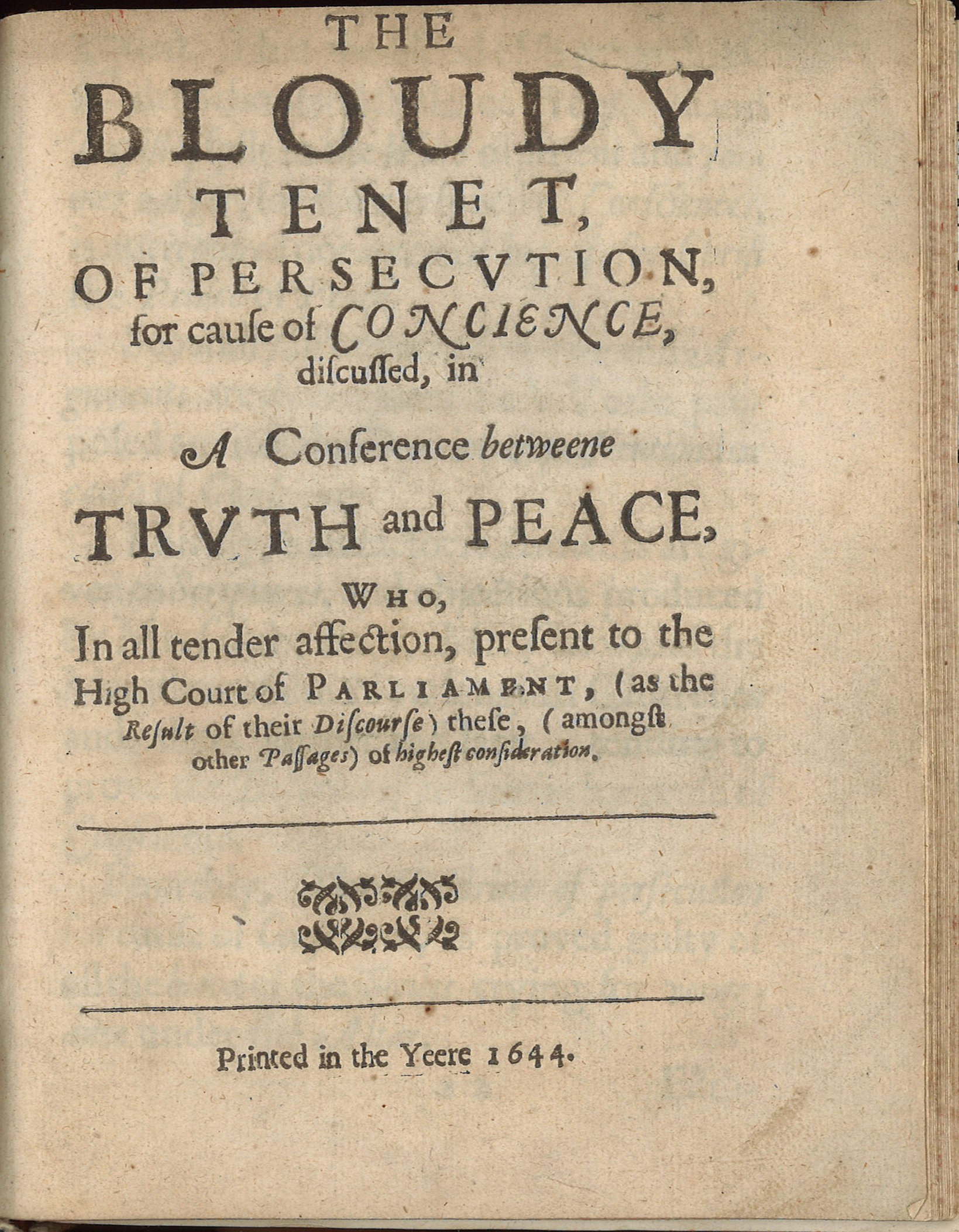
bloudy-tenetThe General and Particular Baptists adopted none of the theological or practical errors of the Anabaptists, but they were somewhat innovative in their approach to public theology. Due to persecutions experienced at the hands of church-run magistrates, they searched the Scriptures and came away with a doctrine that would come to be known as liberty of conscience. Thomas Helwys, a General Baptist, was perhaps the first to write on this subject. Roger Williams, an English migrant to America and a Separatist-turned-Particular Baptist, expounded on Helwys’ earlier work. In his 1644 work entitled The Bloudy Tennent of Persecution, Williams called out civil magistrates for their persecution of the consciences of saints. Nevertheless, he called the saints to expect persecution if they truly be in Christ.

“WHILE I plead the cause of truth and innocence against the bloody doctrine of persecution for cause of conscience, I judge it not unfit to give alarm to myself, and to all men, to prepare to be persecuted or hunted for cause of conscience. Whether you stand charged with ten or but two talents, if you hunt any for cause of conscience, how can you say you follow the Lamb of God, who so abhorred that practice?” (ed. Joseph Early, Jr., Readings in Baptist History, pg. 21).

The Baptist Confession (1644 / 1646)

Liberty of conscience was a universally accepted distinctive of the early English and American Baptists. In The Baptist Confession (1644), the English Particular Baptists made many concessions to the public theology of the continental Reformers as laid out in the Belgic Confession. However, they nuanced it quite a bit. The Dutch Reformers would doubtless wholeheartedly affirm Article XLVIII in The Baptist Confession of 1644. It reads almost verbatim like the Belgic Confession in its insistence that Christians are subject to magistrates:

That a civil Magistracy is an ordinance of God set up by God for the punishment of evil doers, and for the praise of them that do well; and that in all lawful things commanded by them, subjection ought to be given by us in the Lord: and that we are to make supplication and prayer for Kings, and all that are in authority, that under them we may live a peaceable and quiet life in all godliness and honesty.”

However, moving into the next article, there is a slight change of tone from the Belgic Confession to the Baptist Confession. Where The Belgic Confession offers no concession for liberty of conscience, The Baptist Confession highlights it.

“The supreme Magistracy of this Kingdom we believe to be the King and Parliament freely chosen by the Kingdom, and that in all those civil Laws which have been acted by them, or for the present is or shall be ordained, we are bound to yield subjection and obedience unto in the Lord, as conceiving ourselves bound to defend both the persons of those thus chosen, and all civil Laws made by them, with our persons, liberties, and estates, with all that is called ours, although we should suffer never so much from them in not actively submitting to some Ecclesiastical Laws, which might be conceived by them to be their duties to establish which we for the present could not see, nor our consciences could submit unto; yet are we bound to yield our persons to their pleasures” (Article XLIX).

It’s worth noting that, while Particular Baptists at this time saw no place for a civil magistrate to exercise ecclesiastical authority, they do not deny the right of the church described in The Belgic Confession to speak with prophetic authority to civil magistrates. In fact, in the next article, they themselves appeal directly to God for the hearts and the minds of the state to be bent toward them in mercy:

“And if God should provide such a mercy for us, as to incline the Magistrates’ hearts so far to tender our consciences, as that we might be protected by them from wrong, injury, oppression and molestation, which long we formerly have groaned under by the tyranny and oppression of the Prelatical Hierarchy, which God through mercy hath made this present King and Parliament wonderful honorable, as an instrument in his hand, to throw down; and we thereby have had some breathing time, we shall, we hope, look at it as a mercy beyond our expectation, and conceive ourselves further engaged forever to bless God for it” (Article L).

This was a clear appeal not only to God but also to the civil magistrates to show mercy and kindness to them for conscience sake. Yet the Particular Baptists went on to explain that, even if the magistrates did not show mercy but dealt treacherously with them, they were still to submit in all things lawful, yet without violating their consciences. The revision of this Confession in 1646 goes on to expound on this idea of liberty of conscience recognizing it as a duty the state owes to its citizenry. It even goes so far as to dictate to the magistrates what are their duties to men regarding liberty of conscience. As such, we see that the early Particular Baptists did view the use of the prophetic voice as a deterrent for governments that might otherwise violate their liberty of conscience. They did not concede to the notion that the church should not speak to matters of government, only that governments were not free to dictate terms to the church.

______________
In our next article, we will conclude our discussion of public theology in the Reformed confessions by examining developments in The Westminster Confession and The Baptist Confession (1677 / 1689).

A Reformed Baptist Perspective on Public Theology – The Reformed Confessions (Part I)

Read the first three posts here, here, and here.

______________

When discussing the idea of the Two Cities and Two Kingdoms paradigms for understanding public theology, many leave a tremendous gap between Luther and modern scholarship. We would be negligent to do so here, though. For a uniquely Reformed Baptist perspective on these issues to be well informed, one must be aware of the fact that there is more than just a Lutheran perspective of public theology to draw upon. There is also a Reformed tradition, which just so happens to be the tradition from which Baptists sprung.

Luther’s further development of Augustine’s paradigm certainly plays a large role in the development of Calvinistic, Reformed, and Reformed Baptist approaches to public theology. However, Calvin and his predecessors did not adopt Luther’s theology without some contributions of their own. Luther’s views on the subject evolved throughout the course of his life and the life of Saxony. The same could be said of Zwingli in Zurich, Calvin in Geneva, and the Dutch, British, French, German, and American Reformers that would follow in their footsteps.

According to Oliver O’Donovan and Joan Lockwood, Calvin intermingled aspects of the patristics, the scholastics, and Luther in the development of his public theology with ideas and methods he’d received from classical political philosophy as well as humanist literary, historical, and legal scholarship (O’Donovan and Lockwood, From Irenaeus to Grotius, 662). Calvin’s take on public theology took into account not only the collective wisdom of church history and Western Civilization, but it also brought several disciplines to bear on the matter. Thus, it would be highly inappropriate to attempt to transplant Luther’s theory into the Reformed tradition without any consideration of nuance or further development by Calvin and his theological predecessors.

Recognizing the willingness of the Reformers to shift understandings of these matters to meet the ever changing political structures of their times and cultures, it’s important that we as 21st century Westerners seek to discern as best we can the most universal elements of the Reformed take on Public Theology. Perhaps the best place to look to find these universal elements are in the development of the Reformed confessions of faith. For the purposes of this series, we will look at four such confessions that particularly pertain to the Reformed and Reformed Baptists: The Belgic Confession, The Baptist Confession (1644/1646), The Westminster Confession, and The Baptist Confession (1677/1689). As we examine these confessions, we will see how historical considerations over time forced the Reformed to continue to revisit the biblical texts most pertinent to the subject matter at hand and further Reform their views on public theology. Semper Reformanda!

Separation of Church and State

Some would take issue with there even being a chapter on magistrates in the confessions. They argue that there should be a complete separation of church and state neither where the state speaks with authority to the church nor where the church speaks with authority to the state. Sam Waldron has offered a response to such reasoning.

“Does it surprise you that the Confession contains a chapter on the subject ‘Of the Civil Magistrate’? Are you inclined to ask, ‘What does politics have to do with Christ?’ If that is something of your response, may I suggest that you are a victim of a religious background which has retreated from its social responsibilities under a wrong view of the separation of church and state? Such an attitude has virtually denied the sovereignty of God over all areas of life. To restrict Christianity to the ‘spiritual’ realm is, ultimately, to destroy it” (Waldron, A Modern Exposition, 284).

The concept of the separation of church and state was a concept unique with Baptists in England and America. It was framed as a larger concept in which to set the gemstone of liberty of conscience, yet another uniquely Baptist doctrine. This concept was never meant to be taken as a separation of God and state. It is important to note at this juncture that not all Reformed confessions championed these concepts. Of course, we’ll see that quick enough as we examine our first Reformed confession: The Belgic Confession.

The Belgic Confession (1619)

589Reformed confessions have always dealt with the subject of the civil magistrate. Specifically regarding this subject the Reformed confessions are in general agreement that the role of government is to wield the sword granted them by God for the punishment of evil and the promotion of good (cf. Romans 13:1-7). Also, shared among the confessions is the recognition that duty is owed by the governed subjects to their magistrates, those magistrates having been given their office by God. The Belgic Confession goes quite a bit further than this, though.

“And the government’s task is not limited to caring for and watching over the public domain but extends also to upholding the sacred ministry, with a view to removing and destroying all idolatry and false worship of the Antichrist; to promoting the kingdom of Jesus Christ; and to furthering the preaching of the gospel everywhere; to the end that God may be honored and served by everyone, as he requires in his Word” (The Belgic Confession, Article 36).

Thus, the Confession most commonly held by the Dutch Reformed community promotes the use of the magistrate to enforce church discipline and promote the furtherance of the gospel. Without doubt this is seen, at least in seed form, in the practices of Zwingli and Calvin. In fact, it was over this issue that Zwingli’s disciples eventually separated from him birthing what would eventually come to be called the Anabaptist movement in Switzerland. Tellingly, The Belgic Confession takes a clear stance against the Anabaptists, anarchists, and revolutionists in its pronouncements.

“Moreover everyone, regardless of status, condition, or rank, must be subject to the government, and pay taxes, and hold its representatives in honor and respect, and obey them in all things that are not in conflict with God’s Word, praying for them that the Lord may be willing to lead them in all their ways and that we may live a peaceful and quiet life in all piety and decency.

And on this matter we reject the Anabaptists, anarchists, and in general all those who want to reject the authorities and civil officers and to subvert justice by introducing common ownership of goods and corrupting the moral order that God has established among human beings” (Ibid.).

This being the earliest of the Reformed confessions, the Westminster Assembly and the Particular Baptists developed much of their public theology upon it. While an argument can be made that it is the most Reformed position, in that it is most faithful to the views and conduct of Calvin and Zwingli, such an argument does not allow for the application of the Semper Reformanda (always reforming) principle. As circumstances changed in Luther’s and Calvin’s political and cultural situations, their understandings of these matters adapted. The Reformed tradition moving forward into the 17th century also adapted to the changing times, returning again and again to the Scriptures to determine the best approach to new considerations as they arose.

______________
In our next article, we will continue our discussion of public theology in the Reformed confessions by examining developments in some of the English confessions of the 17th century.

A Reformed Baptist Perspective on Public Theology: Two Kingdoms in Luther

Read the first two posts here and here.

______________


In the previous article, we discussed Augustine’s classic work City of God as a means of demonstrating how the Church interacts with the culture in the public sphere. Now, we will examine Martin Luther’s development of Augustine’s ideas.

Much of Luther’s public theology can be examined by interacting with Luther’s 1523 essay Temporal Authority: To What Extent It Should Be Obeyed. In this essay, Luther taught that the temporal authority (i.e. the civil state) exists by divine ordinance (cf. Genesis 4:14-15; 9:6), having existed since creation and having been confirmed by Moses, John the Baptist, and Christ Himself. Luther divided the human race into two groups, one belonging to the kingdom of God and the other belonging to the kingdom of the world. Luther argued that the citizens of the kingdom of God need neither law nor sword, whereas the citizens of the kingdom of this world need both. In light of this need, God has established two governments (one spiritual and one temporal). The spiritual government is for the Holy Spirit to produce righteous Christians under Christ’s rule, and the purpose of the temporal government is for restraining the wicked and non-believers by the sword.

Kingdom vs. Government

It’s important to note here that Luther introduces an important distinction between kingdom and government. The two kingdoms are mutually exclusive (reminiscent of Augustine’s Two Cities), but the two governments are not mutually exclusive. As Luther articulates the idea of the two governments that rule these two kingdoms, Luther makes clear that the temporal authority, which executes the legal and coercive government of the earthly kingdom, brings Christians and non-Christians under its sway. In Luther’s thought, we have a supplement to Augustine’s doctrine of the Two Cities, which David VanDrunen describes this way:

To some degree, Luther’s adding the nuance of two governments to the two kingdoms template accounts for the constructive development of Augustinian thought. For example, Luther’s two governments framework gives the two kingdoms an institutional expression – in church and state – that lurks just below the surface in the City of God but is never unambiguously expressed (Natural Law and the Two Kingdoms: A Study in the Development of Reformed Social Thought, pp. 60).

Moreover, by means of this added nuance of the two governments, Luther taught the validity and legitimacy of Christians participating in civil government, something not clearly articulated by Augustine. Consequently, according to Luther, Christians ought to heartily embrace their roles in the civil realm as an expression of their Christian love. For Luther, public society was a forum for the expression of Christian love and duty. In continuity with the medieval tradition, Luther taught the existence of natural law, of which the Ten Commandments is the primary summary; however, Luther moved beyond the medieval tradition by stating that natural law is the source, judge, and standard of all human laws.

Vocation in Luther’s Thought

It’s important to note that Luther’s Two Kingdom approach to public theology belonged to an entire theological system built around the Reformational doctrine of sola fide. The two governments (spiritual and temporal) relate to two kinds of righteousness (the righteousness of faith and civil righteousness), each of which in turn relates to gospel and law, respectively. Faith directs us upward toward God, while love drives us outward toward our neighbor. As persons we stand before God, while we hold various offices in the world as we live before others. One important application of Luther’s public theology was his doctrine of vocation. Luther saw that non-religious vocations (such as the baker, the shoemaker, and the soldier) came to be seen as equally God-pleasing as religious vocations (such as preachers and clerics). The various callings in human society, ecclesiastical and non-ecclesiastical, could now be fulfilled under God and His Word, and alongside one another with equal value.

Some modern advocates have interpreted Luther’s Two Kingdom doctrine as a justification for a twofold ethic for Christians, one for the spiritual government and the other for the temporal government. For example, one can find Luther saying that if a person is called to be a courageous soldier, that person must obey the summons, not as a Christian, but as a citizen subject to the state. In this view, there would be no such thing as a “Christian soldier” since the ethic of this occupation (associated with the temporary government) is distinct from Christian ethics (associated with the spiritual government). It is our contention that historical accuracy requires a more nuanced and careful analysis of Luther’s 1523 essay; in particular, it’s important to consider large sections of Luther’s teaching, which point to the integration of Christian faith and public service.

Luther’s Counsel for Princes

Consider the following discussion in Luther’s essay, in which he discusses the proper conduct of a Christian prince:

What, then, is a prince to do if he lacks the requisite wisdom and has to be guided by the jurists and the lawbooks? Answer: This is why I said that the princely estate is a perilous one. If he be not wise enough himself to master both his laws and his advisers, then the maxim of Solomon applies, ‘Woe to the land whose prince is a child’ (Eccles. 10:16). Solomon recognized this too. This is why he despaired of all law-even of that which Moses through God had prescribed for him-and of all his princes and counselors. He turned to God himself and besought him for an understanding heart to govern the people (I Kings 3:9). A prince must follow this example and proceed in fear; he must depend neither upon the dead books nor living heads, but cling solely to God, and be at him constantly, praying for a right understanding, beyond that of all books and teachers, to rule his subjects wisely. For this reason I know of no law to prescribe for a prince; instead, I will simply instruct his heart and mind on what his attitude should be toward all laws, counsels, judgments, and actions. If he governs himself accordingly, God will surely grant him the ability to carry out all laws, counsels, and actions in a proper and godly way.

According to Luther, the Christian prince must govern by trusting in God, praying constantly for a right understanding found in divine wisdom that enables the implementation of human laws and counsels in a “proper and godly way”. As a side note: Notice also how Luther not only offers his counsel as to how a prince ought to rule, but even sets himself up as counsel to the prince in question. He writes: “…instead, I will simply instruct his heart and mind on what his attitude should be…” Not only did Luther see that it was right and proper for a Christian to serve in public office but, in the instance that a “so-called” Christian comes to hold public office, Luther saw it necessary for him as a pastor to offer counsel to such a man. Now, one may raise the question: “What is the proper and godly way for a ruler to govern?” This “proper and godly way”, according to Luther, is by following the example of Jesus Christ. Luther continues in his essay:

First. he must give consideration and attention to his subjects, and really devote himself to it. This he does when he directs his every thought to making himself useful and beneficial to them; when instead of thinking, ‘The land and people belong to me, I will do what best pleases me,’ he thinks rather, ‘I belong to the land and the people, I shall do what is useful and good for them. My concern will not be how to lord it over them and dominate them, but how to protect and maintain them in peace and plenty.’ He should picture Christ to himself, and say, ‘Behold, Christ, the supreme ruler, came to serve me; he did not seek to gain power, estate, and honor from me, but considered only my need, and directed all things to the end that I should gain power, estate, and honor from him and through him. I will do likewise, seeking from my subjects not my own advantage but theirs. I will use my office to serve and protect them, listen to their problems and defend them, and govern to the sole end that they, not I, may benefit and profit from my rule.’ In such manner should a prince in his heart empty himself of his power and authority, and take unto himself the needs of his subjects, dealing with them as though they were his own needs. For this is what Christ is to us [Phil. 2:7]; and these are the proper works of Christian love.

Throughout this portion of his essay, Luther appeals to Scripture for instruction on attitude and approach, for example, and for encouragement to rule well as a Christian prince. The same principle would naturally apply to Christian mayors, councilmen, and other Christians in political office. For Luther, “love and natural law” must guide the rule above and beyond all law books and jurists’ opinions for the Christian prince. Although love is a universal norm and love corresponds to deeds that conform to natural law, both love and natural law require the illumination of Scripture. This is not true only for Christian politicians, but for Christians in numerous other vocations. Consider the following thought from Luther

The book [Scripture] is laid in your own bosom, and it is so clear that you do not need glasses to understand Moses and the Law. Thus you are your own Bible, your own teacher, your own theologian, and your own preacher. If you are a manual laborer, you will find that the Bible has been put in your workshop, into your hand, into your heart. It teaches and preaches how you should treat your neighbor. Just look at your tools—at your needle or thimble, your beer barrel, your goods, your scales or yardstick or measure—and you will read this statement inscribed in them. Everywhere you look, it stares at you. . . . All this is continually crying out to you: ‘Friend, use me in your relations with your neighbor just as you want your neighbor to use his property in his relations with you.’

Conclusion

When one surveys Luther’s writings, the overwhelming impression is that for Luther, the Christian faith did not exist alongside public life, but came to expression and functioned within public life. Luther knew how to distinguish between the spiritual government and the temporal government, but he never separated them. Luther entered the world’s domain in the name of God with the Word of God. In this way, Luther’s public theology is thoroughly Augustinian. It is true that one cannot rule the world with the gospel, just as much as the City of Man cannot be transformed into the City of God. However, this does not mean that that Christians are permitted to ignore instruction from the Scripture, like the exhortations from the Sermon on the Mount. The Sermon on the Mount touches a person’s heart and conscience, but from this inward life flows outward conduct so that true humanity finds expression in public life.

In our next post, we will examine how the Reformed, from Calvin to the English Particular Baptists, developed these ideas in brought their own nuances into the development of Public Theology.

A Reformed Baptist Perspective on Public Theology: Augustine’s Two Cities

Read the Introduction here.


______________

Augustine wrote City of God as an apologetic in response to those who were crediting Christians with the downfall of Rome. They argued that Christianity as a religion weakens cultures and makes them susceptible to overthrow by foreign powers. Augustine argued to the contrary that, whereas faithful commitment to the God of Scripture has always brought about flourishing in particular cultures, increased rebellion against Him has always resulted in their downfall. Within these cultures, Augustine recognized that there were two types of citizens: those of the City of God and those of the City of Man (also known as the city of this world or the earthly city).

A Necessary Dichotomy

Augustine distinguished the City of God from the City of Man. These two cities are organized societies with citizens who are respectively distinguished by the standards by which they live. Citizens of the City of Man live by the standard of the flesh, whereas citizens of the City of God live by the Spirit (cf. Galatians 5:13-26). Augustine emphasizes that what ultimately distinguishes the two cities are their loves: “We see then that the two cities were created by two kinds of love: the earthly city was created by self-love reaching the point of contempt for God, the Heavenly City by the love of God carried as far as contempt of self.” (Book 14, Chapter 28).

It’s important to emphasize that, for Augustine, there is no dual citizenship – in other words, each individual member is a member of one city, and one city only. Augustine reiterated Jesus’ teaching that while Christians live in the City of Man, they do not belong to the City of Man (cf. John 18:36). Their presence in the earthly city is like that of strangers sojourning in a foreign country (cf. 1 Peter 1:1-2). The City of Man is not our true home; rather, our citizenship is in heaven (cf. Philippians 3:20) and it is to that Heavenly City that we owe our affections and our ultimate loyalty.

As some have rightly observed, Christians are in a very similar situation to that of the church during the period of the Assyrian Dispersion and the Babylonian Exile. We remain citizens of Zion while we sojourn in a foreign land and seek, in our occupations and conversations, to enable flourishing, both our own and that of those around us. As part of our goal to aid in the flourishing of the land shared by these two competing cities, the City of God necessarily speaks the truth in boldness when addressing the City of Man.

Augustine’s Critique Centered on Virtue

Some have interpreted Augustine’s words as a justification for the withdrawal of Christians (and a Christian worldview) from the civil and political sphere of society, but this would be a misreading of Augustine. Augustine strongly believed that the blessedness of civic life would be enhanced if the majority were to hear and embrace the Christian precepts of justice and moral virtue. Consider the words of Augustine in Book II, Chapter 19 of The City of God:

If ‘the kings of the earth and all nations, princes and all the judges of the earth, young men and maidens, old men and children’ [Psalm 148.11f.], people of every age and each sex; if those to whom John the Baptist spoke, even the tax gatherers and the soldiers [Luke 3.12f.]: if all these together were to hear and embrace the Christian precepts of justice and moral virtue, then would the commonwealth adorn its lands with happiness in this present life and ascend to the summit of life eternal, there to reign in utmost blessedness.

Augustine also emphasized that the City of God and the City of Man are competing, intermingling loyalties within the same culture. It is at this aspect of the City of Man that Augustine’s critique is most pointed.

The City of Man always seeks stability, if for no other reason than to maintain its own power, and as a result, it legislates at the level of the minimal standards needed to preserve society. The City of Man, therefore, emphasizes tolerance of differences (as long as they don’t interfere with the government’s power) in order to avoid conflict. For the City of Man, this passes for peace, albeit distorted by greed and selfishness. The City of Man is dominated by self-love and built around the lowest common denominator in society, which is self-indulgence. Virtue is absent since the citizens of the City of Man love themselves more than others, though good behavior may be enforced by social customs or by coercion by the state. In this environment, the state is necessary to restrain evil. Herein lies the dilemma: the problem is, the government itself is part of the City of Man and is itself dominated by self-love. The State is more interested in self-promotion and power than it is in promoting the good. In the City of Man, the State is nothing less than organized oppression, and maintains its power through violence and threats.

In contrast to the City of Man, the City of God is built around love of God and therefore love of neighbor. Because of this focus on love, all true virtue resides in the City of God. The City of God also seeks peace, though of a different and more profound sort. Whereas the City of Man uses terror to compel good behavior and to protect good people from the wicked, the City of God relies only on penitence, grace, and mercy, not compulsion, to advance its goals. Augustine emphasized that the City of Man cannot accomplish its penultimate ends (i.e. safety, peace, etc.) if its ultimate ends, means, and motivations (i.e. domination, pride, and self-love) are fundamentally disordered. This is a reality that is understood by citizens of the City of God and because of our love for our neighbor, we have a responsibility to speak this truth in boldness to citizens of the City of Man. In this way, the City of God can influence citizens of the City of Man by addressing the moral conscience of the City of Man. In this role, the citizens of the city of God become a prophetic voice to the State – forth-telling the God’s truth as revealed in Scripture.

In the next blog, we will consider how Augustine’s Two Cities has been applied throughout Church history by examining the thoughts of Martin Luther on the subject as well as the modern advocates of Two Kingdoms theology.

A Reformed Baptist Perspective on Public Theology: An Introduction

Disclaimer: The present series is a presentation of the thoughts of two Reformed Baptists (Gabriel Williams and William Leonhart) on the relationship between kingdom and culture. This series is to be taken neither as the view of all Reformed Baptists nor as the view of all contributors to CredoCovenant. Reformed Baptists are a diverse group with a wide variety of perspectives on this issue.

____________________


Paying attention to the news, one will have noticed that 2015 has been a year marked by numerous stories that have deeply affected American cultural life in the present and will doubtless have many ramifications in the future. The following list is a quick rundown of just a few major stories that have gained attention in 2015 (so far) throughout social media.

A cursory examination demonstrates that many of the news stories mentioned above involve matters of social justice and politics. This raises a significant question for Christians to consider: What is the proper Biblical approach regarding matters of social justice and politics? This question is one that addresses fundamental aspects of public theology.

Considerations

Before answering it, we’re compelled to acknowledge the complexity of the question. Its answer demands a discussion on the relationship between the Church and State, the relationship between individual Christians and the institutional Church (i.e. a discussion of ecclesiology), and an honest discussion regarding numerous Biblical passages. Moreover, this discussion will also lead to a discussion on economic theory and political theory.

The purpose of this blog series is to present a biblical approach regarding matters of social justice and politics using Reformed and Baptistic presuppositions and to apply this biblical approach to a number of pressing issues within our American context. Our position on this matter can be summarized by the following ten points:

  1. Christians are truly citizens of the Kingdom of God and we owe our affections and our ultimate loyalty to the Heavenly City where righteousness dwells.
  2. Christians live in this present, evil age and our presence in this earthly city is like that of strangers sojourning in a foreign country.
  3. The Kingdom of God and the kingdom of this present, evil age are competing, conflicting, intermingling loyalties within the same public sphere with antithetical worldviews.
  4. Unbelievers are truly citizens of this earthly city with a nature that is governed by the flesh, rather than the Spirit, and thus have a nature that is antithetical to the Kingdom of God.
  5. Because unbelievers have disordered affections, they cannot have properly ordered penultimate ends (such as peace and justice) and thus, it should not be expected that they will rightly exercise citizenship in the public sphere.
  6. Because this present, evil age is set in opposition to the Kingdom of God, Christians cannot “redeem the culture” or transform the earthly city into the Kingdom of God.
  7. The Kingdom of Grace is already present in the invisible church, while we await the ultimate fulfillment of the Kingdom of God in glory (William Collins, “The Baptist Catechism,” Q.109).
  8. Christians are called to engage the citizens of the earthly city in the public sphere as those who have been transformed by the Spirit and to serve as a prophetic voice to our culture, forth-telling the truth of God as revealed in the Scripture.
  9. Within our American culture, if we desire to speak prophetically to the ruling class of our day, we must do so by going directly to the people, for they are the ruling class in America.
  10. The separation of Church and state means that the state is not permitted to intrude into matters of conscience nor matters of church government.

The Approach

In this blog series, we will examine the biblical warrant for each of these ten points. We will begin by discussing historical perspectives on this topic. The knowledgeable reader will recognize that our ten points are strongly grounded in Augustine’s insights into public theology. It is our contention that any discussion of how the Church interacts with the culture in the public sphere must start by interacting with Augustine’s classic work The City of God.

We will discuss various perspectives from important historical figures (such as Martin Luther, Abraham Kuyper, Herman Dooyeweerd) and from modern voices (such as Dietrich Bonhoeffer, C.S. Lewis, Francis Schaeffer, David VanDrunen, D.G. Hart, and James K. A. Smith). After conducting a historic survey of Christian thought on this issue, we will also conduct a survey of Scripture to examine biblical theology and biblical precedence on this matter. Finally, we will discuss how our position can be applied to various contemporary issues involving social justice and economic justice.

The Desired Tone

Our goal in this series is not first-and-foremost to critique other views on Christian social theory. While we may respectfully disagree with many of our contemporaries in both the theonomist and the modern Two Kingdoms camps, we will place more emphasis on the respect than on the disagreement. We do recognize that we cannot establish one position without discussing its disagreement with other positions. However, we recognize those with whom we disagree as our brothers in Christ.

As such, our goal is to enter the conversation with a positive argument for our position. It is not our goal to engage in a heated debate with a negative argument against the positions of others. We have respectfully chosen to leave that debate for another time and another place. While we do not mean to discourage debate from those who disagree with us, we do ask that you hear us out in full before responding in the comments section. There are several posts to come.