The Ultimate Fate of the Universe

In the previous blog, I argued that God’s providence accounts for the orderliness and regularity of our universe. In essence, the reality of God’s providence allows one to have confidence in the use of the scientific method for the study of natural phenomena. If we believe that the natural world is simply a product of unguided physical laws, then the only way in which we can have confidence in the reliability of the scientific method is through induction of a large collection of observations, which is subject to interpretive errors. However, if we believe that the natural world is upheld and guided by God’s providence, then we can base our scientific knowledge claims on God’s revelation of the natural world.

These are two fundamentally different starting points for understanding our world and ultimately, this means that two people can come to radically different conclusions about the nature of the world based upon the same evidence. In the previous blog, I argued this principle by discussing some of the irrational interpretations from quantum theory, particularly the idea of effects without causes. It is my contention that the Christian worldview concerning the nature of the universe is most consistent with our evidence of the natural world. This means that the universe is not only understandable and consistent, but it is purposely designed to communicate a particular message concerning God’s invisible attributes. In previous blogs, I made arguments concerning the existence and knowability of God based on the creation and maintenance of the universe. To end this mini-series, I want to address a topic of growing interest: what is the ultimate fate of the universe? This is no longer a purely speculative, philosophical question, but it is now a scientific question. This topic is also important because our answer is fully based on deductive reasoning concerning the origin of the universe.

Heat Death or Cold Death

This semester, I have the privilege to teach my favorite physics course as an undergraduate: thermodynamics. The impetus for the development of thermodynamics was the industrial revolution and the efficiency of heat engines, but now we’ve come to understand that many of the fundamental phenomena in our world are implications of the laws of thermodynamics. The key to thermodynamics is to understand the role of entropy.  Entropy is the precursor of the definition of information as developed in information theory. Information is carried, stored and processed by all macroscopic physical systems and is ultimately governed by the laws of physics, so it’s not surprising that physics and information should be closely related to one another. The usefulness of the concept of entropy can hardly be overstated and it’s probably fair to say that the connection between physics and information is still not fully exploited.

There are many ways in which a person can qualitatively understand the concept of entropy. First, it can be said that entropy is a measure of energy concentration in that entropy increases as the energy of a system becomes more dispersed throughout time. This is related to the idea that entropy is a measure of disorder of a given system. Second, it can be said that entropy is the variable that determines irreversibility of physical processes; in particular, entropy controls the direction of heat transfer between systems as well as causal arrow of time in the universe. Finally, it can be said that entropy determines the amount of available energy that can be used to do useful work for a given system. Entropy is also a central concept in understanding the natural world because the 2nd law of thermodynamics states that the entropy of the universe (as a closed, isolated system) will always increase over time. In terms of the above definitions, this means that energy is become more dispersed throughout time, that time is irreversible, and that the avaiable energy in the universe is gradually decreasing.

image: universe

There are numerous implications of the 2nd law of thermodynamics, but one that is relevant concerns the fate of the universe. Even though it is difficult to define the entropy of the universe, there should be a theoretical point in time in the distant future in which the universe reaches a state of maximum entropy according to the 2nd Law. This happens when all the available energy of the universe has been completely exhausted. When this occurs, there will be no more heat flow, no more work done, and the universe will essentially become dead and inert.This can also be thought of in terms of chemical reactions. According to the 2nd law, a chemical reaction will only occur if it results in an increase of entropy. Any reaction that takes place will either result in the products becoming less ordered, or heat being given off. This means at some time far in the future, when all the possible reactions have taken place, all that will be left is heat and fundamental particles. No reactions will be possible, because the universe will have reached its maximum entropy. The only reactions that can take place will result in a decrease of entropy, which is not possible according to the second law, so in effect the universe will have died. Because of the emphasis on the lack of heat flow, this theory is sometimes called the heat death of the universe.

Another theory concerning the fate of the universe is based upon the expansion rate of the universe. Observations suggest that the expansion of the universe will continue forever and that the expansion rate of universe is increasing. If so, the universe will cool as it expands, eventually becoming too cold to sustain life. Moreover, the supply of gas needed for star formation will be exhausted, and as existing stars run out of fuel and ceases to shine, the universe will slowly and inexorably grow darker, one start at a time. Eventually, even the stellar remnants left behind by these stars will disappear, leaving behind only black holes, which themselves will eventually disappear as they emit radiation. In this scenario, the universe ends in a whimper, becoming dark and cold. Because the universe will approach absolute zero temperature in this scenario, this is known as the cold death of the universe

The Conclusion of the Matter

The heat death and cold death theories are just two of many theories produced by cosmologists that seek to explain the ultimate fate of the universe. Though these theories have numerous differences between them, what is common between them is the assumption that the universe will end through slow, gradual, unguided natural processes. Moreover, it is assumed that death of the universe comes from a source within itself and is based on the inherent futility of our universe. These theories are expected if it is believed that the universe has no inherent purpose for its existence and has purely naturalistic origins. The narrative produced by this worldview is that the universe was created without purpose, the earth has no preferred position in the universe, the life within the universe has no inherent purpose, the current cosmological epoch has no central place in time, and the end of the universe has no purpose. With this view of the universe, it’s no wonder why a growing number of people essentially agree with this famous quote from Richard Dawkins:

In a universe of electrons and selfish genes, blind physical forces and genetic replication, some people are going to get hurt, other people are going to get lucky, and you won’t find any rhyme or reason in it, nor any justice. The universe we observe has precisely the properties we should expect if there is, at bottom, no design, no purpose, no evil and no good, nothing but blind, pitiless indifference.

This conclusion is the result of attempting to understand our natural world without acknowledging God’s providence and eternal decree. As was argued previously, the origin of the universe and the meticulous fine tuning of the universe both point to the existence of God. Moreover, the constancy and regularity of the universe all point to the God’s active providence in the world. If the existence of the universe comes from a source outside of itself, then it stands to reason that the end of the universe will occur from a source outside of itself. In other words, if the origin of the universe has a purpose outside of itself, then the end of the universe has a purpose outside of itself as well.

The fundamental Christian argument is that God has intentionally designed our world (and the universe in general) to declare His glory and to make Himself known. Our physical world continues to march forward in time not in meaningless, random fashion, but its purpose is tied up in God’s purposes of redemption. This is best described by the Apostle Paul in Romans 8:19-23

For the creation waits with eager longing for the revealing of the sons of God. For the creation was subjected to futility, not willingly, but because of him who subjected it, in hope that the creation itself will be set free from its bondage to corruption and obtain the freedom of the glory of the children of God. For we know that the whole creation has been groaning together in the pains of childbirth until now. And not only the creation, but we ourselves, who have the firstfruits of the Spirit, groan inwardly as we wait eagerly for adoption as sons, the redemption of our bodies.

The message of the apostles is that the current age we live will end, not when entropy maximizes or when the universe approaches absolute zero, but when God completes His redemptive purposes. This means that we do live in a central place in time and that the end of the universe will also declare God’s glory. If the current universe was created solely from God’s Word (cf. Hebrews 11:3) and upheld by His providence, then it will end based on His decree. This is vividly expressed in 2 Peter 3 in which “the heavens and earth that now exist are stored up for fire, being kept until the day of judgment and destruction of the ungodly” and “the heavenly bodies will be burned up and dissolved, and the earth and the works that are done on it will be exposed.” This is the picture of catastrophic un-creation, which will be replaced by the new heavens and the new earth in the age to come (cf. Revelation 21-22).

So let’s return to the original questions which started this blog series: (1) Why do you believe that God exists? (2) Why do you believe that God can be known by us? The evidence of God can be known based on the very origin of the universe and the active maintenance of the universe. We see God’s power and wisdom in the origin of the universe; we see God’s power and faithfulness in the maintenance of the universe (as observed through the fine tuning of the fundamental forces in the universe); and we see God’s intention and purpose through His active interaction with creation. Contrary to popular opinion, all things are not continuing as they were from the beginning of time. There have been numerous miraculous signs in which God has judged His creation (such as the global flood) and rescued His people (such as the exodus). However, His supreme interaction with His creation and revelation to us has come through the incarnation of His Son through which we have redemption. God’s acts of redemption, creation, and providence ultimately give us the evidence that God exists and can be known.

Providence and the Scientific Method

In the previous blog, I argued that the orderliness and consistency of our physical universe, as seen through the fine tuning of the four fundamental field interactions, provides clear evidence of God’s handiwork. This regularity is not simply the result of unguided, impersonal physical laws, but rather it is due to the faithfulness of God. In other words, the evidence of God in our physical world is seen by His acts of creation and providence. Chapter 5, Paragraph 1 of the 1689 LBCF states it in this way

God the good Creator of all things, in his infinite power and wisdom doth uphold, direct, dispose, and govern all creatures and things, from the greatest even to the least, by his most wise and holy providence, to the end for the which they were created, according unto his infallible foreknowledge, and the free and immutable.

This classic statement on the providence of God explains why being a scientist is an honorable vocation and why the scientific method (when used properly within its constrained limits) does correspond to our reality. When we affirm these basic truths concerning God’s providence with the regularity of our physical world, we will develop a more robust, holistic view of the physical world. Unfortunately, many Christians have inherited a worldview in which the governing physical principles of the natural world are divorced from God’s works of providence. This worldview is not only unbiblical, but it’s also contrary to the worldview of the men who pioneered the modern scientific age. When Isaac Newton published his treatise of classical mechanics, entitled The Principia, he discusses the motivations for his study. He writes:

I had an eye upon such principles as might work, with considering men, for the belief of a deity… this most beautiful system of the sun, planets, and comets, could only proceed from the counsel and dominion of an intelligent and powerful being. And if the fixed stars are the centres of other like systems, these being formed by the like wise counsels, must be all subject to the dominion of One; especially since the light of the fixed stars is of the same nature with the light of the sun, and from every system light passes into all other systems: and lest the systems of the fixed stars should, by their gravity, fall on each other mutually, he hath placed those systems at immense distances one from another. This Being governs all things, not as the soul of the world, but as Lord over all … All that diversity of natural things which we find suited to different times and places could arise from nothing but the ideas and will of a Being necessarily existing.

From the depths of his own soul, Newton came to know God through the Word, but through his study of the design of the physical universe, his belief was reaffirmed. Thus, the diligent student of science and the earnest seeker of truth will learn, as Newton did, that all science and all truth are one which has its beginning and its end in the knowledge of Him whose glory the heavens declare and whose handiwork the firmament shows forth (cf. Psalm 19). Of course, this blog series is being written because many no longer hold on to this worldview. Apart from evolutionary biology, it is my belief that quantum theory militates most strongly against this worldview. In this blog, I want to discuss what happens when we divorce God’s providence from the study of the natural world.

The Leap of Quantum Theory

It is well-known that the two irreconcilable fields in theoretical physics are quantum theory and general relativity. Theorists hope these fields can be reconciled so that a unified field theory can be developed. Undergraduate students tend to ask me whether I believe these fields will be reconciled and my answer has always been in the negative because the interpretations and implications of quantum theory appear to be irrational.

Quantum theory traces its origin to the work of Max Planck, who presented in 1900, the hypothesis that energy comes in discrete units called “quanta”. The watershed moment for quantum theory came in 1927 with the uncertainty principle by German physicist Werner Heisenberg. Heisenberg found that one can learn either the exact position of a given particle or its exact trajectory, but not both simultaneously. This is contrary to the classical physics which states that the location and trajectory of any particle can be determined, in principle, at some point in the future.  This means that classical physics is philosophically built on determinism.

Heisenberg’s experiments showed that this assumption was false – that we can never know everything about the behavior of even one particle and, therefore, can never make predictions about the future that will be completely accurate in every detail. This marked a fundamental change in the worldview of physics and lead to famous debates in the early half of the 20th century. Those who held to classical physics (such as Einstein) believed that the observed randomness is a reflection of our ignorance of some fundamental property of reality, whereas proponents of quantum theory believed that the physical world is fundamentally built on uncertainty and probability.

The interpretation of the mathematical postulates of quantum theory led to a number of implications. The most fundamental interpretation of quantum mechanics asserts that the natural change of any quantum system is by way of indeterministic physically discontinuous transitions between stationary states. For a classical example of this postulate, consider the description of the subatomic world as described by Timothy Ferris in his book Coming of Age in the Milky Way

The more closely physicists examined the subatomic world, the larger indeterminacy loomed. When a photon strikes an atom, boosting an electron into a higher orbit, the electron moves from the lower to the upper orbit instantaneously without having traversed the intervening space. The orbital radii themselves are quantized, and the electron simply ceases to exist at one point, simultaneously appearing at another. This is the famously confounding “quantum leap” and it is no mere philosophical poser; unless it is taken seriously, the behavior of atoms cannot be predicted accurately.

Thus, if this explanation is an accurate description of the subatomic world, then quantum mechanics has revived the concept of change and self-creation as a tool to explain the physical world. If the “quantum leap” is literally simultaneous, then we have a clear violation of the law of non-contradiction since the electron is in an orbit and not in an orbit at the same exact time and in the same relationship. However, a more serious problem with the explanation is that it introduces the tacit assertion that effects can exist without causes. The popular interpretation of quantum theory suggests that quantum leaps occur by “chance” (since probability distributions are the irreducible physical concept) and this justifies the hypothesis that nothing causes the behavior of subatomic particles. To be free of casuality is to be free of logic, and license is given for making nonsense statements with impunity.

Ultimately, we must come to the conclusion that quantum theory and general relativity cannot both be correct. While general relativity allows for (and predicts) a perfect point-like singularity at the beginning of time, quantum mechanics does not, for it prohibits defining at the same time the precise location, velocity, and size of any single particle or singularity. Furthermore, quantum mechanics seems to suggest that the sub-atomic world – and even the world beyond the atom – has no independent structure until it is defined by the human intellect. We can say that quantum theory has great explanative power for many phenomena, but for the reasons given above, it cannot be a full and accurate description of reality.

The Conclusion of the Matter

So what are the conclusions that we should draw from this? First, we should recognize that the behavior of the natural world cannot be fully explained within itself. When we attempt to explain the nature of this world without a consistent natural theology, we end up with inconsistencies and absurdities. No one disputes the appearance of quantum behavior on the subatomic scale, but the interpretation of this behavior leads to absurdities. Second, we are meant to use general and special revelation to understand this world. Human knowledge is limited not only by our sin and our intellect, but it’s also limited by our finitude. Thus, we need special revelation to inform our observations of the natural world.

Third, it’s important to note that no scientific theory develops in a vacuum. Our worldview affects how we interpret the natural world. It is not an accident that many Christian scientists gravitate towards general relativity since this theory is the culmination of classical physics, which is built off of ultimate causation. Conversely, it’s not an accident that quantum theory is appealing to those who gravitate toward Eastern religion and philosophy since its predictions has many similarities to Eastern mysticism. Ultimately, this means that a discussion on the existence of God and science boils down to a question of worldviews. The fundamental Christian claim states that the universe, being made by the all-wise, all-knowing God, is internally self-consistent because it reflects His wisdom and knowledge. Thus, we do not have a universe in which contradictions abound, but one in which Christ upholds all things by the Word of His power. In the next blog, I will conclude this mini-series by discussing two of the strongest unifying concepts in physics, energy and entropy.


Contingency, Complexity, and the Existence of God

In the previous blog, I argued that there is significant evidence that points to the fact that the universe is finite and has an origin (which points to the existence of God). This evidence rules out the possibility of a static, eternal universe, but it also must rule out any notion of self-creation and spontaneous generation.

First, it’s important to note that self-creation and spontaneous generation is a logical and rational impossibility. For something to create itself, it must have the ability to exist and not to exist at the same time and in the same relationship. In other words, for something to create itself, it must exist before it exists. A being can be self-existent and eternal without violating the law of non-contradiction, but a self-generating, self-creating being is a rational impossibility. Second, it’s important to note that if there was a point in which the physical universe did not exist, then this also means that there is no purely naturalistic reason for the why the universe does exist. In other words, there is no cause for the existence of the universe in and of itself – the cause of the universe must come from outside of itself. This means that the universe could not have been created by “chance”. Because chance is not an entity (i.e it has no being), it does not have any instrumental power to cause anything. Therefore, any appeal to “chance” for the existence of the universe is in effect an appeal for self-creation, which has been shown to be a rational contradiction.

Now, we must ask the next question: Why does the universe exist and what is the purpose of its existence? The fundamental Christian argument is that God has intentionally designed our world (and the universe in general) to declare His glory and to make Himself known (cf. Psalm 19:1-6). Here, I’m going to argue for evidence of purposeful design from the vantage point of the physical sciences, rather than the biological sciences.

A basic question that is usually asked is whether or not the scientific method can actually determine whether or not an event can be the result of a purposeful and designed cause. The emphatic answer is yes. Because of what we know about undirected natural causes and their limitations, the scientific method can be used to rigorously test whether or not there are significant design processes in the universe. First, we may ask whether a particular occurrence was naturally necessary or contingent. An occurrence is naturally necessary if the natural laws governing the physical objects involved are sufficient to explain the occurrence, whereas an occurrence is naturally contingent if it’s dependent upon a non-natural explanation. Second, we may ask whether a particular occurrence is simple or complex. Third, we may ask whether the inherent pattern in the complex occurrence is ad hoc or specific. An ad hoc pattern is one that has no true meaning or significance outside the single occurrence in which it is found. The argument of design easily explains the origin of the universe, but I want to apply this to the regularity and orderliness of universe.

Overview of the Standard Model of Particle Physics

Currently, the standard model of particle physics states that there are four fundamental forces throughout the universe which are constant everywhere and affect all physical objects everywhere. These four fundamental forces (or interactions) are the strong nuclear force, the weak nuclear force, the electromagnetic force, and the gravitational force. The standard model seeks to illustrate that matter and energy are best understood in terms of the interactions of elementary particles with their underlying physical field. Thus, the standard model attempts to unify the four fundamental forces into a unified field theory. Although there are problems with the Standard Model, the standard model demonstrates (and anticipates) that there is an inherent self-consistency within our universe. However, the Standard Model also shows that the relative strengths of the fundamental forces are so finely tuned to the extent that life as we know it would be virtually impossible without them.

We can start with the nuclear forces. The strong nuclear force ensures the stability of ordinary matter by binding subatomic particles together within the nuclei of atoms. This force is enormously strong because it must overcome the electromagnetic repulsive force between protons in the nucleus. If the strong force did not exist (or was weaker than it is), all atomic nuclei in the universe would undergo spontaneous fission and the universe would be almost entirely composed hydrogen and neutrons (and thus uninhabitable for human life). With the same reasoning, if the strong force was stronger, then hydrogen would not exist at all in the universe, leading to the same conclusion of an uninhabitable universe (see this article for a more detailed explanation). The weak nuclear force is the interaction which is responsible for radioactive decay of subatomic particles and nuclear fission. If the weak nuclear force increased, too much hydrogen would convert to helium and thus stars would produce an overabundance of heavy elements, making life chemistry impossible. Conversely, if the weak nuclear force decreased, too much helium would be produced and thus stars would not produce enough heavy elements, making life chemistry impossible.

The electromagnetic force binds electrons to the nuclei of atoms. If this force were slightly weaker, the electrons would be repelled by the nuclear forces and thus chemical bonding would be disrupted to the extent that molecules would not form. If the electromagnetic force were slightly stronger, the atoms could not share electrons (since they would strongly bind to the atomic nuclei) and again no molecules would form. Moreover, heavier elements (like boron) would be unstable to fission and thus would not exist. The gravitational force is the weakest of all of the fundamental forces, but it is responsible for the large-scale structure and evolution of stars, galaxies, and planets. If the gravitational force were somewhat stronger, the stars would be so hot that they would burn out too quickly and unevenly for life to form. If gravity were somewhat weaker, the stars would not become hot enough to ignite nuclear fusion. Such stars would burn quietly for a long time but make no heavy elements needed for planets.

The Conclusion of the Matter

So what are the conclusions that we should draw from this? First, we should note that the universe is balanced on a knife-edge and is clearly contingent upon external sources. It is not necessary that the gravitational force and the strong force are as strong as they are. Nor is it necessary that the physical constants and other phenomena of the universe have happened together, making the universe hospitable and observable for us. There are numerous other examples of the fine tuning in the universe that demonstrates that the universe truly is contingent and yet internally consistent. We don’t live in a universe in which instabilities and contradictions abound. These are undeniable realities and these realities become clearer when one takes the time to study the discoveries within these fields. Consider the words of Fred Hoyle, a renowed 20th century English astronomer:

A commonsense interpretation of the facts suggests that a super intellect has monkeyed with physics, as well as chemistry and biology, and that there are no blind forces worth speaking about in nature. The numbers one calculates from the facts seem to me so overwhelming as to put this conclusion almost beyond question.

Second, we should note that the universe is deeply complex and harmonious. Undergraduate physics students around the country who study theoretical physics feel an overwhelming sense of complexity, but also begin to sense a deep sense of internal consistency and harmony within the universe. This sense is magnified by the fact these fundamental interactions that we are describing are also described by deep mathematical symmetries. Again, it’s important to note that there is no necessary reason for why the physical processes of our universe are accurately described by mathematics. Here’s a quote from physicist Eugene Wigner regarding this point

The miracle of the appropriateness of the language of mathematics for the formulation of the laws of physics is a wonderful gift which we neither understand nor deserve. We should be grateful for it and hope that it will remain valid in future research and that it will extend, for better or for worse, to our pleasure, even though perhaps also to our bafflement, to wide branches of learning.

The last question to ask is whether the complexity and harmony in nature is ad-hoc or specific. First, the mere fact that our universe is coherent, understandable, and predictable indicates that the complexity is specific and purposeful. However, here I want to note that the complexity, regularity, and harmony observed in our natural world today is absolutely consistent with God’s covenantal dealings with man as revealed in scripture. In the Noahic covenant (cf. Genesis 9:8-17), God promised consistency and regularity in the cosmos, which means that the orderliness of our physical universe is because of the faithfulness of God. In other words, we don’t have a “natural” world in which supernatural events occasionally happen; rather our universe is held together by the Word of His power (cf. Hebrews 1:3), which includes ordinary events that occur daily and extraordinary events of redemptive history (such as the resurrection, the global flood, and the future return of Christ). The constancy of the physical world is not an a priori assumption, but rather it is the result of God’s covenant faithfulness to man and God’s providence throughout this physical world.

In the next blog, I will address how the harmony of the physical sciences with our human experience serves as evidence of God’s existence and knowability.

The Evidence of God in the Origins of the Universe

As mentioned in the previous blog, the fundamental Christian argument is that God has intentionally designed our world (and the universe in general) to declare His glory and to make Himself known. This statement includes two other presuppositions: truth and reality exists and can be known.

In most matters, most people speak and act as if reality matters, but not when it comes to God. In matters of religion and faith, there seems to be a pervasive idea that all religious beliefs are equally valid, as long as those beliefs do not harm people, and all religious beliefs have different perspectives that should be celebrated and preserved, rather than challenged and critiqued. In other words, many people are troubled by claims that a particular religious belief is objectively true and does correspond to reality. Frankly, if this popular notion is true, then all defenses for the faith are exercises in futility since Christianity (and any other religious belief) would be nothing more than escapism and speculation.  C.S. Lewis addresses this mentality:

Christianity is not a patent medicine. Christianity claims to give an account of facts— to tell you what the real universe is like. Its account of the universe may be true, or it may not, and once the question is really before you, then your natural inquisitiveness must make you want to know the answer. If Christianity is untrue, then no honest man will want to believe it, however helpful it might be: if it is true, every honest man will want to believe it, even if it gives him no help at all.

Escapism in philosophy and religion boils down to a matter of folly and self-deception. It’s simply foolish to try to avoid the truth about who we are, what we are, and why we are here in this world. If there is a God who made us and has placed demands over us as His creation, we need to know. Conversely, if God is nothing more than a clever mythological device from the ancient world, we need to know that, too. Even if one believes that the reality that we live in is a mere illusion (as some do believe), the very concept of an illusion presupposes a reality. Ultimately, reality exists and ultimately, we cannot escape it.

Our common experience also tells that we can know objective truth. For instance, many accept mathematical statements (i.e. 2 + 2 = 4) and scientific statements (i.e. humans require air to breath) as absolute truth. In making these statements, we are not imposing fictional models on reality; rather, we are recognizing truths that would be true even if we did not recognize them. In other words, human beings do not create knowledge, but we recognize the reality of our world. This leads to the ultimate question: if human beings do not create knowledge or reality, then what is its ultimate origin? In this, our ability to know truth (which exists outside of us) is a kind of evidence for the existence of God. If there is a God, then it must be true that some ideas about God will be true and others false.

My first evidence pointing to God’s existence and knowability comes from the very basic fact that the universe has an origin. The topic of the eternality of the universe was originally a matter of philosophy in which Western philosophers generally assumed that the universe had a beginning until the late 18th century. Immanuel Kant originally argued for the infinitude of the universe and over time, this theory became widely accepted among scientists. By the turn of the early 20th century, the common worldview held that the universe is static – more or less the same throughout eternity. However, the discovery of Einstein’s theory of general relativity and astronomical observations contradicted this view.

A Brief Historical Survey of 20th Century Physics

In 1913, astronomers noticed that several galaxies were moving away from our planet at high speeds. Shortly thereafter, Einstein published a series of papers which described the theory of general relativity and derived the Einstein field equations, which was a mathematical tool used to describe the general configuration of matter and space taking the universe as a whole. Einstein’s work was endorsed by numerous famous experiments, and by the early 1920s, most leading scientists agreed that the Einstein field equations could serve as a foundation for cosmology.

Shortly after Einstein published his theory, Dutch astronomer Willem de Sitter produced a cosmological model from the Einstein field equations which pointed to an expanding universe (for those who are interested in the debate between Einstein and de Sitter, see this historical page). Later, Edwin Hubble used his telescope to verify de Sitter’s mathematical prediction that “the farther away a galaxy is, the faster it moves” – implying that the universe was expanding from a central point. The implication of these findings was obvious: the universe is finite and had a beginning. Even though there were (and still are) scientific concerns about the big bang theory, numerous scientists, from Einstein to Eddington, opposed the big bang theory because it contradicted the prevailing worldview of a static, eternal universe. For example, in an exchange of letters with de Sitter, Einstein quipped “this circumstance irritates me,” and “to admit such possibilities seems senseless.”

There were numerous theories that attempted to revive the eternal universe model (for a historical survey, see this historical page), but all of these alternative models, which utilize a static universe, received a fatal flaw through the discovery of the cosmic microwave background (which is the background radiation that the big bang hypothesis had predicted would be left behind by the initial creation of the universe). In early 1990s, the Cosmic Background Explorer (COBE) demonstrated that the cosmic background radiation was homogeneous enough so that the universe must have begun from a singularity point and yet the background radiation had just enough irregularities (of an extremely minute amount) to account for the formation of the universe’s galaxies.

The Conclusion of the Matter

Now what conclusions can we draw from this historical survey? First, even if one argues with the methodology of the big bang hypothesis, what should be plain and obvious is that the universe is finite and has a beginning. This means that there once was a time when matter did not exist. Therefore, any worldview that requires spontaneous generation or self-creation to explain itself must be inherently self-refuting (since something has to already exist in order to create itself). Second, the existence of the universe is not the result of “chance”. If there was a point when matter did not exist, this also means that there is no naturalistic reason for why it is necessary for the universe to exist. This means that questions regarding the purpose of the universe must be asked if we care about matters of truth and reality.

Now this is a point that is not that difficult to understand. All of us have asked questions about the origin of the world as children and I can bet that none of us concluded that the world was eternal. This basically means that this knowledge is self-evident to us and to deny it means that we are suppressing this truth (cf. Romans 1:18-23). This leads to the last point: the fact that the universe has a beginning and is separate from its Creator is only explained in theism. In theism, God is understood as the distinct, eternal being who brought the universe into existence by an act of His will. However, it is only in Christianity in which the purpose of creation is linked with redemption. Consider the apostle Paul’s words concerning Christ in Colossians 1:15-20:

He is the image of the invisible God, the firstborn of all creation. For by him all things were created, in heaven and on earth, visible and invisible, whether thrones or dominions or rulers or authorities—all things were created through him and for him. And he is before all things, and in him all things hold together. And he is the head of the body, the church. He is the beginning, the firstborn from the dead, that in everything he might be preeminent. For in him all the fullness of God was pleased to dwell, and through him to reconcile to himself all things, whether on earth or in heaven, making peace by the blood of his cross.

Christ is not only the agent of creation, but He is the agent of the new creation for those who put trust in Him. In the next blog, I will address the contingent complexity of our universe as an evidence of God’s existence and knowability.

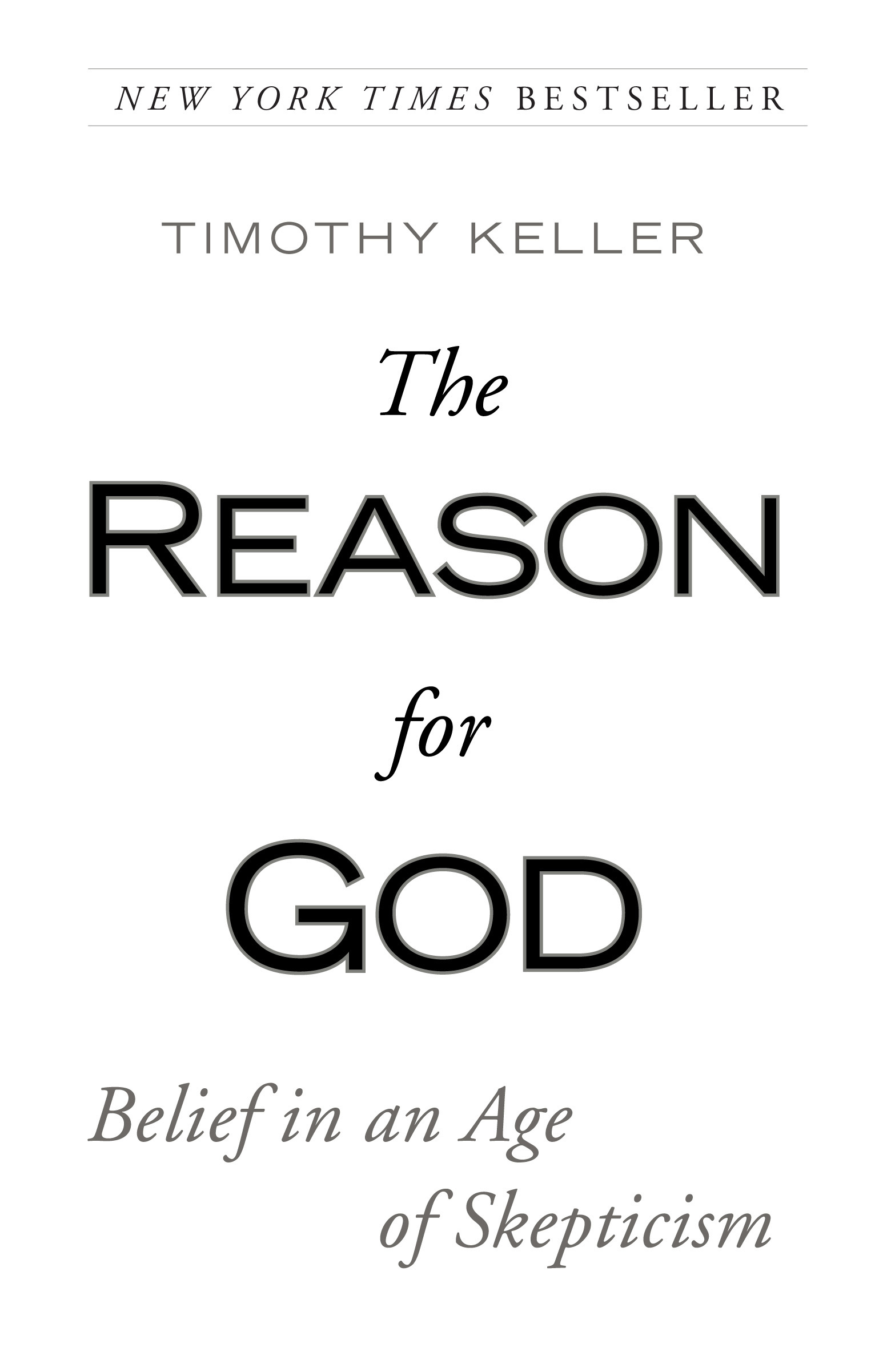
Book Review: The Reason for God by Timothy Keller

Keller, Timothy. The Reason for God: Belief in an Age of Skepticism. New York: Riverhead Books, 2008. 254pp. $16.00.

0cec69c028853f708858c875b6693795_400x400In his 1952 book by the same name, C.S. Lewis attempted to defend what he coined ‘mere’ Christianity. He described Christianity as a house that included Roman Catholics, Eastern Orthodox, and various strands of Protestantism. When a person is first converted, that person is a mere Christian in the great hallway of the house. From that hallway, a mere Christian can and should choose to go into one of the various rooms (denominations). Lewis was not as concerned with getting unbelievers into his particular room as he was with getting them into the great hallway. In keeping with Lewis’ emphasis on converting unbelievers to mere Christianity, Timothy Keller, pastor of Redeemer Presbyterian Church in Manhattan, seeks to meet unbelievers in their doubts and lead them into the great hallway. In Keller’s own words, “I am making a case in this book for the truth of Christianity in general—not for one particular strand of it” (121).

Summary

In The Reason for God, Keller strikes a very pastoral, almost conversational tone. He is not primarily speaking to Christians; his intended audience is made up of doubters. Like C.S. Lewis’ Mere Christianity and Cornelius Van Til’s Why I Believe in God, rather than being an apologetics textbook, The Reason for God presents as a conversation piece for Christians and unbelievers. The main body of the book is broken up into two main parts—Part 1: The Leap of Doubt, and Part 2: The Reasons for Faith.

The Leap of Doubt

In this section, Keller addresses a host of misconceptions about God and Christianity. In the first chapter, he addresses the assumption that exclusivity in religion leads to bigotry by demonstrating that Christianity, while being exclusive, is a religion comprised of members who should themselves have been excluded. Writing Chapter Two, in dealing with the problem of suffering, Keller paints pictures of God and of heaven that are so desirous that, in theory, it retroactively erases all pain experienced this side of death.

Chapter Three is a case for the glory of slavery in the service of a King who became a Slave and died for His subjects. Keller’s goal in the fourth chapter is to point out the inconsistency of committing injustice while claiming the name of Christ. In Chapter Five, he demonstrates the fact that the God of the Bible is not a God primarily comprised of an all-inclusive love, but neither is such a god found in any of the texts of the myriad religions of the word. The seventh and final chapter of Part One demonstrates the folly of trying to interpret God and the Bible through the lens of a modern approach to history and culture.

The Reasons for Faith

After a brief intermission where Keller offers a brief apologetic for his approach to the subject matter, he returns with Part Two: Reasons for Faith.  Having briefly dealt with several reasons unbelievers may have to doubt Christianity, he turns to a positive case for faith. Chapter Eight is Keller’s case for the Christian approach to empirical evidences and against evolutionary science’s unsatisfactory attempt at dismissing divine evidences. He points to internal evidences such as moral obligation, in Chapter Nine, as evidence for God’s existence.

With Chapter Ten, Keller attacks the issue of sin and shows the necessity of the cross. Chapter Eleven is devoted to the demonstration of grace’s triumph over self-righteousness. His twelfth chapter is a demonstration of the relational and social implications of the cross. In Chapter Thirteen, he lays out his apology for the resurrection. The fourteenth and final chapter is a brief treatise on the glories of heaven. Keller concludes this work with an epilogue titled: Where Do We Go from Here? In this section, he walks the unbeliever through the process of conversion and incorporation into the body of Christ.

Critical Evaluation

Christians can gain much from reading The Reason for God. One thing that is immediately noticeable is the fact that no one can write on this subject without upsetting some, if not all, parties: believers and unbelievers, liberals and conservatives, evidentialists and presuppositionalists. However, Keller strikes a tone in this book that can be described in no other way than pastoral. While a case may be made that he makes too many concessions, he does not draw lines in the sand and die on hills where it is not dictated by the subject matter. When writing with such pastoral overtones, it can be difficult to toe the line between unbiblical compromise and gross reactionism. Keller is not always successful in toeing this line, but no one could argue that he has not made a valiant effort at doing so.

Furthermore, though Keller is very accessible and pastoral in his writing, it must be noted that he is widely read on the subject matter at hand. He quite obviously reads broadly, quoting from a wide array of Christian and non-Christian authors. The subject is doubtlessly one of great importance to him, one that he does not think worthy of minimal research and much conjecture. Keller’s heart and his effort in The Reason for God is to be commended highly.

However, there are a few concerns that arise in his method of argumentation. Keller approaches the doubt of an unbeliever as something that is ethically neutral. He makes the gross error of equivocating the common with the honorable. Everyone has their doubts. Thus, it must be honorable to put your doubts on display, right? Wrong. If Christians were to understand doubt for what it is: the sinful suppression of truth, they would reject this equivocation and cease treating the doubts of Christians and non-Christians as something to be praised.

At the end of Keller’s “Introduction,” he describes two scenes where Christ dealt with doubt in others. When found in the apostle Thomas, Christ is said to exhort Thomas to believe and to give him the evidence for which he asked. This is an incomplete account of the confrontation. Christ also rebuked his sinful doubt, “do not be unbelieving” (John 20:27; NASB), and compared him in a negative light with those who do not doubt (vs. 29). In the same way, the father of the epileptic boy in Mark 9 obviously understood the sinfulness of persistent doubt when he said, “I do believe; help my unbelief” (vs. 24). The Greek word here rendered “help” is a word meaning “come to the rescue of.” The direness and sinfulness of doubt are not adequately conveyed in Keller’s approach to unbelievers. Rather, he appears content to applaud their honesty, and join them in it, as long as it moves them to the next point in the discussion.

Of further concern is Keller’s doctrinal minimalism. He admits, as does Lewis in Mere Christianity, that he does see a point where every Christian ought to assume a broad-reaching doctrinal and corporate identity. However, his primary concern in the book is to make a case for “the truth of Christianity in general” (121). As such, the question must be asked how soon a new Christian ought to find a local church. Keller addresses this issue only as a byword, and only after much admitted trepidation, in his Epilogue. He affirms that new Christians must find local congregations with which to identify, but all-the-while passively validating their residual disdain for the bride of Christ (246-247).

Conclusion

In The Reason for God, Timothy Keller sets a commendable example for approaching unbelievers. He is always very cautious to breach the tough topics with much gentleness and humility. However, his method is not representative of a proper hamartiology (doctrine of sin). Doubt is not neutral as it relates to sin; it certainly is not commendable. Christians who engage the unbelieving world do them no favors by pretending that it is, whether in word or deed. Readers would do well to imitate Keller’s tone and patience with the unbelievers with which they come into contact. They would do just as well to approach his many concessions with great discernment, careful not to die on non-essential hills, but willing to draw the line in the sand on matters that are unquestionable in God’s Word.

________________________


Pick up The Reason for God today:ReasonForGod_040809.inddThe Reason for God paperback

by Timothy Keller

Van Til: Futile Self-Deception in Covenant Beings

“No rational creature can escape this witness. It is the witness of the triune God whose face is before men everywhere and all the time. Even the lost in the hereafter cannot escape the revelation of God. God made man a rational-moral creature. He will always be that. As such he is confronted with God. He is addressed by God. He exists in the relationship of covenant interaction. He is a covenant being. To not know God man would have to destroy himself.. He cannot do this. There is no nonbeing into which man can slip in order to escape God’s face and voice. The mountains will not cover him; Hades will not hide him. Nothing can prevent his being confronted ‘with him with whom we have to do.’ Wherever he sees himself, he sees himself confronted with God” (Cornelius Van Til, The Defense of the Faith, pg. 176).

Van Til: Beams Under the Floor

“Our argument as over against this would be that the existence of the God of Christians theism and the conception of his counsel as controlling all things in the universe is the only presupposition which can account for the uniformity of nature the scientist needs. But the best and only possible proof for the existence of such a God is that his existence is required for the uniformity of nature and for the coherence of all things in the world. We cannot prove the existence of beams underneath a floor if by proof we mean that they must be ascertainable in the way that we can see the chairs and tables of the room. But the very idea of a floor as the support of tables and chairs requires the idea of beams that are underneath. But there would be no floor if beams were not underneath. Thus there is absolutely certain proof for the existence of God and the truth of Christian theism. Even non-Christians presuppose its truth while they verbally reject it. They need to presuppose the truth of Christian theism in order to account for their own accomplishments” (Cornelius Van Til, The Defense of the Faith, 125-126).

Positive Confession in the Word of Faith Movement

This paper was initially submitted in April of 2012 to Justin Peters in partial fulfillment of the requirements for his Winter 2012 course on The Theology of the Word of Faith Movement, which he taught at Southwestern Baptist Theological Seminary in Fort Worth, TX.

From the beginning, the essence of false religion has been false worship. When Satan tempted Adam and Eve in the garden of Eden, he did so by enticing them to give into the temptation to worship themselves. He told them, “You will be like God” (Genesis 3:5b; NASB).[1] Likewise, when Jesus told the rich, young ruler to sell all he had, give it to the poor, and follow Christ, “he was saddened, and he went away grieving, for he was one who owned much property” (Mark 10:22). This young man had fashioned the idol of riches in his heart and made it the object of his worship. Thus, it was “impossible” (vs. 27) for him to turn from his sin and follow Christ. The enemy has not changed from the beginning. Even today, there is a movement that teaches men to worship self, wealth, and even health. The Word of Faith movement teaches that Christians can have whatever they desire if they employ a method called positive confession. This doctrine is nothing more than a doctored version of Satan’s first lie. The church must employ a working knowledge of both the Word of Faith movement and the Scriptures in demonstrating to Word / Faith adherents the error of their doctrine of positive confession.

What is Positive Confession?

One observation that ought to be made in the analysis of the doctrine of positive confession is that it does not find its origins in the Word of Faith Movement itself. Positive confession actually finds its roots in the writings of Essek W. Kenyon (1867-1948).[2]  Notably, many of the 21st century proponents of the Word of Faith Movement develop their theologies largely off of Kenyon’s writings.[3] Kenyon, influenced by the New Thought writings of Phineas P. Quimby and Mary Baker Eddy’s Christian Science, laid the foundation for much of what would become Word of Faith theology. Though not as extreme as his predecessors, his approach to theology paved the way for the direction Word / Faith pillars such as Kenneth Hagin, Kenneth Copeland, and Jesse Duplantis would go.

So, what is positive confession? Well, the phrase itself can be a bit misleading. Positive confession is the belief that, whether positive or negative, your words (or confession) determine your destiny. If you speak words of faith, God’s promises will be granted to you but, if you speak words of doubt or fear, you bring upon yourself hardship and suffering. Word of Faith teachers exhort their followers, “Speak life into your life, not death.”[4] They teach that this method of getting what one wants is effective because the words of men have power. Not only do men’s words have power, but men themselves have the power to influence and direct the supernatural by their very wills. Kenneth Copeland once wrote, “The key to this is your will. Your will has everything to do with it. What you will to happen is going to happen.”[5]

Often, much of this thinking gets passively overlooked, because these types of sentences are neatly tucked away in volumes that do not major on this type of thought. However, “A little leaven leavens the whole lump of dough” (Gal. 5:9). Christians ought to have nothing to do with any teachers that espouse such heresy, no matter how marginally. In this family known as the church, Christians owe a debt of love to one another, which includes the recognition that one’s own ability to overlook such doctrines in such writings might give way to a weaker brother’s plunge into full acceptance of it. Such blind indulgence by those who know these teachings to be error is nothing short of irresponsible and unloving.

Proof Texting Positive Confession

Positive confession as a Word / Faith doctrine does not exist in a vacuum. As in biblical Christianity, the doctrines of the Word of Faith movement all touch and influence one another. It is important that Christians understand this concept before they jump headlong into a theological debate with a proponent of Word / Faith theology. One should not simply study positive confession and assume that one can then dismantle the entire erroneous paradigm of the Word / Faith worldview. There are other doctrines that more foundationally anchor Word / Faith proponents in their adherence to positive confession.

The first of these foundational doctrines is the Word / Faith doctrine of faith as a substance. They cite Hebrews 11:3 in support of this view: “By faith we understand that the worlds were prepared by the word of God, so that what is seen was not made out of things which are visible.” Word / Faith adherents argue that this passage teaches that God used words of faith to create the world and, apart from faith, the creation of all things would not have been possible.[6] This faith is a force, a substance of which every believer has been apportioned a certain measure (Rom. 12:3).[7] According to Word / Faith theology, faith is not merely the desire and ability given by God to the elect whereby they know, believe, and trust in Him.

In the hands of the Word of Faith movement, faith becomes a substance that eternally existed apart from God enabling Him to act and accomplish His will. Furthermore, man having been created in the God’s image is entitled a measure of this same faith. God’s will in this whole matter is nowhere taken into consideration. Rather, if you use your measure of faith to accomplish good, you are doing God’s will. If you use it to bring about calamity, you have somehow subverted His will. Passages like Isaiah 46:10 cause great difficulty for such a theology:

“Declaring the end from the beginning, And from ancient times things which have not been done, Saying, ‘My purpose will be established, And I will accomplish all My good pleasure.’”

The question arises naturally, “If both God and man use words of faith to accomplish their individual wills, whose will is accomplished if they are in disagreement?” This question is answered by the Word / Faith teachers. If a man desires to do that which is against God’s will, he desires to do evil. However, in every instance that his desire, though evil, goes against the desire of God, the man’s will is the one that prevails. Such a view undermines the sovereignty and authority of God.

Another foundational though perhaps lesser known doctrine used to support the doctrine of positive confession is the “little gods” doctrine. Word / Faith teachers do not merely teach that Christians have the power to effect their present state because they are made in the image of God and have access to the same “faith” He used to create the world. They further teach that Christians have authority to do the works of God on earth because they themselves are gods.[8]

As men who have been created as “little gods” living in a world created by a God utilizing the same faith “substance” that man has at his disposal, this type of positive confession is simply to be expected. If a man is a god, like God, he should be able to call things into existence with his words, like God. If faith is the substance by which all things come into existence, it only makes sense that such creative power would be summoned up by the power of such a substance. So it is that other doctrines within the Word of Faith movement help to support the doctrine of positive confession in the minds of its adherents.

Therefore, in order for Christians to properly respond to the doctrine of positive confession, they need to know more about the Word of Faith movement than just what is taught in the positive confession doctrine. Christians must understand that the doctrine of positive confession is intrinsically intertwined with the other doctrines of the movement. Thus, there are multiple doctrinal knots constructed of multiple theological ropes that must be unraveled in order to undo the damage done by this heretical movement. The Christian must have more than a surface level understanding of the theology of the Word of Faith movement.

Answering Positive Confession

Surely, many Christians engaging Word of Faith adherence will be better served to have a more comprehensive knowledge of the movement. However, a comprehensive answer to the theology of the Word of Faith movement is not possible in the space allotted in the present article. Thus, this article will seek to answer only the one doctrine of positive confession with some reference to the peripheral doctrines where necessary.

There are many elements of the doctrine of positive confession that must be addressed in order to properly correct the error that it teaches. First, positive confession assumes that the goal of the Christian life is for the Christian to have what the Christian wants. Second, positive confession teaches that the Christian can always expect what he wants as long as he has enough faith and uses the proper words. Third, positive confession teaches that God is always in agreement with the Christian when the Christian channels his faith in order to receive what he desires. Each one of these assertions is fundamentally flawed and straightly denied within the pages of Scripture.

First, the goal of the Christian life is not for the Christian to have what the Christian wants. Though the Christian has been redeemed out of the world, and though the Christian has been set free from sin, the Christian will still struggle with idolatrous desires that go against his new nature (Rom. 7:14-25).[9] He will still want things that are ungodly for him to want. These desires by no means justify the Christian when he goes against the will of God. The will of God must always be primary in all of a Christian’s motives and actions. The questions must be asked, “What if God wants me sick? What if God wants me to be content with a small bank account? What if God doesn’t want me to move to such and such a city for a year and work for such and such employer and build my life savings? What if God has other plans?”

The Word of Faith movement teaches that these questions ought to be suppressed, because they get in the way of one’s faith. The moment you start to ask such questions, you have started doubting God’s will for your life. After all, God always wants you to be healthy. God always wants you to be wealthy. God always wants you to exercise your faith, as He exercised His, to call into being the situations you desire for yourself.

The second issue, then, is crucial: that a Christian can obtain whatever he desires if he simply has enough faith. The Word of Faith movement essentially teaches that Christians can use the same substance that God used to create the world (faith) to call into existence whatever he desires, and God will be on board. The Christian simply needs to have faith in faith and use the proper words.

The problem is that the Bible always points to God, not faith, as the object of faith (Rom. 11:36). The Christian does not simply need to wrangle up enough of some ethereal substance called faith in order to accomplish supernatural occurrences in his life. The Christian is called to call upon his Father in heaven and trust that He will not only do His own good pleasure, but that He will work all things out for the good of those who love Him (Rom. 8:28). If this means that the Christian will suffer trials and hardships, such circumstances are what is best for the believer at that time, and God will give His children everything they need in order to come through on the other side the better for it (1Cor. 10:13).

The third issue, at this junction, ought to be anticipated. The Word / Faith adherent will interject that God always wants him to have what he wants. James, the brother of our Lord, strongly disagrees when he writes:

“Yet you do not know what your life will be like tomorrow. You are just a vapor that appears for a little while and then vanishes away. Instead, you out to say, ‘If the Lord wills, we will live and also do this or that.’ But as it is, you boast in your arrogance; all such boasting is evil” (Jas. 4:14-16).

Such notions that the Christian ought to expect whatever he speaks with faith, in the words of James, is “arrogant” and “evil.” Such notions flatly deny the teachings of Scripture. Such notions presume upon the will of God and bring the judgment of Deuteronomy 18 upon those who teach them: “But the prophet who speaks a word presumptuously in My name which I have not commanded him to speak, or which he speaks in the name of other gods, that prophet shall die” (vs. 20).

In short, the person who lays claim to any such doctrine and roots it in the teachings of the Word of Faith movement must have the full weight of the Scripture brought to bear upon them. The church has the testimony of Scripture on her side. She ought to employ the Scriptures wherever they can in their evangelistic encounters and especially with those who would use the Word in an incorrect and ungodly fashion to justify their erroneous doctrines. “The Protestant apologist cannot be concerned to prove the existence of any other God than the one who has spoken to man authoritatively and finally through Scripture.”[10]

Conclusion

The church must be prepared to answer Word / Faith proponents in their error. They will not have the ability to answer them if they do not at least have some prior knowledge of the teachings of the Word of Faith movement. They must also know how to properly handle the Word of God with precision. Employing these two skills, Christians will be well equipped to demonstrate the error of the Word of Faith movement’s teachings. They will be able to demonstrate the idolatry that underlies such doctrines as positive confession and call Word / Faith adherents to repent and place true faith in the God and Savior who can redeem them from such idolatry.


[1]All citations from the Bible taken from the New American Standard Bible (NASB), except where otherwise noted.

[2]Geir Lie, “The Theology of E.W. Kenyon: Plain Heresy or within the Boundaries of Pentecostal-Charismatic “Orthodoxy”?,” Pneuma 22, no. 1 (2000): 20-21.

[3]Charles Farah, “A Critical Analysis: The “Roots and Fruits” of Faith-Formula Theology,” Pneuma 3, no. 1 (1981): 4.

[4]Joyce Meyer, Me and My Big Mouth: Your Answer Is Right under Your Nose (Tulsa, OK.: Harrison House, 1997), 59.

[5]Kenneth Copeland, Walking in the Realm of the Miraculous (Fort Worth: KCP, 1979), 80.

[6]Kenneth E. Hagin, Exceedingly Growing Faith, 2nd ed. (Tulsa, OK.: K. Hagin Ministries, 1983), 96-97.

[7]Ibid., 97.

[8]Hank Hanegraaff, “Little Gods: Are We Little Gods?” available from http://www.equip.org/perspectives/little-gods (accessed April 15 2012). Internet

[9]William Hendriksen, Romans, New Testament Commentary (Grand Rapids: Baker Book House, 1981).

[10]Cornelius Van Til, The Defense of the Faith, 4th ed. (Phillipsburg, N.J.: P&R, 2008).

The Christian Conception of Being – Cornelius Van Til

“Such then, in broad outline, is the Christian conception of being or the Christian conception of metaphysics. We may speak of it as a two-layer theory of reality. When men ask us, What is, according to your notion, the nature of reality or being?, [sic] we shall have to say that we cannot give an answer unless we are permitted to split the question. For us God’s being is ultimate, while created being is, in the nature of the case, derivative” (Cornelius Van Til, The Defense of the Faith [Fourth Edition], 52-53).