
Christian
A Reformed Baptist Perspective on Public Theology: The Pauline Epistles, Part IX – 1 Corinthians 15-16
You can read earlier posts in this series by clicking on the links below:
- An Introduction
- Augustine’s Two Cities
- Two Kingdoms in Luther
- The Reformed Confessions (Part I)
- The Reformed Confessions (Part II)
- The Reformed Confessions (Part III)
- Sphere Sovereignty in Kuyper
- Redemption and Creation in Kuyper
- John the Baptist
- The Prophet Amos
- The Incarnate Lord (Part I)
- The Incarnate Lord (Part II)
- The Incarnate Lord (Part III)
- Introduction to the Book of Acts
- The Ministry of Peter and John in Acts
- The Ministry of Paul in Acts, Part I
- The Ministry of Paul in Acts, Part II
- The Pauline Epistles, Part I – Romans 1-8
- The Pauline Epistles, Part II – Romans 9-11
- The Pauline Epistles, Part III – Romans 12, 14-16
- The Pauline Epistles, Part IV – Romans 13
- The Pauline Epistles, Part V – Galatians
- The Pauline Epistles, Part VI – 1 Corinthians 1-10
- The Pauline Epistles, Part VII – 1 Corinthians 11
- The Pauline Epistles, Part VIII – 1 Corinthians 12-14
___________________________________________________________________
Every year around April, an onslaught of news stories are published claiming to have discovered Jesus’ pinky toe, and the like. Where these “scientists” got the original, authoritative labs to determine a DNA match is never disclosed. Rather, we are expected to grant more credence to these “scientists” than to 500 eyewitness contemporaries of the resurrection itself, because we have become an elitist culture: a culture that lives in the shallow end of the intellectual pool and defers whenever possible to the “elites” among us.
The Centrality of the Resurrection
Paul doesn’t leave the matter of Christ’s resurrection up to the religious and political elites of his day. Rather, he points to those who knew Christ best. He challenges his contemporaries to do the intellectual leg-work (like Luke; cf. Lk. 1:3) and thoroughly search out the matter of the resurrection. He not only submits the resurrection to the hard scrutiny of his first century contemporaries, but he also declares the resurrection to be of first importance.
Why is the world so determined to disprove the resurrection of Jesus Christ? As Paul states, the resurrection of Jesus Christ is of first importance. Apart from the resurrection of Christ, we are of all men most to be pitied. Hence, when we come to 1 Corinthians 15, we come to the centerpoint of the intersection between Christ and culture.
Charles Darwin, in his autobiography, declared the resurrection to be a “damnable doctrine.” Richard Dawkins is also quoted as having said, “Don’t kid yourself that you’re going to live again after you’re dead; you’re not. Make the most of the one life you’ve got. Live it to the full.” Let us consider that denial of the resurrection and the judgment to follow is precisely what enabled men like Stalin and Mao to “Make the most of the one life you’ve got. Live it to the full.” It led Nietzsche into insanity and William James to commit suicide. “If the dead are not raised, let us eat and drink, for tomorrow we die,” (1Cor. 15:32b; NASB). If the dead are not raised, there is no morality, no teleology, no purpose, no governor—there is only Nihilism, purposelessness, licentiousness, futility, and despair.
Supporting the Kingdom of God among the Kingdom of Man
Since the dead are raised, we have faith in Christ, hope in our great inheritance to come, and love for all the saints. It is because of this love for the saints that Paul presupposes the Corinthian church’s love for the Jerusalem church. Presupposing their love for all the saints, he requests that they set aside in their collection a donation to aid Jerusalem during their time of famine. From within the kingdoms of man, Christ is building His kingdom. This kingdom demands from Christians a greater sense of patriotism than any earthly kingdom may demand. For all of the financial support we may offer to the coffers of earthly magistrates out of a sense of national pride, our duty to the kingdom of heaven takes precedence.
This general point also applies to how local churches ought to use their budgets. Although there are many praiseworthy projects that individual Christians should support, we must remember that the Church (as an institution) has been primarily charged with the task of making and maturing disciples.. Because local churches have limited resources at their disposal, churches should allocate their resources to activities that are of the utmost importance. This approach to the allocation of local church resources would naturally exclude many of the so-called “social justice” projects and all other matters that might otherwise fall under the purview of the kingdom of man (Rom. 13). In other words, local churches should practice the concept of moral proximity and ensure that the kingdom of God is well supplied.
Most Christians rightly denounce hyper-Calvinism in regard to the work of the individual pastor, evangelist, or missionary. Sadly, many of these same Christians become functional hyper-Calvinists when it comes to their own role of supporting the work of the local church, church associations, and missionary societies. Paul did not divorce the importance of financial support for the ministries of the church from the ministries themselves.
Some might have said, “The Jerusalem church is already established. If they cannot support themselves, let them die. We should be supporting new church plants.” I have heard a similar sentiment from some in the church, today. Paul took the contrary position: “On the first day of every week each one of you is to put aside and save, as he may prosper, so that no collections be made when I come. When I arrive, whomever you may approve, I will send them with letters to carry your gift to Jerusalem,” (1Cor. 16:2-3; NASB). Jerusalem’s inability to support their own ministry during this season of their church life was not a blight on them as a church. Paul did not instruct the churches in Corinth and Galatia to just let this church die. Rather, regardless of where the kingdom of God is present and in need within the kingdom of man, it is to receive the support of the churches of God.
Conclusion
As you may have noticed, we have come full circle back to the theme of love. Paul expects that the local church would have love for the church in Jerusalem and for those who are being sent from Paul. In the same way, he encourages them toward others-centered living within their own body. As local churches practice the second Great Commandment of loving others as themselves within the kingdom of God, the natural trajectory is such that our love should naturally spill over into the kingdom of man.
Studies in The Baptist Catechism: Section Three – The Decrees of God (Q.14)
Q.14: What are God’s works of providence?
A. God’s works of providence are His most holy,1 wise,2 and powerful preserving3 and governing of all His creatures, and all their actions.4
1Psalm 145:17
2Psalm 104:24; Isaiah 28:29
3Hebrews 1:3; Psalm 103:19
4Matthew 10:29-31
One way of considering the subject of God’s decrees is to ask the question: How does God relate to every created thing? Of course, we just spent several questions considering the fact that God relates to every created thing as its Creator. There is a great Creator / creature distinction embedded in the design of all things. However, this notion of God as Creator in relation to all things only addresses origins and design. The natural follow-up question remains: How does God still relate to every created thing? This will be the subject of our study today.
The Baptist Catechism breaks up this discussion into two sections. Just as the catechism started with a discussion of creation in general and then narrowed the focus to the creation of man, it also starts with a discussion of providence in general and then narrows the focus to God’s providential dealings with man. This week, we will simply be considering providence in general.
The Sovereign God
Another way to consider God’s decree is by considering His sovereignty. In God’s sovereignty, He created all things and, thereby, established His dominion over them. In love, He uniquely created man, stamping him with His very image. Likewise, God continues to exercise His sovereignty by His great works of providence in all created things. His special act of providence toward man is one of life, love, and redemption.
“The Calvinist finds peace in the conviction that behind God’s all-encompassing providence is the full acquiescence of the triune God. The sovereign grace and love that went to Calvary has the whole world in its hands. God’s fatherly sovereignty in Christ is the essence of who God is,” (Beeke, Living for God’s Glory, pg. 40).
All things that come to pass, even the murder of the only perfect Man to ever live, are part of God’s great decree. He not only allows the evil and calamitous events of our world to come to pass. He decreed that they would and, in His goodness, He has given them purpose and meaning that we could never fully grasp.
The Supernatural God
Some assume that God’s relationship to the current state of created things is like a watch on a beach. God molded and shaped it. He fastened it all together. He even put his mark on the back of it so that people could know who made it. Then he wound it up, set it down, and walked away. This view of God and His relationship to all created things is a modern, naturalistic perversion of who God is and how He relates to the cosmos.
There is no such thing as a natural world, if we are to define natural the same way that Darwin and his predecessors have. There is nothing that just is or just does. When we say that man knows who God is because the whole of creation tells of His glory, we do not merely mean that God designed the cosmos so that men seeking for Him might discover clues in it. God does not leave the reception of His glory to the finite, fallen faculties of man to be discerned from mere clues. God is always, ever acting in every atom of His creation. If a stone attests to the glory of God and a man recognizes the glory to which it attests, God has both acted through the stone and through the man to case the attestation and the recognition. God both speaks and opens the ears of those to whom He speaks.
The Immanent God
Whatsoever comes to pass in this world then is God acting in this world. God has determined whatsoever comes to pass, and He is working it all toward His entirely holy will. “The Lord is righteous in all His ways and kind in all His deeds,” (Ps. 145:17; NASB). Even that which is evil, though God ordains from eternity past that it shall come to pass, though men mean it for evil God means it for good (Gen. 50:20). The most evil deed ever committed, the murder of Christ, was used of God to bring about the greatest good ever wrought.
“Everything depends on God as the primary cause both of its substance and circumstances (Isa. 45:7; Lam. 3:37-38). God often works through means, though He does not need those means. His providence both preserves all things (Ps. 104:19-20; Acts 17:28; Heb. 1:3) and governs all things (Ps. 29:10; Gen. 50:20),” (Beeke and Jones, A Puritan Theology, pg. 163).
The All Wise and Holy God
How does God ensure that all of His acts are holy and good? God has infinite, eternal wisdom. In all of His works, His unsurpassed wisdom is on display. In love and mercy, He has ordained that we should be able to ascertain some of His great wisdom. We can fathom some of the wisdom behind His choices, but the whole of His counsel is to us entirely inscrutable (Rom. 11:33).
“This also comes from the Lord of hosts,
Who has made His counsel wonderful and His wisdom great,” (Isa. 28:29; NASB).
In His wisdom and holiness, God has decreed that whatever comes to pass, regardless of any appearance of evil in its design, is nevertheless designed to accomplish God’s perfect and good design. The Baptist Confession states this doctrine most succinctly:
“The almighty power, unsearchable wisdom, and infinite goodness of God, so far manifest themselves in his providence, that his determinate counsel extendeth itself even to the first fall, and all other sinful actions both of angels and men; and that not by a bare permission, which also he most wisely and powerfully boundeth, and otherwise ordereth and governeth, in a manifold dispensation to his most holy ends; yet so, as the sinfulness of their acts proceedeth only from the creatures, and not from God, who, being most holy and righteous, neither is nor can be the author or approver of sin,” (The Baptist Confession, 5.4).
The All Powerful God
God’s providence is not only holy and wise. His meticulous and purposeful government of all things also required a third trait. God’s providence is girded not just with holiness and wisdom but also with infinite power. God is infinitely capable of accomplishing all He has ordained will come to pass.
As we saw in our study of creation, by His mere word, all things sprang into existence. Likewise, by the word of His power, all things are upheld. Indeed, it is through the Person of the Son that God has determined to hold all things together:
“And He is the radiance of His glory and the exact representation of His nature, and upholds all things by the word of His power. When He had made purification of sins, He sat down at the right hand of the Majesty on high,” (Heb. 1:3; NASB).
Conclusion
God rules all of His creation with absolute sovereignty. He is infinitely capable in His unsearchable wisdom and absolute holiness. In His absolute sovereignty, He governs both His creatures and all of their actions. “The Lord has established His throne in the heavens and His sovereignty rules over all,” (Psalm 103:19; NASB). There is nothing that occurs within the whole of creation apart from the decree of God. Every bird and every hair that falls to the ground does so only how and when it has been eternally determined by the God of glory (Mt. 10:29-31).
Will the Monologue NOW Become a Dialogue?
The past two years have been very exhausting on the ethnic front. As I’m sure most of you are aware, Gabriel Williams and I have been blogging on the subject of Public Theology. It has been a long and challenging series in part because there is much we would like to address day-to-day, but we have opted instead to stick to laying a theological, historical, and biblical foundation before jumping into the weeds. Some on our side of the argument might say that this decision has been made out of cowardice. For my part, I have been speaking out on this issue for several years, and Gabe has read the source material extensively that is often cited over at RAAN. Some on the other side of the argument might say that we should just “shut up and listen.” In fact, we’ve pretty much been told as much. At this point, it is also important to note that the issue of ethnic strife is not the only issue we seek to tackle in the Public Theology series.
Some of our readers may just be hearing of a popular evangelical website called RAANetwork.com (the Reformed African-American Network). Why are they just popping up on the radar of some? Recently, in response to the election of President-elect Trump, Jemar Tisby and Beau York recorded a podcast in which Tisby admitted that the following Lord’s Day he did not “feel safe” worshiping with “white people,” because of statistics that have been floated showing a large number of white professing-evangelical voters cast their votes for Trump (for the record, neither Gabe nor I voted for Trump).
Tisby’s admission should not be taken in isolation, though. It is indicative of the arguments made over at RAAN on a regular basis. His requirement for a “safe” space is indicative of the Marxist agenda RAAN has been seeking to smuggle into the church for years. His labeling of Christian brothers as “white people” is indicative of RAAN’s not-so-subtle push to de-centralize Christ and erect ethno-centric dividing walls among God’s people. It is safe to say, after a few years of following them, that the majority position over at RAAN is one of ethnic partiality and ethno-centrism, not Christ-centrism.
In response to Tisby’s comments, Pastor Saiko Woods offered the following comments:
To his credit, Pastor Woods has been very vocal against RAAN’s teachings for some time. Dr. James White also chimed in on this 1 1/2 hour long episode of the Dividing Line.
We are glad that others are joining the conversation, even if RAAN does not seem to want to have a dialogue on this issue (just a monologue). We are also hopeful that others will be willing to take note of some of the other, more sinister teachings going on over at RAAN. As RAAN’s teachings reverberate throughout the church, we are convinced that they will wreak havoc on local churches everywhere. Please take some time to go and expose yourself to some of their teachings and then familiarize yourself with our series on Public Theology. We pray that the monologue will soon become a dialogue.
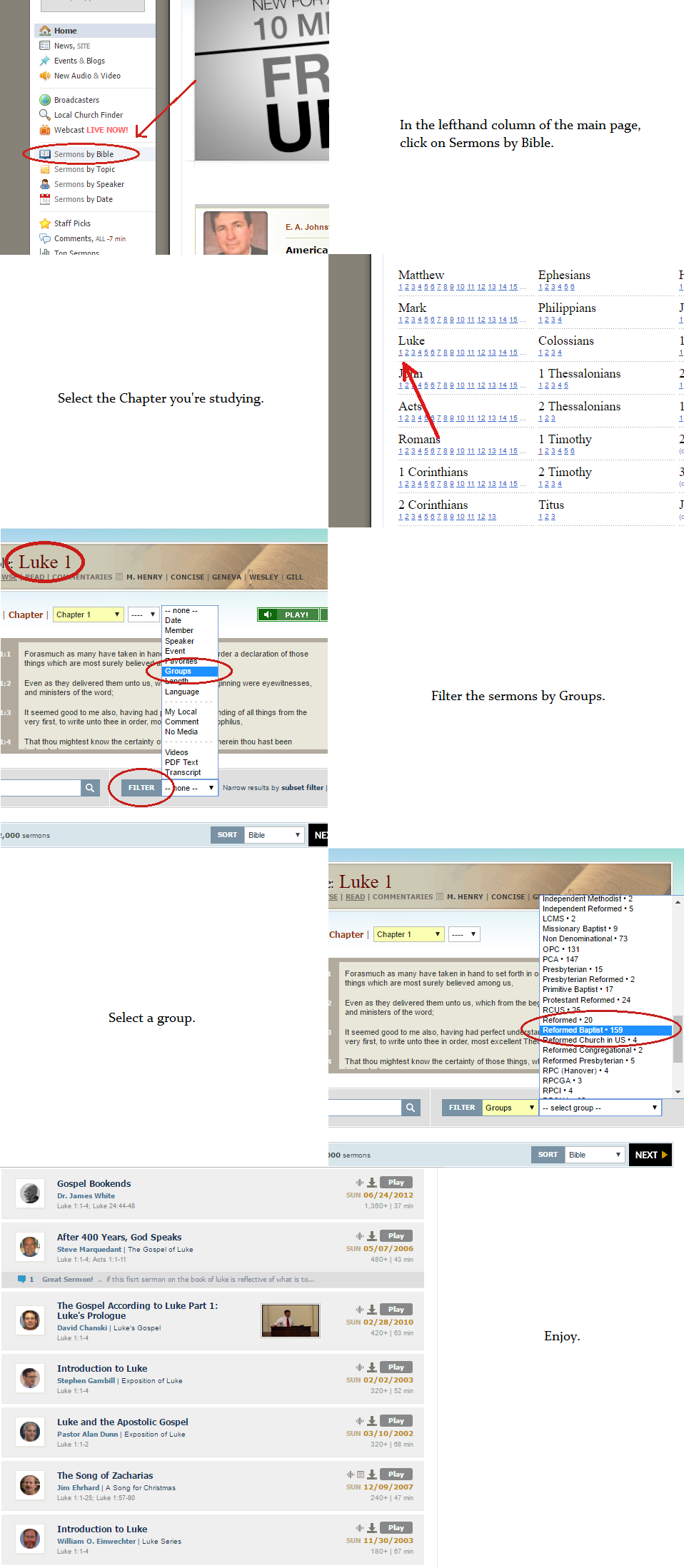
How to Sermon Audio
Studies in The Baptist Catechism: Section Three – The Decrees of God (Q.13)
Q.13: How did God create man?
A. God created man, male and female, after His own image, in knowledge, righteousness, and holiness, with dominion over the creatures.1
1Genesis 1:26-28; Colossians 3:10; Ephesians 4:24
Having examined what the Bible teaches us about creation generally, let us now turn our gaze to the pinnacle of God’s creation: mankind. Mankind is unique in that we were created in God’s image. Now, before we say anything else about what it means that we’re created in God’s image, let us first note the universality of it. The Bible does not teach that some men are created in God’s image. It does not say that some men are more created in God’s image than others. Rather, we read: “So God created man in His own image,” (Genesis 1:27a).
The Dignity of God’s Image
One might argue that the fall of man into sin changed things. Certainly the image of God in us has been marred. However, there still remains a divine image on all men, which brings with it a great dignity. Notice in Genesis 9 that, after the fall, after the murder of Abel, and even after the flood, men are still to be treated with dignity by virtue of the fact that they have been made in the image of God.
“6Whoever sheds man’s blood,
By man his blood shall be shed;
For in the image of God
He made man.
7And as for you, be fruitful and multiply;
Bring forth abundantly in the earth
And multiply in it,” (vv. 6-7; NKJV).
Capital Punishment
The Bible then teaches that all men without exception, as a consequence of having been created in the image of God, have a certain dignity bestowed upon them. This dignity persists beyond the fall of man into sin. As a result, Christianity does not make light of crimes like murder. In fact, God Himself has commanded that all men who destroy a life created in God’s image are to be put to death for the crime they have committed against God Himself.
It could be said that, in the museum of God’s grand creation, He has one gallery in particular upon which He has bestowed favor. This gallery is full of self-portraits. They are not the Artist Himself, but they bear His image and are to be honored with much the same care with which we would honor His very Person. When harm is done to one of His images, it is as though an attack has been made on His very Person.
“1Every person is to be in subjection to the governing authorities. For there is no authority except from God, and those which exist are established by God. 2Therefore whoever resists authority has opposed the ordinance of God; and they who have opposed will receive condemnation upon themselves. 3For rulers are not a cause of fear for good behavior, but for evil. Do you want to have no fear of authority? Do what is good and you will have praise from the same; 4for it is a minister of God to you for good. But if you do what is evil, be afraid; for it does not bear the sword for nothing; for it is a minister of God, an avenger who brings wrath on the one who practices evil. 5Therefore it is necessary to be in subjection, not only because of wrath, but also for conscience’ sake. 6For because of this you also pay taxes, for rulers are servants of God, devoting themselves to this very thing. 7Render to all what is due them: tax to whom tax is due; custom to whom custom; fear to whom fear; honor to whom honor,” (Romans 13:1-7; NASB).
Therefore, there is no debate in Scripture over the issue of capital punishment. When a man kills one or more human beings, given the proper amount of proof and the absence of any doubt, God’s image has been destroyed. A life has been taken; the life-taker’s life shall likewise be taken. A nation that treats this duty with contempt treats God’s very image, and thus God Himself, with contempt.
Abortion
Recently, a presidential candidate came under fire for saying that women who get abortions should be subject to penalties under law, to include imprisonment. Sadly, it was not the Pro-Choice movement that came out against the politician under question; it was the Pro-Life movement that came out and loudly denounced the statement as not representative of the Pro-Life movement. As a result, the politician retracted his statement.
Let us follow this logic, though. If abortion is murder (the destruction of the very image of God), it should be treated as murder by the governing authorities. Now, consider any other situation where a woman might pay someone to murder another human being. Let us take it even further, as the Pro-Choice movement often does, and say that the woman was raped or that she was the victim of incest. Should she have the right, under law, to pay a hitman to surgically dismember the perpetrator?
Now, perhaps we could make the case that such people should receive capital punishment from the government. That is different, though, then a woman hiring someone to murder the individual. Hiring a hitman to kill another human being, for any reason, is the same as committing the murder yourself. Why then is it any different for a woman to hire a hitman to murder the human being in her womb?
“13For You formed my inward parts;
You wove me in my mother’s womb.
14I will give thanks to You, for I am fearfully and wonderfully made;
Wonderful are Your works,
And my soul knows it very well.
15My frame was not hidden from You,
When I was made in secret,
And skillfully wrought in the depths of the earth;
16Your eyes have seen my unformed substance;
And in Your book were all written
The days that were ordained for me,
When as yet there was not one of them,” (Ps. 139:13-16; NASB).
Dealing with Differences
Murder is not the only crime against God’s image, though. Racism has historically taught, from a Darwinian foundation, that man has evolved from lower lifeforms and some “races” are less evolved than others. Akin to racism is also the sin of ethnic favoritism. James condemns favoritism in James 2:
“1My brethren, do not hold your faith in our glorious Lord Jesus Christ with an attitude of personal favoritism. 2For if a man comes into your assembly with a gold ring and dressed in fine clothes, and there also comes in a poor man in dirty clothes, 3and you pay special attention to the one who is wearing the fine clothes, and say, ‘You sit here in a good place,’ and you say to the poor man, ‘You stand over there, or sit down by my footstool,’ 4have you not made distinctions among yourselves, and become judges with evil motives? 5Listen, my beloved brethren: did not God choose the poor of this world to be rich in faith and heirs of the kingdom which He promised to those who love Him? 6But you have dishonored the poor man. Is it not the rich who oppress you and personally drag you into court? 7Do they not blaspheme the fair name by which you have been called?” (Jas. 2:1-7; NASB).
What is true of partiality in general is true also of ethnic partiality. We are not to hold our faith in our glorious Lord Jesus Christ with an attitude of ethnic partiality. Ethnic partiality can be practiced by people of any color and can be used to treat people of other races as either inferior or less deserving of one’s respect. We must recognize that all human beings deserve a certain amount of respect merely out of virtue of the fact that they are created in God’s image. We would not look at a self-portrait of God and curse it. Why then do we so easily curse men, who are the very image of God? To do so is sinful. “But if you show partiality, you are committing sin and are convicted by the law as transgressors,” (Jas. 2:9; NASB).
The disabled, the poor, the foreigner, the sick, the aged—all men are created in the image of God. Thus, we are called to treat all men with dignity and respect. If we are not used to a certain condition of man, it is understandable to have an involuntary reaction when we first meet one. The question is whether or not we take the necessary strides to accommodate for one another’s differences.
A man who has been poor his whole life is not naturally going to be comfortable in the presence of wealthy people, nor is a man who has never been to a homeless shelter going to immediately feel at home serving in a soup kitchen. A black man who grew up in a neighborhood has only known white people who are in positions of authority, like cops, teachers, etc., might have a great deal of discomfort to overcome when attending a predominantly white church. The same is true for white people who have never spent much time around non-whites suddenly attending a Korean church, a predominantly Hispanic church, or a black church.
There is discomfort to overcome when one begins to work with people with disabilities, or in a nursing home, or in hospice care. There is great difference among God’s people, but we are all created in the image of God. Though we may not do it perfectly or instinctively, we must each strive to accommodate for our differences.
Rational and Righteous
Another major aspect of what it means to have been created in the image of God is that we were created “in knowledge, righteousness, and holiness.” These three ideas interplay with one another. Obviously, righteousness assumes holiness and vice versa. Knowledge, when referring to the original estate of man, also assumes righteousness and holiness.
Knowledge
Adam was not created a super intelligent being. He was not created with all knowledge. As we said earlier in our study, were we to have all knowledge, we would be God. Adam did not have all knowledge, but he did have pure knowledge. That is to say that the knowledge that he had was pure, undefiled, and God-glorifying.
We do not often think of knowledge as having an ethical element to it. Knowledge is seen, especially in modernity, as a rather neutral endeavor. We often think, “I may be wrong about this or that, but what does it ultimately matter?” It ultimately matters because, if we are to “think God’s thoughts after Him,”—if we are to reason biblically about things—we must think correctly about things. We are often so consumed with the mere acquisition of knowledge that we do not take the time to apply to it understanding and wisdom. This is the process by which the Bible would have us acquire knowledge.
“9For this reason also, since the day we heard of it, we have not ceased to pray for you and to ask that you may be filled with the knowledge of His will in all spiritual wisdom and understanding, 10so that you will walk in a manner worthy of the Lord, to please Him in all respects, bearing fruit in every good work and increasing in the knowledge of God,” (Col. 1:9-10; NASB; cf. Prov. 2:6; 9:10).
According to Paul, the way that we take in knowledge is to first acquire it, then to apply to it understanding and wisdom and, when this is done appropriately, we will bear fruit in every good work and increase all the more in knowledge. Adam was created a learning being. He did not have knowledge of all things (e.g. good and evil; see Gen. 3:4-7), but what he did have was pure and rightly coupled with understanding and wisdom.
We know that rational thinking is godly, because it is part of the very image of God. Paul understood this rational element of God’s image when he wrote: “and have put on the new self who is being renewed to a true knowledge according to the image of the One who created him,” (Col. 3:10; NASB). When in the garden, Adam reasoned rationally. After the fall, men ceased to think the thoughts of God after him; our very thinking was marred. Now that we are in Christ, we are being renewed in this aspect of God’s image.
Righteousness and Holiness
That man was created upright is undisputed. “Behold, I have found only this, that God made men upright, but they have sought out many devices,” (Eccl. 7:29; NASB). Adam and Eve were originally created holy and happy. These two qualities of their first estate were intrinsically intertwined such that, when they sinned, they fell into a new estate of sin and misery, an estate that persists to this day.
Adam was able to sin and not to sin. Since the fall mankind is not able not to sin. Since Christ’s death, burial, and resurrection, Christians are freed from slavery to sin, but not its presence and influence. In glory, we will be free from all aspects of sin: its power, its abiding influence, and even its very presence. These are what have come to be known as the four estates of man.
Though Adam was created in God’s image, holy and happy, we have all now fallen from that glorious estate. That is not our final end, though. As Christians, we are called and enabled to “put on the new self, which in the likeness of God has been created in righteousness and holiness of truth,” (Eph. 4:24; NASB). We are daily being renewed according to the image of God the Son (Rom. 8:29). According to Beeke and Jones, “[John Owen] says that while ‘image’ denoted man’s original faculties properly oriented toward God, likeness denoted righteousness and the ability to respond to God in obedience,” (Beeke and Jones, A Puritan Theology, pp. 670-671). In like manner, being made over (renewed) in His image means we have the righteousness of Christ and the enabling of the Spirit to respond to God in obedience.
Dominion
Finally, the image of God means that we have been granted dominion over the whole earth. The world was created for our benefit, and man was commanded to subdue it. Among other things, this means that natural resources, vegetation, the animals, and all of the other elements of the world around us could rightly have been harnessed by man in his original state to be used for his own benefit. Since the fall, even the creation has been distorted.
“18For I consider that the sufferings of this present time are not worthy to be compared with the glory that is to be revealed to us. 19For the anxious longing of the creation waits eagerly for the revealing of the sons of God. 20For the creation was subjected to futility, not willingly, but because of Him who subjected it, in hope 21that the creation itself also will be set free from its slavery to corruption into the freedom of the glory of the children of God. 22For we know that the whole creation groans and suffers the pains of childbirth together until now,” (Rom. 8:18-22; NASB).
There is a sense in which creation itself has an innate understanding of the proper order of things. The fall of man essentially removed man from his rightful throne. Jesus refers to Satan as “the ruler of this world,” (John 12:31; 16:11). Paul refers to him as “the prince of the power of the air, of the spirit that is now working in the sons of disobedience,” (Eph. 2:2).
Thankfully, though, we read that we are no longer under his rule. We have been freed from his influence through the great love and mercy of God (Eph. 2:4ff). Furthermore, we read that the ruler of this world has already been judged as a result of the sending of the Spirit after Christ’s ascension (John 12:31; 16:11). The Godman, Jesus Christ, has reestablished man’s reign through His resurrection (Col. 2:15; cf. Heb. 2:9-18). As a result, we now understand our position of one of ruling and reigning with him in the heavenly places (Eph. 2:4-6).
A Reformed Baptist Perspective on Public Theology: The Pauline Epistles, Part VIII – 1 Corinthians 12-14
You can read earlier posts in this series by clicking on the links below:
- An Introduction
- Augustine’s Two Cities
- Two Kingdoms in Luther
- The Reformed Confessions (Part I)
- The Reformed Confessions (Part II)
- The Reformed Confessions (Part III)
- Sphere Sovereignty in Kuyper
- Redemption and Creation in Kuyper
- John the Baptist
- The Prophet Amos
- The Incarnate Lord (Part I)
- The Incarnate Lord (Part II)
- The Incarnate Lord (Part III)
- Introduction to the Book of Acts
- The Ministry of Peter and John in Acts
- The Ministry of Paul in Acts, Part I
- The Ministry of Paul in Acts, Part II
- The Pauline Epistles, Part I – Romans 1-8
- The Pauline Epistles, Part II – Romans 9-11
- The Pauline Epistles, Part III – Romans 12, 14-16
- The Pauline Epistles, Part IV – Romans 13
- The Pauline Epistles, Part V – Galatians
- The Pauline Epistles, Part VI – 1 Corinthians 1-10
- The Pauline Epistles, Part VII – 1 Corinthians 11
___________________________________________________________________
We often place a divide between ecclesiology and public theology but, depending on where we draw that line, we can often be in error. What we do within the church walls can potentially reap major consequences outside the church walls. If the world looks upon the church and sees that she is behaving in an unloving, disunified, or disordered manner, it very well could be that we are setting up unnecessary, though unintended, divisions between us and the culture. If we are more concerned with putting on a show for the world than speaking forth the word of conviction to the world, the world may join in, but they will have no incentive to submit to Christ’s discipleship. Rather, we will inevitably be expected to bow to their customs, preferences, and cultural mandates. Christ’s disciples will be guilted, coerced, or seduced into becoming disciples of the culture.
Preliminary Considerations
In 1 Corinthians 12, Paul begins a discussion that follows through to 1 Corinthians 14. Many, both cessationists and continuationists, erroneously believe that chapters 12-14 center on the topic of tongues. Not only do people in both of these camps believe that tongues is the central theme here, but they falsely interpret tongues as an ecstatic utterance of an unlearned language.
While continuationists more commonly believe that this is not a known language but an angelic one, many cessationists argue that the tongue is a known, though foreign, unlearned, and thus ecstatic tongue. That said, there are also several people in both camps that could not be defined precisely by the descriptions detailed above. I would argue that the Reformers, Puritans, and Particular Baptists are certainly cessationists, though they would not fit the cessationist mold described above.
Before we get into a more detailed discussion of the character of tongues and the cessation or continuation of them, it is important to note what chapters 12-14 really are about. As I have stated, tongues is not the central concern of Paul in these chapters. His central concern, as is the case in much of the rest of 1 Corinthians, is their love and unity.
Chapter 12
Paul begins his current discussion of love and unity by making a general argument, in chapter 12, for the proper use of the gifts. Paul does not offer a spiritual gifts quiz and say, “Everyone needs to take this quiz and then you will know precisely what your gifts are and the committee to which you are to report.” Just as in Colossians Paul points his readers heavenward for their remedy for sin (Col. 3:1-2) rather than toward the traditions of man and worldly philosophies (Col. 2:8), here he points them to love and unity for their spiritual growth rather than some gifts test. To put it another way, the gifts are a circumstance of the argument, a necessary point of contact, but they are not the main argument. The main argument is love and unity.
Paul does not say, “Figure out your spiritual gift and then you will know how to love the body and be strengthened in the bonds of unity.” Rather, the assumption is that they are already working toward love and unity and, consequently, their spiritual gifts have been unearthed, but some on account of their spiritual gifts were thinking more highly of themselves than they ought. Thus, if Christians want to discern their spiritual gifts, they don’t need to take a test; they need to work toward strengthening the body in love and unity. As they serve the church in this manner, they will naturally walk in the spiritual giftings God has given them, whether or not they ever nail down precisely what those spiritual gifts are.
Chapter 13
It becomes all the more clear that Paul’s primary concern is the love and unity of the church when we get to chapter 13. 1 Corinthians 13 has often been enshrined “the Love Chapter,” and people often say it from the back of their throat, like someone mimicking a Barry White voice-over. Sadly, many do not even realize the context in which this love is meant to be displayed, because they have only heard these words read in romantic contexts such as weddings. If, however, people understood that the love described here is the love that is meant to exist between Spirit-indwelt Christians as they serve and are served within the local church, they may come to view the church quite differently.
There are three all-surpassing gifts God has universally given to each one of His people: faith, hope, and love. Regardless of our individual giftings, we are all called to excel in these. However, faith is only of temporal necessity, because we have not yet seen Him face to face. Hope is likewise temporary, because we will one day receive the fulness of the object of our hope. Love, however, is different. For the Christian who has truly experienced it, the love of the saints will endure forever (1Cor. 13:8-13).
1 Corinthians 14
Now we return to the gift of tongues. Earlier, I mentioned that I do not believe that the Reformers, the Puritans, and the Particular Baptists held to a particular view of cessationism, the view that says that tongue-speakers in Corinth were ecstatically speaking unlearned languages, whether known or unknown. It is my conviction that these forerunners of the current Reformed Baptist movement would not have even considered the idea that these languages spoken in the Corinthian church were either unknown or unlearned.
Reformed and Puritanical commentary. In his commentary on 14:2, Calvin wrote: “The term denotes a foreign language. The reason why he does not speak to men is — because no one heareth, that is, as an articulate voice. For all hear a sound, but they do not understand what is said.” Calvin was clearly convinced that, in the port city of Corinth, many nationalities and, therefore, languages were represented. Thus, in the multi-ethnic church at Corinth, many languages would have been spoken, especially as traveling apostles, preachers, evangelists, and other Christians of different nationalities passed through their doors. Matthew Henry further clarified, in his commentary on vs. 11:
“In this case, speaker and hearers are barbarians to each other (v. 11), they talk and hear only sounds without sense; for this is to be a barbarian. For thus says the polite Ovid, when banished into Pontus, Barbarus hic ego sum, quia non intelligor ulli, I am a barbarian here, none understand me. To speak in the church in an unknown tongue is to talk gibberish; it is to play the barbarian; it is to confound the audience, instead of instructing them; and for this reason is utterly vain and unprofitable.”
Particular Baptists. John Gill insisted that the tongue spoken by the “gifted” in 1 Corinthians 14 was the Hebrew tongue. He believed the language was insisted upon by some Hebrew-speaking members for the Corinthian church’s liturgy. This would have been very much like how Rome used Latin in the Medieval church, subsequently keeping many unlearned in darkness for centuries. Gill’s argument is a very interesting one, but it is also a highly unsubstantiated one.
In support of the view that these languages were learned by the speaker, the paragraph on translation of the Bible into the vulgar languages of the people (1.8), The Baptist Confession tellingly offers the following citations as support: 1 Corinthians 14:6, 9, 11, 12, 24, 28. It was my study of the confession that first alerted me to the possibility that there were other views of the nature of tongues in 1 Corinthians 14. After looking into the matter further, I am convinced that historical events such as the Azuza Street Revival of the early 20th century and the camp meetings of the early 19th century have distorted the way that both cessationist and continuationist theologians understand the nature of tongues in 1 Corinthians 14. To view these languages as unlearned by the speakers would likely have been considered a bizarre interpretation to the Reformers and their early theological heirs. For a more thorough argument for the “known, learned language” argument, see this article from Robert Zerhusen over at the Alliance of Confessing Evangelicals.
Applications. There are two major applications for our study of Public Theology that stem from this perspective on tongues. First, as is observed in The Baptist Confession, to say that these tongues were learned, known languages is to move them from the category of a miraculous, revelatory gift unique to the first century and into such categories as Bible translation, textual criticism, sermon translation, etc. That is to say that, while all revelatory gifts have certainly ceased, tongues being neither miraculous nor revelatory continues as a gift to this day.
Under this understanding of the nature of tongues, anytime a Christian learns one or more secondary languages for service in the mission field, a Bible translation society, or service in the local church, he or she is operating in the gift of tongues. When a Honduran pastor stands and translates for a visiting American pastor preaching before his church, he is operating in the gift of tongues. When a textual critique helps a Bible translation board determine the best manuscripts from which to choose, he is operating in the gift of tongues. When a linguist takes The Second London Baptist Confession and translates it for the first time into Romanian, he is operating in the gift of tongues. So, it is consistent, in one breath, to say that you believe the gift of tongues continues today while, in the very next breath, championing the cessationist view of the revelatory gifts of the first century.
This view is often contested under the assumption that spiritual gifts are only bestowed post-conversion. However, let us recall the fact that Paul was trained as a rabbi (Acts 22:3). Timothy had learned the Word from childhood (2Tim. 3:15). Apollos, though needing further instruction in theology and perhaps other practical matters of the faith, was a gifted orator (Acts 18:24-26), and all this before they were saved. God does not appear to work on a linear timeline with the gifts. The gifts cannot be neatly placed at any given point within the Ordo Saludis. God can use a person’s past education as a linguist, a carpenter, or an accountant to uniquely equip him or her for service in the local church.
Second, we see in 1 Corinthians 14 the necessity of doing all things in the local church in an orderly manner. When the world walks into the church and sees diversity, this is a good thing. When the world sees that all ethnicities and languages are welcome within the walls of the church, they know there is something right and proper about our proceedings. However, when the gifts we should be using to serve one another are used for self-aggrandisement, we do one another, the world, and the gospel a grave disservice.
Within the regulative principle of worship, music can be chosen that aids people in feeling at home in the church. Ethnic minorities within the body should certainly be asked to provide input into such matters. However, when such an effort moves the church away from biblical worship, and the culture begins to demand elements of worship not commanded in the Scripture, the church must be ready to lovingly put her foot down.
Accommodations are necessary and right. However, those accommodations must be in line with the Bible and must accord with proper church order. Thus, Paul does not forbid the speaking of other languages in the church, and he expressly forbids others from forbidding the speaking of foreign languages. What he does require is order, because we do not serve a God of confusion, but of order.
Studies in The Baptist Catechism: Section Three – The Decrees of God (Q.11-12)
Q.11: How doth God execute His decrees?
A. God executeth His decrees in the works of creation and providence.
Under the headings of creation and providence, God accomplishes all of His good purposes. Thereby, He creates, sustains, and directs all things toward His own desired, good, and glorious ends. Nothing that comes into existence does so without God’s decree. Likewise, nothing that comes to pass does so without God’s decree. God is the prime Actor in all of creation and is necessary for its continued existence.
Q.12: What is the work of Creation?
A. The work of creation is God’s making all things of nothing, by the word of His power, in the space of six days, and all very good.1
1Genesis 1; Hebrews 11:3
Ex Nihilo
“In the beginning God created the heavens and the earth,” (Gen. 1:1; NASB; cf. the rest of Gen. 1).
The Latin term ex nihilo can be somewhat misleading. The term means out of nothing, and it is used to assert just that: that God made the whole of creation out of nothing. Some may take this assertion a bit further and claim that, before God created all things, nothing existed. Of course, this could only be understood in terms of created things. Thus, it is important for us to clarify that no created thing existed, no temporal thing existed, no material thing existed. Put more plainly, before God created the cosmos (the created order), only God existed. According to A.A. Hodge:
“In the beginning of time God first, by a word of command, brought into being all the material elements of which the universe exists,” (A.A. Hodge, The System of Theology Contained in the Westminster Shorter Catechism. Wipf & Stock, Eugene, OR. 2004, pg. 21).
This is a proper understanding of the testimony of the earliest portions of Scripture. There is no before God; God has always existed. There is only before the created order. Before all things were created, there was the one, triune, divine Being who is, and who was, and who ever will be. Hence, when we say that God created all things ex nihilo, we do not mean that nothing proceeded all things.
Taken in the negative, another idea represented in the notion of ex nihilo creation is the fact that God did not use pre-existing materials to make the world. Rather, all that is material was brought into existence from a purely immaterial non-existence. That which was not, by the power of God’s Word, became so. In the material sense, nothing preceded everything. These are important concepts for us to grasp, because there are many false notions of the relationship between God and all things.
The ancient Greeks taught, as Hindus still teach, that matter has always existed. In fact, ancient Greeks like Plato taught that even moral concepts such as good and evil transcended the gods. For Plato, both moral concepts and the material world is as eternal as the gods. Also, given the choice between the gods arbitrarily creating their own morality or a co-eternal morality external to the gods being imposed even on the gods themselves, Plato chooses the latter. As Christians, we affirm that God created all material things. We also affirm that God neither created nor is subject to a moral code outside of Himself. Rather, morality is a reflection of God’s eternal and immutable goodness and perfection.
By His Word
“1In the beginning God created the heavens and the earth. 2The earth was formless and void, and darkness was over the surface of the deep, and the Spirit of God was moving over the surface of the waters. 3Then God said, ‘Let there be light’; and there was light,” (Gen. 1:1-3; NASB).
It has well been noted that the first three verses of the Bible follow a Trinitarian pattern. The first verse is obviously a reference to our Father in heaven. The second verse makes explicit mention of the Spirit of God. Where, though is there any mention of the second Person of the Trinity: the Son? In order to answer this question, let us consider the one verse in the Bible that most parallels Genesis 1:1-3.
“1In the beginning was the Word, and the Word was with God, and the Word was God. 2He was in the beginning with God. 3All things came into being through Him, and apart from Him nothing came into being that has come into being,” (John 1:1-3; NASB).
We must note first that the apostle John begins his Gospel with precisely the same wording as the Septuagint (LXX; an ancient Greek translation of the Old Testament used in the first century): “Ἐν ἀρχῇ.” John, in writing in this way, was clearly drawing a parallel between his gospel of the new creation and the account of creation in Genesis 1.
First, John tells his readers, “In the beginning was the Word,” (John 1:1a; NASB), clearly signifying the God who speaks. Second, he goes on to say that this Word was God putting Him on par with the Father in glory, authority, and essence. Third, he tells us that He was in the beginning with the Father, drawing our attention to the eternal, intra-Trinitarian oneness and fellowship existing within the Godhead. Fourth, and most important for our discussion today, he writes that all things came into existence through the Word, and nothing came into being apart from Him.
All of this discussion of the Word of God begs the question, who is this Word of God? John answers this question in verse 14: “And the Word became flesh and dwelt among us, and we beheld His glory, the glory as of the only begotten of the Father, full of grace and truth” (John 1:14; NKJV). He further clarifies in verse 18 who this only begotten of the Father is: “No one has seen God at any time. The only begotten Son, who is in the bosom of the Father, He has declared Him,” (NKJV; emphasis added; other manuscripts read: “the only begotten God”). The Word of God of which John writes is the only begotten of the Father, the very Son of God Himself, the only begotten God.
Thus, when God spoke, through the divine agency of the Son of God, all things sprang into existence. In fact, nothing that was created was created apart from the Word of God. This is an important assertion to highlight when speaking with Unitarians like the Jehovah’s Witnesses who assert that Christ was created. When confronted with the suggestion that Christ was created, we must ask how John could assert that nothing that was created was created apart from His agency. He could not have been created through Himself, could He? John obviously belabors this point so that there would be no question of Christ’s eternality. The Word is distinct from all creation, just as the Father and the Spirit are distinct from all created things.
Where then do we see the second Person of the Trinity in Genesis 1:1-3? In verse three: “Then God said, ‘Let there be light’; and there was light” (NASB; emphasis added). When God spoke the world into creation, He spoke through the agency of His Word, His eternally begotten Son.
Six Days
“So the evening and the morning were the first day. . . And God called the firmament Heaven. So the evening and the morning were the second day. . . So the evening and the morning were the third day. . . So the evening and the morning were the fourth day. . . So the evening and the morning were the fifth day. . . Then God saw everything that He had made, and indeed it was very good. So the evening and the morning were the sixth day,” (Gen. 1:5, 8, 13, 19, 25, 31; NKJV).
In the span of six days, God created all things that exist. This is a hotly debated issue in Christianity today, but the testimony of Scripture is plain. All things that were created were created in the span of six ordinary days comprised of both one evening and one morning. Whether these evenings and mornings put together comprised a 24, 23, or 25 hour day, the Bible does not say, but there is no reason to assume that each evening and morning spanned hundreds, thousands, and perhaps even millions of years.
Sam Waldron explains: “To state matters succinctly, the only sound interpretation of the Bible is the one which understands it to teach that God did, indeed, make the world in a literal work week,” (Waldron, An Exposition of the 1689 London Baptist Confession. Evangelical Press, Darlington, Eng. 2005, pg. 76). What Waldron means by literal is that the meaning of the text is to be accepted in its plainest sense. When Scripture says “evening and morning,” it clearly means to designate an ordinary day of the week.
Some have suggested that the days of creation are unimportant and that our focus really should be on God’s creative power and the beauty and perfection of His creation. Certainly they are right in the latter assertion. We truly ought to place a primary focus on the beauty and perfection of God’s creation. Furthermore, the focus of modernity on the materialistic, naturalistic science of creation is a faulty starting point, to be sure. However, this does not mean there is no significance behind God’s choosing to create the world in six ordinary days.
Certainly, were it God’s pleasure to do so, He could have created all things in the span of six minutes or six millennia. Instead, He ordained that the world should be created in six days. In doing so, He set the example for mankind of a six day work-week to be followed by a full day of covenant rest in Him.
“He ‘rested the seventh day;’ as if the Lord should say, Will you not follow me as a patter? Having finished all my works of creation, I rested the seventh day; so having done all your secular work on the six days, you should now cease from the labour of your calling, and dedicate the seventh day to me, as a day of holy rest,” (Thomas Watson, The Ten Commandments. Scriptura Press, New York City. 2015, 2.4 [3]).
In short, God did not create the world in order to satisfy all of our naturalistic, materialistic inquiries. He did not create the world in the span of six days in order to help us “butter up” to the modern scientific community or to satisfy all of our vexations brought on by the Star Light theory and other such quandaries. He did, however, create all things in the span of six days. He did so as a model for us so that we might follow it.
Very Good
“Then God saw everything that He had made, and indeed it was very good. So the evening and the morning were the sixth day,” (Gen. 1:31; NKJV).
When God created all things, He created them good: the lights of the day and of the night, the land, the seas, the animals, the plants, the planets, the moon, the angels, and all other things whatsoever He created. There is nothing that God created that He did not in turn look upon and say, “This is good.” However, it was only after God completed one particular creation that He finally looked upon all that He had made and said, “Very good!” This particular creation was mankind.
Mankind is alone in all of creation in that we were made in the image of God. Insofar as we are created in His image, we are the pinnacle of all of His creation. As we will see in the answer to question 13, God’s image is not the only mark of favor He bestowed upon us.
5 Perks of Attending a School with Which You Disagree
Some people say you should only attend a school if you have a great deal of agreement with them. Certainly, if I were to further pursue post-graduate studies, I would seek a school of the Reformed tradition. There are many perks to doing so, not the least of which is being thoroughly grounded and reinforced in what you will be teaching at the local church level. However, my undergrad experience at a school with which I had major areas of disagreement was not all bad.
Know What You Believe
“For a man to come shuffling into a College, pretending that he holds his mind open to any form of truth, and that he is eminently receptive, but has not settled in his mind such things as whether God has an election of grace, or whether he loves his people to the end, seems to me to be a perfect monstrosity. ‘Not a novice,’ says the apostle; yet a man who has not made up his mind on such points as these, is confessedly and egregiously ‘a novice,’ and ought to be relegated to the catechism-class until he has learned the first truths of the gospel,” (C.H. Spurgeon, Lectures to My Students. Zondervan, Grand Rapids. 1954, pg. 39).
Before I started going to The College at Southwestern, I had already come to hold some pretty solid convictions in my theology. I grew up in church but, only in 2007, I came to be convinced of both Covenant Theology and Amillennialism. I also began hearing about a doctrine of salvation that was comparable to what I was already reading in Scripture, namely that regeneration necessarily precedes faith in the conversion of sinners.
Then, in early 2008, I was deployed to Kuwait where I met a group of young men who called themselves Calvinists. When they explained to me the Doctrines of Grace (the Five Points of Calvinism or T.U.L.I.P.), I immediately recognized these doctrines as lining up with what I was already seeing in Scripture. Finally, after returning home in 2009 and joining a Calvinistic Baptist church, I was introduced to Cornelius Van Til and his transcendental approach to defending the faith (apologetics).
As such, Calvinism had come to take shape in my understanding of the faith in a very holistic way. I understood Calvinism as more than just a soteriology, but rather as a holistic, thoroughly biblical worldview. These were matters on which I was settled. Thus, I determined that I would not budge on these issues as, in late 2009, I began acquiring a higher education at The College at Southwestern, which providentially teaches against all of these positions.
Grow in What You Believe
As I continued on in college, I took every instance of disagreement, between my professors and me and between my fellow students and me, as an opportunity to learn more about my own tradition. I began to research the earliest Calvinistic Baptists, a group of men in England who called themselves Particular Baptists. I was delighted to discover that they saw themselves as being in the same theological vein as the British Reformers and Puritans, a group from which I had already derived great spiritual benefit.
As I studied these men, I discovered that they had written a confession (The Second London Baptist Confession of Faith of 1677 / 1689), and I also discovered that their confession was part of a much larger confessional heritage in the Reformed tradition. I began to study this confession and the others within the Reformed tradition. In studying these confessions, I came to realize that Reformed theology was much larger even than what I already knew. It spanned far beyond a Calvinist soteriology, Covenant Theology, Transcendental apologetics, and Amillennialism. Reformed Baptist theology also extends into ecclesiology, worship, Christian liberty, and other matters.
I also discovered that the early Particular Baptists and Reformed Baptists had written several catechisms, including some of the earliest catechisms for children. In the Calvinistic Baptist tradition (I was not yet confessional), one often hears about catechisms such as The Westminster Shorter and Larger Catechisms and The Heidelberg Catechism. It was truly delightful to learn that Hubmaier, Luther, and Calvin all had developed catechisms in the early days of the Reformation and, following the British Reformers, Particular Baptists such as Hercules Collins, William Collins, and Benjamin Keach had also developed catechisms for the Baptist tradition.
So it was that, as I was challenged in my views at Southwestern, I was forced to research my own tradition. The more I became familiar with my own tradition and was forced to defend it, the more Reformed I became. So I entered this Dispensational, Traditionalist Baptist seminary as a Calvinistic Baptist, but I left as a thoroughly confessional Reformed Baptist.
Grow in Your Knowledge of What Others Believe
Lest anyone be mistaken, I must take a moment to explain that I did not merely shrink back into my own theological bubble. I am sure that, at times, it may have seemed that way to some of my classmates. I was unapologetic about my beliefs, and would openly question some of the assertions made about Reformed theology in class.
I recall staying after class one afternoon to talk with one of my professors. I apologized to him for pushing back as hard as I sometimes do. He told me not to apologize, but that he actually found my interactions in class to be a breath of fresh air. He lamented the fact that many Millennials are too reserved about their opinions preferring to float through their college years without ever participating much in classroom discussions. I did notice that the Gen Xrs in my classes did express their opinions a lot more freely while Millennials often tended to sit toward the back of the class and treat the classes as just a grade. This is not an indictment on all Millennials. For all the cons one might highlight about any given generation, there are many pros to make up for it.
On my part, I made the most use I could out of my professors. In fact, the more I disagreed with a professor, the more likely I was to stick around after class and talk with him. I learned a lot in this season of my life about Christians who think differently than me. For instance, I am less inclined to call someone who is not a Calvinist an Arminian. Rather than simply assigning someone a title on the basis of what they are not, I am now more inclined to find out from them what they prefer to be called on the basis of what they affirm.
Also, having sat through lecture after lecture where terms like “Replacement Theology” were used without apology and the Doctrines of Grace were grossly misrepresented, I learned the value of honest representation. If Reformed Baptists desire for others to represent us fairly, it is important that we do the same in representing others. This is not to say that we cannot represent those with whom we disagree in a negative light. However, if we do, we need to be prepared to back up our conclusions with facts.
Grow in Areas Where You Are Wrong
One area where I was surprised to find that I had changed by the time I left school was in the area of ecclesiology. Going in to Southwestern, I was a staunch proponent of elder-rule ecclesiology. However, as I read up on the issue and talked with my professors about it, I soon discovered that my ecclesiology was just as reactionary as the worst arguments from the other side. I would hear people complain about the abuses of elders in an elder rule system, and I would counter with experiences I had seeing people use and abuse the congregational system.
Once I honestly stopped and looked at all of the arguments from Scripture for elder-led congregationalism (or, as I’ve heard it put, elder-rule congregationalism), I found this take on congregational ecclesiology to be thoroughly biblical. I had formulated a doctrine of church government on the basis of personal preference and pragmatic arguments, and I was unwilling to hear arguments from Scripture. Were it not for my education, I might still hold to the other view. I certainly never would have desired to have changed on the view were I not convinced otherwise.
Develop Friendships with People with Whom You Disagree
Now, I was a bit of an outcast among my classmates in college. I gather that some of the more Calvinistic students did look up to me a bit. I was a cofounder of an apologetics club, I started a Bible study with several students off campus, and I still talk with some of my fellow students from time to time. However, for the most part, I did not primarily hang with my fellow students. I preferred to talk offline with my professors.
Sometimes I would stay after class for over an hour to talk with my professors. Though we disagreed on a great deal of theology, I found that we were able to get past that and focus on the areas where we found agreement. Sometimes, after more than an hour of conversation, I would look at my watch and realize that I had missed chapel. Sometimes, that would happen even on days when the chapel speaker was someone I was really looking forward to hearing. Overall, I left school with a great love and admiration for—though still a great deal of disagreement with—my professors.
Really, the only reason I gravitated to professors with whom I disagreed rather than fellow students with whom I disagreed was generational. Generationally speaking, I did not feel I had as much in common with my fellow students. This was quite a learning experience for me. There are probably no two back-to-back generations that are more different in temperament and life experiences than Gen Xrs and Millennials. Somehow, though, I was able to forge a handful of friendships with Millennials as well.
Conclusion
Well, these were the five things I found most beneficial about going to a school with which I harbored great disagreement. I would not say it is for everyone, especially if you are not settled in your theology. What are some of the perks that perhaps I missed? I would be interested to hear the positive aspects of your experience attending a school with which you had great disagreement.
A Reformed Baptist Perspective on Public Theology: The Pauline Epistles, Part VI – 1 Corinthians 1-10
You can read earlier posts in this series by clicking on the links below:
- An Introduction
- Augustine’s Two Cities
- Two Kingdoms in Luther
- The Reformed Confessions (Part I)
- The Reformed Confessions (Part II)
- The Reformed Confessions (Part III)
- Sphere Sovereignty in Kuyper
- Redemption and Creation in Kuyper
- John the Baptist
- The Prophet Amos
- The Incarnate Lord (Part I)
- The Incarnate Lord (Part II)
- The Incarnate Lord (Part III)
- Introduction to the Book of Acts
- The Ministry of Peter and John in Acts
- The Ministry of Paul in Acts, Part I
- The Ministry of Paul in Acts, Part II
- The Pauline Epistles, Part I – Romans 1-8
- The Pauline Epistles, Part II – Romans 9-11
- The Pauline Epistles, Part III – Romans 12, 14-16
- The Pauline Epistles, Part IV – Romans 13
- The Pauline Epistles, Part V – Galatians
___________________________________________________________________
When discussing Paul’s letters to the church at Corinth, we must recognize that Paul did not merely write to address one single issue, but several. Corinth had asked several very valid questions of Paul. There were also some concerns about which Paul wanted them to know there was no question, because the answer was so clear. There were also reports that were brought to Paul about matters on which the Corinthian church was settled, but they had settled on the wrong side. In the following article, we will address several of these concerns, because many of them are still concerns for us today. Given the theme of our series, we will primarily be dealing with those concerns that touch the issue of public theology and, sadly, we will not have time to address all of the issues as thoroughly as we might desire.
To the Saints
First, let us recognize the endearment that Paul assigns to this church. He calls them saints: “To the church of God which is at Corinth, to those who have been sanctified in Christ Jesus, saints by calling,” (1Cor. 1:2a; NASB). Yes, this church had some major failings. However, he recognizes that they are beloved of God and, even as an apostle, he does not have the right to rail against Christ’s bride. He will go on to rebuke her, but he desires that she see that his rebukes come from a heart of love, not self-righteousness.
Furthermore, he does not write to Corinthian unbelievers out of a desire to offer a defense of the faith and attempt to validate those unbelievers’ objections to the Corinthian church’s errors. When Paul sees that the actions of the church are enabling the world in their blasphemy of God, he addresses the church. Never does he side with the world in condemning the bride of Christ.
Acquiring Knowledge
Before addressing the Corinthians’ error of being “puffed up” in knowledge, notice his prayer on their behalf:
“I thank my God always concerning you for the grace of God which was given to yu by Christ Jesus, that you were enriched in everything by Him in all utterance and all knowledge,” (vv. 4-5; NKJV).
Paul does not desire that the Christians in Corinth be ignorant of the truths of the faith. Rather, he thanks God regularly for the fact that they have been enriched in their knowledge of Him. Oftentimes, Christians will read 1 Corinthians, and they think there is something virtuous about remaining blissfully ignorant about the truths of God.
What these Christians do not realize is that it is the not the acquiring of knowledge Paul argues is improper for Christians. The error is found in the fact that the Corinthians were misapplying their knowledge. They were acquiring knowledge for the sake of winning arguments, or perhaps for the sake of looking good in front of their friends (1Cor. 8:1), but they were not acquiring it for the sake of growing in their worship of God.
As we acquire greater and greater amounts of knowledge, we should do so for the sake of growing closer to the God of all truth. We will address the Christian’s relationship to knowledge in more detail when we get to our study of the book of Colossians, but Christians should want to grow in knowledge. The more we know about our faith, the more we know about the God we claim to love. The more we know about our faith, the more we know about the neighbors we claim to love.
Love and Marriage
In fact, love is perhaps the defining issue in the first six chapters of book of 1 Corinthians. Paul spends an entire chapter focused on the superiority of love over any other gift we receive from God (chapter 13). Paul contrasts true, godly love with the Corinthians’ selfish motives for acquiring knowledge and presuming themselves to be worldly wise (chapters 1-2). Paul contrasts true, godly love with the factionalism that was prevalent in the church at Corinth (3-4). Paul contrasts true, godly love with the license the Corinthian church gave to unrepentant so-called brothers in their midst (5). Paul contrasts true, godly love with the practice of taking fellow church members into secular law court (6).
For our discussion of public theology, it is important at this juncture to stop here and take note of two things. First, Paul tells us not to judge outsiders. In this context, he does not mean that we do not hold political leaders—especially political leaders claiming to be Christian—to a high standard. What he means is, in regard to church life, we are not to allow open, unrepentant sinners to go around claiming to be so-called brothers (1Cor. 5:9-13). Thus, when a man claims to be a Presbyterian and brags about sleeping with married women, or a woman claims to be a Methodist and openly supports women’s supposed right to murder their children, church leaders have no right to publicly affirm their Christian profession. In doing so, these church leaders make themselves accomplices in the sins of these candidates and the resulting blasphemy of an ever watching world.
Second, it is important for the church to police itself in matters of sin and offense. We do not take our in-house disputes before unbelieving magistrates. If a matter occurs in the local church, the local church is to handle it locally. If the local church, for whatever reason, is unable to judge the matter properly, that is why we have associations. Under special circumstances, a local church may call upon local church elders within its association to serve as officiators over local church tribunals. In these instances, though, Baptist polity requires that we recognize that these associating elders are serving as consultants to the church, not as an authority over the church.
In chapter seven, Paul addresses questions raised in the church of Corinth in regard to married people, single people, widows, and widowers. The gist of this chapter, as it relates to our study, is that Christian singles ought to marry other Christian singles, married people—saved or not—ought to remain married except in the case of abandonment, if you are single and able to remain single without burning (there is an interesting debate on this word, but we will not cover that here), stay single and devote your time to God in ways that married people are not able and, if a married person’s spouse dies, he / she is free to remarry. Seeing as marriage is a picture of Christ and the church to a lost and dying world, it truly is deserving of a full chapter. One of the most important things to which Christians must commit in order to properly engage the culture for Christ is a biblical affirmation and a biblical practice of marriage.
Christian Liberty
In chapters 8-10, Paul uses their question about meat sacrificed to idols to address a whole host of issues regarding Christian liberty. When discussing Christian liberty, the same questions always seem to arise: “What can we do?” “What can’t we do?” “Where are the boundaries?” Paul answers some similar questions in chapters 8-10: “Can we eat meat sacrificed to idols if we don’t recognize those idols as real?” “Can we eat it in a pagan temple?” “Can church leaders marry?” “Should church leaders be make their living from the church?” Paul affirms that Christians are free in all of these, except assembling with pagans to partake of their idolatrous meals. He says Christians are free, but that our freedom comes with the responsibility to love our weaker brothers.
Now, we must note here that Paul does not mean that we ought to refrain from the practice of our liberty in Christ so as not to offend mature brothers. There are seminary professors, pastors, and even seminary presidents who will tell us that we ought not to enjoy our liberty in Christ so that we might appease their ill-informed consciences. These men are supposed to be church leaders, and yet they would have us treat them like weaker brothers so that they might control our actions. Brothers, if the Lord has freed your conscience in a matter, walk in that freedom. Only, do not use your liberty in such a way as to offend or entice new converts to disobey their consciences.
In chapter 10, Paul warns against using our liberty for the sake of license and indulgence rather than a means to glorify God, and he uses Israel as an example. Christians do have liberty but, if we abuse that liberty, we can shipwreck our faith. Israel had liberty to eat, drink, and play. They had plenty of reason to do so, having been freed from their bondage in Egypt. However, they sat down to eat and drink and rose up to play without any thought to the glory of the God who had just delivered them out of Egypt. Their liberty had become license and, before long, they found themselves worshipping at the feet of a golden calf. Christians must likewise be careful in the use of our liberty, lest we run the same course as the generation that died in the desert.
 CredoCovenant