Repost: Why Publicly Contend for Christian Morality?

I found this article, today, that I originally posted all the way back in 2011. It’s the earliest original article I posted on CredoCovenant, and it pretty much summarizes the reason for my participation in the current Public Theology series. As such, I thought it was worth a repost. Enjoy.

____________________________

In the subculture of evangelicalism I inhabit, the issue of publicly contending for Christian morality (i.e. abortion, the definition of marriage, “Don’t ask, don’t tell,” etc.) surfaces from time to time. There seems to be basically two camps: those for it and those against it. On the surface, I tend to agree with many of the arguments made by those who are against making a public defense of the moral claims of the Bible. They say it detracts from our focus on the gospel. They say that it can often stem from post-millennial idealism. They say that it makes us look silly to a world that already hates us for the gospel. On the surface, I can agree with all of these arguments. However, allow me to offer some arguments for the other side in response:

  1. The gospel does not make sense apart from conviction of sin, and there is no conviction of sin in a society where the church is by-and-large silent on moral issues in the public sector.
  2. To want a better society for one’s children, and to want to see people live according to the precepts of Scripture, does not automatically make that one a post-millennialist.
  3. The authors of Scripture spent more time defending the moral assertions of the Bible than they did defending the epistemological assertions of the Bible. Think about it.
  4. The law and the gospel are not diametrically opposed to one another, but rather God uses both to bring people to repentance and faith. The problem comes when one is shared without the other.
  5. Throughout church history, church leaders have contended for biblical morality in their cultural settings.
  6. Someone’s worldview will be the current that drives the culture. Why not Christianity’s?

Gospel Issues: An Open Letter to Western Evangelicals

With a small amount of interest, I have occasionally turned my gaze on the provocative happenings in the world of Evangelicalism. Just to be fair, by a very loose definition, I would be considered an Evangelical, though I prefer the term Protestant or, even better, Reformed Baptist. Read me right, though. I’m not bashing the movement. As one whose hope is set intently on the inheritance being kept for me, which works to embolden my faith in Christ Jesus, I have a love and fervent concern for all the saints (Col. 1:3-5). However, I grow weary when exposed too long to the internet sensationalism surrounding much of Western Evangelicalism. I trust that many of our readers can relate.

Gospel Minimalism

Evangelicals, at the very least, are marked by a central concern for the Gospel of Jesus Christ. By this definition of Evangelicalism, I consider myself among the fold. However, many in recent days have taken to a minimalistic practice of Evangelicalism in which Christians are encouraged to focus almost exclusively on the Gospel, with very little emphasis on other very important doctrines in the Christian faith. Within this same fold are those who, wanting to minimize all non-Gospel issues as far secondary, have taken to labeling every issue under the sun a “Gospel issue.” So, they minimize all Christian doctrine that is not the Gospel while, at the same time, broadening the Gospel so that it encompasses far more than what the Bible teaches.

This is an understandable position to take if you are a Gospel-minimalist. If all issues are unimportant, or of minimal significance, unless they touch the Gospel in some way, you must demonstrate how any issue that is important to you touches the Gospel. As a result, Gospel-minimalists seem to be bending over backward to demonstrate how their pet issues are Gospel-issues. This hermeneutical technique requires such interpretive gymnastics in order to arrive at the intended conclusions that it can easily leave onlookers’ heads reeling.

I’m not arguing that the issues in question shouldn’t come under the umbrella and influence of the Gospel. They should, and all issues in that sense are Gospel-issues. Everything for the Christian, to a certain degree, is subject to the Gospel of Jesus Christ. Whether we’re talking about race relations, the environment, gun control, taxes, family life, work, etc., etc., etc., the Gospel impacts every area of life. The problem arises when someone comes to endorse one particular solution to one of these issues—a solution that is not the direct result of their study of the Gospel—and then they claim that, because the issue itself is a “Gospel-issue,” Christians must without exception adopt the same solution to addressing the issue that they do.

Gospel-Issues or Gospel-Solutions

This line of argumentation fails to account for certain very important nuances within the Christian community. To say that racism is a Gospel-issue is not an incorrect statement. However, to say that only one approach to alleviating the church of racism is the correct “Gospel” approach is dishonest at the very least. Nor is it incorrect to say that orphans and widows are a Gospel-issue. However, to say that others don’t have a proper handle on the Gospel because they are convinced of the merits of a different solution than you is disingenuous at best.

The difference is a categorical difference. Simply because a brother in Christ has a different approach to solving the problem, which you both recognize as a problem, does not mean that he doesn’t recognize the implications the Gospel brings to bear on that issue. Rather, it means that his culture, his education and, more generally, his life experiences bring him to vastly different conclusions as to how to solve this Gospel-issue.

The issue itself is a Gospel-issue insofar as all things in the life of the Christian touch the Gospel at some point. However, the approach to solving it may not be shaped by the Gospel. In fact, the Gospel message itself often offers no practical, “how-to” solutions for the woes of society. It simply exposes them as woes in the minds and consciences of believers. The Gospel will often compel us to act without giving us the necessary guidelines on how to act in every particular instance.

Gospel Zeal

For instance, we understand that the two Great Commandments teach us to love God and love our neighbor. As a result of the regenerating work of the gospel and the indwelling of the Holy Spirit, Christians are now enabled to recognize where we need to grow in our love for God and love for neighbor, and we are now enabled to act out of love for God and love for our neighbor. The grace of God makes us zealous for good deeds (Tit. 2:11-14), but zeal without reason is foolhardy.

Christians are to temper our zeal with sound judgment. The gospel and the grace it bears emboldens Christians with a godly zeal necessary to live lives that are pleasing to our Father in heaven. However, without the tools for navigating the nuances of cultural discernment, many of us will fall into pitfalls and commit our Gospel-fueled zeal to unprofitable ends. We recognize that the Gospel emboldens us to take action and be “salt and light” in the world, so we ride off into battle without the proper weapons and armor of our warfare.

As a result, we call for action that does the opposite of what we intend. We don’t rightly understand economics, so we call for actions on the part of the government that we think help the poor when really they are the very things doing them the most harm. We don’t rightly understand the best means for preserving human life, so we call for measures to be put in place by the government that we think will minimize violent crimes and death, but those very measures make people more vulnerable to violent criminals and devalues human life. We don’t rightly understand the biblical teaching on ethnicity, so we call for measures from state and church authorities that encourage deeper divisions rather than promoting unity across ethnicities. And those are just three issues of concern.

The Gospel Hammer

Worst of all, many who promote these counter-productive solutions seek to reinforce their arguments for them by appealing to the Gospel. They (rightly) recognize that every Christian must come under the shadow of the cross when considering the issue about which they are concerned. Subsequently, they recognize that this issue touches the Gospel, in one way or another, the moment a Christian comes to consider it. Wrongly, though, they assume that their approach must be the only Gospel-centered approach to solving their issue.

This approach to addressing issues within our cultures and within our local churches has an undercurrent of gracelessness. It assumes, “If someone else’s approach to solving this Gospel-issue is different than mine, this person is not as Gospel-centered as I am.” Allow me to play the role of peacemaker, here, and call for a little more Christian charity and mercy in regard to these issues.

Simply because someone recognizes the Gospel compels us to act on an issue does not make their subsequent action necessarily right. Just because someone disagrees with your action when you were the first to point out the fact that the problem at hand is a Gospel-issue does not mean the person in question is not Gospel-centered. You don’t have the right to use the Gospel as a hammer to bash your brother in the faith simply because he endorses a different solution to the problem you both recognize. So allow me to call for a moratorium.

A Call for Gospel Grace

Let’s stop saying issues are Gospel-issues, as though not all issues should come under the authority of the cross in the Christian life. Let’s recognize that all issues to one degree or another are Gospel-issues, which means none of them are Gospel-issues in the way Western Evangelicals use (more appropriately: abuse) the term. Let’s stop telling Christians they have to endorse the exact same solutions we do, or they aren’t Gospel-centered enough. The world is more nuanced than that.

We should feel free to point out problems in our world, but then we should be humble enough to ask, “What can be done about this?” rather than shouting one another down when we have difficulty arriving at a consensus. Wasn’t it our Savior who said: “Blessed are the merciful, for they will receive mercy”? Let’s endeavor to show one another a little more mercy. Let’s stop using the Gospel as a hammer to bash one another when we disagree on how to solve problems. Rather, let’s commit to listen to one another, pray, submit ourselves to the Gospel, educate ourselves so we can make the most informed decision possible, and commit to following our consciences in the zeal God has granted us by His grace.

Soli Deo Gloria

A Reformed Baptist Perspective on Public Theology – The Prophet Amos

In the last blog, we examined the public theology of John the Baptist who was the last Old Testament prophet. A question that we asked concerning our discussion was: Did John the Baptist operate according to the principles outlined for us in these days? In other words, are John the Baptist’s actions in the gospel accounts normative for the Church? In our article, we argued that there was much that we, as the Church, can learn from John the Baptist’s interaction with the religious leaders and the Roman leaders of his day. In this blog, we are going to examine another Old Testament prophet who dealt with numerous matters of social injustice in his time – the prophet Amos. This blog will primarily answer three questions: (1) How did Amos respond to the culture in his day? (2) Is his response to the culture normative to the church?

A Word of Caution

We must first start this discussion with a statement of caution. With regards to Amos, we must keep in mind that Amos is writing in a time when Israel was still supposed to function as a theocracy within its borders, both geographical and ethnic. In other words, Israel was still formally under the Mosaic covenant as the moral law and the law of the land. This fact governs our interpretation and application of the prophet Amos. This point is discussed in Chapter 19, Paragraphs 3-5 in the 1689 London Baptist Confession:

  1. Besides this law, commonly called moral, God was pleased to give to the people of Israel ceremonial laws, containing several typical ordinances, partly of worship, prefiguring Christ, his graces, actions, sufferings, and benefits; and partly holding forth divers instructions of moral duties, all which ceremonial laws being appointed only to the time of reformation, are, by Jesus Christ the true Messiah and only law-giver, who was furnished with power from the Father for that end abrogated and taken away. (Hebrews 10:1; Colossians 2:17; 1 Corinthians 5:7; Colossians 2:14, 16, 17; Ephesians 2:14, 16 )

  2. To them also he gave sundry judicial laws, which expired together with the state of that people, not obliging any now by virtue of that institution; their general equity only being of moral use. (1 Corinthians 9:8-10)

  3. The moral law doth for ever bind all, as well justified persons as others, to the obedience thereof, and that not only in regard of the matter contained in it, but also in respect of the authority of God the Creator, who gave it; neither doth Christ in the Gospel any way dissolve, but much strengthen this obligation.

Paragraph 4 is most relevant to our discussion. Based its scriptural justification, Paragraph 4 suggests that the general equity of the civil and ceremonial law applies most pointedly to the covenant community of the church, not unbelieving civil magistrates, since Christ’s first advent. However, Paragraph 5 states that moral law binds all persons, whether it is the church or unbelieving magistrates. Whatever principles we apply from the prophet Amos to the culture at large must keep these considerations in mind.

The Background

Amos was a shepherd from a rural area in Judah whom God called to preach at Israel’s royal sanctuary. His prophesying took place during the reign of Jeroboam II and lasted only a few days. Amos found in Israel great social extremes of comfortable prosperity and abject poverty. His message was against the wealthy. The poor were being exploited and cheated. Merchants were greedy and dishonest. The judicial system was corrupt. There was religious arrogance, as well, and even the attempt to corrupt some of the religious leaders. In essence, affluence had lulled the wealthy into such apathy that they refused to recognize the sickness of their society. Amos’ warning to the worshipers at Bethel was that, because of their sins, destruction was coming upon them from both Egypt and Assyria, a prophecy all the more bold because the international scene was relatively quiet, and Assyria was still in a period of decline. Amaziah, the priest of Bethel, made it clear to Amos that he was not welcome and that he should go home to his own country. Amos refused to back down, explaining that he was not a professional prophet, but he was there solely because God had sent him.

The Judgments on the Nations

Before addressing the sins of the covenant community, Amos delivers a series of six oracles from God, showing that no one can escape the consequences of his action. Hence, the major theme of the nations is the universal justice of God.

Amos pronounces his first oracle to Damascus in 1:3-4. In using the picture of separating grain kernels from their hulls, Amos says that Syria has treated the people of Gilead as though they were nothing but a pile of grain, crushing them to the ground. For this ill-treatment and extreme cruelty of the people, the Syrians were being sent back to where they started (Kir) with nothing to show for the intervening years.

The next three oracles deals with how the surrounding nations dealt with the capture and sale of Israelites during the reign of Jehoram (2 Chronicles 21:16-17). Amos pronounces his second oracle to the Philistines in 1:6-8. The Philistines are condemned for selling a whole population of Israelites into slavery. In his third oracle, Tyre is accused of the same inhumanity as the Philistines in 1:9-10, but it is considered more heinous because they repudiated the covenant of brotherhood with Israel. In his fourth oracle in 1:11-12, Edom is judged for their perpetual and implacable anger, which extended at least as far back as Israel’s journey from the wilderness to the plains of Moab.

The next two oracles demonstrate the fact that the judgments on the nation is not due to ethnicity, but on the basis of the universal judgment of God. In the fifth oracle, the Ammonites are accused of a horrific human rights atrocity – they have “ripped open pregnant women in Gilead that they might enlarge their border”. This particular atrocity was also practiced by Hazael of Syria (2 Kings 8:12), Menahem of Israel (2 Kings 15:16), and Assyria (Hosea 13:16) with the intended goal of eliminating descendants who might try to reclaim the land. In the sixth oracle, Moab is accused of burning the bones of the King of Edom, which seems to be a sign of special contempt for the Edomites.

In all of these oracles, God brings judgment through the Assyrians via exile or death. From the prophet Amos, the picture is abundantly clear – no person, king, or nation escapes the judgment of God.

The Judgments on the Covenant Community

At this point, one can imagine that Amos’s Israelite hearers were very pleased with his message since he was reinforcing exactly what they believed. The “Day of the Lord” was coming to the godless nations. However, the last, and by far the longest opening oracle is addressed to Israel. Israel is guilty of gross social injustice and sexual immorality.

First, Israel is accused of “selling the righteous for silver and the need for a pair of sandals.” This appears to be a direct reference to the corruption of Israel’s judicial system in which judges are willing to convict the innocent upon payment of a bribe. In the Law, the Lord placed a special concern for needy so that their basic rights are protected (Exodus 23:6; Jeremiah 5:28). However, because of the corruption of the judicial system, the needy are being sold into slavery even for insignificant debts (i.e. “a pair of sandals”). The point here is that Israel committed the same sort of social injustice as the surrounding neighbors and as a consequence, they will also be judged.

Second, Amos decries unbridled sexual immorality in Israel. In Israel, a “man and his father go into the same girl, so that my holy name is profaned.” Such behavior is contrary to the sexual ethics defined in the moral law (Genesis 2:21-24; Matthew 19:4-6) and would be otherwise forbidden through the Mosaic law (Leviticus 18:6-18). Their sins of sexual immorality are compounded in that they have slept on clothing taken as pledges for loans to the poor (Amos 2:8). According to the Mosaic Law, such garments are not to be kept overnight (Exodus 22:26; Deuteronomy 24:12-13).

After addressing Israel’s guilt and punishment, Amos turns his indictments to the wealthy citizens of Israel. Amos provides an extensive cataloging of their sins, which includes

  • The matrons of the wealthy Samaritans oppressing the poor and crushing the needy (Amos 4:1).
  • Trampling on the poor and exacting taxes of grain from them to build the own houses of luxury (Amos 5:7, 11).
  • Taking a bribe to afflict the righteous and turning aside the needy in the gate (Amos 5:12).
  • Living in luxurious ease without concern for sin and evil in the land (Amos 6:4-6).
  • Using false balances to unjustly profit from the poor (Amos 8:4-6).

It’s important to note that although each of these social injustices is definitely addressed within the Law of Moses, these sins are not peculiar to the nation of Israel (unlike the sins described towards Judah in Amos 2:4-5) – rather these are basic sins against humanity. These sins are violations of God’s moral law and thus are applicable to all peoples at all times. In particular, it is sinful for any judge to use their position of authority for self-aggrandizement and for their own glory, ease, profit, or pleasure. It is required that we should all act truthfully, faithfully, and justly in our contractual and business relationships with our fellow human beings so that we give to all what they deserve, rather than exploiting them. Moreover, we are to make restitution for anything we have unlawfully acquired from its rightful owners. Finally, we must do our best, by all just and lawful means, to acquire, preserve, and increase our own and others’ possessions.

Our Response

Many of the social injustices described in Amos occur within our American society and in our world in general. The basic question is: how should Christians respond to this? I think we can learn much about how we should respond by examining how Amos responded to these things. Amos did not simply call for judgment, but he pleaded with the judges and wealthy.

“Seek good, and not evil that you may live; and so the LORD, the God of hosts, will be with you, as you have said. Hate evil, and love good, and establish justice in the gate,” (Amos 5:15).

And again

“Let justice roll down like waters, and righteousness like an ever-flowing stream,” (Amos 5:24).

Amos’ response was to address the sin directly and to call the guilty to repentance. Amos is compelled to directly address this sin – “The Lord GOD has spoken, who can but prophesy?” (Amos 3:8). Even when Amaziah the priest tells Amos that he should go back to his own country (Amos 7:12), Amos remains resolute in his call. This is similar today to the idea that Christians should keep the law of God and the Scriptures out of the public sphere and only speak about them among other Christians in church (i.e. the so-called “freedom to worship” vs. “religious liberty” debate).

Some may say that it is not enough to simply call out the gross sins of our culture and to call them to repentance – there must be tangible social activism attached to it. It is at this point in which we can learn much from Amos. Amos is not a professional prophet, nor is he a wealthy Israelite. Amos was simply “a herdsman and a dresser of sycamore figs” who was called to prophesy to Israel. In dealing with the great social evils around him, Amos realizes that the only weapon that he has is the prophetic Word. He doesn’t have a coalition of faithful Israelites around him who can rally to the cause – all He has is the prophetic Word which he proclaims. Amos reproves the guilty and labors to persuade them of their guilt by the prophetic Word.

The same basic principle applies to the Christians in the public sphere. If we were honest, we would acknowledge that we hold a minority position in our culture. Today, we are not only considered backwards and outdated in our beliefs, but today, our views are considered immoral within our culture. We don’t have tactical allies that we can pull together to change the hearts of people; the weapon that we have is the prophetic Word, which is the written Word. We have the full counsel of God in the written Word – the Law and the Gospel. It is through the Law that we expose the sinfulness of man in the public sphere (such as the social evils that is discussed in Amos); however, it is through the Gospel that we found our deepest motivation to confront our society and that we call men and women out of darkness and into His marvelous light. It is only through the Gospel that lives are transformed by the grace of God. Since Christ is the Great Prophet, the Church is the steward and guardian of both messages and it is His Word that we proclaim, admonishing and warning every man. We confront, exhort, reprove, and persuade every man through His Word, relying on God to accomplish His purposes through it.

A Reformed Baptist Perspective on Public Theology – John the Baptist

Read the first eight posts here, here, here, here, here, herehere, and here.

_________________________________________________________________

It’s been a long road to get here, but now we move into the section of our discussion of Public Theology where we observe pertinent biblical texts. There are several places in Scripture where one might start but, for our purposes, an examination of the life of John the Baptist will help us to understand some of the more important questions to ask as we proceed. The first glimpse that we see of John’s approach to Public Theology can be found in his interactions with those who came to him for baptism.

“So he began saying to the crowds who were going out to be baptized by him, ‘You brood of vipers, who warned you to flee from the wrath to come? Therefore bear fruits in keeping with repentance, and do not begin to say to yourselves, ‘We have Abraham for our father,’ for I say to you that from these stones God is able to raise up children to Abraham. ‘Indeed the axe is already laid at the root of the trees; so every tree that does not bear good fruit is cut down and thrown into the fire.’ And the crowds were questioning him, saying, ‘Then what shall we do?’ And he would answer and say to them, ‘The man who has two tunics is to share with him who has none; and he who has food is to do likewise.’ And some tax collectors also came to be baptized, and they said to him, ‘Teacher, what shall we do?’ And he said to them, ‘Collect no more than what you have been ordered to.’ Some soldiers were questioning him, saying, “And what about us, what shall we do?” And he said to them, ‘Do not take money from anyone by force, or accuse anyone falsely, and be content with your wages.’” (Luke 3:7-14; NASB).

General Depravity

The first thing that we notice is John’s assertion of the universal depravity of mankind. John understood that all men, whether they be Jewish leaders, the Jews themselves, or Greek converts, were a “brood of vipers.” All men are born of Adam. We are all born into the City of Man and, therefore, we all have been blinded by the god of this world. A proper understanding of Public Theology, then, must start with a proper understanding of our inability to reason with a proper, biblical rationality.

John understood that the crowd that was coming to him for baptism—a crowd comprised of all types of men: tax collectors, soldiers, Jewish leaders, etc.—was coming to him with flawed thinking. The first thing they needed to understand was that they were the offspring of Satan, a “brood of vipers.” Only after they rightly understood their spiritual poverty could they rightly assess the riches of Christ. And understanding the riches of Christ, His mercy and His kindness, is what leads us to repentance.

John came preaching a message of repentance: “Repent, for the kingdom of heaven is at hand,” (Mt. 3:2; NASB). Notice also that this is the same message Christ Himself came preaching (Mt. 4:17). However, the repentance they preached was not devoid of specificity. Once the hearts of the people were pierced to the core by the gospel John preached, they naturally wanted to know specifically what repentance looked like for them. John addressed them one-by-one according to the sphere of influence in which they operated. What should be observed here is that John the Baptist directly applies God’s moral law to the sphere of influence of each individual person.

Children of Abraham

For the Jewish leaders, it was important that they not teach a false hope in fleshly inheritance. Christ would prove to be the Seed of Abraham (Gal. 3:16) in Whom all who believe as did Abraham would come to be descendants of Abraham. Thus, for the Jewish leaders to insist that they were the rightful heirs of Abraham’s promises, due to their heredity or the circumcision of their flesh, was to rob Christ of His rightful position as Covenant Head. Therefore, John called for the Jewish leaders to repent of their heresy:

“Therefore bear fruit in keeping with repentance; and do not suppose that you can say to yourselves, ‘We have Abraham for our father’; for I say to you that from these stones God is able to raise up children to Abraham” (Mt. 3:8-9; NASB).

The Faith / Works Principle

Secondly, John addressed the entire group who asked, “Then what shall we do?” He responded, “The man who has two tunics is to share with him who has none; and he who has food is to do likewise,” (Lk. 3:11; NASB). John was not here teaching works-based salvation. Rather, he was demonstrating what true, faith-based repentance looks like. As the apostle James explained, “What use is it, my brethren, if someone says he has faith but he has no works? Can that faith save him? If a brother or sister is without clothing and in need of daily food, and one of you says to them, ‘Go in peace, be warmed and be filled,’ and yet you do not give them what is necessary for their body, what use is that? Even so faith, if it has no works, is dead, being by itself,” (Jas. 2:14-17; NASB).

John wanted the people to understand that mere lip-service to the Savior is not genuine faith. Faith without works is dead. If a man truly has faith in God, true saving faith, it will change the way he lives. He will love God, and he will love his neighbor. He will not merely say to his neighbor in need, “Go. I have faith that God will be with you in your affliction.” Rather, the true Christian, saved by faith alone, will act in love to help his neighbor. This is the evidence that he truly has saving faith.

It’s important to note that John’s message is consistent with the message of previous Old Testament prophets. As Moses instituted, “If among you, one of your brothers should become poor, in any of your towns within your land that the LORD your God is giving you, you shall not harden your heart or shut your hand against your poor brother, but you shall open your hand to him and lend him sufficient for his need, whatever it may be.” (Deuteronomy 15:7-8). Here, we have specific application of the Law given to the crowd.

Tax Collectors

Thirdly, John addressed the tax collectors. Tax collectors were agents for the government who were notorious for exploiting the people. Many of them were Jews themselves and were seen as traitors for the way they took advantage of their fellow countrymen. When John saw these tax collectors coming, he had specific instruction for them as well concerning their repentance: “Collect no more than what you have been ordered to.”

Notice he did not tell them to stop being tax collectors. He did not tell them that a true Christian would have no part in government affairs, so they should find a new job. He did not tell them, as the Jehovah’s Witnesses would, that governments are run by Satan, so they are working for Satan and must repent. Rather, he told them to take only what they were ordered to by the civil magistrates. In other words, one can be a Christian while living and operating in a public office. However, being a Christian means that we will operate according to Christian principles in that particular sphere of life. For tax collectors, this meant that they would not rob their fellow countrymen.

It’s important to note that John the Baptist is holding them accountable to the eighth commandment, even when they are operating in public office. The eighth commandment requires us people to act truthfully, faithfully, and justly in our contractual and business relationships. Previously, these tax collectors violated this trust with the people, but repentant sinners, the entire ethical code for tax collectors should change. Instead of being extortioners, they should be individuals who “love justice” (cf. Mic. 6:8) and refuse to oppress the poor through exploitation (cf. Zech. 7:8-10).  This message should continue to be proclaimed since we live in a day where numerous politicians enrich themselves off of the poor.

Soldiers

Fourthly, John addressed the soldiers that came to him: “Do not take money from anyone by force, or accuse anyone falsely, and be content with your wages.” Now, it might be observed that these principles are universal principles to be observed by all Christians. However, they have specific significance for the particular groups John was addressing.

It could be noted that soldiers in a land of occupation have a unique vantage point from which they can exploit the people being occupied. If a soldier is not content with his wages, he might be prone to take the possessions of those under occupation, either by force or by false accusation. This was likely a very common practice in John’s day, so he instructed these men to love their occupied neighbors with integrity rather than with wicked hearts.

Unbelieving Magistrates

Now, it might be observed that John is here instructing people who had come to him for repentance, so we as Christians might seek to instruct Christians in similar positions in a similar way. However, since John was talking to converts and instructing them on how they should repent, it would be improper to talk to our pagan neighbors who have yet to repent in a similar way. Rather, we should speak only the gospel to our unconverted neighbors. At first glance, this seems a glowing, gospel-centered policy to have when formulating one’s Public Theology. However, was that really the approach of John the Baptist? Let’s look at another instance in which John calls a pagan to repentance:

“For Herod himself had sent and had John arrested and bound in prison on account of Herodias, the wife of his brother Philip, because he had married her. For John had been saying to Herod, ‘It is not lawful for you to have your brother’s wife.’ Herodias had a grudge against him and wanted to put him to death and could not do so; for Herod was afraid of John, knowing that he was a righteous and holy man, and he kept him safe. And when he heard him, he was very perplexed; but he used to enjoy listening to him. A strategic day came when Herod on his birthday gave a banquet for his lords and military commanders and the leading men of Galilee; and when the daughter of Herodias herself came in and danced, she pleased Herod and his dinner guests; and the king said to the girl, ‘Ask me for whatever you want and I will give it to you.’ And he swore to her, ‘Whatever you ask of me, I will give it to you; up to half of my kingdom.’ And she went out and said to her mother, ‘What shall I ask for?’ And she said, ‘The head of John the Baptist.’ Immediately she came in a hurry to the king and asked, saying, ‘I want you to give me at once the head of John the Baptist on a platter.’ And although the king was very sorry, yet because of his oaths and because of his dinner guests, he was unwilling to refuse her. Immediately the king sent an executioner and commanded him to bring back his head. And he went and had him beheaded in the prison, and brought his head on a platter, and gave it to the girl; and the girl gave it to her mother. When his disciples heard about this, they came and took away his body and laid it in a tomb” (Mark 6:17-29; NASB).

So we see that John not only called converted Christians to a specific repentance, but he even called unconverted pagans to repent of their specific sins. His call for repentance even rose to the ears of Herod himself, whom he rebuked in strong terms. This rebuke was not a safe rebuke. He did not simply, generally tell Herod to turn from sin. He called out Herod for his specific sin, and it cost John his life.

Questions Moving Forward

There are several questions this study of John the Baptist raises. In the articles to come, we hope to answer several of these by looking at other texts in the word of God. These questions may include:

  • What is the role of government?
  • What is the role of the moral law in relationship to government?
  • What is the role of the church in relationship to government?
  • Did John the Baptist operate according to the principles outlined for us in these last days?
  • Does the church have a mandate to preach anything other than the gospel to our pagan culture and pagan magistrates?
  • What is the role of activism in our Christian witness to our culture?
  • What expectations should Christians have of our pagan magistrates?
  • What Christian principles might be governing John the Baptist’s approach to Public Theology that may help us govern ours?

A Reformed Baptist Perspective on Public Theology – The Reformed Confessions (Part II)

Read the first four posts here, herehere, and here.

______________

In the last post, we examined the approach of the framers of The Belgic Confession to public theology, specifically as it regards civil government. In this article and the next, we will shift our attention from the Continental Reformation to the English Reformation. Without further introduction, let us begin with the earliest of the English confessions we will consider: The Baptist Confession (1644 / 1646).

Not Anabaptists

The considerations that would lead to further development of the public theology laid out in The Belgic Confession came sooner for the early English Baptists than for others. In 1644, a group of Baptists came together in London to publish a new confession of faith. This Confession was meant to be a source of unity for the churches in question, but it also had a secondary purpose. On the European continent, Anabaptism had spread since the time of Zwingli. The early Anabaptists, especially those who were initially among Zwingli’s disciples, were very thoughtful, orthodox, and studious in their approach to theological systematization. However, as the years passed and persecution ensured that Anabaptists had less and less ecclesiastical resources at their disposal, they began to become more extreme in their stances against government and to develop heretical and heterodox views on key doctrines.

As persecution arose for Reformed pastors and theologians at different points of British history, the Reformed would often flee to the continent. Continental Europe, especially in Switzerland and the Dutch provinces, was understood to be more favorable toward the Reformation. In their sojourn on the continent, many Reformed pastors were made aware of the errors of these later Anabaptists. As a result, when Baptists began to emerge in England out of the Separatist movement, they were viewed with an eye of suspicion and slandered as Anabaptists. For this reason, they saw fit to entitle their first confession: London Baptist Confession of Faith, A.D. 1644: The CONFESSION OF FAITH, Of those CHURCHES which are commonly (though falsely) called ANABAPTISTS.

Liberty of Conscience

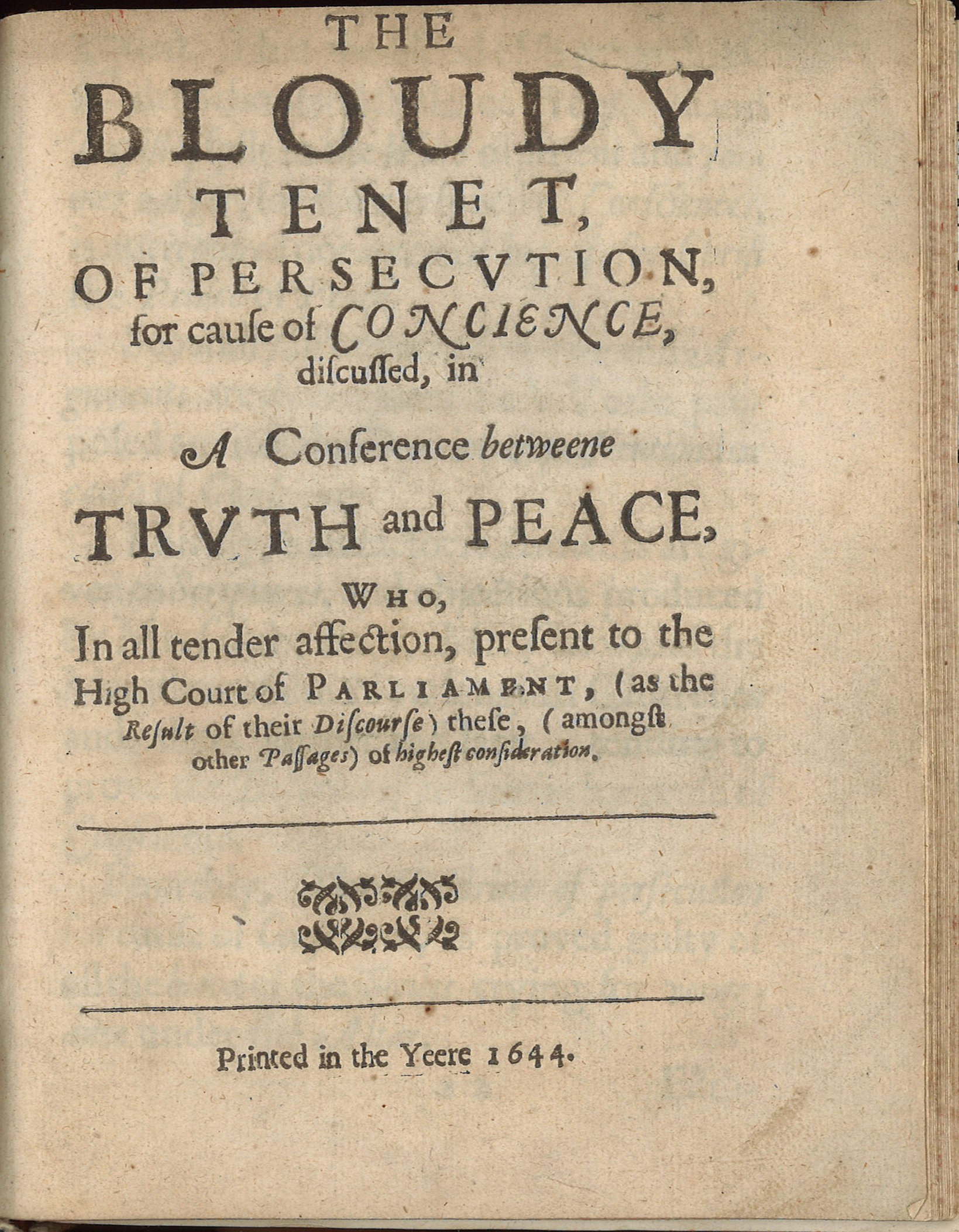
bloudy-tenetThe General and Particular Baptists adopted none of the theological or practical errors of the Anabaptists, but they were somewhat innovative in their approach to public theology. Due to persecutions experienced at the hands of church-run magistrates, they searched the Scriptures and came away with a doctrine that would come to be known as liberty of conscience. Thomas Helwys, a General Baptist, was perhaps the first to write on this subject. Roger Williams, an English migrant to America and a Separatist-turned-Particular Baptist, expounded on Helwys’ earlier work. In his 1644 work entitled The Bloudy Tennent of Persecution, Williams called out civil magistrates for their persecution of the consciences of saints. Nevertheless, he called the saints to expect persecution if they truly be in Christ.

“WHILE I plead the cause of truth and innocence against the bloody doctrine of persecution for cause of conscience, I judge it not unfit to give alarm to myself, and to all men, to prepare to be persecuted or hunted for cause of conscience. Whether you stand charged with ten or but two talents, if you hunt any for cause of conscience, how can you say you follow the Lamb of God, who so abhorred that practice?” (ed. Joseph Early, Jr., Readings in Baptist History, pg. 21).

The Baptist Confession (1644 / 1646)

Liberty of conscience was a universally accepted distinctive of the early English and American Baptists. In The Baptist Confession (1644), the English Particular Baptists made many concessions to the public theology of the continental Reformers as laid out in the Belgic Confession. However, they nuanced it quite a bit. The Dutch Reformers would doubtless wholeheartedly affirm Article XLVIII in The Baptist Confession of 1644. It reads almost verbatim like the Belgic Confession in its insistence that Christians are subject to magistrates:

That a civil Magistracy is an ordinance of God set up by God for the punishment of evil doers, and for the praise of them that do well; and that in all lawful things commanded by them, subjection ought to be given by us in the Lord: and that we are to make supplication and prayer for Kings, and all that are in authority, that under them we may live a peaceable and quiet life in all godliness and honesty.”

However, moving into the next article, there is a slight change of tone from the Belgic Confession to the Baptist Confession. Where The Belgic Confession offers no concession for liberty of conscience, The Baptist Confession highlights it.

“The supreme Magistracy of this Kingdom we believe to be the King and Parliament freely chosen by the Kingdom, and that in all those civil Laws which have been acted by them, or for the present is or shall be ordained, we are bound to yield subjection and obedience unto in the Lord, as conceiving ourselves bound to defend both the persons of those thus chosen, and all civil Laws made by them, with our persons, liberties, and estates, with all that is called ours, although we should suffer never so much from them in not actively submitting to some Ecclesiastical Laws, which might be conceived by them to be their duties to establish which we for the present could not see, nor our consciences could submit unto; yet are we bound to yield our persons to their pleasures” (Article XLIX).

It’s worth noting that, while Particular Baptists at this time saw no place for a civil magistrate to exercise ecclesiastical authority, they do not deny the right of the church described in The Belgic Confession to speak with prophetic authority to civil magistrates. In fact, in the next article, they themselves appeal directly to God for the hearts and the minds of the state to be bent toward them in mercy:

“And if God should provide such a mercy for us, as to incline the Magistrates’ hearts so far to tender our consciences, as that we might be protected by them from wrong, injury, oppression and molestation, which long we formerly have groaned under by the tyranny and oppression of the Prelatical Hierarchy, which God through mercy hath made this present King and Parliament wonderful honorable, as an instrument in his hand, to throw down; and we thereby have had some breathing time, we shall, we hope, look at it as a mercy beyond our expectation, and conceive ourselves further engaged forever to bless God for it” (Article L).

This was a clear appeal not only to God but also to the civil magistrates to show mercy and kindness to them for conscience sake. Yet the Particular Baptists went on to explain that, even if the magistrates did not show mercy but dealt treacherously with them, they were still to submit in all things lawful, yet without violating their consciences. The revision of this Confession in 1646 goes on to expound on this idea of liberty of conscience recognizing it as a duty the state owes to its citizenry. It even goes so far as to dictate to the magistrates what are their duties to men regarding liberty of conscience. As such, we see that the early Particular Baptists did view the use of the prophetic voice as a deterrent for governments that might otherwise violate their liberty of conscience. They did not concede to the notion that the church should not speak to matters of government, only that governments were not free to dictate terms to the church.

______________
In our next article, we will conclude our discussion of public theology in the Reformed confessions by examining developments in The Westminster Confession and The Baptist Confession (1677 / 1689).

A Reformed Baptist Perspective on Public Theology – The Reformed Confessions (Part I)

Read the first three posts here, here, and here.

______________

When discussing the idea of the Two Cities and Two Kingdoms paradigms for understanding public theology, many leave a tremendous gap between Luther and modern scholarship. We would be negligent to do so here, though. For a uniquely Reformed Baptist perspective on these issues to be well informed, one must be aware of the fact that there is more than just a Lutheran perspective of public theology to draw upon. There is also a Reformed tradition, which just so happens to be the tradition from which Baptists sprung.

Luther’s further development of Augustine’s paradigm certainly plays a large role in the development of Calvinistic, Reformed, and Reformed Baptist approaches to public theology. However, Calvin and his predecessors did not adopt Luther’s theology without some contributions of their own. Luther’s views on the subject evolved throughout the course of his life and the life of Saxony. The same could be said of Zwingli in Zurich, Calvin in Geneva, and the Dutch, British, French, German, and American Reformers that would follow in their footsteps.

According to Oliver O’Donovan and Joan Lockwood, Calvin intermingled aspects of the patristics, the scholastics, and Luther in the development of his public theology with ideas and methods he’d received from classical political philosophy as well as humanist literary, historical, and legal scholarship (O’Donovan and Lockwood, From Irenaeus to Grotius, 662). Calvin’s take on public theology took into account not only the collective wisdom of church history and Western Civilization, but it also brought several disciplines to bear on the matter. Thus, it would be highly inappropriate to attempt to transplant Luther’s theory into the Reformed tradition without any consideration of nuance or further development by Calvin and his theological predecessors.

Recognizing the willingness of the Reformers to shift understandings of these matters to meet the ever changing political structures of their times and cultures, it’s important that we as 21st century Westerners seek to discern as best we can the most universal elements of the Reformed take on Public Theology. Perhaps the best place to look to find these universal elements are in the development of the Reformed confessions of faith. For the purposes of this series, we will look at four such confessions that particularly pertain to the Reformed and Reformed Baptists: The Belgic Confession, The Baptist Confession (1644/1646), The Westminster Confession, and The Baptist Confession (1677/1689). As we examine these confessions, we will see how historical considerations over time forced the Reformed to continue to revisit the biblical texts most pertinent to the subject matter at hand and further Reform their views on public theology. Semper Reformanda!

Separation of Church and State

Some would take issue with there even being a chapter on magistrates in the confessions. They argue that there should be a complete separation of church and state neither where the state speaks with authority to the church nor where the church speaks with authority to the state. Sam Waldron has offered a response to such reasoning.

“Does it surprise you that the Confession contains a chapter on the subject ‘Of the Civil Magistrate’? Are you inclined to ask, ‘What does politics have to do with Christ?’ If that is something of your response, may I suggest that you are a victim of a religious background which has retreated from its social responsibilities under a wrong view of the separation of church and state? Such an attitude has virtually denied the sovereignty of God over all areas of life. To restrict Christianity to the ‘spiritual’ realm is, ultimately, to destroy it” (Waldron, A Modern Exposition, 284).

The concept of the separation of church and state was a concept unique with Baptists in England and America. It was framed as a larger concept in which to set the gemstone of liberty of conscience, yet another uniquely Baptist doctrine. This concept was never meant to be taken as a separation of God and state. It is important to note at this juncture that not all Reformed confessions championed these concepts. Of course, we’ll see that quick enough as we examine our first Reformed confession: The Belgic Confession.

The Belgic Confession (1619)

589Reformed confessions have always dealt with the subject of the civil magistrate. Specifically regarding this subject the Reformed confessions are in general agreement that the role of government is to wield the sword granted them by God for the punishment of evil and the promotion of good (cf. Romans 13:1-7). Also, shared among the confessions is the recognition that duty is owed by the governed subjects to their magistrates, those magistrates having been given their office by God. The Belgic Confession goes quite a bit further than this, though.

“And the government’s task is not limited to caring for and watching over the public domain but extends also to upholding the sacred ministry, with a view to removing and destroying all idolatry and false worship of the Antichrist; to promoting the kingdom of Jesus Christ; and to furthering the preaching of the gospel everywhere; to the end that God may be honored and served by everyone, as he requires in his Word” (The Belgic Confession, Article 36).

Thus, the Confession most commonly held by the Dutch Reformed community promotes the use of the magistrate to enforce church discipline and promote the furtherance of the gospel. Without doubt this is seen, at least in seed form, in the practices of Zwingli and Calvin. In fact, it was over this issue that Zwingli’s disciples eventually separated from him birthing what would eventually come to be called the Anabaptist movement in Switzerland. Tellingly, The Belgic Confession takes a clear stance against the Anabaptists, anarchists, and revolutionists in its pronouncements.

“Moreover everyone, regardless of status, condition, or rank, must be subject to the government, and pay taxes, and hold its representatives in honor and respect, and obey them in all things that are not in conflict with God’s Word, praying for them that the Lord may be willing to lead them in all their ways and that we may live a peaceful and quiet life in all piety and decency.

And on this matter we reject the Anabaptists, anarchists, and in general all those who want to reject the authorities and civil officers and to subvert justice by introducing common ownership of goods and corrupting the moral order that God has established among human beings” (Ibid.).

This being the earliest of the Reformed confessions, the Westminster Assembly and the Particular Baptists developed much of their public theology upon it. While an argument can be made that it is the most Reformed position, in that it is most faithful to the views and conduct of Calvin and Zwingli, such an argument does not allow for the application of the Semper Reformanda (always reforming) principle. As circumstances changed in Luther’s and Calvin’s political and cultural situations, their understandings of these matters adapted. The Reformed tradition moving forward into the 17th century also adapted to the changing times, returning again and again to the Scriptures to determine the best approach to new considerations as they arose.

______________
In our next article, we will continue our discussion of public theology in the Reformed confessions by examining developments in some of the English confessions of the 17th century.

The New Birth in First Peter

With Sovereign Grace Baptist Church in San Angelo, TX., I have had the honor of preaching through the book of 1 Peter. This past week, we got as far as 2:17 in our study. Reflecting on the study thus far, and looking forward to where we are headed, I have come to the conclusion that everything in the first half of 1 Peter flows out of the reality of the new birth (1Pt. 1:3).

Outline:

As a result of the new birth:

1) …we have a new relationship with God (1:1-21).
2) …we have a new relationship with one another (1:22-2:3).
3) …we have a new relationship with unbelievers (2:4-3:17):

a) …unbelieving Jews (2:4-12).
b) …unbelieving civil authorities (2:13-17).
c) …unbelieving masters (2:18-20)

(In all this Christ is our example; 2:21-25)

d) …unbelieving husbands (3:1-6).
e) …unbelieving wives (3:7).

4) …we are to love as brothers (3:8-12).
5) …we will suffer (3:13-17).

Hopefully this serves as a helpful outline for those of you who would like to engage the book of 1 Peter a little deeper. I was almost done with the first chapter of the book before I realized this was what Peter was doing with his argumentation. Let me flesh it out a little further though for those of you who may be a bit skeptical of my approach here.

New Relationship with God

Peter starts by securing our new relationship with God in eternity past through the election of God’s people (1:1-2). Understanding how our new relationship with God is rooted in eternity past gives us great security. He will go one to explain how our relationship with God is also being kept secure in the here and now.

First, he points us to the new birth itself (1:3-9). We are born again to a living hope, an inheritance being kept in heaven for us who are being kept by God Himself. We rejoice in this new standing we have before God as heirs of the promise, even though now we are sojourners in a land where we are persecuted strangers. We have a home, a glorious family awaiting us in heaven. The hope and assurance of that great promise sustains us through our trials.

Second, we have this hope revealed to us this side of the incarnation. We are a privileged generation in that we have these great mysteries revealed to us. The prophets prophesied of the Messiah to come, the things He would suffer, and the glories that would follow, but they did not have as full a revelation as we now have.

Third, as a result of this new birth, this inheritance we have received as sons of God, we have a new relationship with Him. We are no longer children of wrath (Eph. 2:3) and sons of disobedience (Eph. 2:2; 5:6; Col. 3:6). Rather, we are now called children of obedience. As such, our behavior is to reflect what we truly are as a result of having born again into the family of God (1Pt. 1:13-21).

New Relationship with One Another

IMG_8323Also, as a result of our new birth, we have new brothers and sisters. We have brothers and sisters in the flesh, but flesh is like grass. “All flesh is like grass, and all its glory like the flower of grassThe grass withers, and the flower falls off, but the word of the Lord endures forever” (1:24-25a). By contrast, our inheritance and relationships with our new family are imperishable (1:22-25).

Our new relationships with one another yield new behaviors (2:1-3). As a result of our new birth, we now have familial obligations and familial motivations. We seek unity rather than division, and this new motivation effects how we live in fellowship with one another. We put aside devices of discord and cling to the One who builds up the body: Christ Jesus.

New Relationship with Unbelievers

As a result of our new birth, we have been grafted into true Israel (2:4-12). Paul taught that unbelieving Jews in the New Covenant have been broken off so that believing Gentiles might be grafted in (Rom. 11:17-24). This is part of a greater argument Paul made about his unbelieving brothers in the flesh starting in Romans 9. Peter refers to these unbelieving Jews as builders. We know he has unbelieving Jews in mind because he quotes the same verses Paul quotes in his argumentation in Romans 9-11.

We also know that he is referring to unbelieving Jews and Gentiles who are being grafted into true Israel because he applies uniquely Jewish titles to the New Covenant believing community. He describes the church as a temple being built and we are the stones and we are the priests, with Christ as the Capstone / Cornerstone. In fact, Peter calls us a royal priesthood and a holy nation. We ought not to take this to mean that we have replaced Israel, though. We have not. We have merely been grafted into true Israel. As such, true Israel has taken on a new shape.

As a result of the new birth, we also have a new relationship with civil government (2:13-17). Just as I would expect my kids to obey any adults with whom I would leave them, God expects us to honor the authorities He has placed in our lives. To disobey and dishonor the civil authorities God has established in our lives is to disobey and dishonor God.

We also have a new relationship to our masters as a result of the new birth (2:18-20). This has particular application in our day and age where people hold so loosely to their commitments to their employers. In Peter’s day, you entered into a contractual agreement with your master. It was much like joining the military. If a man were to come to a church and say, “I went AWOL from the military, because my sergeant was an unbeliever,” our proper response would be to tell him he needs to return and honor his enlistment. In the same way, Christian employees should not be flippant about jumping from job to job simply because their employers are unbelievers. We need to honor our commitments and show honor to our bosses.

Christ is our example in these things (2:21-25). When He was slandered and reviled, He did not revile in return. He willingly submitted to His persecutors and, as such, He was submitting to the will of God. We do not know the will of God for our lives or what He is orchestrating for our future, so we ought to humble ourselves and submit to the hardships we will receive as a result of our new relationship to the world.

Our new birth does not give us license to divorce or liberty to ill-treat our spouses (3:1-7). Rather, wives are to respect and submit to their unbelieving husbands. Husbands, are likewise to deal with their unbelieving wives in an understanding way and not to domineer them. When I was first introduced to the Doctrines of Grace, I tried to force-feed them to my wife. This is not how wives learn. We need to be patient with them and allow them to sit under the word and be convinced by God, not our forcefulness.

Love for the Brethren

Once again, Peter returns to our familial motivations / obligations (3:8-12). As a result of the new birth, we are to deal with one another with brotherly affections. This will result in certain heart motivations, which will then lead to changes in the way that we behave toward one another.

The Suffering to Follow

If we commit all of these things to memory and allow them to shape us and motivate us in how we walk in this world, we will have hardship. The world hates Christ. As those who are being made over in His image, they will hate us. We are to be ready to give a defense in the face of the trials that come our way. However, we must do so in fear and solemnity, recognizing that we represent our holy Father who is in heaven, and we have a brotherhood who will reap the consequences for our misdeeds in the flesh.

Band of Brothers: Bound by the Word of God

The following article is my sermon transcript from this past Lord’s Day. I don’t take my transcripts into the pulpit with me; I take an outline based on the transcript. However, this is the jist of the exposition. It seemed appropriate given some recent events on the interwebs that I post it here. For the record, I am not a fan of how things translate from Microsoft Word to WordPress, but I’ll get over it.

Introduction

I am convinced that many of the “one another” passages of Scripture originally had in view only the local church. Still today, even in this age of social media and the blogosphere, I still believe its primary application is for the local church. However, more and more, I am seeing Christians putting their disdain for one another on public display on the internet. We are often haughty, self-promoting, impatient, cynical, and irreverent in the way that we speak to and about our fellow believers on the internet.

I don’t view this as a practical deficiency within the church. I see it primarily as a theological deficiency. It’s a sign that many of us who name the name of Christ and call God our Father do not truly understand the implications for such a claim when we address one another in public forums. We too easily forget the apostle John’s warnings:

“The one who says he is in the Light and yet hates his brother is in the darkness until now” (1Jn. 2:9; NASB).[1]

“But the one who hates his brother is in the darkness and walks in the darkness, and does not know where he is going because the darkness has blinded his eyes” (1Jn. 2:11; NASB).

“Everyone who hates his brother is a murderer; and you know that no murderer has eternal life abiding in him” (1Jn. 3:15; NASB).

“If someone says, ‘I love God,’ and hates his brother, he is a liar; for the one who does not love his brother whom he has seen, cannot love God whom he has not seen” (1Jn. 4:20; NASB).

We must recognize that, when we lack genuine brotherly affection for one another, we are living like pagans. This commends neither us nor our God to a lost and dying world. However, Peter has a different understanding of how and why we ought to treat one another with brotherly love. As Christians, we are expected to have purified ourselves in obedience to truth. As such, we should bear the fruit of that obedience: brotherly love. We bear that fruit because of the seed that has taken root in our hearts: the word of God.


The Fruit of Obedience to the Truth: Brotherly Love

“Having purified your souls in obedience to the truth into a genuine brotherly love, [you] fervently love one another from the heart” (1Peter 1:22; personal translation).[2]

In Obedience to the Truth

Here Peter uses another participle: having purified. He assumes that his readers have already purified themselves. Indeed, this is one of the marks of a true Christian. A true Christian will set himself apart, sanctify himself, and purify himself from all worldliness (Rom. 12:2; 1Cor. 3:18-19). How primarily does he purify himself? By availing himself of the word of God (2Tim. 3:16-17).

“All Scripture is given by inspiration of God, and is profitable for doctrine, for reproof, for correction, for instruction in righteousness, 17 that the man of God may be complete, thoroughly equipped for every good work” (2Tim. 3:16-17).

Notice that Peter says we purify our souls “in obedience to the truth.” The truth being spoken of here is found only in Scripture, the very word of God. We are called to be obedient to Scripture. However, if we are to rightly subject ourselves to the word of God, we must rightly understand what the word of God is teaching us. This requires study. This requires work. This requires commitment and discernment.

The world tells us this dogged commitment to truth cannot coincide with a lifestyle marked by love. I have heard seasoned Christians go so far as to say that John 1:14 gives us a paradox because it describes Christ as “full of grace and truth” (NASB; emphasis added). This idea that love and truth are diametrically opposed to one another has bled even into the church. I would argue, however, that the apostles had no concept of truth existing apart from love or love apart from truth. If I tell my friend I love him, and I know he’s blindly walking toward a cliff, I don’t demonstrate my love for him by withholding truth from him.

Christians can get nitpicky. We can correct people for things that don’t need correcting, especially on social media. When we become overcritical of our friends and family, this could be a sign of an unloving spirit. We can certainly fall into the trap of speaking the truth in an unloving way, but that does not mean that we throw the baby out with the bathwater. Often, to speak the unadulterated truth is the most loving thing we can do.

However, when confronted with the truths of Scripture to the degree that most Reformed Christians are in Western society today, we ought to be the most loving, most caring, most merciful Christians people meet. We spend so much time studying and relishing in the gospel and the great mercies that we’ve been shown by God. Ought we to show mercy to our fellow man as well?

We take a great fire into our bosom when we study the truths of God’s word. Can a man take a fire into his bosom and not be burned? And can we regularly take the refining words of God into our hearts and not be permanently changed? Yet, many of us claim to read the word regularly and affirm the historic doctrines of the faith, but we don’t seem to know the first thing about loving our brothers. We would rather treat the truth of God as an academic endeavor or a reason to debate. We often treat God’s truth as a tool for changing others when we should first be changed by it. We first need to internalize God’s truth and let it purify us.

Brotherly Love

This gets us to the heart of this obedience to truth. We are called to be obedient to the truth not merely for the sake of knowing and loving God more. Rather, as we are purified in obedience to the truth of God, it should cause us to love both Him and one another more.

The truth of God teaches us of our original state holiness and joy in the garden (Eph. 4:24). It further teaches us the value of each human being, in that we’ve each been created in the image of God (Gen. 1:26-27). God’s truth goes on to teach us how we have all fallen short of God’s glory and marred His image in ourselves (Rom. 3:23; 8:29). Finally, we discover from God’s truth how each of us are utterly helpless to save ourselves apart from God’s amazing grace through the gospel (Mk. 10:26-27). This knowledge ought to compel us to have a deeper appreciation for our brothers and sisters in the faith, and to extend a greater amount of mercy toward them, even in their sin (Mt. 5:7).

Furthermore, when we recognize the fact that we are each born into a new family through Christ, our love for one another takes on yet another aspect. We have gone from merely having common life experiences to having a common Father in heaven. We are brothers and sisters in Christ in a very real, very eternal sense. As such, we are bound to one another not merely by some human contract, but by a divinely established familial bond (Mk. 10:28-30).

As brothers and sisters, then, we have obligations to one another. Think of it this way. The only way that earthly brothers or sisters can remove themselves permanently from their siblings is to remove themselves from their parents’ house. As long as we call ourselves children of our Father in heaven, we are likewise bound to our Christian brothers and sisters. This means that we have certain obligations to one another. We’re a family.

This means that, when I see a brother sinning, I not only have an obligation to stop him from sinning. I also have an obligation to do so in a manner that helps him retain as much dignity as possible. A common knee-jerk reaction to sin among Christians is to see a brother headed over a cliff and think it’s our job to give him the final shove. That is not brotherly love. Brotherly love means to reach out to that brother, show him the error of his ways, seek reconciliation, and ultimately to seek restoration (Gal. 6:1-2):

“Brethren, if a man is overtaken in any trespass, you who are spiritual restore such a one in a spirit of gentleness, considering yourself lest you also be tempted. Bear one another’s burdens, and so fulfill the law of Christ” (Gal. 6:1-2).


The Root of Obedience to the Truth: The Gospel

having been born again not with perishable seed but imperishable through the living and eternal word of God. Because,

All flesh is as grass,

And all their glory is as a flower in the grass.

The grass withers,

And the flower falls,

But the word of the Lord abides forever.

And this is the word that was proclaimed to you (1Pt. 1:23-25; personal translation).

We have been born again into an eternal, spiritual family. That which brought about our new birth is likewise eternal and spiritual: the living and eternal word of God. Were we born into this new family through flesh and blood, we would have nothing in which to be confident, for flesh and blood both perish. Rather, “as many as received Him, to them He gave the right to become children of God, to those who believe in His name: who were born, not of blood, nor of the will of the flesh, nor of the will of man, but of God” (John 1:12-13; NKJV).

We are born of an imperishable seed. We are born of God (John 1:13) “through the living and eternal word of God” (vs. 23). In other words, it was through the word of God that God brought about our salvation. The word was the seed that was planted in our hearts’ soil (Mt. 13:1-23 – “Parable of the Sower”). This word, once it takes root and extends deep into the soil of our hearts, reaps in us eternal life!

It’s this word of God that Peter says is living and eternal. He takes this description from Isaiah 40. In Isaiah 40, Isaiah is prophesying about the coming of the Messiah and His forerunner: John the Baptist (vs. 3; cf. Mt. 3:3). Isaiah goes on to prophesy regarding the Messiah:

“The glory of the LORD shall be revealed,

And all flesh shall see it together;

For the mouth of the LORD has spoken.”

The voice said, ‘Cry out!’

And he said, ‘What shall I cry?’

‘All flesh is grass,

And all its loveliness is like the flower of the field.

The grass withers, the flower fades,

Because the breath of the LORD blows upon it;

Surely the people are grass.

The grass withers, the flower fades,

But the word of our God stands forever’” (Isa. 40:5-8).

Isaiah prophesied these words as words of deliverance for the people of God. They had been in exile, and now they were going to see their deliverance. God’s people had seen tremendous warfare and received from the Lord’s hands “double for all her sins” (Isa. 40:2). Now, God speaks comfort to His people, “that her warfare is ended, that her iniquity is pardoned.” Now, we know that this peace to come was Christ Himself, given that this is the passage used to refer to His forerunner in Matthew 3:3. Christ is the glory of the Lord that shall be revealed (Isa. 40:5).

The people of God, then, have just experienced a great trial in their exile to Babylon. They had seen much death and much war. They had experienced a tremendous defeat and been carried away by a foreign people. Looking forward to the Messiah to come, they are now told to set aside any faith they had previously put in flesh that fades, and to trust in the abiding, imperishable word of God.

In like manner, we are told to lay aside any trust that we may have placed in the flesh. Our confidence is not in the flesh, but in Christ. The Jews will not be saved on account of the fact that they share in flesh and blood with Abraham. They will only be saved if they believe like Abraham in the Seed of Abraham, which is Christ (Gal. 3:16, 29):

“Now to Abraham and his Seed were the promises made. He does not say, “And to seeds,” as of many, but as of one, “And to your Seed,” who is Christ” (Gal. 3:16).

“And if you are Christ’s, then you are Abraham’s seed, and heirs according to the promise” (Gal. 3:29).

John the Baptist told the Pharisees and Sadducees, who were trusting in the flesh, “Brood of vipers! Who warned you to flee from the wrath to come? Therefore bear fruits worthy of repentance, and do not think to say to yourselves, ‘We have Abraham as our father.’ For I say to you that God is able to raise up children to Abraham from these stones” (Mt. 3:7-9).

Many today even think they will get to heaven on account of fleshly association. They reason that they were raised in church by godly parents and, thus, they must be good to go. Let us not fool ourselves into thinking that we can ride into heaven on our parents’ faith. We must have faith ourselves, but not in ourselves. We must each put our faith in Christ for our own salvation. We will not get into heaven on the merits of the flesh, whether ours or another’s.

The Lord, through Isaiah, said:

All flesh is as grass,

And all their glory is as a flower in the grass.

The grass withers,

And the flower falls,

But the word of the Lord abides forever” (1Pt. 1:24; personal translation).

We are then to trust in the preached word, not in some genetic heredity. Our inheritance is heavenly, eternal, secure, and abiding. It is as secure and abiding as the very word of God, but it is for those who believe and for those who believe alone. Will there be a great remnant of Jews who will be saved before the return of the Lord and the consummation of all things? Many believe this to be the case. It certainly seems so from my study of Romans 11. However, those Jews who come to salvation in the end will be saved, not on account of their flesh, but on account of their belief in the Lord Jesus Christ.

This is the word that was proclaimed to us: our salvation in Jesus Christ! It’s on account of this word and on account of our belief in this word that we come to be included in this great family of God. It’s because of this word of truth that we have heard and now obey that we are purified and compelled to a fervent brotherly love toward one another.

The word here rendered proclaimed is the verb form for the word εὐαγγέλιον, from which we get our English word evangelism. In essence, it means good proclamation, and it’s where we also get the word gospel (or good news). So then, we know that we have come to be brothers and sisters in Christ through the preaching of the gospel, the truth of God from the word of God.

It’s only through this word that any of us are ever saved. According to Romans 10:

“How then shall they call on Him in whom they have not believed? And how shall they believe in Him of whom they have not heard? And how shall they hear without a preacher? And how shall they preach unless they are sent? As it is written:

‘How beautiful are the feet of those who preach the gospel of peace,

Who bring glad tidings of good things!’” (Rom. 10:14-15).

We must then hear the word of God to be saved. We must hear the gospel. It goes without saying then that, if we want to see others in our lives come to salvation, they too must hear the gospel. How shall they believe on Him of whom they have not heard? And how shall they hear without a preacher? Let us then go forth with boldness and proclaim to our friends, family, coworkers, and neighbors the only word that has any power to save them from their sins.

Conclusion

Those who receive this word and obey it will be purified and set apart into the family of God. Each new convert to the gospel of Jesus Christ is a new brother or sister in our great family. We need to treat them as such. We need to treat one another as such, because that is what we are. We are a family, and as sons and daughters of the God of love, we ought to be the greatest example of love the world has ever seen. So be holy as your Father in heaven is holy (1Pt. 1:16). But also let us love one another, because our Father in heaven is love.

[1]All citations from Holy Scripture from the New King James Version of the Bible, except where otherwise noted.

[2]Personal translations translated from UBS4.
Thinking Critically About Complementarianism

Recently, I’ve finished a 12-part blog series offering, largely, a thoughtful critique on complementarianism. Having been raised as an egalitarian, I had no thought that my inherent disposition toward my role in marriage was ungodly or unbiblical. However, in desiring to have a God-honoring marriage, I spent a lot of time studying the proper role of women and men in marriage, sought advice, read books, etc. I understand and accept that complementarianism is biblically consistent and the God-given design for marriage; however, I still wrestle with some things that complementarians do, generally believe, and sometimes teach.

This blog series largely examines those contestable points from the viewpoint of what Christian egalitarians believe and try to foster in their statement of beliefs, with the hope and intention of promoting more critical thought and precision among complementarians. The latter part of the series offers some very important points that complementarians believe that are absent from egalitarian beliefs, with the hope and intention of also promoting critical thought and self-examination among egalitarians. Finally, the series ends with some lessons that I have learned during my short journey in marriage that may offer some insight and encouragement to other complementarians, mainly women, who are striving to glorify God by fulfilling their own God-given role in marriage.

Part 1: Sliding Into Complementarianism

Part 2: What Do Christian Egalitarians Believe?

Part 3: Egalitarian Beliefs: The Use of Spiritual Gifts

Part 4: Egalitarian Beliefs: Public Recognition

Part 5: Egalitarian Beliefs: Addressing the Sense of Inferiority Among Women

Part 6: Egalitarian Beliefs: Voices in the Home

Part 7: Egalitarian Beliefs: Valuing and Protecting Self in the Marriage

Part 8: Egalitarian Beliefs: Clarifying What We Believe

Part 9: Complementarian Beliefs: Addressing Cultural Influences

Part 10: Complementarian Beliefs: Biblical Consistency

Part 11: Complementarian Beliefs: Tackling the What and Where of the Problem

Part 12: Lessons for the Developing Complementarian Journey


M’Cheyne Bible Reading Plan: May 10

Numbers 19 (NASB, ESV, KJV, HCSB)

biblecoffee2_kjekolPsalms 56&57 (NASB, ESV, KJV, HCSB)

Isaiah 8 (NASB, ESV, KJV, HCSB)

James 2 (NASB, ESV, KJV, HCSB)