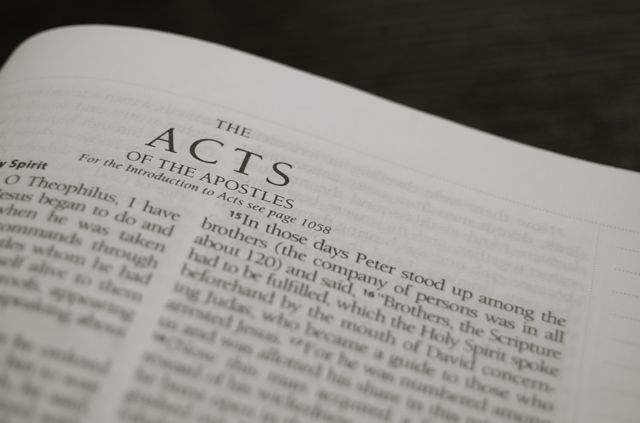
M’Cheyne Bible Reading Plan: January 5

Genesis 5 (NASB, ESV, KJV, HCSB)

Matthew 5 (NASB, ESV, KJV, HCSB)

Ezra 5 (NASB, ESV, KJV, HCSB)

Acts 5 (NASB, ESV, KJV, HCSB)

M’Cheyne Bible Reading Plan: January 2

Genesis 2 (NASB, ESV, KJV, HCSB)

Matthew 2 (NASB, ESV, KJV, HCSB)

Ezra 2 (NASB, ESV, KJV, HCSB)

Acts 2 (NASB, ESV, KJV, HCSB)

M’Cheyne Bible Reading Plan: January 1

Genesis 1 (NASB, ESV, KJV, HCSB)

Matthew 1 (NASB, ESV, KJV, HCSB)

Ezra 1 (NASB, ESV, KJV, HCSB)

Acts 1 (NASB, ESV, KJV, HCSB)

What I’m Not Saying About the Godly Line of Seth

Recently, I posted a four-post argument on my understanding of the identity of the “sons of God” in Genesis 6. Since settling on my view of this passage, I have read several articles from those who hold to the more common view. In these articles there are some misnomers I’d like to address. I think each of these arguments can be reduced down to one very simple assertion: Don’t hear what I’m not saying. Let’s address each one of these misnomers in turn.

I’m not saying that the Sethites were anywhere else referred to in Genesis as ‘sons of God’

Sure, the Sethites are not identified anywhere other than Genesis 6 by Moses as sons of God, but neither are fallen angels. The book of Job alludes to angels being called ‘sons of God,’ but even that assumes a certain interpretation. Think of it this way:

Job was the first book written in the Bible. Hundreds of years later Moses wrote the Pentateuch. Hundreds of years after that the prophets tell us that Satan was actually a guardian cherub in the Garden of Eden. Thus, we must assume that Moses, foreseeing the prophets’ understanding of Satan’s nature, interprets that back into Job and then uses that interpretation to identify fallen angels able to create for themselves bodies capable of procreating with female humans. This hermaneutic is, to say that least, bizarre.

However, for God to designate His remnant people as His children is far from bizarre, even for Moses. In Exodus 4:23 God, through Moses, told Pharaoh, “Let My son go that he may serve Me” (NASB). God is a covenant keeping God, and we with whom He keeps covenant are not His mere subjects. We are His sons (Matthew 5:9; Luke 20:36; Romans 8:14; 9:26; Galatians 3:26; 4:6).

I’m not saying that the Sethites were intrinsically godly

Some call into question the certainty with which we can say that the line of Seth were all godly. I would call that into question as well. In and of himself, no man has ever been completely biblecoffee2_kjekolrighteous. Look at the life of Abraham. He deceived to monarchs and put his wife’s purity on the line to save his own skin, and yet he is called righteous. Look at his nephew Lot. He offered up his daughters to the city, got drunk, and impregnated his daughters, and yet he is called righteous.

By referring to the Sethites as the godly line of Seth, we are not eschewing the fact that we are here referring to sinful men. Beyond any doubt, they were sinful men. However, look at the way that sinful men of God are remembered in the Bible vs. sinful men of the world. The New Testament authors only recall the good in the life of Abraham. They refer to Lot as righteous Lot. They recall only the sins of Balaam, but recall only the faith of Rahab the harlot.

So, what is the difference between the godly and the ungodly in a world where all have sinned and fallen short? The difference is a difference of covenant and perseverance. Those who are in covenant with God, though they may sin (even scandalously), through repentance and perseverance, they will be called godly. They will be called sons of God!

I’m not saying that all who are called ‘sons of God’ persevere

Obviously, not all of the Sethites persevered to the end. There is always a certain level of corruption among God’s people. There will always be wheat among the tares. However, God always has His remnant. For the Sethites, the corruption reached so far that, by the time of the flood, the only remnant left was Noah and his immediate family. There were times in the life of the nation of Israel when there were only 7,000 who had not bowed the knee to Baal.

To say that a people of God is godly in the Bible is not necessarily to say that all of them do all things with all godliness at all times. That notion is simply preposterous. If that were the case, why in the world would Paul tell Titus that God’s grace enables us to live godly lives (Titus 2:12)? Why on earth would Peter say that God rescues the godly (2Peter 2:9)? None of us is perfect. We all fall short in many ways. So, to say that the Sethites were godly is not to say that they were perfect or that they persevered to the end. It is simply to say that they were God’s people at that time.

By the time of Noah, they obviously had come to be very corrupt, just as did the nation of Israel before the dispersion and Judah before the exile. That is the point, though. Even though men may fail, God always keeps His promises. He promised a Messiah that would crush the serpent’s head and, though men may fail us every time, God will remain faithful to His promises. God preserved His chosen Seed through Noah, even though the line of Seth eventually failed.

I will not concede that the daughters of men are the daughters of all mankind

Some have also pointed out that “daughters of men” seems to be used to refer generally to the female offspring of all men, not just those of the Cainites. When placed in contrast to the sons of God, though, it is not hard to understand that two very distinct groups are being referenced here. It is much like the use of the two Adams in 1Corinthians 15.

The first Adam became a living soul, but the last Adam (Christ) became a life-giving spirit (vs. 45). Therefore, “as in Adam all die, so also in Christ all will be made alive” (vs. 22; NASB). Does Paul mean here that every individual in Christ has been or will be made alive? Of course he doesn’t. What he is teaching is that there are two types of men. There are those who are in Adam and, therefore, dead in their trespasses and sins, and there are those who are in Christ, who have been raised with Him to walk in newness of life.

Sometimes the biblical authors used general, universal-sounding terms to designate one group, but then mark them out as not being general and universal by contrasting them with a more specific group. That is what Paul was doing when he wrote 1Corinthians 15, and that is what Moses is doing when he speaks of the daughters of men in Genesis 6. The daughters of men are best understood when contrasted with the sons of God. They are those who follow after the precepts of men rather than the precepts of God. So, when God’s chosen people went after them, they committed a great evil in the sight of the Lord.

M’Cheyne Bible Reading Plan: November

November 1


November 2


November 3


November 4


November 5


November 6


November 7


November 8


November 9


November 10


November 11


November 12


November 13


November 14


November 15


November 16


November 17


November 18


November 19


November 20


November 21


November 22


November 23


November 24


November 25


November 26


November 27


November 28


November 29


November 30

Circumcision and Baptism in Colossians 2

In two recent episodes (here and here) of the CredoCovenant Fellowship, some debate arose regarding the definition of circumcision and baptism in the context of Colossians 2. I found myself in disagreement with Nehemiah Coxe on the meaning of the passage, and decided I’d like to use my bully pulpit to argue my case. I’ve consulted with JD ahead of time so that he might have time to prepare a response.

Nehemiah Coxe seeks to demonstrate in Covenant Theology: From Adam to Christ how Colossians 2 teaches that water baptism replaces fleshly circumcision. He posits that the circumcision referenced in the passage is Christ’s own fleshly circumcision performed in His incarnate infancy. He further insinuates that, water baptism being a symbol pointing to Spirit baptism, we can assume that Paul means for us to recognize that he is in fact calling to mind water baptism. The conclusion to his argument is that water baptism, the symbol representing Spirit baptism, effectively nullifies the Covenant of Circumcision as symbolized in Christ’s circumcision. If you are confused by this argument, you may or may not be helped by reading Coxe’s argument in greater detail on pages 127-130 of Covenant Theology: From Adam to Christ.

The Book We Discussed…

In this post, I would like to argue that what we find in Colossians 2 is not a conclusive statement regarding the nature of fleshly circumcision and the nature of water baptism. Rather, it is the beginning of a much different argument that persists on into the beginning of Colossians 3. In this argument, Paul’s statements evoking circumcision and baptism are best understood to be premises rather than the conclusion.

Paul establishes three premises in his argument (2:8-12), circles back around to further explain his premises (2:13-3:4), and then gives his concluding statements in the form of application (3:5ff).

  • Premise 1 (2:8-11)
  • Premise 2 (2:12a)
  • Premise 3 (2:12b)
  • Further Explanation of Premise 1 (2:13-19)
  • Further Explanation of Premise 2 (2:20-23)
  • Further Explanation of Premise 3 (3:1-4)
  • Concluding Application (3:5ff)

His first premise is the fact that Christ has established Himself as the ultimate authority over all, and particularly in the life of the believer through heart-circumcision (vv. 8-11; cf. 13-19). His second premise is that we have been buried with Christ in spirit-baptism (vs. 12a; cf. 20-23). His third premise is that we have been raised from spiritual death with Him through His resurrection (vs. 12b; cf. 3:1-4). Let’s take these point by point.


For in Him all the fullness of Deity dwells in bodily form, and in Him you have been made complete, and He is the head over all rule and authority; and in Him you were also circumcised with a circumcision made without hands, in the removal of the body of the flesh by the circumcision of Christ (all Scripture citations taken from the New American Standard Bible);

As has been well documented, when Paul wrote to the church at Colossae, he was combating Judaizers and other false teachers (e.g. an early heretical group referred to by scholars as proto-Gnostics) who had added to the law of God and were perverting the teachings of Christ. He wanted to remind his brethren that they were under no yoke or burden but that under which Christ had placed them (Mt. 11:30). In fact, they had been placed under Christ’s yoke, not by rite of Jewish circumcision, but by regeneration—the greater reality:  spiritual circumcision of the heart.

In claiming His full and ultimate authority over all things, Christ is said to exercise His authority in two particular spheres: over creation generally (Col. 1:15-17) and over the church particularly (Col. 1:18-20). It is the second sphere to which Paul here addresses himself. Christ exercises His reign peculiarly in the lives of believers through the indwelling of His Spirit, but this indwelling has a starting point. That starting point is regeneration—the circumcision of the heart (Deut. 10:16; 30:6; Jer. 4:4; Rom. 2:29). After laying out his other two premises, Paul goes on to expound on this argument in verses 16-19:

16Therefore no one is to act as your judge in regard to food or drink or in respect to a festival or a new moon or a Sabbath day— 17things which are a mere shadow of what is to come; but the substance belongs to Christ. 18Let no one keep defrauding you of your prize by delighting in self-abasement and the worship of the angels, taking his stand on visions he has seen, inflated without cause by his fleshly mind, 19and not holding fast to the head, from whom the entire body, being supplied and held together by the joints and ligaments, grows with a growth which is from God.

Christ Himself is the rightful King and Ruler of His church. Therefore, no one else is to attempt to usurp His authority. If anyone attempts to compel his fellow saints to return to the types and shadows or to adopt some form of legalism or asceticism, he is effectively heaving an added burden upon the shoulders of Christ’s subjects. He is removing the delight of Christ’s rulership and replacing it with an extra-biblical, despotic oppression. Christ is King and Ruler over His church and will not share His throne.

But it is not a fleshly circumcision under which we have come, not even (I would argue) Christ’s incarnate fleshly circumcision. Such a notion is not even hinted at in the text. Rather it is that same circumcision under which God’s true people have always come: the circumcision of the heart. Under this circumcision, there are no civil or ceremonial laws that must be obeyed. Likewise, there are no ascetic practices which must be observed. Rather, the true believer passively receives the stamp of God’s approval in Christ upon his heart, and upon his heart the law is written (Jer. 31:33; Heb. 8:10; 10:16) that, in it, he might find his delight (Ps. 1:2; 40:8).


having been buried with Him in baptism,

Paul furthers his argument by calling to mind the doctrine of spirit baptism, a common theme in Paul’s letters (Rom. 6:6; 1Cor. 12:13; Gal. 3:27; Eph. 2:5). In order for Nehemiah Coxe’s argument to remain in tact, he must prove that this text is referring to either water baptism or Spirit baptism of which water baptism is a picture. Obviously,  he would have to make the second argument as (I will demonstrate), Paul is clearly referring to Spirit baptism. The problem is that Coxe does not make an argument that the symbol of Spirit baptism (water baptism) is being referenced here. He merely assumes it. Paul, on the other hand, will go on to make it clear that he is not talking about the physical symbol, but the spiritual reality.

20If you have died with Christ to the elementary principles of the world, why, as if you were living in the world, do you submit yourself to decrees, such as, 21“Do not handle, do not taste, do not touch!” 22(which all refer to things destined to perish with use)—in accordance with the commandments and teachings of men? 23These are matters which have, to be sure, the appearance of wisdom in self-made religion and self-abasement and severe treatment of the body, but are of no value against fleshly indulgence.

When Paul refers to burial in this passage, he is referring to that spiritual reality of our dying in Christ. In a very real sense, we have died and been buried with Him. We have died to sin (Rom. 6:2, 10; 1Pt. 2:24), to the law (Rom. 7:2-6; Gal. 2:19), and to the elementary principles of the world (Col. 2:20). Like a wife whose husband had died in battle, we have been freed and lawfully betrothed to Another. Being dead to sin and the law, they no longer have mastery over us.

Having died to these things, we are no longer to come under their bondage. We have died to the Old Covenant system. Therefore, we are neither to come under the yoke of fleshly circumcision nor the yoke of the civil or ceremonial laws. Likewise, we are no longer in the world, so we ought not to submit to the edicts of man imposed upon our consciences. Our consciences are to be bound ultimately and finally by Scripture alone! This is the first aspect of what the apostle means when he speaks of baptism: our union with Christ in His death and burial.


in which you were also raised up with Him through faith in the working of God, who raised Him from the dead.

The second aspect of Paul’s meaning is like the first: our having been raised with Christ! It is clear in the immediate text that Paul is not referring to water baptism when he says that we are raised “through faith.” This is not true of our water baptism. We are not raised up out of the water through faith, but by the joint efforts of the preachers arms and our abdominal muscles. Further, there is no talk of symbol in the text, so the faithful exegete is not at liberty to assume its presence in the argumentation. The baptism referenced here obviously takes on a spiritual meaning. Paul goes on to explain that meaning in Chapter Three, verses 1-4:

3:1Therefore if you have been raised up with Christ, keep seeking the things above, where Christ is, seated at the right hand of God. 2Set your mind on the things above, not on the things that are on earth. 3For you have died and your life is hidden with Christ in God. 4When Christ, who is our life, is revealed, then you also will be revealed with Him in glory.

Our baptism in Christ: our death, burial, and resurrection in Him, has the intended outcome of a victorious lifestyle lived with the knowledge that Christ was not defeated. Christ was raised, He ascended, and He currently reigns with the Father in heaven. If we have likewise been raised, we likewise have the joy of knowing that we are currently seated in the heavenly places with Him (Eph. 2:6), ruling and reigning with Christ our Brother.

We are no longer to live as slaves, defeated and conquered by the world in which we live. Rather, we are to recognize our true, royal positions as sons of the King of heaven and earth. The contrast here in Paul’s language is not between two covenants: one of fleshly circumcision and the other of water baptism. Instead, the contrast is between slavery to the world and freedom in Christ.


Conclusion

Whatever we may say about fleshly circumcision and water baptism, and the covenants to which they belong, we are not at liberty to argue toward those conclusions from this text. The reason why not is very simple: this text is not arguing for a contrasted understanding between fleshly circumcision and water baptism. This text is talking about Christ’s authority over believers as demonstrated by our heart circumcision (regeneration) and Spirit baptism (union with Christ in His death, burial, and resurrection).

CCF Episode Twenty-Eight: Concluding Our Discussion of Covenant Theology

CredoCovPodcastMaster

In this episode, JD and Billy sit down with Junior “The Big Dippa” Duran and Rene Del Rio to conclude their discussion of Covenant Theology: From Adam to Christ by Nehemiah Coxe and John Owen.

MP3 Download | stream:

Subscribe to future podcasts and leave us a review on iTunes: RSS | iTunes  

The book we read…coxeowen2

Covenant Theology: From Adam to Christ by Nehemiah Coxe and John Owen

We’d love your participation. Contact us with your comments and questions about the books contents:

50 Shades of Christ: The Other Side of a Much Needed Dialogue

On last Thursday’s episode of The Briefing and in this article Al Mohler, president of The Southern Baptist Theological Seminary, made a much needed call for empathy regarding the Ferguson debacle. This call for empathy has been forefront in much of what I have read from bloggers, though it has been more implicit than explicit. In the wake of protests and riots following the tragic death of Michael Brown, African-Americans of all stripes have taken to their keypads. They have offered their unique perspectives on the issue and encourage empathy for a large group within the black community that sees Ferguson as indicative of a greater problem with law enforcement in many communities. Here and here are just a few from the Reformed blogosphere. I would recommend that our readers take the time to read them, as they are truly eye-opening.

Taking Dr. Mohler seriously that we ought to empathize with others and assuming that he’s talking to all Christians, not just majority-culture Christians, I am compelled to give my unique perspective for what it’s worth. It is my desire to be empathetic, as Dr. Mohler has urged. At the same time, I would like to aid my African-American friends in their efforts to be empathetic as well. I want this to be a dialogue, not just a monologue. I also recognize this is not a very popular subject for a Caucasian male to address. That is why this article was peer reviewed by friends of other races before I published it. Please, bear with me.

Background

When I was in seventh grade, I remember having a life-changing conversation with a friend of mine. I had made a very insensitive comment, as I am wont to do from time to time. This time it had to do with race relations. My friend quickly pulled me to the side and with tears explained to me the negative effects that racism had had on his life.

James was the product of an interracial marriage. His dad was Irish / Native-America and his mother had immigrated from Mexico. Consequently, some people thought he was either Arabic or Indian. He told me how people had teased him, calling him a camel jockey and a towel head. From that night forward, I have fought sinful urges to tolerate racism in myself or others. A moment of honesty: I have not always been completely successful. I don’t deny that I have made some rather absent-minded, insensitive statements from time to time.

As I got older the light of nature began to reveal to me things that were only further confirmed when I came to Christ. When I would hear white people speak negatively of other races, I would become extremely uncomfortable. Over time, I also came to be increasingly uncomfortable with the idea that one ought to find a special identity with one’s own race. Notions such as “my people” and “our people” came to be just as repulsive as any other type of racism.

The Bible and Partiality

Perhaps the book in Scripture that had the most effect on me as a young man, and especially after I came to Christ, was the book of James. Some have referred to James as the Proverbs of the New Testament. It is full of pithy precepts and imperatives, one of which is the prohibition of partiality:

“My brethren, do not hold your faith in our glorious Lord Jesus Christ with an attitude of personal favoritism. . . If, however, you are fulfilling the royal law according to the Scripture, ‘You shall love your neighbor as yourself,’ you are doing well. But if you show partiality, you are committing sin and are convicted by the law as transgressors” (James 2:1, 8-9; NASB).

In the immediate context James uses the example of partiality toward the rich as an example of how one might show favoritism within the body. The precepts he outlines are much farther reaching than just how we deal with the rich, though. Partiality of any kind ought to be condemned. When men and women leave all to follow Christ, we need to recognize the fact that we are their earthly inheritance (Mark 10:21, 28-31). Thus, to shun them for any reason, be it wealth, race, disability, etc., is to cease to function as the church ought to function.

As a Christian man seeking to apply these principles, I find it highly inappropriate to identify myself in church life as “a white man.” I am an image bearer, and I am to love all image bearers alike. To gravitate toward people who share with me in skin color to the exclusion of others would be contrary to everything I am as a new man in Christ (Ephesians 2:13-16). If the words “my people” were ever to flow from my lips, you could be quite positive that I would be referring to the whole body of Christ, not merely some people who share my skin pigmentation. Were I to use a term such as “white church,” you can bet that it would have an extremely negative connotation.

For all of the above reasons, I am at a loss for how godly pastors and bloggers who I respect would resort to using such terms so freely, African-American pastors and bloggers who claim they are for tearing down racial dividing walls. I don’t understand why, when I see many predominantly white churches bending over backwards to become more “multicultural,” it seems to be just a given that we accept the existence of “black” churches, Korean churches, Hispanic churches, etc. (the language consideration aside), without expecting them to strive for the same diversity. I hate the idea that there would be any church that would have any predominating identity other than Christ. To be honest it sickens me. At best it’s sub-Christian.

Multi-Culturalism

Then again, I have not been the most outspoken proponent of the modern multi-cultural movement in the American church. The call has gone out that predominantly white churches ought to be particularly intentional about seeking to look less “white” and more like the community. Here’s the problem: in order for churches to strive toward such ends, they must compete with churches in their communities that have a long history of gearing their ministry methods toward serving one race.

For instance, say you have a large Vietnamese culture in your community. You could take extra pains to teach your people conversational Vietnamese, hire Vietnamese staff members, seek to raise up or extend a call to potential Vietnamese elders, print out Sunday bulletins in Vietnamese, etc. At the end of the day, you are still at a disadvantage in competing with the Vietnamese church down the road and, in taking so many strides toward catering toward one people group, you have excluded all others. You have not become all things to all people; rather, you have become one thing to one group of people. Even worse, you have made your agenda the deciding factor, rather than the Holy Spirit, on who you hire, raise up in ministry, and even target with the gospel. Who are we to usurp the role of the Spirit in these matters?

See, the question for me is not whether you take added pains to accommodate for a select group of potential membership candidates in your area based on race and ethnicity. Rather, the question is, When you have new members who are not like you, how do you respond? How do you respond when the poor come into your meetings? How do you respond when the disabled come into your meetings? How do you respond when the white man, the black woman, the Vietnamese family, or the Hispanic couple walk through your doors? Do you give first place to any particular group, or do you wait and see who the Spirit will exalt?

Don’t get me wrong. I agree that the precepts of the gospel should result in a more pan-cultural face in local churches. I believe it has in the church where I serve. We are a very diverse group of people, and it can all be attributed to the primacy of the gospel in our body life. However, I worry that some who have made it their aim to see a more intentional approach to multi-culturalism in the church might be taking their own particular applications of these principles and equating them with the gospel itself. As such, they add to the gospel an added burden that simply is not there, making it no gospel at all. They have made multi-culturalism primary over the gospel while claiming it is subservient to the same gospel.

It seems clear to me both from the Bible and from experience that, if we simply conduct ourselves according to the principles outlined for us in Scripture, these things should iron themselves out in body life. R.C. Sproul put it best in a recent Twitter Q&A. When asked, “How important is racial diversity in the LOCAL church? What is the best approach to developing diversity?” Sproul responded, “Let the church be the church in all that she does.” Let’s be slow to judge the bride of Christ when the sin of partiality could very well exist primarily in the surrounding community and other more race-centric churches in the area.

Conclusion

The biggest hindrance to accomplishing the goals outlined by the multi-cultural church movement is multi-culturalism itself. As long as we have pastors who monolithically refer to their ethnic groups as “my people,” as long as it is socially acceptable to have such things as “black churches,” “Hispanic churches,” “Romanian churches,” etc., as long as we seek to be multi-cultural, letting racial dividing walls persist even within one local church, we will never see true peace among God’s people. Such rhetoric only serves to deepen the very real racial divide in the Western church. For those of you who have yet to hear this position on this issue in the church, I hope I have been of assistance. I hope this monologue can now become more of a dialogue, and I hope that we can all take strides toward the ends Dr. Mohler outlined and lead with empathy.