The Human-like Creature

Some are strangely fascinated by rainstorms. They are amused with flashes of lightning, thunderous rumblings, and the tap-tap-tap of rain on the window. On this particular night, I was none-too-fond of the weather. Nevertheless, after much struggle, and a seeming excess of tossing and turning in my bed, I finally succumbed to a deep sleep. As is the custom of the night, accompanying my sleep was a dream.

As I dreamed, I passed through what seemed an ocean of wet leaves and soft branches until I came to a lush green meadow amid the willow trees. Toward the far side of the meadow, was hunched a gruesome looking figure feeding on the carcass of another of his kind. He was not quite human, but he certainly had human-like qualities. He was bent forward with his bare back and ribs protruding through his thin, nearly translucent skin. His long thick hair was matted to his pale gray skin so that his large ears were greatly emphasized. He had what appeared to be the remnants of clothing draped over his body the original color of which was not, by this point, discernable. From my dreamy recollection, I cannot conjure the details of his face, except to note the wildness of his eyes, which seemed never to rest long on one object. Feverishly, he fed on the flesh of his poor fellow, and I could discern from this callous feast no history of affection between one and the other.

As my eyes drifted to survey the meadow and the willows that provided its border, I noticed the seeming calmness with which the wild animals accepted the presence of this creature. The birds continued their nesting, whistling and chirping as they fluttered from branch to field to branch. A doe and her fawn inched their way along the tree line nibbling the grass with a coolness of temper. A monarch butterfly passed just inches from my nose as the heather drifted gently atop the breeze settling here and there in the tall grass.

Suddenly, there was a disturbance in the meadow. A faint snap of a twig from the right side of the meadow (my right, that is) sent the birds in a flash into the cover of the trees. The deer darted deep into the woods, and the entirety of the dream seemed to sink into a hazy, low tremor under a dark red hue. I could feel my pulse rising, though I knew not the source of the danger. The only being in all of this lonely pocket of existence who seemed totally unaware of the danger was the creature on the other side of the meadow. As my awareness of this ever growing danger increased, I grew more and more unsettled until finally I shifted, rather fluidly, around the meadow to my left until, passing through trees as a spirit, my being settling near the creature. Surprisingly, he did not seem to notice my presence, and I did not feel quite as threatened by him as by the danger now emerging from the trees on the other side of the meadow.

Slowly, a tall, dark figure emerged from the trees. This was clearly a man, though he was cloaked in his entirety. From head to toe, the dark figure was covered in what appeared to be a suit of cast-iron. His helmet was tightly fit to his head so that it did not wobble when he turned to observe his surroundings. His neck, arms, and torso were tightly fit with black mail and a large breastplate was strapped snug just under his broad shoulders. On the breastplate was the imprint of an open book and this same image adorned the large black shield strapped to his left forearm. As he crossed through the middle of the meadow, I became aware of a large, double-edged, black iron sword. He held the fearsome weapon at a forty-five degree angle behind his right leg, his shield now held tightly under his chin as he approached the creature.

As the knight approached, his steady pace slowed, and he lowered his shield as if to get a better look at the creature. In that moment, without any warning, in one motion, the creature leapt at the knight bringing him to the ground with a thud. In my curiosity, losing all fear, my entire being rushed forward to soak in the commotion.  As the two grappled on the ground, the human-like creature moved around to the back of the knight, wrapping his legs around his torso and his arms around his neck. The creature was roughly half the size of the knight. However, he seemed to have more fierceness of spirit and he certainly had less constraint by way of heavy armor.

In the end, though, the knight’s size and strength won out. The creature was no match for the knight. The knight reached around, grabbed the creature, threw him to the ground and mounted him. After gathering his senses, he reached over into the grass and grabbed his sword, the creature still squirming, fighting for every moment of life with every ounce of strength he could muster. In a low calm voice, after gathering his breath, I heard the knight say, “Please, sir. Do not struggle against me.” At that, I witnessed the strangest of occurrences. After a short, seeming deliberation of thought, the creature laid his head and arms back against the grass exposing his chest, ceased his struggle, and closed his eyes. With this, the knight raised his sword high in the air and drove it into the heart of the creature.

In that instant, I felt a strong sense of righteous indignation surge through me. Part of me knowing that the creature ought to die—that part of one’s dreaming self that ever remains anchored in reality—but the other part of me felt an unnatural sense of oneness with the creature. However, I was not, to the best of my knowledge, part of this reality, so I restrained any physical intervention on my part. I would say that I expected at the moment of the death blow to see life and color depart from the creature had the creature not already so vividly exhibited all the marks of death in his body. What I saw, instead, was stunning, to say the least.

As the knight pulled his sword from the chest of his victim, his chest wound automatically began to heal. The knight stood with a little difficulty of effort, keeping his eyes ever on the creature, except now he did not look so much like a creature as an actual human being. His flesh began slowly to turn from a milky grey to a tannish brown. His eyes, which had never closed, turned from a steal blue to a dark brown, and his form transfigured in seconds from its formerly disfigured smallness to a straightened, full-statured, stateliness. It was as though that which was thought to bring death had actually brought life into this creature. The sword that brought death to the horrid, gruesome creature at once brought newness of life to a healthy, vibrant, young, black man.

Standing, as it were, and considering these things, I realized that for a span of time unmeasured I had ceased to observe my subjects in the meadow. As I gathered my thoughts and yet again focused on them, I saw the newly revived young man surrounded now by five or six knights, these in silver armor strikingly similar to that of the black knight. The knights all busily worked to fit the young man in his own armor which looked like theirs in every way.  I did not see the black knight among them, but the newly revived young man was handed a sword and a shield as he walked and talked together with the others. They continued in this mode of discourse to the edge of the meadow and, as they approached the willows, the branches moved as though the trees themselves were making way for royalty, and the knights passed through to a journey I know not where.

In that moment, I would have liked to say this was the end of my dream, but it was not, for the meadow seemed so empty in the absence of the knights. That is it seemed empty until, venturing out into its center, I realized that the carcass of the other creature was still present. I passed over toward the creature where I beheld a scene that gripped all my senses. What had appeared to me at first to be just one carcass was several: this one and several others strewn out into the forest beyond him. Atop and among many of these carcasses were creatures like the one who had just been slain and revived. Each of them had more of the marks of deadness in him than the one before. They took no notice of me but continued to feed on one another and on the carcasses that lay on the forest floor.

As I looked on this horrifying scene, I fully expected to be repulsed and even nauseous. Instead, what I felt was an all-too-familiar sharp pain in my gut. At first I did not know what it was, but it came to me soon enough. The sharp pain I felt was hunger. Turning to the carcass in the meadow and looking over his half-eaten figure, the hunger within me intensified! The intensity of this hunger would only be rivaled by one thing: a besetting curiosity. As I approached the carcass, I noticed a shiny object lying on the nearby turf. Drawing near to the object, I realized that it was a piece of a mirror and, lifting it up, I saw my own reflection, but it was not my own. It was different.

I cannot give you the details of my face as I saw it in the mirror. My hair was long and matted down to my flesh so that my large round ears were greatly emphasized, and my eyes shifted wildly from one object to another. I was small, disfigured, bony, and exhibited more signs of deadness within myself than them all. Horrified, I threw the mirror fragment to the ground. At that very same moment, I felt a presence to my left and, looking, I saw the black knight standing just a couple yards from me, poised to attack. I knew at that moment what I must do. I stood as tall as I knew how, spread my arms, threw my head back, and closed my eyes. The next moment pain. The next moment death. The next moment life, and life more abundant than ever I had experienced.

Awaking, I sat up against the headboard of my bed pondering the meaning of all these things. Listening to the steady rain as it rolled against my window with each new gust of wind, I found the melody of it. After nestling back down on my pillow, I allowed the melody of the rain to sing me back into a deep sleep. As is the custom of the night, accompanying my sleep was another dream. This dream, however, shall go untold for the present.

CredoCovenant Fellowship 2.0?

A while back, we revamped the website and made it a community blog, a plurality of bloggers so-to-speak. In a sense, we went from being a local blog to being a transnational website. Part of this effort was a request for our readers to consider whether or not they had a desire to contribute to our website. That request still stands, and we’d always love to have new contributors. However, we know that writing is not everyone’s “bag.”

Vintage microphone on green background. Retro style. 3d

Around the same time that we became a plurality of bloggers website, several things occurred that made it impossible for us to continue the CredoCovenant Fellowship podcast in its (then) present form. Some of our podcast contributors had major events transpiring in their lives. I myself have since moved 3½ hours away. Recently, there have been some stirring in the underground. If the website is no longer local, why should the podcast be, assuming we’re even interested in relaunching the podcast?

Let’s assume for the moment that CredoCovenant were interested in relaunching the podcast. I’d be interested to find out how many of our readers have the talent and desire to be on said podcast. We would be using Google Hangouts, so there will be no geographic limitations. If you are curious about how you might participate, check out our Contribute Page and, assuming you meet our very loose qualifications, hit me up. I’d like to know what unique contributions you might be able to bring to a CredoCovenant Fellowship 2.0 podcast. Whether you’d be interested in contributing to the website or to a potential podcast, take a look at the qualifications on the Contribute page, and give us a shout!

Why I Lovingly Push Reformed Theology

Periodically, an article is published to which I am compelled to respond. This doesn’t necessarily mean that I have to respond with nastiness or even direct disagreement. A response is not a reaction. The following article is an attempt at a friendly response to an article published today over at RAANetwork. The goal here is not to discredit the article or punch holes in its reasoning. My goal isn’t even to correct anything I believe to be improperly stated. Rather, my goal here will be to offer an alternative viewpoint, or perhaps to approach the subject from a bit of a different angle.

Defining Our Terms

Many well-intentioned articles have been written to persuade Reformed Christians to go easy—fly under the radar—in the discussion over Calvinism and non- (or anti-) Calvinism. Let us take a moment before diving into this discussion ourselves to discuss some important definitions. It’s important that we all understand from the outset that, when we say someone is Reformed or Calvinistic, we don’t all mean the same thing. Some equate Reformed Theology with Calvinism. Others recognize that Calvinism has come to be defined in Evangelicalism as a much different thing from Reformed Theology. For the purposes of this article, I will be using the two terms to describe two different, but related, concepts.

First, when I say Calvinism, I will mean the minimalistic adherence to the five points of Calvinism as outlined in the Canons of Dort. Second, when I say Reformed, I will mean a much more comprehensive approach to the Christian life that certainly affirms the five points of Calvinism, but also holds to historic Reformed expressions and formulations of both belief and practice as outlined in the historic Reformed confessions of faith. By this definition, many among the Dutch Reformed, Presbyterians, Anglicans, and even Baptists fit comfortably under the heading Reformed.

(Note: I believe the article mentioned above does a decent job of using the historical definitions of these terms.)

It Is Biblical

One area where you might say I agree that we should not be in the business of pushing Reformed Theology is in regard to pushing “mere Calvinism.” If all that a man ever seems to talk about is the five points of Calvinism to the expense of the other godly wisdom we’ve inherited from the early Reformers, Puritans, and Particular Baptists, that man will inevitably exhibit a certain imbalance in his life and doctrine. Reformed Theology is holistic, touching every part of the Christian life.

Q.6: What things are chiefly contained in the Holy Scriptures?

A. The Holy Scriptures chiefly contain what man ought to believe concerning God, and what duty God requireth of man (Collins, The Baptist Catechism of 1693).

Reformed Theology is holistic because it is biblical, and the Bible is holistic. This is where Calvinistic Christians have often gone wrong in recent decades. We have often focused on the academic aspect of the Christian belief system without demonstrating the connectedness of Christian thought with Christian practice. We have failed to maintain an element of the Christian life that was essential for the Reformers, Puritans, and Particular Baptists: that knowledge not coupled with understanding and wisdom (right knowledge that does not lead to right action) is not biblical knowledge.

The problem with Reformed Theology is a PR problem more than anything else. The problem isn’t that Reformed Theology isn’t biblical. The problem is that the acquiescence and application of Reformed Theology on the part of many Reformed Christians has not been biblical. Many of us have accepted Reformed Theology because it is true; it lines up with Scripture (knowledge). That’s a good thing. However, how many Reformed Christians apply themselves to imbibing these teachings as they are found in Scripture (understanding) and actually walking them out in their everyday lives (wisdom)?

It’s not enough merely to affirm Reformed Theology as true and biblical. When our Christian and non-Christian friends hear us discussing Reformed Theology, if they only hear platitudes and well-structured arguments, but they see lives unaffected by these truths, they rightly recognize that something is “off.” What’s “off” is the fact that we have biblical knowledge, but we have not coupled that knowledge with biblical wisdom and understanding (Eph. 1:17-18).

One Church United in Truth

When properly acquired and applied, Reformed Theology is more powerful than any other Scriptural, theological formulation in uniting Christians with one another. For many of our readers, this assertion doubtless seems odd. After all, we’ve been told, it’s doctrine that divides, and especially that dreaded Reformed doctrine (queue suspenseful music).

KONICA MINOLTA DIGITAL CAMERA

On the contrary, the Bible teaches that proper doctrine unites the church. When Christ ascended, Paul wrote to the Ephesian church, He bestowed gifts upon the church. He not only led captivity captive (freeing us from our slavery to sin, the traditions of men, the world, the flesh, and the devil), but He also gave godly men to the church to unite us in proper Christian doctrine. The result of this unity would be that we would no longer be as babes in the faith carried about by every current of doctrine, but we would be built up like a man of full stature able to stand with feet firmly planted on the riverbed of the world, immovable and complete with the strength that every part supplies, and with Christ as our Head (Eph. 4:7-16).

Now for a sober thought. To undervalue unity in truth (and that’s what Reformed Theology is: truth) is to weaken and divide the church where God has ordained that ought to find our true unity. Is the church divided? We sure are. Is it proper that we should point to true doctrine as the source of that disunity? May it never be! Rather we should pray, as Paul and Timothy did for the church at Colossae, that God’s children would grow in knowledge, wisdom, and understanding (Colossians 1:9).

Real Sources of Disunity

What then is the source of our disunity? There are several sources to which we can and should point. First among them are divisive brothers. The Bible is riddled with warnings against divisive brothers. They are called an abomination to God in Proverbs (6:16-19). Paul wrote to Titus: “Reject a factious man after a first and second warning, knowing that such a man is perverted and is sinning, being self-condemned” (Tit. 3:10-11; NASB). The problem with these men is not the doctrine being taught from the pulpit, but a divisive spirit that has gone unchecked within them.

Another source of disunity in the church is an unteachable spirit. This isn’t solely the fault of individual congregants. All too often, churches leave their doctrinal positions undefined. As people join their ranks, they come in with the assumption that the church is fluid where they are fixed. They are allowed from the onset to believe that they, as an untrained, non-ordained member of the church will be able to sway the church this way or that on their pet doctrine. Rather than being shaped by the word preached, they desire to shape the word preached through their human influence. They prefer to accumulate for themselves teachers that tell them what they want to hear, turning their ears away from the truth (2Tim. 4:3-4).

Once a man allows this presumption to fester in his heart, a hostile environment is inevitable. The moment the pastor authoritatively opposes his pet doctrine, a wound is opened within his soul and the infection of bitterness begins to set in. In this way, the unteachable spirit is not unlike the discontented spirit. Both can lead to disunity if unchecked, and both will use Reformed Theology as an occasion to sow division within the body. We would be wise to keep in mind, however, that Reformed Theology is not the cause but the occasion of this division.

A third source of disunity is immaturity in the faith. Reformed Christians have affectionately coined the term cage-stage Calvinist to describe these immature believers, but it’s important to recognize that this phenomenon is not unique to Reformed Theology. Truth in the hands of an immature man is always a dangerous weapon. Wise parents don’t hand scalpels to their toddlers and leave them unsupervised. However, in the hands of a skilled surgeon, a scalpel is a necessary tool. The same is true for sound biblical knowledge, such as Reformed Theology.

Lusts (or passions) can also be a real source of disunity within the body. James points out that the cause of all quarrels is unchecked passion (Jas. 4:1-3). We want, but we do not have, so we steal, murder, slander, and destroy. We bite and devour one another, when we should be building one another up in the faith.

These are all sources of disunity. They all point to man’s universal, sinful condition. Note, however, that nowhere in Scripture does the Bible point to truth properly acquired and applied as a source of unity. In fact, it is the exact opposite.

Reformed Theology Is High Theology

So is it wrong or unwise to contend for Reformed Theology with our brothers and sisters in the faith? It depends. It depends on your heart and on the heart of your listener. If your heart, or the heart of your listener, is to win an argument rather than to demonstrate and share the rich spiritual benefit that is to be found in an affirmation of biblical truth, then your heart is not in the right place to be discussing Reformed Theology. There is a time and a place for swordplay: among parties who agree. The problem often comes when we take that playfulness and try to employ it with people who diametrically oppose our understanding of Scripture. We must approach these conversations with much more prayerfulness and seriousness, because much more is at stake.

What is it that’s at stake? What is it that Reformed Theology can grant our non-Reformed brothers and sisters that they don’t already have? In a word: consistency. We don’t deny that Arminians, and all other forms of non-Calvinists, can and do have a high view of God. The fact is, however, that Reformed Theology offers the highest view of God there is.

Our non-Calvinistic brothers and sisters will not care to hear from us that we believe their high view of God to be inconsistent with their approach to biblical interpretation. However, that is precisely what we believe as Reformed Christians. Yet it should be noted that they have the same critique of our theology. Why not just be honest about it? Much as it would be unloving for me to have a prolonged relationship with a Jehovah’s Witness or a Mormon without ever sharing the gospel with them, it is (to a drastically less significant degree) likewise unloving for us as Reformed Christians to think we have the richest, most deeply rewarding view of God and then to withhold it from our brothers and sisters in the faith. Why would we deny them this rich heritage that we have found so rewarding to our faith and practice?

Might it be because we have not truly found it rewarding? Might it be that we have not thought out how truly holistic Reformed Theology is and applied its teaching to every aspect of our life and our doctrine? See, our zeal for truth tells those who disagree with us how truly committed we are to that truth. If we have no zeal for truth we are telling others, whether we intend to or not, that we find it neither true nor beneficial. This has not been our experience, though. We affirm Reformed Theology not simply because we have been logically convinced; we affirm it also because we have been experientially convinced. That is, unless we haven’t. Our actions will tell.

The Necessary Contrast between Christianity and Rome

Not only do our non-Reformed brothers and sisters miss out on the benefit of a high theology, but often they also fail to see the very necessary contrast between Christianity and Rome. There are many pastors and theologians in the church today who, as a result of their abandonment of Reformation theology, have completely abandoned the Reformation! Everywhere you look, there are pastors, seminary professors, theologians, and biblical scholars who claim to represent a Protestant tradition or denomination while simultaneously holding out a hand of fellowship to Rome. These men and women speak of three orthodox groups under the umbrella of Christianity: Roman Catholicism, Eastern Orthodoxy, and Protestantism.

As Reformed Christians, we recognize only one of three groups just listed as truly Christian according to the Bible. I have had professors that would view this statement as divisive. Well, with all due respect to my professors, the Council of Trent was just as much to blame for this division as any Reformer, Puritan, Baptist, or Reformed confession or catechism. When the papacy holds a council that takes an essential doctrine such as Justification by Faith Alone and calls any who teach it accursed, this act alone is enough to place Rome squarely outside the pale of biblical orthodoxy.

Yet we have “Protestant” Christians claiming that those who have called us anathema (and have not retracted it) are under our same umbrella. We shouldn’t merely push Reformed Theology because of its high view of God. Reformed Theology is also a necessary guard from adopting heterodox views of our relationship to Rome and the Eastern Orthodox church.

Conclusion

Again, why do I push Reformed Theology? I push Reformed Theology because it’s biblical. I push Reformed Theology because biblical truth, when rightly acquired and applied, unites. I push Reformed Theology because it offers the most consistent interpretation of the Bible with a truly high view of God. I push Reformed Theology because it keeps us from erroneous, though perhaps well-intentioned, attempts at unity with groups with whom the Bible requires we disagree. For all of these reasons, it would be both unloving and a disregard for the unity of the church for Reformed Christians not to push Reformed Theology.

Edit – After getting some feedback from the author of the article that inspired this one, I wanted to offer the following statement as a kind of second conclusion:

It seems to me that the heart of the article’s author is in the right place, wanting to bridge gaps between disparate Christians and break down barriers. I would prefer that Reformed Christians with such a heart boldly use the terminology we believe to be the most biblical, but do so in such a way that we utterly destroy the stereotypes people have erected of us in their minds. That is to say that we should employ Reformed terminology (early in our conversations) in such a way that our non-Reformed friends are completely disarmed by the love and tenderness behind it.

A Working Definition of Evangelism (Second Revision)

You can see the original Definition here, and the first revision here.

__________________________

With a view toward making disciples of all nations and entering them into covenant membership with a local church, through baptism in the name of the Father and of the Son and of the Holy Spirit, in order that they may be taught all that Christ commanded, evangelism is the endeavor of the church to explain to the unregenerate—both in their midst and in the world—God’s holiness, man’s sin and its wages, Christ’s accomplishment of redemption through His obedience in life, death, and resurrection, and the proper response of sinners: repentance from sin toward God and faith in Jesus Christ alone for salvation.

Repost: Why Catechize?

I originally posted this article back in February of 2013. In discussing catechesis with my wife tonight, I went in search for it. After reading it, I decided it was worth a repost. I hope you find it helpful.

___________________

It has been such a blessing for our family to catechize our daughter. My wife and I use The Baptist Catechism, but my four-year-old and the children’s ministry at our church use the more basic Catechism for Boys and Girls. Every night we get together as a family to pray, sing hymns, and read God’s word. Of course, we haven’t always been able to do this perfectly, but it has become a fairly regular expectation for my family. When we gather together at night to have family worship, we also spend some time catechizing our daughter and one another. We even let our daughter ask us questions from The Baptist Catechism. She loves it. So, today, I was thinking about the benefits of catechesis and thought I’d simply blog about it.

Some Benefits of Catechesis:

  • It helps us to make sense of the things we are reading regularly in Scripture. We should not simply be concerned that our families understand what the texts say in their immediate contexts, but what the Bible as a whole has to say on various topics. If we simply focused in on the immediate contexts of certain texts, we would never arrive at a full-fledged understanding of even the essentials of Christianity such as the Trinity, Justification by Faith Alone, and the Hypostatic Union.
  • It helps us to set a context for making sense of the gospel. When children have a big picture understanding of the teachings of Scripture, they can better understand not only the truths of the gospel, but also the importance of those truths to their everyday lives. The Bible’s claims make the most sense from within a biblical worldview. It is this worldview that catechetical parents hope to instill in their kids.
  • It provides us with healthy opportunities for daily, intentional interaction with our kids. Our kids crave and long for our attention. When we catechize them, we are providing them with an opportunity (scripted, but an opportunity nonetheless) to interact with their parents in a way that few other things do. They have a sense of accomplishment and, more importantly, they bond with their parents.
  • It provides us with the opportunity to pass on our worldview and subsequent values to our children. The influences in our society are plenty which compete for our children’s affections. Catechisms are an invaluable tool for ensuring that our children are immersed in a biblical worldview on a daily basis.

This is by no means meant to be an exhaustive list. I’m sure there are many benefits I have yet to consider, but I think these are sufficient for whetting our appetites for catechizing our children. I pray this has been an encouragement for you in your endeavors to raise your children in the fear and the admonition of the Lord.

Repost: Why Publicly Contend for Christian Morality?

I found this article, today, that I originally posted all the way back in 2011. It’s the earliest original article I posted on CredoCovenant, and it pretty much summarizes the reason for my participation in the current Public Theology series. As such, I thought it was worth a repost. Enjoy.

____________________________

In the subculture of evangelicalism I inhabit, the issue of publicly contending for Christian morality (i.e. abortion, the definition of marriage, “Don’t ask, don’t tell,” etc.) surfaces from time to time. There seems to be basically two camps: those for it and those against it. On the surface, I tend to agree with many of the arguments made by those who are against making a public defense of the moral claims of the Bible. They say it detracts from our focus on the gospel. They say that it can often stem from post-millennial idealism. They say that it makes us look silly to a world that already hates us for the gospel. On the surface, I can agree with all of these arguments. However, allow me to offer some arguments for the other side in response:

  1. The gospel does not make sense apart from conviction of sin, and there is no conviction of sin in a society where the church is by-and-large silent on moral issues in the public sector.
  2. To want a better society for one’s children, and to want to see people live according to the precepts of Scripture, does not automatically make that one a post-millennialist.
  3. The authors of Scripture spent more time defending the moral assertions of the Bible than they did defending the epistemological assertions of the Bible. Think about it.
  4. The law and the gospel are not diametrically opposed to one another, but rather God uses both to bring people to repentance and faith. The problem comes when one is shared without the other.
  5. Throughout church history, church leaders have contended for biblical morality in their cultural settings.
  6. Someone’s worldview will be the current that drives the culture. Why not Christianity’s?

Gospel Issues: An Open Letter to Western Evangelicals

With a small amount of interest, I have occasionally turned my gaze on the provocative happenings in the world of Evangelicalism. Just to be fair, by a very loose definition, I would be considered an Evangelical, though I prefer the term Protestant or, even better, Reformed Baptist. Read me right, though. I’m not bashing the movement. As one whose hope is set intently on the inheritance being kept for me, which works to embolden my faith in Christ Jesus, I have a love and fervent concern for all the saints (Col. 1:3-5). However, I grow weary when exposed too long to the internet sensationalism surrounding much of Western Evangelicalism. I trust that many of our readers can relate.

Gospel Minimalism

Evangelicals, at the very least, are marked by a central concern for the Gospel of Jesus Christ. By this definition of Evangelicalism, I consider myself among the fold. However, many in recent days have taken to a minimalistic practice of Evangelicalism in which Christians are encouraged to focus almost exclusively on the Gospel, with very little emphasis on other very important doctrines in the Christian faith. Within this same fold are those who, wanting to minimize all non-Gospel issues as far secondary, have taken to labeling every issue under the sun a “Gospel issue.” So, they minimize all Christian doctrine that is not the Gospel while, at the same time, broadening the Gospel so that it encompasses far more than what the Bible teaches.

This is an understandable position to take if you are a Gospel-minimalist. If all issues are unimportant, or of minimal significance, unless they touch the Gospel in some way, you must demonstrate how any issue that is important to you touches the Gospel. As a result, Gospel-minimalists seem to be bending over backward to demonstrate how their pet issues are Gospel-issues. This hermeneutical technique requires such interpretive gymnastics in order to arrive at the intended conclusions that it can easily leave onlookers’ heads reeling.

I’m not arguing that the issues in question shouldn’t come under the umbrella and influence of the Gospel. They should, and all issues in that sense are Gospel-issues. Everything for the Christian, to a certain degree, is subject to the Gospel of Jesus Christ. Whether we’re talking about race relations, the environment, gun control, taxes, family life, work, etc., etc., etc., the Gospel impacts every area of life. The problem arises when someone comes to endorse one particular solution to one of these issues—a solution that is not the direct result of their study of the Gospel—and then they claim that, because the issue itself is a “Gospel-issue,” Christians must without exception adopt the same solution to addressing the issue that they do.

Gospel-Issues or Gospel-Solutions

This line of argumentation fails to account for certain very important nuances within the Christian community. To say that racism is a Gospel-issue is not an incorrect statement. However, to say that only one approach to alleviating the church of racism is the correct “Gospel” approach is dishonest at the very least. Nor is it incorrect to say that orphans and widows are a Gospel-issue. However, to say that others don’t have a proper handle on the Gospel because they are convinced of the merits of a different solution than you is disingenuous at best.

The difference is a categorical difference. Simply because a brother in Christ has a different approach to solving the problem, which you both recognize as a problem, does not mean that he doesn’t recognize the implications the Gospel brings to bear on that issue. Rather, it means that his culture, his education and, more generally, his life experiences bring him to vastly different conclusions as to how to solve this Gospel-issue.

The issue itself is a Gospel-issue insofar as all things in the life of the Christian touch the Gospel at some point. However, the approach to solving it may not be shaped by the Gospel. In fact, the Gospel message itself often offers no practical, “how-to” solutions for the woes of society. It simply exposes them as woes in the minds and consciences of believers. The Gospel will often compel us to act without giving us the necessary guidelines on how to act in every particular instance.

Gospel Zeal

For instance, we understand that the two Great Commandments teach us to love God and love our neighbor. As a result of the regenerating work of the gospel and the indwelling of the Holy Spirit, Christians are now enabled to recognize where we need to grow in our love for God and love for neighbor, and we are now enabled to act out of love for God and love for our neighbor. The grace of God makes us zealous for good deeds (Tit. 2:11-14), but zeal without reason is foolhardy.

Christians are to temper our zeal with sound judgment. The gospel and the grace it bears emboldens Christians with a godly zeal necessary to live lives that are pleasing to our Father in heaven. However, without the tools for navigating the nuances of cultural discernment, many of us will fall into pitfalls and commit our Gospel-fueled zeal to unprofitable ends. We recognize that the Gospel emboldens us to take action and be “salt and light” in the world, so we ride off into battle without the proper weapons and armor of our warfare.

As a result, we call for action that does the opposite of what we intend. We don’t rightly understand economics, so we call for actions on the part of the government that we think help the poor when really they are the very things doing them the most harm. We don’t rightly understand the best means for preserving human life, so we call for measures to be put in place by the government that we think will minimize violent crimes and death, but those very measures make people more vulnerable to violent criminals and devalues human life. We don’t rightly understand the biblical teaching on ethnicity, so we call for measures from state and church authorities that encourage deeper divisions rather than promoting unity across ethnicities. And those are just three issues of concern.

The Gospel Hammer

Worst of all, many who promote these counter-productive solutions seek to reinforce their arguments for them by appealing to the Gospel. They (rightly) recognize that every Christian must come under the shadow of the cross when considering the issue about which they are concerned. Subsequently, they recognize that this issue touches the Gospel, in one way or another, the moment a Christian comes to consider it. Wrongly, though, they assume that their approach must be the only Gospel-centered approach to solving their issue.

This approach to addressing issues within our cultures and within our local churches has an undercurrent of gracelessness. It assumes, “If someone else’s approach to solving this Gospel-issue is different than mine, this person is not as Gospel-centered as I am.” Allow me to play the role of peacemaker, here, and call for a little more Christian charity and mercy in regard to these issues.

Simply because someone recognizes the Gospel compels us to act on an issue does not make their subsequent action necessarily right. Just because someone disagrees with your action when you were the first to point out the fact that the problem at hand is a Gospel-issue does not mean the person in question is not Gospel-centered. You don’t have the right to use the Gospel as a hammer to bash your brother in the faith simply because he endorses a different solution to the problem you both recognize. So allow me to call for a moratorium.

A Call for Gospel Grace

Let’s stop saying issues are Gospel-issues, as though not all issues should come under the authority of the cross in the Christian life. Let’s recognize that all issues to one degree or another are Gospel-issues, which means none of them are Gospel-issues in the way Western Evangelicals use (more appropriately: abuse) the term. Let’s stop telling Christians they have to endorse the exact same solutions we do, or they aren’t Gospel-centered enough. The world is more nuanced than that.

We should feel free to point out problems in our world, but then we should be humble enough to ask, “What can be done about this?” rather than shouting one another down when we have difficulty arriving at a consensus. Wasn’t it our Savior who said: “Blessed are the merciful, for they will receive mercy”? Let’s endeavor to show one another a little more mercy. Let’s stop using the Gospel as a hammer to bash one another when we disagree on how to solve problems. Rather, let’s commit to listen to one another, pray, submit ourselves to the Gospel, educate ourselves so we can make the most informed decision possible, and commit to following our consciences in the zeal God has granted us by His grace.

Soli Deo Gloria

A Reformed Baptist Perspective on Public Theology – John the Baptist

Read the first eight posts here, here, here, here, here, herehere, and here.

_________________________________________________________________

It’s been a long road to get here, but now we move into the section of our discussion of Public Theology where we observe pertinent biblical texts. There are several places in Scripture where one might start but, for our purposes, an examination of the life of John the Baptist will help us to understand some of the more important questions to ask as we proceed. The first glimpse that we see of John’s approach to Public Theology can be found in his interactions with those who came to him for baptism.

“So he began saying to the crowds who were going out to be baptized by him, ‘You brood of vipers, who warned you to flee from the wrath to come? Therefore bear fruits in keeping with repentance, and do not begin to say to yourselves, ‘We have Abraham for our father,’ for I say to you that from these stones God is able to raise up children to Abraham. ‘Indeed the axe is already laid at the root of the trees; so every tree that does not bear good fruit is cut down and thrown into the fire.’ And the crowds were questioning him, saying, ‘Then what shall we do?’ And he would answer and say to them, ‘The man who has two tunics is to share with him who has none; and he who has food is to do likewise.’ And some tax collectors also came to be baptized, and they said to him, ‘Teacher, what shall we do?’ And he said to them, ‘Collect no more than what you have been ordered to.’ Some soldiers were questioning him, saying, “And what about us, what shall we do?” And he said to them, ‘Do not take money from anyone by force, or accuse anyone falsely, and be content with your wages.’” (Luke 3:7-14; NASB).

General Depravity

The first thing that we notice is John’s assertion of the universal depravity of mankind. John understood that all men, whether they be Jewish leaders, the Jews themselves, or Greek converts, were a “brood of vipers.” All men are born of Adam. We are all born into the City of Man and, therefore, we all have been blinded by the god of this world. A proper understanding of Public Theology, then, must start with a proper understanding of our inability to reason with a proper, biblical rationality.

John understood that the crowd that was coming to him for baptism—a crowd comprised of all types of men: tax collectors, soldiers, Jewish leaders, etc.—was coming to him with flawed thinking. The first thing they needed to understand was that they were the offspring of Satan, a “brood of vipers.” Only after they rightly understood their spiritual poverty could they rightly assess the riches of Christ. And understanding the riches of Christ, His mercy and His kindness, is what leads us to repentance.

John came preaching a message of repentance: “Repent, for the kingdom of heaven is at hand,” (Mt. 3:2; NASB). Notice also that this is the same message Christ Himself came preaching (Mt. 4:17). However, the repentance they preached was not devoid of specificity. Once the hearts of the people were pierced to the core by the gospel John preached, they naturally wanted to know specifically what repentance looked like for them. John addressed them one-by-one according to the sphere of influence in which they operated. What should be observed here is that John the Baptist directly applies God’s moral law to the sphere of influence of each individual person.

Children of Abraham

For the Jewish leaders, it was important that they not teach a false hope in fleshly inheritance. Christ would prove to be the Seed of Abraham (Gal. 3:16) in Whom all who believe as did Abraham would come to be descendants of Abraham. Thus, for the Jewish leaders to insist that they were the rightful heirs of Abraham’s promises, due to their heredity or the circumcision of their flesh, was to rob Christ of His rightful position as Covenant Head. Therefore, John called for the Jewish leaders to repent of their heresy:

“Therefore bear fruit in keeping with repentance; and do not suppose that you can say to yourselves, ‘We have Abraham for our father’; for I say to you that from these stones God is able to raise up children to Abraham” (Mt. 3:8-9; NASB).

The Faith / Works Principle

Secondly, John addressed the entire group who asked, “Then what shall we do?” He responded, “The man who has two tunics is to share with him who has none; and he who has food is to do likewise,” (Lk. 3:11; NASB). John was not here teaching works-based salvation. Rather, he was demonstrating what true, faith-based repentance looks like. As the apostle James explained, “What use is it, my brethren, if someone says he has faith but he has no works? Can that faith save him? If a brother or sister is without clothing and in need of daily food, and one of you says to them, ‘Go in peace, be warmed and be filled,’ and yet you do not give them what is necessary for their body, what use is that? Even so faith, if it has no works, is dead, being by itself,” (Jas. 2:14-17; NASB).

John wanted the people to understand that mere lip-service to the Savior is not genuine faith. Faith without works is dead. If a man truly has faith in God, true saving faith, it will change the way he lives. He will love God, and he will love his neighbor. He will not merely say to his neighbor in need, “Go. I have faith that God will be with you in your affliction.” Rather, the true Christian, saved by faith alone, will act in love to help his neighbor. This is the evidence that he truly has saving faith.

It’s important to note that John’s message is consistent with the message of previous Old Testament prophets. As Moses instituted, “If among you, one of your brothers should become poor, in any of your towns within your land that the LORD your God is giving you, you shall not harden your heart or shut your hand against your poor brother, but you shall open your hand to him and lend him sufficient for his need, whatever it may be.” (Deuteronomy 15:7-8). Here, we have specific application of the Law given to the crowd.

Tax Collectors

Thirdly, John addressed the tax collectors. Tax collectors were agents for the government who were notorious for exploiting the people. Many of them were Jews themselves and were seen as traitors for the way they took advantage of their fellow countrymen. When John saw these tax collectors coming, he had specific instruction for them as well concerning their repentance: “Collect no more than what you have been ordered to.”

Notice he did not tell them to stop being tax collectors. He did not tell them that a true Christian would have no part in government affairs, so they should find a new job. He did not tell them, as the Jehovah’s Witnesses would, that governments are run by Satan, so they are working for Satan and must repent. Rather, he told them to take only what they were ordered to by the civil magistrates. In other words, one can be a Christian while living and operating in a public office. However, being a Christian means that we will operate according to Christian principles in that particular sphere of life. For tax collectors, this meant that they would not rob their fellow countrymen.

It’s important to note that John the Baptist is holding them accountable to the eighth commandment, even when they are operating in public office. The eighth commandment requires us people to act truthfully, faithfully, and justly in our contractual and business relationships. Previously, these tax collectors violated this trust with the people, but repentant sinners, the entire ethical code for tax collectors should change. Instead of being extortioners, they should be individuals who “love justice” (cf. Mic. 6:8) and refuse to oppress the poor through exploitation (cf. Zech. 7:8-10).  This message should continue to be proclaimed since we live in a day where numerous politicians enrich themselves off of the poor.

Soldiers

Fourthly, John addressed the soldiers that came to him: “Do not take money from anyone by force, or accuse anyone falsely, and be content with your wages.” Now, it might be observed that these principles are universal principles to be observed by all Christians. However, they have specific significance for the particular groups John was addressing.

It could be noted that soldiers in a land of occupation have a unique vantage point from which they can exploit the people being occupied. If a soldier is not content with his wages, he might be prone to take the possessions of those under occupation, either by force or by false accusation. This was likely a very common practice in John’s day, so he instructed these men to love their occupied neighbors with integrity rather than with wicked hearts.

Unbelieving Magistrates

Now, it might be observed that John is here instructing people who had come to him for repentance, so we as Christians might seek to instruct Christians in similar positions in a similar way. However, since John was talking to converts and instructing them on how they should repent, it would be improper to talk to our pagan neighbors who have yet to repent in a similar way. Rather, we should speak only the gospel to our unconverted neighbors. At first glance, this seems a glowing, gospel-centered policy to have when formulating one’s Public Theology. However, was that really the approach of John the Baptist? Let’s look at another instance in which John calls a pagan to repentance:

“For Herod himself had sent and had John arrested and bound in prison on account of Herodias, the wife of his brother Philip, because he had married her. For John had been saying to Herod, ‘It is not lawful for you to have your brother’s wife.’ Herodias had a grudge against him and wanted to put him to death and could not do so; for Herod was afraid of John, knowing that he was a righteous and holy man, and he kept him safe. And when he heard him, he was very perplexed; but he used to enjoy listening to him. A strategic day came when Herod on his birthday gave a banquet for his lords and military commanders and the leading men of Galilee; and when the daughter of Herodias herself came in and danced, she pleased Herod and his dinner guests; and the king said to the girl, ‘Ask me for whatever you want and I will give it to you.’ And he swore to her, ‘Whatever you ask of me, I will give it to you; up to half of my kingdom.’ And she went out and said to her mother, ‘What shall I ask for?’ And she said, ‘The head of John the Baptist.’ Immediately she came in a hurry to the king and asked, saying, ‘I want you to give me at once the head of John the Baptist on a platter.’ And although the king was very sorry, yet because of his oaths and because of his dinner guests, he was unwilling to refuse her. Immediately the king sent an executioner and commanded him to bring back his head. And he went and had him beheaded in the prison, and brought his head on a platter, and gave it to the girl; and the girl gave it to her mother. When his disciples heard about this, they came and took away his body and laid it in a tomb” (Mark 6:17-29; NASB).

So we see that John not only called converted Christians to a specific repentance, but he even called unconverted pagans to repent of their specific sins. His call for repentance even rose to the ears of Herod himself, whom he rebuked in strong terms. This rebuke was not a safe rebuke. He did not simply, generally tell Herod to turn from sin. He called out Herod for his specific sin, and it cost John his life.

Questions Moving Forward

There are several questions this study of John the Baptist raises. In the articles to come, we hope to answer several of these by looking at other texts in the word of God. These questions may include:

  • What is the role of government?
  • What is the role of the moral law in relationship to government?
  • What is the role of the church in relationship to government?
  • Did John the Baptist operate according to the principles outlined for us in these last days?
  • Does the church have a mandate to preach anything other than the gospel to our pagan culture and pagan magistrates?
  • What is the role of activism in our Christian witness to our culture?
  • What expectations should Christians have of our pagan magistrates?
  • What Christian principles might be governing John the Baptist’s approach to Public Theology that may help us govern ours?

A Reformed Baptist Perspective on Public Theology – The Reformed Confessions (Part III)

Read the first five posts here, here, here, here, and here.

______________


In our discussion of a Reformed Baptist perspective on public theology, we have recently been examining the Reformed confessions. In the last two posts, we examined two Reformed confessions’ assertions regarding the relationship of the civil government to the church: The Belgic Confession and The Baptist Confession (1644 / 1646). In today’s article, we will conclude our discussion of public theology in the Reformed confessions by examining two more confessions: The Westminster Confession and The Baptist Confession (1677 / 1689).

The Westminster Confession (1647)

In 1647, a year after the 1646 revision of The Baptist Confession, the Westminster Assembly published the second Reformed confession to be adopted in England: The Westminster Confession. In this Confession, they too addressed the topic of the civil magistrate. However, they returned to the language of the earlier Belgic Confession on the matter.

“The civil magistrate may not assume to himself the administration of the Word and sacraments, or the power of the keys of the kingdom of heaven: yet he hath authority, and it is his duty, to take order, that unity and peace be preserved in the Church, that the truth of God be kept pure and entire; that all blasphemies and heresies be suppressed; all corruptions and abuses in worship and discipline prevented or reformed; and all the ordinances of God duly settled, administered, and observed. For the better effecting whereof, he hath power to call synods, to be present at them, and to provide whatsoever is transacted in them be according to the mind of God” (WCF 23.3).

The Westminster Confession then denied the right of the state to step in and administer the word and sacraments, but argued that it was the duty of the state to oversee and ensure “that unity and peace be preserved in the Church, that the truth of God be kept pure and entire; that all blasphemies and heresies be suppressed; all corruptions and abuses in worship and discipline prevented or reformed; and all the ordinances of God duly settled, administered, and observed.” In other words, the Westminster view of the state’s role was one of enforcing ecclesiastical order and discipline.

On this front, the Reformed began to see a clear divide in regard to public theology. Both credobaptists and paedobaptists among the Reformed agreed that the church had a duty to speak to the state. However, where English Particular Baptists argued for the state’s role to be one of ensuring liberty of conscience on matters of church practice, the paedobaptists in England as well as on the continent were arguing for more of an enforcer role for the state.

The Baptist Confession (1677 / 1689)

In the latter part of the 17th century, a new generation of Baptists convened to draft a new confession of faith. This Confession would be more robust than the first, but it would take a shape much closer to that of the Westminster Confession than that of the previous Baptist Confession. This change of shape is often mistaken for a change of substance, but nothing could be farther from the truth. Though things are stated differently in the Second London Baptist Confession, it represents the same basic theological framework on which the Particular Baptists operated in the early 17th century.

Notably, the 1689 Confession presents a much more streamlined doctrine of the civil magistrate. The emphasis on duties of the civil magistrate toward the church and regarding liberty of conscience is not as strong, but it is certainly still present. In particular, the laws of the state are put in subjection to a greater, more absolute law.

“Civil magistrates being set up by God for the ends aforesaid; subjection, in all lawful things commanded by them, ought to be yielded by us in the Lord, not only for wrath, but for conscience’ sake; and we ought to make supplications and prayers for kings and all that are in authority, that under them we may live a quiet and peaceable life, in all godliness and honesty” (LBCF 1689, 24.3).

What is suggested in the language “in all lawful things” is the idea that there may be certain unlawful things commanded by the state that would force Christians to violate their consciences. If the question arises as to which to follow, man or our Spirit-led, Bible-informed consciences, we are to choose our conscience every time. As such, the Baptist Confessions are unanimous in promoting (even demanding) liberty of conscience and, when the state violates the conscience of the believer, civil disobedience along with the consequences that follow. There is a higher law to which we are called, so we are to subject ourselves in all things which do not violate that higher law. Even the confessional Presbyterian Americans eventually came to agree with their Baptist brothers on this view altering their own Westminster Confession to allow for liberty of conscience in their public theology.

Conclusion

From our study of the Reformed confessions, we see that there are certain universal principles that must be granted for any truly Reformed approach to public theology. First, God has given the sword to the civil magistrate for the purpose of punishing evil and promoting good. Second, in affirming this biblical truth, the Reformers confessed the duty of the church to speak directly to the state concerning its duties and responsibilities. Third, Christians are to subject themselves to all lawful ordinances of the state (meaning laws not requiring sin or disobedience toward God on the part of Christians). Fourth, Christians are to render respect and honor to all those who are in authority as men and women placed in authority by God to rule over us. Fifth, Christians are to pray for our magistrates in all matters as will lead to the comfort and prosperity of the state so that we might lead quiet and peaceful lives.

Where the confessions disagreed was in areas of ecclesiastical dealings and liberty of conscience. Where The Belgic Confession and the early Westminster Confession both argued that the state should have an enforcer role in the church and that it could force on the people a particular church’s views on the sacraments, the Baptist confessions endorsed a view that removed the state’s power to enforce church matters and promoted liberty of conscience. The Particular Baptists were careful to avoid intermingling of the Two Kingdoms, while not removing the prophetic voice from the church. Eventually, in America, the Particular Baptist perspective on public theology won out even for most paedobaptist churches. Thus, at least in the West, the Baptist view came to be the predominant view of the Reformed. Semper Reformanda!

______________
Having laid a confessional foundation for our discussion, in the next article we will begin our discussion of some more recent developments regarding Reformed perspectives of Public Theology.

A Reformed Baptist Perspective on Public Theology – The Reformed Confessions (Part II)

Read the first four posts here, herehere, and here.

______________

In the last post, we examined the approach of the framers of The Belgic Confession to public theology, specifically as it regards civil government. In this article and the next, we will shift our attention from the Continental Reformation to the English Reformation. Without further introduction, let us begin with the earliest of the English confessions we will consider: The Baptist Confession (1644 / 1646).

Not Anabaptists

The considerations that would lead to further development of the public theology laid out in The Belgic Confession came sooner for the early English Baptists than for others. In 1644, a group of Baptists came together in London to publish a new confession of faith. This Confession was meant to be a source of unity for the churches in question, but it also had a secondary purpose. On the European continent, Anabaptism had spread since the time of Zwingli. The early Anabaptists, especially those who were initially among Zwingli’s disciples, were very thoughtful, orthodox, and studious in their approach to theological systematization. However, as the years passed and persecution ensured that Anabaptists had less and less ecclesiastical resources at their disposal, they began to become more extreme in their stances against government and to develop heretical and heterodox views on key doctrines.

As persecution arose for Reformed pastors and theologians at different points of British history, the Reformed would often flee to the continent. Continental Europe, especially in Switzerland and the Dutch provinces, was understood to be more favorable toward the Reformation. In their sojourn on the continent, many Reformed pastors were made aware of the errors of these later Anabaptists. As a result, when Baptists began to emerge in England out of the Separatist movement, they were viewed with an eye of suspicion and slandered as Anabaptists. For this reason, they saw fit to entitle their first confession: London Baptist Confession of Faith, A.D. 1644: The CONFESSION OF FAITH, Of those CHURCHES which are commonly (though falsely) called ANABAPTISTS.

Liberty of Conscience

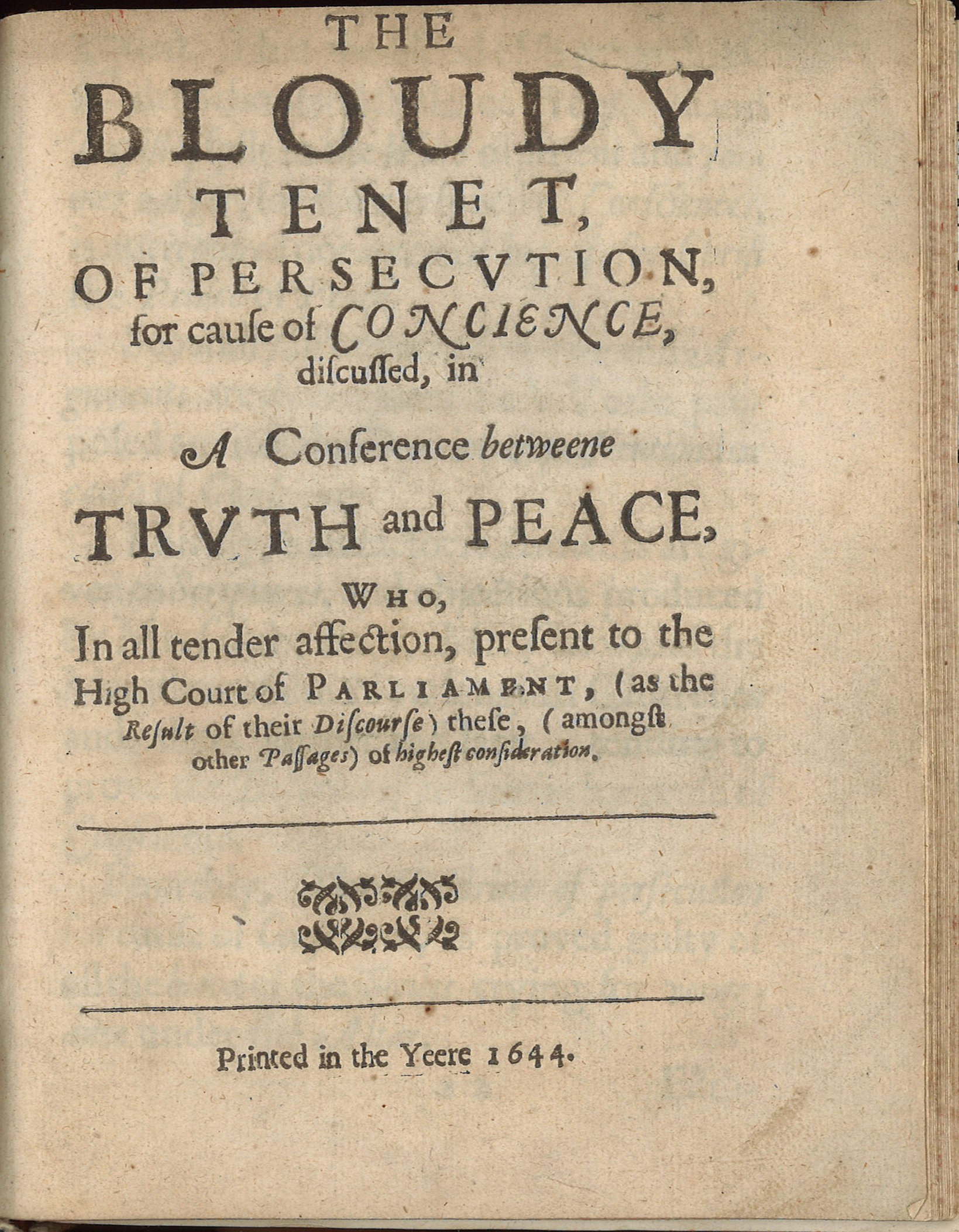
bloudy-tenetThe General and Particular Baptists adopted none of the theological or practical errors of the Anabaptists, but they were somewhat innovative in their approach to public theology. Due to persecutions experienced at the hands of church-run magistrates, they searched the Scriptures and came away with a doctrine that would come to be known as liberty of conscience. Thomas Helwys, a General Baptist, was perhaps the first to write on this subject. Roger Williams, an English migrant to America and a Separatist-turned-Particular Baptist, expounded on Helwys’ earlier work. In his 1644 work entitled The Bloudy Tennent of Persecution, Williams called out civil magistrates for their persecution of the consciences of saints. Nevertheless, he called the saints to expect persecution if they truly be in Christ.

“WHILE I plead the cause of truth and innocence against the bloody doctrine of persecution for cause of conscience, I judge it not unfit to give alarm to myself, and to all men, to prepare to be persecuted or hunted for cause of conscience. Whether you stand charged with ten or but two talents, if you hunt any for cause of conscience, how can you say you follow the Lamb of God, who so abhorred that practice?” (ed. Joseph Early, Jr., Readings in Baptist History, pg. 21).

The Baptist Confession (1644 / 1646)

Liberty of conscience was a universally accepted distinctive of the early English and American Baptists. In The Baptist Confession (1644), the English Particular Baptists made many concessions to the public theology of the continental Reformers as laid out in the Belgic Confession. However, they nuanced it quite a bit. The Dutch Reformers would doubtless wholeheartedly affirm Article XLVIII in The Baptist Confession of 1644. It reads almost verbatim like the Belgic Confession in its insistence that Christians are subject to magistrates:

That a civil Magistracy is an ordinance of God set up by God for the punishment of evil doers, and for the praise of them that do well; and that in all lawful things commanded by them, subjection ought to be given by us in the Lord: and that we are to make supplication and prayer for Kings, and all that are in authority, that under them we may live a peaceable and quiet life in all godliness and honesty.”

However, moving into the next article, there is a slight change of tone from the Belgic Confession to the Baptist Confession. Where The Belgic Confession offers no concession for liberty of conscience, The Baptist Confession highlights it.

“The supreme Magistracy of this Kingdom we believe to be the King and Parliament freely chosen by the Kingdom, and that in all those civil Laws which have been acted by them, or for the present is or shall be ordained, we are bound to yield subjection and obedience unto in the Lord, as conceiving ourselves bound to defend both the persons of those thus chosen, and all civil Laws made by them, with our persons, liberties, and estates, with all that is called ours, although we should suffer never so much from them in not actively submitting to some Ecclesiastical Laws, which might be conceived by them to be their duties to establish which we for the present could not see, nor our consciences could submit unto; yet are we bound to yield our persons to their pleasures” (Article XLIX).

It’s worth noting that, while Particular Baptists at this time saw no place for a civil magistrate to exercise ecclesiastical authority, they do not deny the right of the church described in The Belgic Confession to speak with prophetic authority to civil magistrates. In fact, in the next article, they themselves appeal directly to God for the hearts and the minds of the state to be bent toward them in mercy:

“And if God should provide such a mercy for us, as to incline the Magistrates’ hearts so far to tender our consciences, as that we might be protected by them from wrong, injury, oppression and molestation, which long we formerly have groaned under by the tyranny and oppression of the Prelatical Hierarchy, which God through mercy hath made this present King and Parliament wonderful honorable, as an instrument in his hand, to throw down; and we thereby have had some breathing time, we shall, we hope, look at it as a mercy beyond our expectation, and conceive ourselves further engaged forever to bless God for it” (Article L).

This was a clear appeal not only to God but also to the civil magistrates to show mercy and kindness to them for conscience sake. Yet the Particular Baptists went on to explain that, even if the magistrates did not show mercy but dealt treacherously with them, they were still to submit in all things lawful, yet without violating their consciences. The revision of this Confession in 1646 goes on to expound on this idea of liberty of conscience recognizing it as a duty the state owes to its citizenry. It even goes so far as to dictate to the magistrates what are their duties to men regarding liberty of conscience. As such, we see that the early Particular Baptists did view the use of the prophetic voice as a deterrent for governments that might otherwise violate their liberty of conscience. They did not concede to the notion that the church should not speak to matters of government, only that governments were not free to dictate terms to the church.

______________
In our next article, we will conclude our discussion of public theology in the Reformed confessions by examining developments in The Westminster Confession and The Baptist Confession (1677 / 1689).