education
5 Perks of Attending a School with Which You Disagree
Some people say you should only attend a school if you have a great deal of agreement with them. Certainly, if I were to further pursue post-graduate studies, I would seek a school of the Reformed tradition. There are many perks to doing so, not the least of which is being thoroughly grounded and reinforced in what you will be teaching at the local church level. However, my undergrad experience at a school with which I had major areas of disagreement was not all bad.
Know What You Believe
“For a man to come shuffling into a College, pretending that he holds his mind open to any form of truth, and that he is eminently receptive, but has not settled in his mind such things as whether God has an election of grace, or whether he loves his people to the end, seems to me to be a perfect monstrosity. ‘Not a novice,’ says the apostle; yet a man who has not made up his mind on such points as these, is confessedly and egregiously ‘a novice,’ and ought to be relegated to the catechism-class until he has learned the first truths of the gospel,” (C.H. Spurgeon, Lectures to My Students. Zondervan, Grand Rapids. 1954, pg. 39).
Before I started going to The College at Southwestern, I had already come to hold some pretty solid convictions in my theology. I grew up in church but, only in 2007, I came to be convinced of both Covenant Theology and Amillennialism. I also began hearing about a doctrine of salvation that was comparable to what I was already reading in Scripture, namely that regeneration necessarily precedes faith in the conversion of sinners.
Then, in early 2008, I was deployed to Kuwait where I met a group of young men who called themselves Calvinists. When they explained to me the Doctrines of Grace (the Five Points of Calvinism or T.U.L.I.P.), I immediately recognized these doctrines as lining up with what I was already seeing in Scripture. Finally, after returning home in 2009 and joining a Calvinistic Baptist church, I was introduced to Cornelius Van Til and his transcendental approach to defending the faith (apologetics).
As such, Calvinism had come to take shape in my understanding of the faith in a very holistic way. I understood Calvinism as more than just a soteriology, but rather as a holistic, thoroughly biblical worldview. These were matters on which I was settled. Thus, I determined that I would not budge on these issues as, in late 2009, I began acquiring a higher education at The College at Southwestern, which providentially teaches against all of these positions.
Grow in What You Believe
As I continued on in college, I took every instance of disagreement, between my professors and me and between my fellow students and me, as an opportunity to learn more about my own tradition. I began to research the earliest Calvinistic Baptists, a group of men in England who called themselves Particular Baptists. I was delighted to discover that they saw themselves as being in the same theological vein as the British Reformers and Puritans, a group from which I had already derived great spiritual benefit.
As I studied these men, I discovered that they had written a confession (The Second London Baptist Confession of Faith of 1677 / 1689), and I also discovered that their confession was part of a much larger confessional heritage in the Reformed tradition. I began to study this confession and the others within the Reformed tradition. In studying these confessions, I came to realize that Reformed theology was much larger even than what I already knew. It spanned far beyond a Calvinist soteriology, Covenant Theology, Transcendental apologetics, and Amillennialism. Reformed Baptist theology also extends into ecclesiology, worship, Christian liberty, and other matters.
I also discovered that the early Particular Baptists and Reformed Baptists had written several catechisms, including some of the earliest catechisms for children. In the Calvinistic Baptist tradition (I was not yet confessional), one often hears about catechisms such as The Westminster Shorter and Larger Catechisms and The Heidelberg Catechism. It was truly delightful to learn that Hubmaier, Luther, and Calvin all had developed catechisms in the early days of the Reformation and, following the British Reformers, Particular Baptists such as Hercules Collins, William Collins, and Benjamin Keach had also developed catechisms for the Baptist tradition.
So it was that, as I was challenged in my views at Southwestern, I was forced to research my own tradition. The more I became familiar with my own tradition and was forced to defend it, the more Reformed I became. So I entered this Dispensational, Traditionalist Baptist seminary as a Calvinistic Baptist, but I left as a thoroughly confessional Reformed Baptist.
Grow in Your Knowledge of What Others Believe
Lest anyone be mistaken, I must take a moment to explain that I did not merely shrink back into my own theological bubble. I am sure that, at times, it may have seemed that way to some of my classmates. I was unapologetic about my beliefs, and would openly question some of the assertions made about Reformed theology in class.
I recall staying after class one afternoon to talk with one of my professors. I apologized to him for pushing back as hard as I sometimes do. He told me not to apologize, but that he actually found my interactions in class to be a breath of fresh air. He lamented the fact that many Millennials are too reserved about their opinions preferring to float through their college years without ever participating much in classroom discussions. I did notice that the Gen Xrs in my classes did express their opinions a lot more freely while Millennials often tended to sit toward the back of the class and treat the classes as just a grade. This is not an indictment on all Millennials. For all the cons one might highlight about any given generation, there are many pros to make up for it.
On my part, I made the most use I could out of my professors. In fact, the more I disagreed with a professor, the more likely I was to stick around after class and talk with him. I learned a lot in this season of my life about Christians who think differently than me. For instance, I am less inclined to call someone who is not a Calvinist an Arminian. Rather than simply assigning someone a title on the basis of what they are not, I am now more inclined to find out from them what they prefer to be called on the basis of what they affirm.
Also, having sat through lecture after lecture where terms like “Replacement Theology” were used without apology and the Doctrines of Grace were grossly misrepresented, I learned the value of honest representation. If Reformed Baptists desire for others to represent us fairly, it is important that we do the same in representing others. This is not to say that we cannot represent those with whom we disagree in a negative light. However, if we do, we need to be prepared to back up our conclusions with facts.
Grow in Areas Where You Are Wrong
One area where I was surprised to find that I had changed by the time I left school was in the area of ecclesiology. Going in to Southwestern, I was a staunch proponent of elder-rule ecclesiology. However, as I read up on the issue and talked with my professors about it, I soon discovered that my ecclesiology was just as reactionary as the worst arguments from the other side. I would hear people complain about the abuses of elders in an elder rule system, and I would counter with experiences I had seeing people use and abuse the congregational system.
Once I honestly stopped and looked at all of the arguments from Scripture for elder-led congregationalism (or, as I’ve heard it put, elder-rule congregationalism), I found this take on congregational ecclesiology to be thoroughly biblical. I had formulated a doctrine of church government on the basis of personal preference and pragmatic arguments, and I was unwilling to hear arguments from Scripture. Were it not for my education, I might still hold to the other view. I certainly never would have desired to have changed on the view were I not convinced otherwise.
Develop Friendships with People with Whom You Disagree
Now, I was a bit of an outcast among my classmates in college. I gather that some of the more Calvinistic students did look up to me a bit. I was a cofounder of an apologetics club, I started a Bible study with several students off campus, and I still talk with some of my fellow students from time to time. However, for the most part, I did not primarily hang with my fellow students. I preferred to talk offline with my professors.
Sometimes I would stay after class for over an hour to talk with my professors. Though we disagreed on a great deal of theology, I found that we were able to get past that and focus on the areas where we found agreement. Sometimes, after more than an hour of conversation, I would look at my watch and realize that I had missed chapel. Sometimes, that would happen even on days when the chapel speaker was someone I was really looking forward to hearing. Overall, I left school with a great love and admiration for—though still a great deal of disagreement with—my professors.
Really, the only reason I gravitated to professors with whom I disagreed rather than fellow students with whom I disagreed was generational. Generationally speaking, I did not feel I had as much in common with my fellow students. This was quite a learning experience for me. There are probably no two back-to-back generations that are more different in temperament and life experiences than Gen Xrs and Millennials. Somehow, though, I was able to forge a handful of friendships with Millennials as well.
Conclusion
Well, these were the five things I found most beneficial about going to a school with which I harbored great disagreement. I would not say it is for everyone, especially if you are not settled in your theology. What are some of the perks that perhaps I missed? I would be interested to hear the positive aspects of your experience attending a school with which you had great disagreement.
A Reformed Baptist Perspective on Public Theology: The Pauline Epistles, Part VI – 1 Corinthians 1-10
You can read earlier posts in this series by clicking on the links below:
- An Introduction
- Augustine’s Two Cities
- Two Kingdoms in Luther
- The Reformed Confessions (Part I)
- The Reformed Confessions (Part II)
- The Reformed Confessions (Part III)
- Sphere Sovereignty in Kuyper
- Redemption and Creation in Kuyper
- John the Baptist
- The Prophet Amos
- The Incarnate Lord (Part I)
- The Incarnate Lord (Part II)
- The Incarnate Lord (Part III)
- Introduction to the Book of Acts
- The Ministry of Peter and John in Acts
- The Ministry of Paul in Acts, Part I
- The Ministry of Paul in Acts, Part II
- The Pauline Epistles, Part I – Romans 1-8
- The Pauline Epistles, Part II – Romans 9-11
- The Pauline Epistles, Part III – Romans 12, 14-16
- The Pauline Epistles, Part IV – Romans 13
- The Pauline Epistles, Part V – Galatians
___________________________________________________________________
When discussing Paul’s letters to the church at Corinth, we must recognize that Paul did not merely write to address one single issue, but several. Corinth had asked several very valid questions of Paul. There were also some concerns about which Paul wanted them to know there was no question, because the answer was so clear. There were also reports that were brought to Paul about matters on which the Corinthian church was settled, but they had settled on the wrong side. In the following article, we will address several of these concerns, because many of them are still concerns for us today. Given the theme of our series, we will primarily be dealing with those concerns that touch the issue of public theology and, sadly, we will not have time to address all of the issues as thoroughly as we might desire.
To the Saints
First, let us recognize the endearment that Paul assigns to this church. He calls them saints: “To the church of God which is at Corinth, to those who have been sanctified in Christ Jesus, saints by calling,” (1Cor. 1:2a; NASB). Yes, this church had some major failings. However, he recognizes that they are beloved of God and, even as an apostle, he does not have the right to rail against Christ’s bride. He will go on to rebuke her, but he desires that she see that his rebukes come from a heart of love, not self-righteousness.
Furthermore, he does not write to Corinthian unbelievers out of a desire to offer a defense of the faith and attempt to validate those unbelievers’ objections to the Corinthian church’s errors. When Paul sees that the actions of the church are enabling the world in their blasphemy of God, he addresses the church. Never does he side with the world in condemning the bride of Christ.
Acquiring Knowledge
Before addressing the Corinthians’ error of being “puffed up” in knowledge, notice his prayer on their behalf:
“I thank my God always concerning you for the grace of God which was given to yu by Christ Jesus, that you were enriched in everything by Him in all utterance and all knowledge,” (vv. 4-5; NKJV).
Paul does not desire that the Christians in Corinth be ignorant of the truths of the faith. Rather, he thanks God regularly for the fact that they have been enriched in their knowledge of Him. Oftentimes, Christians will read 1 Corinthians, and they think there is something virtuous about remaining blissfully ignorant about the truths of God.
What these Christians do not realize is that it is the not the acquiring of knowledge Paul argues is improper for Christians. The error is found in the fact that the Corinthians were misapplying their knowledge. They were acquiring knowledge for the sake of winning arguments, or perhaps for the sake of looking good in front of their friends (1Cor. 8:1), but they were not acquiring it for the sake of growing in their worship of God.
As we acquire greater and greater amounts of knowledge, we should do so for the sake of growing closer to the God of all truth. We will address the Christian’s relationship to knowledge in more detail when we get to our study of the book of Colossians, but Christians should want to grow in knowledge. The more we know about our faith, the more we know about the God we claim to love. The more we know about our faith, the more we know about the neighbors we claim to love.
Love and Marriage
In fact, love is perhaps the defining issue in the first six chapters of book of 1 Corinthians. Paul spends an entire chapter focused on the superiority of love over any other gift we receive from God (chapter 13). Paul contrasts true, godly love with the Corinthians’ selfish motives for acquiring knowledge and presuming themselves to be worldly wise (chapters 1-2). Paul contrasts true, godly love with the factionalism that was prevalent in the church at Corinth (3-4). Paul contrasts true, godly love with the license the Corinthian church gave to unrepentant so-called brothers in their midst (5). Paul contrasts true, godly love with the practice of taking fellow church members into secular law court (6).
For our discussion of public theology, it is important at this juncture to stop here and take note of two things. First, Paul tells us not to judge outsiders. In this context, he does not mean that we do not hold political leaders—especially political leaders claiming to be Christian—to a high standard. What he means is, in regard to church life, we are not to allow open, unrepentant sinners to go around claiming to be so-called brothers (1Cor. 5:9-13). Thus, when a man claims to be a Presbyterian and brags about sleeping with married women, or a woman claims to be a Methodist and openly supports women’s supposed right to murder their children, church leaders have no right to publicly affirm their Christian profession. In doing so, these church leaders make themselves accomplices in the sins of these candidates and the resulting blasphemy of an ever watching world.
Second, it is important for the church to police itself in matters of sin and offense. We do not take our in-house disputes before unbelieving magistrates. If a matter occurs in the local church, the local church is to handle it locally. If the local church, for whatever reason, is unable to judge the matter properly, that is why we have associations. Under special circumstances, a local church may call upon local church elders within its association to serve as officiators over local church tribunals. In these instances, though, Baptist polity requires that we recognize that these associating elders are serving as consultants to the church, not as an authority over the church.
In chapter seven, Paul addresses questions raised in the church of Corinth in regard to married people, single people, widows, and widowers. The gist of this chapter, as it relates to our study, is that Christian singles ought to marry other Christian singles, married people—saved or not—ought to remain married except in the case of abandonment, if you are single and able to remain single without burning (there is an interesting debate on this word, but we will not cover that here), stay single and devote your time to God in ways that married people are not able and, if a married person’s spouse dies, he / she is free to remarry. Seeing as marriage is a picture of Christ and the church to a lost and dying world, it truly is deserving of a full chapter. One of the most important things to which Christians must commit in order to properly engage the culture for Christ is a biblical affirmation and a biblical practice of marriage.
Christian Liberty
In chapters 8-10, Paul uses their question about meat sacrificed to idols to address a whole host of issues regarding Christian liberty. When discussing Christian liberty, the same questions always seem to arise: “What can we do?” “What can’t we do?” “Where are the boundaries?” Paul answers some similar questions in chapters 8-10: “Can we eat meat sacrificed to idols if we don’t recognize those idols as real?” “Can we eat it in a pagan temple?” “Can church leaders marry?” “Should church leaders be make their living from the church?” Paul affirms that Christians are free in all of these, except assembling with pagans to partake of their idolatrous meals. He says Christians are free, but that our freedom comes with the responsibility to love our weaker brothers.
Now, we must note here that Paul does not mean that we ought to refrain from the practice of our liberty in Christ so as not to offend mature brothers. There are seminary professors, pastors, and even seminary presidents who will tell us that we ought not to enjoy our liberty in Christ so that we might appease their ill-informed consciences. These men are supposed to be church leaders, and yet they would have us treat them like weaker brothers so that they might control our actions. Brothers, if the Lord has freed your conscience in a matter, walk in that freedom. Only, do not use your liberty in such a way as to offend or entice new converts to disobey their consciences.
In chapter 10, Paul warns against using our liberty for the sake of license and indulgence rather than a means to glorify God, and he uses Israel as an example. Christians do have liberty but, if we abuse that liberty, we can shipwreck our faith. Israel had liberty to eat, drink, and play. They had plenty of reason to do so, having been freed from their bondage in Egypt. However, they sat down to eat and drink and rose up to play without any thought to the glory of the God who had just delivered them out of Egypt. Their liberty had become license and, before long, they found themselves worshipping at the feet of a golden calf. Christians must likewise be careful in the use of our liberty, lest we run the same course as the generation that died in the desert.
Cultural Footprints in Public Discourse
Take a brief moment today to consider name-calling as a rhetorical device. Most of us would agree that it is disgusting when a person calls another person a name simply for the purpose of stigmatizing his or her ideas. This is a terrible approach to debate and dialogue. It may work to solidify opposition among the less astute, but it is nonetheless little more than mud-slinging. Not every use of names can be reduced to mud-slinging, though.
We would do well to recognize that many very historical names leave behind massive cultural footprints. Granted, sometimes people can be falsely charged as Marxists, Pelagians, Hitlers, and the like. However, to evoke one of these names—and myriad others—in a spirited debate, is not necessarily reducible to mud-slinging. In fact, oftentimes, when we reduce the use of these historical names in the cultural dialogue to mere mud-slinging, we run headlong into the error of denying cultural footprints and we demonstrate that we are ignorant of history.
For instance, a person who has studied church history should be very aware of the Pelagian debate where Augustine asserted that men must be enabled by God to do what He requires us to do. Pelagias responded that God would not require anything of us that we are incapable of accomplishing. When some professors and seminary presidents respond to Calvinists with the same line of argumentation and, subsequently, they are told they are making Pelagian arguments, they will often accuse their brothers of mud-slinging. By accusing Calvinists of mud-slinging, simply because they did not (directly) receive their argumentation from Pelagius himself, they deny Pelagius’ cultural footprint and / or demonstrate that they are ignorant of a major debate in church history.
Likewise, a person who has studied political history should be very aware of the Marxist debate where Marx and Engels asserted that a narrative must be forwarded that pits oppressors against oppressed so that a one-world communist utopia could arise. Marx and Engels primarily focused on economics, but they were also for the toppling of other institutions as well, like the family and the church. For them, any destabilization would lead ultimately to revolution, and revolution could only make possible the rise of their desired utopia.
So, when Christian leaders start to smuggle this language of oppressor and oppressed into the church, the idea of a power struggle between classes even within God’s church, some have rightly called them on the use of a Marxist tactic. Yet, predictably, they claim that this recognition of Marxism is nothing more than mud-slinging. By accusing their detractors of mud-slinging, simply because they do not (directly) receive their argumentation from Marx and Engels, they deny Marx’s and Engel’s cultural footprints and / or demonstrate that they are ignorant of a major debate in political history.
Conclusion
The next time someone uses a name you consider to be very negative to describe your position, try not to respond with a knee-jerk reaction and accuse them of mud-slinging. Rather, ask them why they make that connection. You may have imbibed a cultural footprint of which you are unaware. You may have a blind spot in your understanding of history. The other person may have a very valid reason for the connection he or she is making and, if he or she doesn’t, you can offer a more gentle correction than merely accusing him or her of mudslinging.
Repost: Why Catechize?
I originally posted this article back in February of 2013. In discussing catechesis with my wife tonight, I went in search for it. After reading it, I decided it was worth a repost. I hope you find it helpful.
___________________
It has been such a blessing for our family to catechize our daughter. My wife and I use The Baptist Catechism, but my four-year-old and the children’s ministry at our church use the more basic Catechism for Boys and Girls. Every night we get together as a family to pray, sing hymns, and read God’s word. Of course, we haven’t always been able to do this perfectly, but it has become a fairly regular expectation for my family. When we gather together at night to have family worship, we also spend some time catechizing our daughter and one another. We even let our daughter ask us questions from The Baptist Catechism. She loves it. So, today, I was thinking about the benefits of catechesis and thought I’d simply blog about it.
Some Benefits of Catechesis:
- It helps us to make sense of the things we are reading regularly in Scripture. We should not simply be concerned that our families understand what the texts say in their immediate contexts, but what the Bible as a whole has to say on various topics. If we simply focused in on the immediate contexts of certain texts, we would never arrive at a full-fledged understanding of even the essentials of Christianity such as the Trinity, Justification by Faith Alone, and the Hypostatic Union.
- It helps us to set a context for making sense of the gospel. When children have a big picture understanding of the teachings of Scripture, they can better understand not only the truths of the gospel, but also the importance of those truths to their everyday lives. The Bible’s claims make the most sense from within a biblical worldview. It is this worldview that catechetical parents hope to instill in their kids.
- It provides us with healthy opportunities for daily, intentional interaction with our kids. Our kids crave and long for our attention. When we catechize them, we are providing them with an opportunity (scripted, but an opportunity nonetheless) to interact with their parents in a way that few other things do. They have a sense of accomplishment and, more importantly, they bond with their parents.
- It provides us with the opportunity to pass on our worldview and subsequent values to our children. The influences in our society are plenty which compete for our children’s affections. Catechisms are an invaluable tool for ensuring that our children are immersed in a biblical worldview on a daily basis.
This is by no means meant to be an exhaustive list. I’m sure there are many benefits I have yet to consider, but I think these are sufficient for whetting our appetites for catechizing our children. I pray this has been an encouragement for you in your endeavors to raise your children in the fear and the admonition of the Lord.
The State of Higher Education

Recently, I’ve finished a blog series in which I examined the state of college education from a Reformed Christian perspective. The goal of this mini-series was to address how the decline in morality and ethics, along with the abandonment of a Christian worldview of education, has affected the quality of our college education system. This was accomplished by answering two basic questions: (1) How have the noetic effects of sin directly and indirectly impacted the current state and trajectory of American education? (2) What should be the Christian’s response to the current state and trajectory of American education?
As Christians, we know that the discipleship of the mind and the heart are inseparable. In other words, it is impossible to separate morality and education because they both are part of the discipleship process and thus they mutually influence each other. My basic thesis is that the darkening of the American culture (due to its rejection of God’s moral law and a Biblical worldview) has invariably led to the darkening of the American college education system. This post breaks up that series into seven basic parts:
Part I: The Effects of Sin on Higher Education
Part II: Higher Education and the Discipleship of the Mind
Part III: The Autonomous Self and Higher Education
Part IV: Morality and Education
Part V: Naturalism and Education
Part VI: Liberalism and Education
Part VII: The Cost of Higher Education
The Cost of Higher Education
In this blog series, I have been examining the effects of sin on the quality of American college education. In particular, we have addressed the growing lack of mental discipline from students, the promotion of the autonomous self, the promotion of a morally neutral education, the lack of balance in undergraduate natural science education, and the lack of genuine rigor in the liberal arts within the American college education system. The last issue that I want to address is the most obvious issue in college education and, in many ways, is the culmination of many of the topics discussed previously: the unnecessarily high cost of education.
The Higher Education Bubble
A college degree once looked to be the path to prosperity. Like the housing bubble of the 2000s, the higher education bubble is about security and insurance against the future. Both whisper the same seductive promise into the ears of Americans: Do this and you will be safe. It is thought that a student will gain knowledge and seasoning in college that will make him or her more productive and a candidate for a high-paying career. The investment of time and money in knowledge pays through higher productivity and is translated into higher income. Thus, higher education is meant to be the higher-order means to a successful career.
 The reality is that our core national belief on the value of college education has many of the same irrational thought processes as home ownership. In any economic sector, a true bubble is created when something is highly overvalued and intensely believed. In the 2000s, the prevailing belief among Americans was that housing prices would always go up and no matter what happens in the world, houses were the best investments you could make. The housing bubble has shattered that myth. However, there is still a rather persistent belief among Americans: no matter what happens in the world, education is the best investment you can make. In other words, you will always make more money if you are college educated. Sounds familiar?
Similar to the housing bubble, we can say that there is significant malinvestment in higher education, which has led to the overinflated cost of college education today. According to Bloomberg News, college tuition and fees have increase 1,120% since records began in 1978 and state school tuition is rising even faster – 50% faster at state schools versus private in roughly the last decade. Similar to the housing bubble, this higher education bubble is fueled by easy debt, totaling $1.2 trillion outstanding. In other words, student loan debt is easy to get, but hard to get rid of. The low interest rates for loans (based in part to perceived demand for college degrees) have continued to create a favorable environment for colleges to expand, increasing the debt of major universities. Since the cost of these expansion projects are partially passed on to the students, the higher education bubble continues to inflate.
As mentioned previously, students are willing to tolerate this increase in cost for two basic reasons: (1) high paying jobs will require a college degree and (2) high paying jobs will be plentiful when the student graduates. Both of these assumptions are being challenged today based on the high unemployment rates of recent graduates. The painful reality is that there are many college graduates today that are baby-sitters, sales clerks, telemarketers, and bartenders. In other words, college education for many is a significant malinvestment. The higher education bubble also has had an unintended social cost. Because of the economic constraint placed upon them, these debtors are postponing marriage and childbearing and, in many cases, severely limiting the number of children that they will have.
An even more critical question is whether students will graduate in the first place since only about 40% of full-time students earn a degree within four years. To quote economist Doug French, unfinished college education is as useful as an unfinished house.
Vocation and Higher Education
From what we have discussed above, the essential cause of the higher education bubble is the public’s perceived belief in and value of traditional college education. As discussed in previous blogs, a culture’s perception of value stems directly from their worldview. We have been told in numerous places that college education should be a right that should be guaranteed to every America. This raises an obvious question: should all Americans even go to college? Or more directly, should all current college students be in college?
The reality is that the expansion of college education has opened the door to students who are unqualified based on their lack of interest or lack of an appropriate skill set for college. In doing student advising as a professor, one of the common statements that I hear from students is: “I don’t want to do that type of work.” This statement is usually said with a sense that certain types of work (usually blue-collar jobs) are beneath them. Today, there are few students entering college who desire to be elevator repairers, electrical power line installers, transportation inspectors, boilermakers, and electricians. In other words, we have a large amount of students who are not necessarily interested or gifted enough to do intellectually demanding work, but who refuse to do “menial work”.
It is at this point that a good understanding regarding the Protestant doctrine of vocation is quite helpful. Much discussion in our culture has been given to the dignity of living the life of the mind and pursuing white collar jobs as the careers of the future. In the same breadth, there has been mere lip service given to blue-collar work. This has given the impression that a person only works blue-collar jobs because they are not fortunate enough to obtain better employment. As Christians, we recognize that there is inherent dignity in ALL forms of lawful work that’s beneficial to society. In other words, there is inherent dignity with jobs that require significant manual labor. These blue-collar jobs are legitimate and honorable callings for those who are qualified and trained. This implies that there should be qualitative differences between the various types of higher education that we offer. In other words, there should be distinct differences in mission and in purpose between colleges/universities, technical schools, community colleges, and trade schools.
In developing the multiversity structure for higher education, many current universities are guilty of “mission creep” by attempting to do the job that community colleges, trade schools, and even formal apprenticeships use to do. In my view, this has caused a large disjunction between the real purpose of colleges/universities and the sort of students that they attract. This “mission creep”, coupled with the administrative apparatus needed to handle university expansion, also helps to explain the rising cost of higher education. Moreover, there is a large disjunction between the skills developed in university education and the skills demanded by employers. The truth is that everyone does not need to go to college to be well-educated or to find a good job. The availability of knowledge from the internet (such as MIT OpenCourseWare) suits many students quite well so that they can determine what they are called to do. Furthermore, more American companies are moving towards the apprenticeship model in order to attract qualified potential employees.
The Morality of Debt
There is also a significant moral element to this discussion: is it ethical for 18-19 year old adults to incur $100K of debt? The Scriptures teach us that it’s usually dangerous and unwise for a person to incur large debt (cf. Proverbs 6:1-5; 17:18; 20:16; Romans 13:8) because debt essentially makes us a slave to the one who provides the loan. Moreover, the contractual nature of loans makes them similar to taking oaths. Just as we are commanded not to take oath rashly, we should not enter into financial debt rashly as well.
The unfortunate reality is that many students simply take out loans indiscriminately without counting the necessary costs, which is antithetical to a Christian worldview. This attitude towards debt helps to produce the economic miscalculation that fuels higher education costs. Moreover, a culture in which debt is taken lightly is also a culture in which defaults are inevitable and plentiful. Some college graduates even take the position that defaulting on debt is morally good.
From a Christian worldview, defaulting on student loans is akin to stealing. The 8th commandment requires us to act truthfully, faithfully, and justly in our contractual and business relationships with our fellow man so that we give to all what they deserve (cf. Romans 13:7). As testified by older college graduates, there use to be a time in which a student could pay their tuition in cash by working a summer job or by working while in school. This meant that any loan that was taken out for education was paid for as soon as possible. Thus, Christians today should carefully consider whether having the “college experience” and the illusory prospect of high-paying future employment is worth potentially violating the 8th commandment in the future. This is not only a message to individual students and their parents, but it’s a message to our general culture: if we have an educational system that encourages stealing, then it’s a system that needs to be called into question.
Liberalism and Modern Education
In the previous blog, I gave a critique on the biggest problem facing the standard STEM (science, technology, engineering, and mathematics) education across the country – namely the lack of philosophical self-reflection and training. Because of this, many undergraduate STEM majors graduate with good scientific training, but they overwhelming adopt a worldview of naturalistic materialism as a methodological assumption without thinking through its implications and foundational assumptions. This leads to the unbalanced education of many scientists observed by many commentators. Now in making this critique, it is assumed that the liberal arts wing of the university system is doing its job to add the proper balance to the STEM fields. This is the ideal, but unfortunately, it is not the reality. In this blog, I want to focus my critique on the humanities and liberal arts. In my view, the fifth major issue associated with contemporary education is the devolution of liberal arts studies.
Now, some who are reading this blog may claim that I am presenting a biased view of modern liberal arts education because I am a faculty member in the STEM fields. This complaint is not only observed among STEM faculty, but it is observed across the academy. Consider the commentary from University of Notre Dame Professor Patrick J. Deneen concerning the decline of the liberal arts:
The scandalous state of the modern university can be attributed to various corruptions that have taken root in the disciplines of the humanities. The university was once the locus of humanistic education in the great books; today, one is more likely to find there indoctrination in multiculturalism, disability studies, queer studies, postcolonial studies, a host of other victimization studies, and the usual insistence on the centrality of the categories of race, gender, and class. The humanities today seem to be waning in presence and power in the modern university in large part because of their solipsistic irrelevance, which has predictably increased students’ uninterest in them.
Now there are numerous reasons for Deneen’s conclusion, but I want to focus on two: (1) science and global competition have hallowed out the liberal arts and (2) liberalism has led to self-destructive tendencies within the liberal arts.
The Old Science and the University
 When most people today think of science, they usually think of the natural and physical sciences. According to the Oxford English Dictionary, this is a relatively new definition of science, which occurred sometime during the 18th century at the time of the growth of rationalism and the Enlightenment. The “old science” finds its classic definition as “knowledge acquired by study, acquaintance with or mastery of any department of learning.” The old science was pre-modern in origins, mostly religious and cultural, deriving its authority from the faith traditions and cultural practices that one generation sought to pass on to the next. The vestiges of this older tradition still exists on campuses today, such as the Gothic buildings; the titles “professor”, “dean”, and “provost”; and the robes worn at graduation.
For centuries, the humanistic disciplines were at the heart of the university. The “old science” recognized that a unique feature of man was his capacity for liberty – in other words, man was unique for his ability to choose and to consciously order and direct his life. Anchored by a Biblical worldview, it was acknowledged that this liberty was subject to misuse and excess. Thus, to understand ourselves was to understand how to use our liberty well in light of the sinfulness of man. Thus, the liberal arts sought to encourage that hard task of negotiating what was permitted and what was forbidden, what constituted the highest and best use of our freedom, and what actions were immoral and wrong. Hence, to be free (or liberal) was itself an art, something that was learned not by nature or instinct, but by refinement and education.
At the center of the liberal arts were the humanities, the education of how to be a human being. Thus, each new generation was encouraged to consult the great works of our tradition (the vast epics; the classic tragedies and comedies; the reflections of philosophers and theologians; the Word of God; etc.) to teach us what it was to be human. This means that one of the core skills learned in the liberal arts is how to properly analyze worldviews. While the modern sciences were an integral part of the original liberal arts education, they were considered the main avenue towards understanding the natural and created order of which mankind was the crown. This was the original vision of the university and as it can be seen, the humanities were guided by a comprehensive religious vision.
The New Science and the Multiversity
The current dilemma concerning the humanities began in the early modern period (1500-1800s) with the basic argument that a new science was needed to replace the “old science” of the liberal arts. The “new science” is synonymous with the natural and physical science and thus is restricted to those branches of study that relate to the phenomena of the material universe and their laws. Historically, this new science no longer sought to merely understand the world, but to transform it. This impulse gave rise to a scientific, industrial, and technological revolution. The success of the modern scientific revolution in bringing unprecedented prosperity provided the motivation to reject the “old science” with its claims of tradition and culture. This debate also changed the way in which we viewed the philosophy of higher education. Consider the words of Deenen
In the nineteenth century, U.S. institutions of higher learning began to emulate the German universities, dividing themselves into specialized disciplines and placing stress on expertise and the discovery of new knowledge. The religious underpinnings of the university dissolved; the comprehensive vision that religion had afforded the humanities was no longer a guide. What had been the organizing principle for the efforts of the university—the tradition from which the faculty received their calling—was systematically disassembled. In the middle part of the twentieth century, renewed emphasis upon scientific training and technological innovation—spurred especially by massive government investment in the “useful arts and sciences”—further reoriented many of the priorities of the university system.
Thus, the original vision of the university was considered archaic and the multiversity vision was adopted, which was presented in the 1960s as “central to the further industrialization of the nation, to spectacular increases in productivity with affluence following, to the substantial extension of human life, and to worldwide military and scientific supremacy”. This creates new incentives and motivations for the faculty, not to study classic works, but to create new knowledge. Hence, innovation and progress are the virtues of the multiversity and the past was understood to offer little guidance in a world oriented toward future progress. The prominence of the library (the central place of the university in the transmission of culture and tradition) was replaced by the laboratory (the central place of knowledge creation in the multiversity). The core curricula at universities – formed originally out of an understanding of what older generations had come to believe necessary for the formation of fully human beings – were displaced increasingly by either “distribution requirements” or no requirements whatsoever, in the belief that students should be free to establish their course of study according to their own wisdom.
Liberalism and the Liberal Arts
In response to these changes, the humanities began to question their place within the university. Did it make sense any longer to teach young people the challenging lessons of how to use freedom well, when increasingly the scientific world seemed to make those lessons unnecessary? Could an approach based on culture and tradition remain relevant in an age that valued, above all, innovation and progress? How could the humanities prove their worth, in the eyes of administrators and the broader world?
In my view, this is the background behind the transformation of many liberal arts programs. Modern liberal arts are very much characterized by liberation from tradition. Liberal arts faculty could demonstrate their usefulness and progressiveness by showing the backwardness of the classical texts; they could “create knowledge” by showing their own superiority to the authors they studied; and they could display their irrational anti-traditionalism by attacking the very books that formed their discipline. Thus, instead of teaching students how to weigh conflicting views of the world for themselves, too many liberal arts courses (and departments) have simply indoctrinated students into adopting this anti-traditionalism, which is another form of chronological snobbery.
In the 1960s, there was still a desire to read the classic texts (usually for the purposes of critique); today, the classical texts of the humanities have largely been discarded. For example, a recent study have shown that the average English major is not required to take courses on the classic works from Shakespeare and Chaucer. Instead, we now have classes in English departments such as Literature, Food, and the American Racial Diet, Punk Culture: The Aesthetics and Politics of Refusal, The Politics of Hip Hop, Gender, Sexuality, and Literature: Our Cyborgs, Our Selves (for more information on the typical liberal arts curriculum, see this work from Peter Wood and Michael Toscano). After rejecting the objective anchors in the academic canon of classical texts, these fields succumbed to passionate group thinking and self-absorption. The liberal arts have devolved into a free-for-all, as witnessed by the plethora of departments categorized by identity politics.
Our Response
From a Christian perspective, underlying the devolution in the liberal arts was an acceptance of the modern understanding of liberty. For the “old science”, liberty had long been understood to be the achievement of hard discipline – a victory over appetite and desire. In the 20th century, the humanities adopted the modern, scientific understanding, which holds that liberty is constituted by the removal of obstacles, by the overcoming of limits, and by the transformation of the world – whether the world of nature or the nature of humanity itself. Education thus came to be a process of liberation, not the cultivation of self-restraint. Moreover, the postmodernism that is typically associated with the humanities has led many to believe that all of our natural conditions are socially constructed. Thus, if man had any kind of “nature,” then the sole permanent feature was the centrality of the autonomous will and thus the raw assertion of power over any restraint is definitional of mankind (a topic discussed in a previous blog).
The humanities of old (fostered with a Christian worldview) can muster a powerful argument against this tendency. The warning in essence is simple: at the end of the path of liberation lies enslavement. Liberation from all obstacles and self-restraint is illusory because human appetite is insatiable and the world is limited. Without mastery over our desires, we will be eternally driven by them, never satisfied by their attainment. What we are seeing is the excesses of modernity – the flattening of the soul and the theft of transcendent meaning and value. Thus, the only way to reclaim the proper usefulness of the liberal arts is to reclaim the religious underpinnings of liberal education and the comprehensive vision that religion has afforded the humanities. Liberal arts can find its proper place in the academy if it returns to its original intention of studying the true nature of man and serving as a corrective to the philosophical hubris of the philosophy of modern science. A restored liberal education would be an education in the limits that culture and nature impose upon us – an education in living in ways that do not tempt us to live for ourselves. Thus, we would learn a proper understanding of liberty: not as liberation from constraint, but rather, as a capacity to govern ourselves well, living in our Father’s world.
Naturalism and Education
In this blog series, I have been examining the effect of sin on the quality of higher education. In particular, I have been examining how worldview changes (and their subsequent effects of society) have led to a change in the quality of higher education as well as the mission of higher education. Most of these changes can be described by examining how the presence of sin in our hearts negatively affects and undermines the human mind and intellect (otherwise known as noetic effects of sin). In previous blogs, I addressed general problems with higher education, but in this blog I want to focus my critique on STEM (science, technology, engineering, and mathematics) education. In my view, the fourth major issue associated with contemporary education is the growing neglect of philosophical self-reflection and training in the STEM fields. One important aspect of contemporary education which needs to be recovered is the belief that all college students, including STEM majors, need to receive a thorough philosophical training so that they can understand the proper usefulness and limitations of their academic discipline.
Our Current View of the Philosophy and the Humanities
Historically, one of the pillars of higher education was the study of philosophy and the application of philosophy to the other sciences. However, as rising tuition and mounting student debt makes prospective income a bigger part of choosing a major, disciplines such as philosophy and history are under attack in favor of fields as engineering and business, which are more likely to lead to jobs and salaries that justify the cost of four-year college education. Now, the debate concerning the cost of education will be the subject of another blog, but the usefulness of the humanities is no longer just an academic conversation as only 8 percent of students now major in the humanities, according to the American Academy of Arts and Sciences, down from a peak of more than 17 percent in 1967. Humanities professors contend that what would be lost in eliminating humanities majors is exactly what employers say they really need: the kind of education that teach students how to think, innovate, work in teams, and solve problems. In other words, humanities professors are concerned that we have become shortsighted because we are more concerned with the cost of education rather than the value of education. So far, the humanities are losing the argument.
Now, the debate concerning the cost of education will be the subject of another blog, but it is quite clear that many people have quite a low view of the value of the humanities and the other classical fields of education. In addressing the argument concerning the value of the humanities majors, consider the comment from a non-humanities major
And how exactly are they going to solve problems when they don’t have any skills with which to do so? After all, they have just spent four years reading books by old dead white men and then arguing about it. They have also listened to four years of professors telling them that “the life of the mind” is something that can’t be taken away from you by the soulless vocational professions. Maybe they should just eat their books when they are done with them… maybe then they would have realized that reading old poetry doesn’t really prepare you to be a contributing member of society.
Generally speaking, when STEM majors hear that there are certain critical thinking skills that are not learned within the STEM fields, the response is usually very defensive. Consider the comments in the above article from physical scientists and engineers:
I’m sorry, but this REALLY irritates me. I’ve got nothing against the humanities, but I really get annoyed by this idea that the ONLY place you can learn critical thinking, communicating, and problem solving is through them. Yes, a good liberal arts background will help teach you these skills. But so will a good engineering or science background (and surely other degrees as well which I know less of). I’ve been working on a multinational science satellite mission for the past decade. You’re really telling me that because I got an engineering degree, I don’t know how to work with a team, pose complex and creative problems, and think critically about how to solve them?
A Major Flaw in Science Education
From my personal experience, the opinions expressed in the comments section from the above TIME magazine article are generally consistent with how STEM majors view the humanities. Most STEM majors believe that there are many valuable insights that a STEM education can offer to society (and to other fields), but there is relatively little insight offered in the humanities that cannot be gleaned in a standard STEM education. In my view, this has contributed to a very unbalanced science education in America. Today, the prevailing view seems to be that if a STEM major takes their general education courses in psychology, sociology, history, English, and philosophy, then they have learned everything that they really need to know about those fields. It is quite true that STEM majors learn critical thinking abilities, but it is also quite true that STEM majors are usually quite non-reflective on the philosophical basis for the STEM fields. The intellectual ignorance and faulty perspectives on this matter are usually self-inflicted, but it is also true that this ignorance is promoted by the general culture around us. We live in a society in which it appears that moral reality is created by the observer, while things that are “scientifically proven” are considered formally true. To some, this gives the impression that what scientists do deals with reality, whereas what philosophers and others do is speculation.
 In my view, the biggest flaw in STEM education today is the lack of philosophical reflection. Working scientists (and science students by implication) usually take for granted a set of basic assumptions that are needed to justify the scientific method: (1) there is an objective reality shared by all rational observers; (2) This objective reality is governed by natural laws; and (3) These natural laws can be discovered by means of systematic observation and experimentation. These are all assumptions that need to justified philosophically and the philosophy of science seeks a deep understanding of what these underlying assumptions mean and whether they are valid.
A cursory examination of the 20th century discussion on the philosophy of science should bring a sense of self-reflection to modern scientists concerning the formal validity of the scientific method. Moreover, a cursory examination of the critiques of the scientific method (i.e. the problem of induction) should produce a sense of humility to modern STEM majors concerning the limitations of the scientific method. Most STEM students are not introduced to the limitations of science until graduate school. Moreover, most STEM majors have been taught that nothing is to be accepted unless it has been “scientifically proved”, and nothing has any claim to be called true unless science acknowledges that claim. Obtaining a deeper background in philosophy will give STEM majors hesitancy before they make vacuous statements such as “it has been scientifically proved”. When STEM majors accept these statements without thinking through the critiques and limitations, it’s only a matter of time before a worldview of naturalistic materialism is accepted as a methodological assumption.
Our Response
Unfortunately, this is the state of science education around the country and the general outlook from STEM students and professionals. It is at this point in which a Christian view of education and knowledge is superior. The Christian worldview informs us that supernatural revelation is the only objective source of truth and this supernatural revelation is given to us through the Bible. Thus, this worldview compels us to address the philosophical grounding and implications of other knowledge claims, including the claims of modern science. This means that a rigorous philosophical education is necessary for each student to have so that he/she can properly assess the difference between that which is formally true and that which is useful. For the case of STEM majors, philosophical training and self-reflection will helps us to know the difference between falsification and verification or the relationship between metaphysics and science, both of which have implications for the working scientist. Thus, for the quality of American education to improve (particularly in the STEM fields), we (i.e. those of us in the academy) need to insist that it is insufficient for any student to leave college without undergoing deep philosophical reflection on the nature and usefulness of their academic discipline.
M’Cheyne Bible Reading Plan: May 10
Numbers 19 (NASB, ESV, KJV, HCSB)
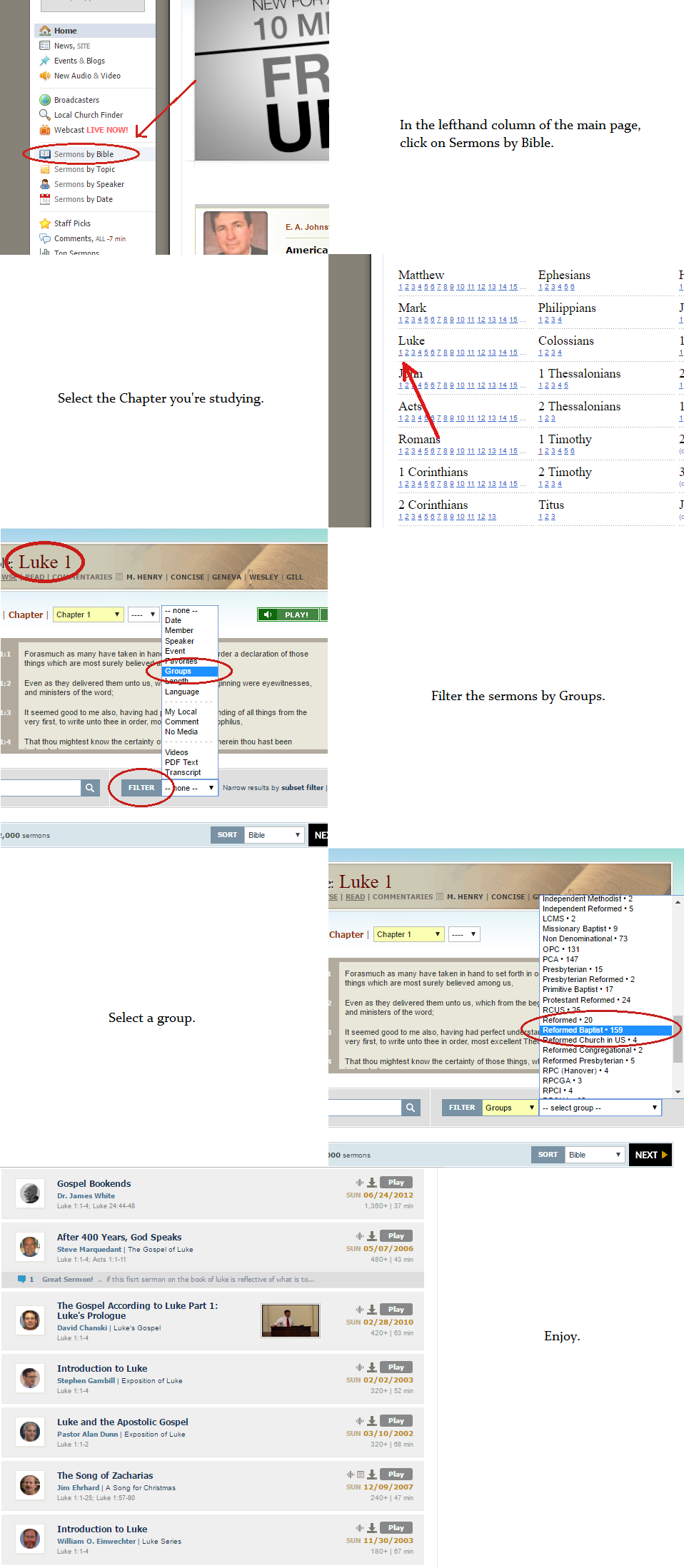
- Sermons (Reformed Baptist, ARBCA)
- Commentaries (Henry, Gill)
 Psalms 56&57 (NASB, ESV, KJV, HCSB)
- Sermons for Psalm 56 (Reformed Baptist, ARBCA)
- Commentaries for Psalm 56 (Henry, Gill)
- Sermons for Psalm 57 (Reformed Baptist, ARBCA)
- Commentaries for Psalm 57 (Henry, Gill)
Isaiah 8 (NASB, ESV, KJV, HCSB)
- Sermons (Reformed Baptist, ARBCA)
- Commentaries (Henry, Gill)
James 2 (NASB, ESV, KJV, HCSB)
- Sermons (Reformed Baptist, ARBCA)
- Commentaries (Henry, Gill)
 CredoCovenant