A Reformed Baptist Perspective on Public Theology – The Incarnate Lord (Part I)

I realize it’s been a while since our last post on Public Theology. That’s because it was agreed ahead of time that I’d do this next series and, with two full-time jobs and a young family, anything from me will be slow coming. Enough about me, though. You can read the last post in this series here, or just pick up in your reading below. Enjoy.

Introduction

In the last two posts in our series on public theology, we examined the approaches to public theology employed by two notable prophets: John the Baptist and Amos. There are many approaches to the relationship between the Old Testament and the New Testament. Some argue for more radical discontinuity between the two epochs than others. Regardless of what approach we take to entering this discussion, Reformed Baptists must not deny the the existence of discontinuity between them.

For instance, Reformed Baptists overwhelmingly affirm the cessation of the theocratic relationship between God and the ethnic, geographically-identified nation of Israel (see The Baptist Confession, 19.4). With the cessation of this relationship, Gentiles were grafted into the covenant community of God and men ceased worshipping God “on this mountain or that mountain,” worshipping Him instead in truth and in spirit (John 4:19-24). This was certainly a massive shift. God’s people went from a covenant nation comprised of both believers and unbelievers primarily of one particular ethnicity and nationality to covenant communities (churches) comprised only of believers (a credocovenant relationship) from all ethnic groups and nations. The question is whether this shift simultaneously represented a shift in approach to public theology. Certainly, it must have.

In the remainder of our posts, we will attempt to determine the nature and extent of the shift in public theology that occurred between the Old Testament and the New Testament. In the next two posts, we will look to our incarnate Lord and His approach to public theology while on this earth. Particularly, we will examine His approach to public theology during the period known as His incarnation.

First, we must recognize the fact that Christ, in the New Testament, is distinguished from His forerunners. He was different from the prophets who preceded Him.

God, after He spoke long ago to the fathers in the prophets in many portions and in many ways, in these last days has spoken to us in His Son, whom He appointed heir of all things, through whom also He made the world (Hebrews 1:1-2; NASB).

Though Christ was different from the prophets that preceded Him, we also recognize that Christ came as the antitypical Prophet, Priest, and King. By this, we mean that the prophets, priests, and kings of Israel were types of the Christ to come. They foreshadowed Him in the roles they filled within the nation of Israel. As such, the roles to which they were called, and the laws governing those roles, point to the role Christ was to play. Hence, the author of Hebrews writes, “God. . . in these last days has spoken to us in His Son.”

This assertion is of paramount importance. The God of Israel, the immutable God of the Holy Scriptures, the God who spoke through the prophets of old, is the same God who spoke to us through His Son Jesus Christ. We must assume, then, that there must be some great continuity between the prophets and the Prophet. In the next two posts, we will examine both: the continuity and the discontinuity.

Why I Lovingly Push Reformed Theology

Periodically, an article is published to which I am compelled to respond. This doesn’t necessarily mean that I have to respond with nastiness or even direct disagreement. A response is not a reaction. The following article is an attempt at a friendly response to an article published today over at RAANetwork. The goal here is not to discredit the article or punch holes in its reasoning. My goal isn’t even to correct anything I believe to be improperly stated. Rather, my goal here will be to offer an alternative viewpoint, or perhaps to approach the subject from a bit of a different angle.

Defining Our Terms

Many well-intentioned articles have been written to persuade Reformed Christians to go easy—fly under the radar—in the discussion over Calvinism and non- (or anti-) Calvinism. Let us take a moment before diving into this discussion ourselves to discuss some important definitions. It’s important that we all understand from the outset that, when we say someone is Reformed or Calvinistic, we don’t all mean the same thing. Some equate Reformed Theology with Calvinism. Others recognize that Calvinism has come to be defined in Evangelicalism as a much different thing from Reformed Theology. For the purposes of this article, I will be using the two terms to describe two different, but related, concepts.

First, when I say Calvinism, I will mean the minimalistic adherence to the five points of Calvinism as outlined in the Canons of Dort. Second, when I say Reformed, I will mean a much more comprehensive approach to the Christian life that certainly affirms the five points of Calvinism, but also holds to historic Reformed expressions and formulations of both belief and practice as outlined in the historic Reformed confessions of faith. By this definition, many among the Dutch Reformed, Presbyterians, Anglicans, and even Baptists fit comfortably under the heading Reformed.

(Note: I believe the article mentioned above does a decent job of using the historical definitions of these terms.)

It Is Biblical

One area where you might say I agree that we should not be in the business of pushing Reformed Theology is in regard to pushing “mere Calvinism.” If all that a man ever seems to talk about is the five points of Calvinism to the expense of the other godly wisdom we’ve inherited from the early Reformers, Puritans, and Particular Baptists, that man will inevitably exhibit a certain imbalance in his life and doctrine. Reformed Theology is holistic, touching every part of the Christian life.

Q.6: What things are chiefly contained in the Holy Scriptures?

A. The Holy Scriptures chiefly contain what man ought to believe concerning God, and what duty God requireth of man (Collins, The Baptist Catechism of 1693).

Reformed Theology is holistic because it is biblical, and the Bible is holistic. This is where Calvinistic Christians have often gone wrong in recent decades. We have often focused on the academic aspect of the Christian belief system without demonstrating the connectedness of Christian thought with Christian practice. We have failed to maintain an element of the Christian life that was essential for the Reformers, Puritans, and Particular Baptists: that knowledge not coupled with understanding and wisdom (right knowledge that does not lead to right action) is not biblical knowledge.

The problem with Reformed Theology is a PR problem more than anything else. The problem isn’t that Reformed Theology isn’t biblical. The problem is that the acquiescence and application of Reformed Theology on the part of many Reformed Christians has not been biblical. Many of us have accepted Reformed Theology because it is true; it lines up with Scripture (knowledge). That’s a good thing. However, how many Reformed Christians apply themselves to imbibing these teachings as they are found in Scripture (understanding) and actually walking them out in their everyday lives (wisdom)?

It’s not enough merely to affirm Reformed Theology as true and biblical. When our Christian and non-Christian friends hear us discussing Reformed Theology, if they only hear platitudes and well-structured arguments, but they see lives unaffected by these truths, they rightly recognize that something is “off.” What’s “off” is the fact that we have biblical knowledge, but we have not coupled that knowledge with biblical wisdom and understanding (Eph. 1:17-18).

One Church United in Truth

When properly acquired and applied, Reformed Theology is more powerful than any other Scriptural, theological formulation in uniting Christians with one another. For many of our readers, this assertion doubtless seems odd. After all, we’ve been told, it’s doctrine that divides, and especially that dreaded Reformed doctrine (queue suspenseful music).

KONICA MINOLTA DIGITAL CAMERA

On the contrary, the Bible teaches that proper doctrine unites the church. When Christ ascended, Paul wrote to the Ephesian church, He bestowed gifts upon the church. He not only led captivity captive (freeing us from our slavery to sin, the traditions of men, the world, the flesh, and the devil), but He also gave godly men to the church to unite us in proper Christian doctrine. The result of this unity would be that we would no longer be as babes in the faith carried about by every current of doctrine, but we would be built up like a man of full stature able to stand with feet firmly planted on the riverbed of the world, immovable and complete with the strength that every part supplies, and with Christ as our Head (Eph. 4:7-16).

Now for a sober thought. To undervalue unity in truth (and that’s what Reformed Theology is: truth) is to weaken and divide the church where God has ordained that ought to find our true unity. Is the church divided? We sure are. Is it proper that we should point to true doctrine as the source of that disunity? May it never be! Rather we should pray, as Paul and Timothy did for the church at Colossae, that God’s children would grow in knowledge, wisdom, and understanding (Colossians 1:9).

Real Sources of Disunity

What then is the source of our disunity? There are several sources to which we can and should point. First among them are divisive brothers. The Bible is riddled with warnings against divisive brothers. They are called an abomination to God in Proverbs (6:16-19). Paul wrote to Titus: “Reject a factious man after a first and second warning, knowing that such a man is perverted and is sinning, being self-condemned” (Tit. 3:10-11; NASB). The problem with these men is not the doctrine being taught from the pulpit, but a divisive spirit that has gone unchecked within them.

Another source of disunity in the church is an unteachable spirit. This isn’t solely the fault of individual congregants. All too often, churches leave their doctrinal positions undefined. As people join their ranks, they come in with the assumption that the church is fluid where they are fixed. They are allowed from the onset to believe that they, as an untrained, non-ordained member of the church will be able to sway the church this way or that on their pet doctrine. Rather than being shaped by the word preached, they desire to shape the word preached through their human influence. They prefer to accumulate for themselves teachers that tell them what they want to hear, turning their ears away from the truth (2Tim. 4:3-4).

Once a man allows this presumption to fester in his heart, a hostile environment is inevitable. The moment the pastor authoritatively opposes his pet doctrine, a wound is opened within his soul and the infection of bitterness begins to set in. In this way, the unteachable spirit is not unlike the discontented spirit. Both can lead to disunity if unchecked, and both will use Reformed Theology as an occasion to sow division within the body. We would be wise to keep in mind, however, that Reformed Theology is not the cause but the occasion of this division.

A third source of disunity is immaturity in the faith. Reformed Christians have affectionately coined the term cage-stage Calvinist to describe these immature believers, but it’s important to recognize that this phenomenon is not unique to Reformed Theology. Truth in the hands of an immature man is always a dangerous weapon. Wise parents don’t hand scalpels to their toddlers and leave them unsupervised. However, in the hands of a skilled surgeon, a scalpel is a necessary tool. The same is true for sound biblical knowledge, such as Reformed Theology.

Lusts (or passions) can also be a real source of disunity within the body. James points out that the cause of all quarrels is unchecked passion (Jas. 4:1-3). We want, but we do not have, so we steal, murder, slander, and destroy. We bite and devour one another, when we should be building one another up in the faith.

These are all sources of disunity. They all point to man’s universal, sinful condition. Note, however, that nowhere in Scripture does the Bible point to truth properly acquired and applied as a source of unity. In fact, it is the exact opposite.

Reformed Theology Is High Theology

So is it wrong or unwise to contend for Reformed Theology with our brothers and sisters in the faith? It depends. It depends on your heart and on the heart of your listener. If your heart, or the heart of your listener, is to win an argument rather than to demonstrate and share the rich spiritual benefit that is to be found in an affirmation of biblical truth, then your heart is not in the right place to be discussing Reformed Theology. There is a time and a place for swordplay: among parties who agree. The problem often comes when we take that playfulness and try to employ it with people who diametrically oppose our understanding of Scripture. We must approach these conversations with much more prayerfulness and seriousness, because much more is at stake.

What is it that’s at stake? What is it that Reformed Theology can grant our non-Reformed brothers and sisters that they don’t already have? In a word: consistency. We don’t deny that Arminians, and all other forms of non-Calvinists, can and do have a high view of God. The fact is, however, that Reformed Theology offers the highest view of God there is.

Our non-Calvinistic brothers and sisters will not care to hear from us that we believe their high view of God to be inconsistent with their approach to biblical interpretation. However, that is precisely what we believe as Reformed Christians. Yet it should be noted that they have the same critique of our theology. Why not just be honest about it? Much as it would be unloving for me to have a prolonged relationship with a Jehovah’s Witness or a Mormon without ever sharing the gospel with them, it is (to a drastically less significant degree) likewise unloving for us as Reformed Christians to think we have the richest, most deeply rewarding view of God and then to withhold it from our brothers and sisters in the faith. Why would we deny them this rich heritage that we have found so rewarding to our faith and practice?

Might it be because we have not truly found it rewarding? Might it be that we have not thought out how truly holistic Reformed Theology is and applied its teaching to every aspect of our life and our doctrine? See, our zeal for truth tells those who disagree with us how truly committed we are to that truth. If we have no zeal for truth we are telling others, whether we intend to or not, that we find it neither true nor beneficial. This has not been our experience, though. We affirm Reformed Theology not simply because we have been logically convinced; we affirm it also because we have been experientially convinced. That is, unless we haven’t. Our actions will tell.

The Necessary Contrast between Christianity and Rome

Not only do our non-Reformed brothers and sisters miss out on the benefit of a high theology, but often they also fail to see the very necessary contrast between Christianity and Rome. There are many pastors and theologians in the church today who, as a result of their abandonment of Reformation theology, have completely abandoned the Reformation! Everywhere you look, there are pastors, seminary professors, theologians, and biblical scholars who claim to represent a Protestant tradition or denomination while simultaneously holding out a hand of fellowship to Rome. These men and women speak of three orthodox groups under the umbrella of Christianity: Roman Catholicism, Eastern Orthodoxy, and Protestantism.

As Reformed Christians, we recognize only one of three groups just listed as truly Christian according to the Bible. I have had professors that would view this statement as divisive. Well, with all due respect to my professors, the Council of Trent was just as much to blame for this division as any Reformer, Puritan, Baptist, or Reformed confession or catechism. When the papacy holds a council that takes an essential doctrine such as Justification by Faith Alone and calls any who teach it accursed, this act alone is enough to place Rome squarely outside the pale of biblical orthodoxy.

Yet we have “Protestant” Christians claiming that those who have called us anathema (and have not retracted it) are under our same umbrella. We shouldn’t merely push Reformed Theology because of its high view of God. Reformed Theology is also a necessary guard from adopting heterodox views of our relationship to Rome and the Eastern Orthodox church.

Conclusion

Again, why do I push Reformed Theology? I push Reformed Theology because it’s biblical. I push Reformed Theology because biblical truth, when rightly acquired and applied, unites. I push Reformed Theology because it offers the most consistent interpretation of the Bible with a truly high view of God. I push Reformed Theology because it keeps us from erroneous, though perhaps well-intentioned, attempts at unity with groups with whom the Bible requires we disagree. For all of these reasons, it would be both unloving and a disregard for the unity of the church for Reformed Christians not to push Reformed Theology.

Edit – After getting some feedback from the author of the article that inspired this one, I wanted to offer the following statement as a kind of second conclusion:

It seems to me that the heart of the article’s author is in the right place, wanting to bridge gaps between disparate Christians and break down barriers. I would prefer that Reformed Christians with such a heart boldly use the terminology we believe to be the most biblical, but do so in such a way that we utterly destroy the stereotypes people have erected of us in their minds. That is to say that we should employ Reformed terminology (early in our conversations) in such a way that our non-Reformed friends are completely disarmed by the love and tenderness behind it.

A Reformed Baptist Perspective on Public Theology – The Reformed Confessions (Part III)

Read the first five posts here, here, here, here, and here.

______________


In our discussion of a Reformed Baptist perspective on public theology, we have recently been examining the Reformed confessions. In the last two posts, we examined two Reformed confessions’ assertions regarding the relationship of the civil government to the church: The Belgic Confession and The Baptist Confession (1644 / 1646). In today’s article, we will conclude our discussion of public theology in the Reformed confessions by examining two more confessions: The Westminster Confession and The Baptist Confession (1677 / 1689).

The Westminster Confession (1647)

In 1647, a year after the 1646 revision of The Baptist Confession, the Westminster Assembly published the second Reformed confession to be adopted in England: The Westminster Confession. In this Confession, they too addressed the topic of the civil magistrate. However, they returned to the language of the earlier Belgic Confession on the matter.

“The civil magistrate may not assume to himself the administration of the Word and sacraments, or the power of the keys of the kingdom of heaven: yet he hath authority, and it is his duty, to take order, that unity and peace be preserved in the Church, that the truth of God be kept pure and entire; that all blasphemies and heresies be suppressed; all corruptions and abuses in worship and discipline prevented or reformed; and all the ordinances of God duly settled, administered, and observed. For the better effecting whereof, he hath power to call synods, to be present at them, and to provide whatsoever is transacted in them be according to the mind of God” (WCF 23.3).

The Westminster Confession then denied the right of the state to step in and administer the word and sacraments, but argued that it was the duty of the state to oversee and ensure “that unity and peace be preserved in the Church, that the truth of God be kept pure and entire; that all blasphemies and heresies be suppressed; all corruptions and abuses in worship and discipline prevented or reformed; and all the ordinances of God duly settled, administered, and observed.” In other words, the Westminster view of the state’s role was one of enforcing ecclesiastical order and discipline.

On this front, the Reformed began to see a clear divide in regard to public theology. Both credobaptists and paedobaptists among the Reformed agreed that the church had a duty to speak to the state. However, where English Particular Baptists argued for the state’s role to be one of ensuring liberty of conscience on matters of church practice, the paedobaptists in England as well as on the continent were arguing for more of an enforcer role for the state.

The Baptist Confession (1677 / 1689)

In the latter part of the 17th century, a new generation of Baptists convened to draft a new confession of faith. This Confession would be more robust than the first, but it would take a shape much closer to that of the Westminster Confession than that of the previous Baptist Confession. This change of shape is often mistaken for a change of substance, but nothing could be farther from the truth. Though things are stated differently in the Second London Baptist Confession, it represents the same basic theological framework on which the Particular Baptists operated in the early 17th century.

Notably, the 1689 Confession presents a much more streamlined doctrine of the civil magistrate. The emphasis on duties of the civil magistrate toward the church and regarding liberty of conscience is not as strong, but it is certainly still present. In particular, the laws of the state are put in subjection to a greater, more absolute law.

“Civil magistrates being set up by God for the ends aforesaid; subjection, in all lawful things commanded by them, ought to be yielded by us in the Lord, not only for wrath, but for conscience’ sake; and we ought to make supplications and prayers for kings and all that are in authority, that under them we may live a quiet and peaceable life, in all godliness and honesty” (LBCF 1689, 24.3).

What is suggested in the language “in all lawful things” is the idea that there may be certain unlawful things commanded by the state that would force Christians to violate their consciences. If the question arises as to which to follow, man or our Spirit-led, Bible-informed consciences, we are to choose our conscience every time. As such, the Baptist Confessions are unanimous in promoting (even demanding) liberty of conscience and, when the state violates the conscience of the believer, civil disobedience along with the consequences that follow. There is a higher law to which we are called, so we are to subject ourselves in all things which do not violate that higher law. Even the confessional Presbyterian Americans eventually came to agree with their Baptist brothers on this view altering their own Westminster Confession to allow for liberty of conscience in their public theology.

Conclusion

From our study of the Reformed confessions, we see that there are certain universal principles that must be granted for any truly Reformed approach to public theology. First, God has given the sword to the civil magistrate for the purpose of punishing evil and promoting good. Second, in affirming this biblical truth, the Reformers confessed the duty of the church to speak directly to the state concerning its duties and responsibilities. Third, Christians are to subject themselves to all lawful ordinances of the state (meaning laws not requiring sin or disobedience toward God on the part of Christians). Fourth, Christians are to render respect and honor to all those who are in authority as men and women placed in authority by God to rule over us. Fifth, Christians are to pray for our magistrates in all matters as will lead to the comfort and prosperity of the state so that we might lead quiet and peaceful lives.

Where the confessions disagreed was in areas of ecclesiastical dealings and liberty of conscience. Where The Belgic Confession and the early Westminster Confession both argued that the state should have an enforcer role in the church and that it could force on the people a particular church’s views on the sacraments, the Baptist confessions endorsed a view that removed the state’s power to enforce church matters and promoted liberty of conscience. The Particular Baptists were careful to avoid intermingling of the Two Kingdoms, while not removing the prophetic voice from the church. Eventually, in America, the Particular Baptist perspective on public theology won out even for most paedobaptist churches. Thus, at least in the West, the Baptist view came to be the predominant view of the Reformed. Semper Reformanda!

______________
Having laid a confessional foundation for our discussion, in the next article we will begin our discussion of some more recent developments regarding Reformed perspectives of Public Theology.

A Reformed Baptist Perspective on Public Theology – The Reformed Confessions (Part II)

Read the first four posts here, herehere, and here.

______________

In the last post, we examined the approach of the framers of The Belgic Confession to public theology, specifically as it regards civil government. In this article and the next, we will shift our attention from the Continental Reformation to the English Reformation. Without further introduction, let us begin with the earliest of the English confessions we will consider: The Baptist Confession (1644 / 1646).

Not Anabaptists

The considerations that would lead to further development of the public theology laid out in The Belgic Confession came sooner for the early English Baptists than for others. In 1644, a group of Baptists came together in London to publish a new confession of faith. This Confession was meant to be a source of unity for the churches in question, but it also had a secondary purpose. On the European continent, Anabaptism had spread since the time of Zwingli. The early Anabaptists, especially those who were initially among Zwingli’s disciples, were very thoughtful, orthodox, and studious in their approach to theological systematization. However, as the years passed and persecution ensured that Anabaptists had less and less ecclesiastical resources at their disposal, they began to become more extreme in their stances against government and to develop heretical and heterodox views on key doctrines.

As persecution arose for Reformed pastors and theologians at different points of British history, the Reformed would often flee to the continent. Continental Europe, especially in Switzerland and the Dutch provinces, was understood to be more favorable toward the Reformation. In their sojourn on the continent, many Reformed pastors were made aware of the errors of these later Anabaptists. As a result, when Baptists began to emerge in England out of the Separatist movement, they were viewed with an eye of suspicion and slandered as Anabaptists. For this reason, they saw fit to entitle their first confession: London Baptist Confession of Faith, A.D. 1644: The CONFESSION OF FAITH, Of those CHURCHES which are commonly (though falsely) called ANABAPTISTS.

Liberty of Conscience

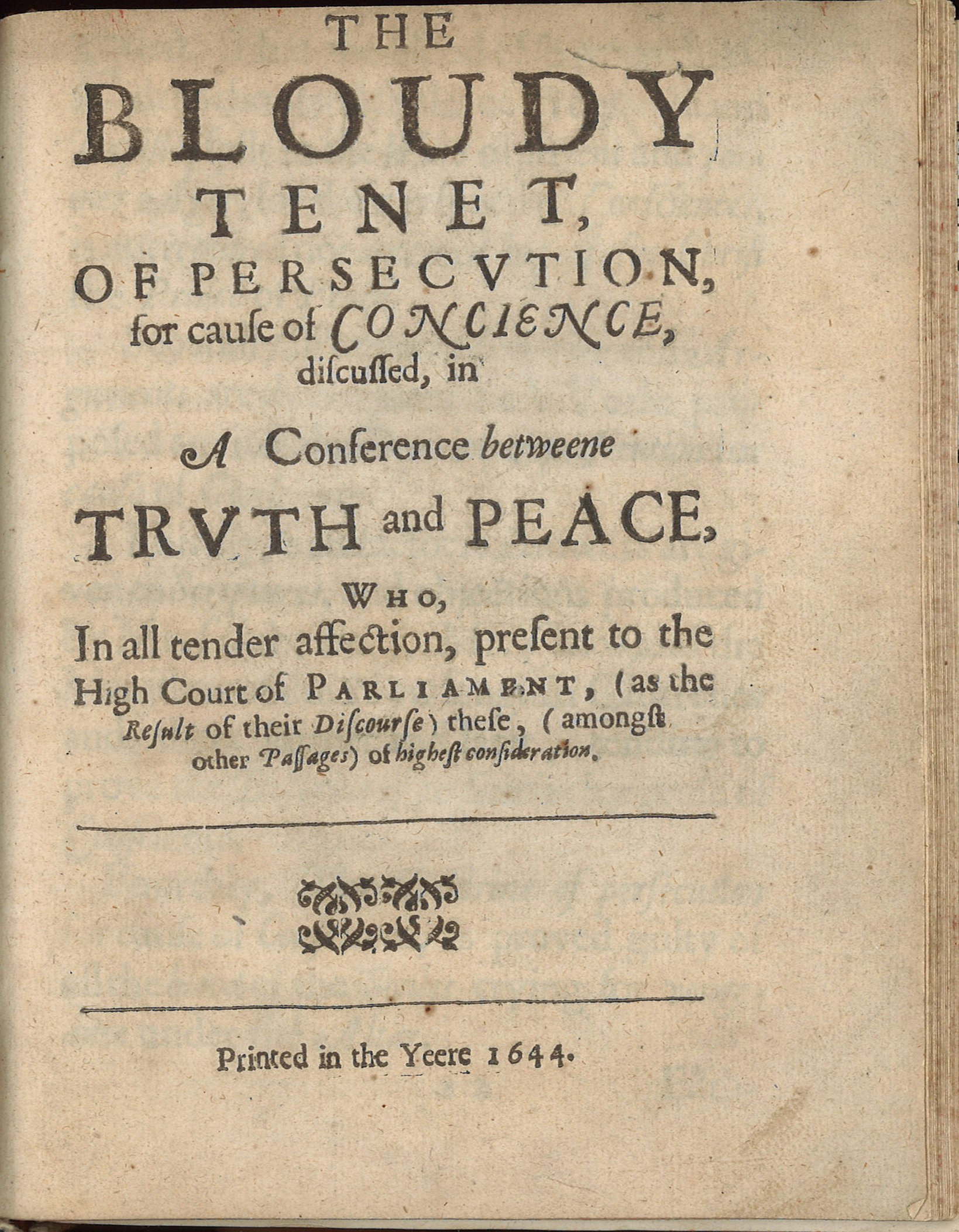
bloudy-tenetThe General and Particular Baptists adopted none of the theological or practical errors of the Anabaptists, but they were somewhat innovative in their approach to public theology. Due to persecutions experienced at the hands of church-run magistrates, they searched the Scriptures and came away with a doctrine that would come to be known as liberty of conscience. Thomas Helwys, a General Baptist, was perhaps the first to write on this subject. Roger Williams, an English migrant to America and a Separatist-turned-Particular Baptist, expounded on Helwys’ earlier work. In his 1644 work entitled The Bloudy Tennent of Persecution, Williams called out civil magistrates for their persecution of the consciences of saints. Nevertheless, he called the saints to expect persecution if they truly be in Christ.

“WHILE I plead the cause of truth and innocence against the bloody doctrine of persecution for cause of conscience, I judge it not unfit to give alarm to myself, and to all men, to prepare to be persecuted or hunted for cause of conscience. Whether you stand charged with ten or but two talents, if you hunt any for cause of conscience, how can you say you follow the Lamb of God, who so abhorred that practice?” (ed. Joseph Early, Jr., Readings in Baptist History, pg. 21).

The Baptist Confession (1644 / 1646)

Liberty of conscience was a universally accepted distinctive of the early English and American Baptists. In The Baptist Confession (1644), the English Particular Baptists made many concessions to the public theology of the continental Reformers as laid out in the Belgic Confession. However, they nuanced it quite a bit. The Dutch Reformers would doubtless wholeheartedly affirm Article XLVIII in The Baptist Confession of 1644. It reads almost verbatim like the Belgic Confession in its insistence that Christians are subject to magistrates:

That a civil Magistracy is an ordinance of God set up by God for the punishment of evil doers, and for the praise of them that do well; and that in all lawful things commanded by them, subjection ought to be given by us in the Lord: and that we are to make supplication and prayer for Kings, and all that are in authority, that under them we may live a peaceable and quiet life in all godliness and honesty.”

However, moving into the next article, there is a slight change of tone from the Belgic Confession to the Baptist Confession. Where The Belgic Confession offers no concession for liberty of conscience, The Baptist Confession highlights it.

“The supreme Magistracy of this Kingdom we believe to be the King and Parliament freely chosen by the Kingdom, and that in all those civil Laws which have been acted by them, or for the present is or shall be ordained, we are bound to yield subjection and obedience unto in the Lord, as conceiving ourselves bound to defend both the persons of those thus chosen, and all civil Laws made by them, with our persons, liberties, and estates, with all that is called ours, although we should suffer never so much from them in not actively submitting to some Ecclesiastical Laws, which might be conceived by them to be their duties to establish which we for the present could not see, nor our consciences could submit unto; yet are we bound to yield our persons to their pleasures” (Article XLIX).

It’s worth noting that, while Particular Baptists at this time saw no place for a civil magistrate to exercise ecclesiastical authority, they do not deny the right of the church described in The Belgic Confession to speak with prophetic authority to civil magistrates. In fact, in the next article, they themselves appeal directly to God for the hearts and the minds of the state to be bent toward them in mercy:

“And if God should provide such a mercy for us, as to incline the Magistrates’ hearts so far to tender our consciences, as that we might be protected by them from wrong, injury, oppression and molestation, which long we formerly have groaned under by the tyranny and oppression of the Prelatical Hierarchy, which God through mercy hath made this present King and Parliament wonderful honorable, as an instrument in his hand, to throw down; and we thereby have had some breathing time, we shall, we hope, look at it as a mercy beyond our expectation, and conceive ourselves further engaged forever to bless God for it” (Article L).

This was a clear appeal not only to God but also to the civil magistrates to show mercy and kindness to them for conscience sake. Yet the Particular Baptists went on to explain that, even if the magistrates did not show mercy but dealt treacherously with them, they were still to submit in all things lawful, yet without violating their consciences. The revision of this Confession in 1646 goes on to expound on this idea of liberty of conscience recognizing it as a duty the state owes to its citizenry. It even goes so far as to dictate to the magistrates what are their duties to men regarding liberty of conscience. As such, we see that the early Particular Baptists did view the use of the prophetic voice as a deterrent for governments that might otherwise violate their liberty of conscience. They did not concede to the notion that the church should not speak to matters of government, only that governments were not free to dictate terms to the church.

______________
In our next article, we will conclude our discussion of public theology in the Reformed confessions by examining developments in The Westminster Confession and The Baptist Confession (1677 / 1689).

A Reformed Baptist Perspective on Public Theology – The Reformed Confessions (Part I)

Read the first three posts here, here, and here.

______________

When discussing the idea of the Two Cities and Two Kingdoms paradigms for understanding public theology, many leave a tremendous gap between Luther and modern scholarship. We would be negligent to do so here, though. For a uniquely Reformed Baptist perspective on these issues to be well informed, one must be aware of the fact that there is more than just a Lutheran perspective of public theology to draw upon. There is also a Reformed tradition, which just so happens to be the tradition from which Baptists sprung.

Luther’s further development of Augustine’s paradigm certainly plays a large role in the development of Calvinistic, Reformed, and Reformed Baptist approaches to public theology. However, Calvin and his predecessors did not adopt Luther’s theology without some contributions of their own. Luther’s views on the subject evolved throughout the course of his life and the life of Saxony. The same could be said of Zwingli in Zurich, Calvin in Geneva, and the Dutch, British, French, German, and American Reformers that would follow in their footsteps.

According to Oliver O’Donovan and Joan Lockwood, Calvin intermingled aspects of the patristics, the scholastics, and Luther in the development of his public theology with ideas and methods he’d received from classical political philosophy as well as humanist literary, historical, and legal scholarship (O’Donovan and Lockwood, From Irenaeus to Grotius, 662). Calvin’s take on public theology took into account not only the collective wisdom of church history and Western Civilization, but it also brought several disciplines to bear on the matter. Thus, it would be highly inappropriate to attempt to transplant Luther’s theory into the Reformed tradition without any consideration of nuance or further development by Calvin and his theological predecessors.

Recognizing the willingness of the Reformers to shift understandings of these matters to meet the ever changing political structures of their times and cultures, it’s important that we as 21st century Westerners seek to discern as best we can the most universal elements of the Reformed take on Public Theology. Perhaps the best place to look to find these universal elements are in the development of the Reformed confessions of faith. For the purposes of this series, we will look at four such confessions that particularly pertain to the Reformed and Reformed Baptists: The Belgic Confession, The Baptist Confession (1644/1646), The Westminster Confession, and The Baptist Confession (1677/1689). As we examine these confessions, we will see how historical considerations over time forced the Reformed to continue to revisit the biblical texts most pertinent to the subject matter at hand and further Reform their views on public theology. Semper Reformanda!

Separation of Church and State

Some would take issue with there even being a chapter on magistrates in the confessions. They argue that there should be a complete separation of church and state neither where the state speaks with authority to the church nor where the church speaks with authority to the state. Sam Waldron has offered a response to such reasoning.

“Does it surprise you that the Confession contains a chapter on the subject ‘Of the Civil Magistrate’? Are you inclined to ask, ‘What does politics have to do with Christ?’ If that is something of your response, may I suggest that you are a victim of a religious background which has retreated from its social responsibilities under a wrong view of the separation of church and state? Such an attitude has virtually denied the sovereignty of God over all areas of life. To restrict Christianity to the ‘spiritual’ realm is, ultimately, to destroy it” (Waldron, A Modern Exposition, 284).

The concept of the separation of church and state was a concept unique with Baptists in England and America. It was framed as a larger concept in which to set the gemstone of liberty of conscience, yet another uniquely Baptist doctrine. This concept was never meant to be taken as a separation of God and state. It is important to note at this juncture that not all Reformed confessions championed these concepts. Of course, we’ll see that quick enough as we examine our first Reformed confession: The Belgic Confession.

The Belgic Confession (1619)

589Reformed confessions have always dealt with the subject of the civil magistrate. Specifically regarding this subject the Reformed confessions are in general agreement that the role of government is to wield the sword granted them by God for the punishment of evil and the promotion of good (cf. Romans 13:1-7). Also, shared among the confessions is the recognition that duty is owed by the governed subjects to their magistrates, those magistrates having been given their office by God. The Belgic Confession goes quite a bit further than this, though.

“And the government’s task is not limited to caring for and watching over the public domain but extends also to upholding the sacred ministry, with a view to removing and destroying all idolatry and false worship of the Antichrist; to promoting the kingdom of Jesus Christ; and to furthering the preaching of the gospel everywhere; to the end that God may be honored and served by everyone, as he requires in his Word” (The Belgic Confession, Article 36).

Thus, the Confession most commonly held by the Dutch Reformed community promotes the use of the magistrate to enforce church discipline and promote the furtherance of the gospel. Without doubt this is seen, at least in seed form, in the practices of Zwingli and Calvin. In fact, it was over this issue that Zwingli’s disciples eventually separated from him birthing what would eventually come to be called the Anabaptist movement in Switzerland. Tellingly, The Belgic Confession takes a clear stance against the Anabaptists, anarchists, and revolutionists in its pronouncements.

“Moreover everyone, regardless of status, condition, or rank, must be subject to the government, and pay taxes, and hold its representatives in honor and respect, and obey them in all things that are not in conflict with God’s Word, praying for them that the Lord may be willing to lead them in all their ways and that we may live a peaceful and quiet life in all piety and decency.

And on this matter we reject the Anabaptists, anarchists, and in general all those who want to reject the authorities and civil officers and to subvert justice by introducing common ownership of goods and corrupting the moral order that God has established among human beings” (Ibid.).

This being the earliest of the Reformed confessions, the Westminster Assembly and the Particular Baptists developed much of their public theology upon it. While an argument can be made that it is the most Reformed position, in that it is most faithful to the views and conduct of Calvin and Zwingli, such an argument does not allow for the application of the Semper Reformanda (always reforming) principle. As circumstances changed in Luther’s and Calvin’s political and cultural situations, their understandings of these matters adapted. The Reformed tradition moving forward into the 17th century also adapted to the changing times, returning again and again to the Scriptures to determine the best approach to new considerations as they arose.

______________
In our next article, we will continue our discussion of public theology in the Reformed confessions by examining developments in some of the English confessions of the 17th century.

Why Mark Jones Is Right… and Wrong

Jones-Mark-HigherRes

Mark Jones

Let me be the first (perhaps not) Baptist to admit that Mark Jones was spot on in many regards in his post “A Plea for Realism”:Are Presbyterians Christians? It seems to me that Mark Jones is simply calling for a little intellectual honesty from us Baptists. Well, allow me to humor him.

I certainly agree that, if we do not allow unbaptized believers to take communion, that should include those who have been “baptized” in a way that we believe to be unbiblical and, thus, no baptism at all. If a paedobaptist came to my church who refused to be baptized post-confession due to having been sprinkled as an infant, we would not allow him to be a member, so why would we allow him to take communion? Baptism, in every Christian tradition, has historically preceded communion. Baptism preceding communion is both a historical and a biblical view. On this point, most Baptists and Presbyterians agree.

Therefore, for me to dissuade my Presbyterian friends from taking communion in my local church, I am not saying they are not Christians so much as that they have not followed biblical mandate in regard to the order of the sacraments. That is, baptism precedes communion. On this point, they would obviously disagree with me, because they hold to a different understanding of baptism. However, for Baptists to cave on this issue and allow for unbaptized Presbyterians (and that’s what we think they are) to take communion, we would be going against our confession’s definition of true baptism.

However, we are not alone in this stance. Presbyterians must take issue with at least some Baptists taking communion in their churches. Just this week, I listened to a somewhat refreshing episode of Reformed Forum in which Jim Cassidy admitted that Baptist parents are in sin who do not baptize their infants in keeping with a Presbyterian view of baptism. I think this is the only consistent Presbyterian view and, as such, I don’t see how Baptist parents can take communion in Presbyterian churches, unless Presbyterians encourage people in open, unrepentant sin to take communion.

ctc-album300Either way, both traditions have an issue when it comes to what Jones calls “catholicity” and baptism. Neither one of us can deny that we see the other as being disobedient to our Lord’s ordinance of baptism. Are Baptists inconsistent to call their Presbyterian friends Christians? Not quite as inconsistent, I would argue, as those Presbyterian churches that allow consistently Baptist parents to take communion.

So, perhaps the proper way to respond to our Presbyterian friends when they try to corner us on these issues is not to bend over backward to try to be ecumenical. Perhaps, the best response is to affirm them where they are correct, but demonstrate how they have to answer the same questions regarding their sacramentology. None of us are immune. At a certain level, each believe the other (credos and paedos) is disobedient at a certain level, and that must stand as a guard to the communion table at some point.

See also Tom Hicks’ response to Jones’ article. Michael Haykin has also chimed in, and Jones has offered his critique of Haykins’ response here.

CredoCovenant 2.0

EA-2.0We are now actively and publicly recruiting new contributors to the blog. We’re looking for all kinds of bloggers with different backgrounds and life experiences. We will be privately contacting some solo-bloggers from around the web (those who openly publish their contact info), but if you read this and know someone who meets the criteria, let us know.


Criteria:

  1. Must subscribe to the 1689 London Baptist Confession of Faith.
  2. Must attend a confessionally Reformed church (if you are able).
  3. Must have previous blogging experience or be able to submit previously written material via e-mail for our consideration.
  4. Must be a member in good standing in a local church.
  5. Must bring something unique to the CredoCovenant dynamic.

We are also open to hearing from our readers how we might improve our website. Feel free to contact us at credocov@gmail.com to be considered as a contributor.

CCF Episodes 13-14, 25-28: Covenant Theology by Nehemiah Coxe

Grab Covenant Theology: From Adam to Christ by Nehemiah Coxe and John Owen and read along with the CredoCovenant Fellowship as we engage its major themes from a Reformed Baptist perspective:


coxeowen2

Covenant Theology: From Adam to Christ

by Nehemiah Coxe and John Owen

CCF Episode Twenty-Eight: Concluding Our Discussion of Covenant Theology

CredoCovPodcastMaster

In this episode, JD and Billy sit down with Junior “The Big Dippa” Duran and Rene Del Rio to conclude their discussion of Covenant Theology: From Adam to Christ by Nehemiah Coxe and John Owen.

MP3 Download | stream:

Subscribe to future podcasts and leave us a review on iTunes: RSS | iTunes  

The book we read…coxeowen2

Covenant Theology: From Adam to Christ by Nehemiah Coxe and John Owen

We’d love your participation. Contact us with your comments and questions about the books contents: