Why I Lovingly Push Reformed Theology

Periodically, an article is published to which I am compelled to respond. This doesn’t necessarily mean that I have to respond with nastiness or even direct disagreement. A response is not a reaction. The following article is an attempt at a friendly response to an article published today over at RAANetwork. The goal here is not to discredit the article or punch holes in its reasoning. My goal isn’t even to correct anything I believe to be improperly stated. Rather, my goal here will be to offer an alternative viewpoint, or perhaps to approach the subject from a bit of a different angle.

Defining Our Terms

Many well-intentioned articles have been written to persuade Reformed Christians to go easy—fly under the radar—in the discussion over Calvinism and non- (or anti-) Calvinism. Let us take a moment before diving into this discussion ourselves to discuss some important definitions. It’s important that we all understand from the outset that, when we say someone is Reformed or Calvinistic, we don’t all mean the same thing. Some equate Reformed Theology with Calvinism. Others recognize that Calvinism has come to be defined in Evangelicalism as a much different thing from Reformed Theology. For the purposes of this article, I will be using the two terms to describe two different, but related, concepts.

First, when I say Calvinism, I will mean the minimalistic adherence to the five points of Calvinism as outlined in the Canons of Dort. Second, when I say Reformed, I will mean a much more comprehensive approach to the Christian life that certainly affirms the five points of Calvinism, but also holds to historic Reformed expressions and formulations of both belief and practice as outlined in the historic Reformed confessions of faith. By this definition, many among the Dutch Reformed, Presbyterians, Anglicans, and even Baptists fit comfortably under the heading Reformed.

(Note: I believe the article mentioned above does a decent job of using the historical definitions of these terms.)

It Is Biblical

One area where you might say I agree that we should not be in the business of pushing Reformed Theology is in regard to pushing “mere Calvinism.” If all that a man ever seems to talk about is the five points of Calvinism to the expense of the other godly wisdom we’ve inherited from the early Reformers, Puritans, and Particular Baptists, that man will inevitably exhibit a certain imbalance in his life and doctrine. Reformed Theology is holistic, touching every part of the Christian life.

Q.6: What things are chiefly contained in the Holy Scriptures?

A. The Holy Scriptures chiefly contain what man ought to believe concerning God, and what duty God requireth of man (Collins, The Baptist Catechism of 1693).

Reformed Theology is holistic because it is biblical, and the Bible is holistic. This is where Calvinistic Christians have often gone wrong in recent decades. We have often focused on the academic aspect of the Christian belief system without demonstrating the connectedness of Christian thought with Christian practice. We have failed to maintain an element of the Christian life that was essential for the Reformers, Puritans, and Particular Baptists: that knowledge not coupled with understanding and wisdom (right knowledge that does not lead to right action) is not biblical knowledge.

The problem with Reformed Theology is a PR problem more than anything else. The problem isn’t that Reformed Theology isn’t biblical. The problem is that the acquiescence and application of Reformed Theology on the part of many Reformed Christians has not been biblical. Many of us have accepted Reformed Theology because it is true; it lines up with Scripture (knowledge). That’s a good thing. However, how many Reformed Christians apply themselves to imbibing these teachings as they are found in Scripture (understanding) and actually walking them out in their everyday lives (wisdom)?

It’s not enough merely to affirm Reformed Theology as true and biblical. When our Christian and non-Christian friends hear us discussing Reformed Theology, if they only hear platitudes and well-structured arguments, but they see lives unaffected by these truths, they rightly recognize that something is “off.” What’s “off” is the fact that we have biblical knowledge, but we have not coupled that knowledge with biblical wisdom and understanding (Eph. 1:17-18).

One Church United in Truth

When properly acquired and applied, Reformed Theology is more powerful than any other Scriptural, theological formulation in uniting Christians with one another. For many of our readers, this assertion doubtless seems odd. After all, we’ve been told, it’s doctrine that divides, and especially that dreaded Reformed doctrine (queue suspenseful music).

KONICA MINOLTA DIGITAL CAMERA

On the contrary, the Bible teaches that proper doctrine unites the church. When Christ ascended, Paul wrote to the Ephesian church, He bestowed gifts upon the church. He not only led captivity captive (freeing us from our slavery to sin, the traditions of men, the world, the flesh, and the devil), but He also gave godly men to the church to unite us in proper Christian doctrine. The result of this unity would be that we would no longer be as babes in the faith carried about by every current of doctrine, but we would be built up like a man of full stature able to stand with feet firmly planted on the riverbed of the world, immovable and complete with the strength that every part supplies, and with Christ as our Head (Eph. 4:7-16).

Now for a sober thought. To undervalue unity in truth (and that’s what Reformed Theology is: truth) is to weaken and divide the church where God has ordained that ought to find our true unity. Is the church divided? We sure are. Is it proper that we should point to true doctrine as the source of that disunity? May it never be! Rather we should pray, as Paul and Timothy did for the church at Colossae, that God’s children would grow in knowledge, wisdom, and understanding (Colossians 1:9).

Real Sources of Disunity

What then is the source of our disunity? There are several sources to which we can and should point. First among them are divisive brothers. The Bible is riddled with warnings against divisive brothers. They are called an abomination to God in Proverbs (6:16-19). Paul wrote to Titus: “Reject a factious man after a first and second warning, knowing that such a man is perverted and is sinning, being self-condemned” (Tit. 3:10-11; NASB). The problem with these men is not the doctrine being taught from the pulpit, but a divisive spirit that has gone unchecked within them.

Another source of disunity in the church is an unteachable spirit. This isn’t solely the fault of individual congregants. All too often, churches leave their doctrinal positions undefined. As people join their ranks, they come in with the assumption that the church is fluid where they are fixed. They are allowed from the onset to believe that they, as an untrained, non-ordained member of the church will be able to sway the church this way or that on their pet doctrine. Rather than being shaped by the word preached, they desire to shape the word preached through their human influence. They prefer to accumulate for themselves teachers that tell them what they want to hear, turning their ears away from the truth (2Tim. 4:3-4).

Once a man allows this presumption to fester in his heart, a hostile environment is inevitable. The moment the pastor authoritatively opposes his pet doctrine, a wound is opened within his soul and the infection of bitterness begins to set in. In this way, the unteachable spirit is not unlike the discontented spirit. Both can lead to disunity if unchecked, and both will use Reformed Theology as an occasion to sow division within the body. We would be wise to keep in mind, however, that Reformed Theology is not the cause but the occasion of this division.

A third source of disunity is immaturity in the faith. Reformed Christians have affectionately coined the term cage-stage Calvinist to describe these immature believers, but it’s important to recognize that this phenomenon is not unique to Reformed Theology. Truth in the hands of an immature man is always a dangerous weapon. Wise parents don’t hand scalpels to their toddlers and leave them unsupervised. However, in the hands of a skilled surgeon, a scalpel is a necessary tool. The same is true for sound biblical knowledge, such as Reformed Theology.

Lusts (or passions) can also be a real source of disunity within the body. James points out that the cause of all quarrels is unchecked passion (Jas. 4:1-3). We want, but we do not have, so we steal, murder, slander, and destroy. We bite and devour one another, when we should be building one another up in the faith.

These are all sources of disunity. They all point to man’s universal, sinful condition. Note, however, that nowhere in Scripture does the Bible point to truth properly acquired and applied as a source of unity. In fact, it is the exact opposite.

Reformed Theology Is High Theology

So is it wrong or unwise to contend for Reformed Theology with our brothers and sisters in the faith? It depends. It depends on your heart and on the heart of your listener. If your heart, or the heart of your listener, is to win an argument rather than to demonstrate and share the rich spiritual benefit that is to be found in an affirmation of biblical truth, then your heart is not in the right place to be discussing Reformed Theology. There is a time and a place for swordplay: among parties who agree. The problem often comes when we take that playfulness and try to employ it with people who diametrically oppose our understanding of Scripture. We must approach these conversations with much more prayerfulness and seriousness, because much more is at stake.

What is it that’s at stake? What is it that Reformed Theology can grant our non-Reformed brothers and sisters that they don’t already have? In a word: consistency. We don’t deny that Arminians, and all other forms of non-Calvinists, can and do have a high view of God. The fact is, however, that Reformed Theology offers the highest view of God there is.

Our non-Calvinistic brothers and sisters will not care to hear from us that we believe their high view of God to be inconsistent with their approach to biblical interpretation. However, that is precisely what we believe as Reformed Christians. Yet it should be noted that they have the same critique of our theology. Why not just be honest about it? Much as it would be unloving for me to have a prolonged relationship with a Jehovah’s Witness or a Mormon without ever sharing the gospel with them, it is (to a drastically less significant degree) likewise unloving for us as Reformed Christians to think we have the richest, most deeply rewarding view of God and then to withhold it from our brothers and sisters in the faith. Why would we deny them this rich heritage that we have found so rewarding to our faith and practice?

Might it be because we have not truly found it rewarding? Might it be that we have not thought out how truly holistic Reformed Theology is and applied its teaching to every aspect of our life and our doctrine? See, our zeal for truth tells those who disagree with us how truly committed we are to that truth. If we have no zeal for truth we are telling others, whether we intend to or not, that we find it neither true nor beneficial. This has not been our experience, though. We affirm Reformed Theology not simply because we have been logically convinced; we affirm it also because we have been experientially convinced. That is, unless we haven’t. Our actions will tell.

The Necessary Contrast between Christianity and Rome

Not only do our non-Reformed brothers and sisters miss out on the benefit of a high theology, but often they also fail to see the very necessary contrast between Christianity and Rome. There are many pastors and theologians in the church today who, as a result of their abandonment of Reformation theology, have completely abandoned the Reformation! Everywhere you look, there are pastors, seminary professors, theologians, and biblical scholars who claim to represent a Protestant tradition or denomination while simultaneously holding out a hand of fellowship to Rome. These men and women speak of three orthodox groups under the umbrella of Christianity: Roman Catholicism, Eastern Orthodoxy, and Protestantism.

As Reformed Christians, we recognize only one of three groups just listed as truly Christian according to the Bible. I have had professors that would view this statement as divisive. Well, with all due respect to my professors, the Council of Trent was just as much to blame for this division as any Reformer, Puritan, Baptist, or Reformed confession or catechism. When the papacy holds a council that takes an essential doctrine such as Justification by Faith Alone and calls any who teach it accursed, this act alone is enough to place Rome squarely outside the pale of biblical orthodoxy.

Yet we have “Protestant” Christians claiming that those who have called us anathema (and have not retracted it) are under our same umbrella. We shouldn’t merely push Reformed Theology because of its high view of God. Reformed Theology is also a necessary guard from adopting heterodox views of our relationship to Rome and the Eastern Orthodox church.

Conclusion

Again, why do I push Reformed Theology? I push Reformed Theology because it’s biblical. I push Reformed Theology because biblical truth, when rightly acquired and applied, unites. I push Reformed Theology because it offers the most consistent interpretation of the Bible with a truly high view of God. I push Reformed Theology because it keeps us from erroneous, though perhaps well-intentioned, attempts at unity with groups with whom the Bible requires we disagree. For all of these reasons, it would be both unloving and a disregard for the unity of the church for Reformed Christians not to push Reformed Theology.

Edit – After getting some feedback from the author of the article that inspired this one, I wanted to offer the following statement as a kind of second conclusion:

It seems to me that the heart of the article’s author is in the right place, wanting to bridge gaps between disparate Christians and break down barriers. I would prefer that Reformed Christians with such a heart boldly use the terminology we believe to be the most biblical, but do so in such a way that we utterly destroy the stereotypes people have erected of us in their minds. That is to say that we should employ Reformed terminology (early in our conversations) in such a way that our non-Reformed friends are completely disarmed by the love and tenderness behind it.
Repost: Why Catechize?

I originally posted this article back in February of 2013. In discussing catechesis with my wife tonight, I went in search for it. After reading it, I decided it was worth a repost. I hope you find it helpful.

___________________

It has been such a blessing for our family to catechize our daughter. My wife and I use The Baptist Catechism, but my four-year-old and the children’s ministry at our church use the more basic Catechism for Boys and Girls. Every night we get together as a family to pray, sing hymns, and read God’s word. Of course, we haven’t always been able to do this perfectly, but it has become a fairly regular expectation for my family. When we gather together at night to have family worship, we also spend some time catechizing our daughter and one another. We even let our daughter ask us questions from The Baptist Catechism. She loves it. So, today, I was thinking about the benefits of catechesis and thought I’d simply blog about it.

Some Benefits of Catechesis:

  • It helps us to make sense of the things we are reading regularly in Scripture. We should not simply be concerned that our families understand what the texts say in their immediate contexts, but what the Bible as a whole has to say on various topics. If we simply focused in on the immediate contexts of certain texts, we would never arrive at a full-fledged understanding of even the essentials of Christianity such as the Trinity, Justification by Faith Alone, and the Hypostatic Union.
  • It helps us to set a context for making sense of the gospel. When children have a big picture understanding of the teachings of Scripture, they can better understand not only the truths of the gospel, but also the importance of those truths to their everyday lives. The Bible’s claims make the most sense from within a biblical worldview. It is this worldview that catechetical parents hope to instill in their kids.
  • It provides us with healthy opportunities for daily, intentional interaction with our kids. Our kids crave and long for our attention. When we catechize them, we are providing them with an opportunity (scripted, but an opportunity nonetheless) to interact with their parents in a way that few other things do. They have a sense of accomplishment and, more importantly, they bond with their parents.
  • It provides us with the opportunity to pass on our worldview and subsequent values to our children. The influences in our society are plenty which compete for our children’s affections. Catechisms are an invaluable tool for ensuring that our children are immersed in a biblical worldview on a daily basis.

This is by no means meant to be an exhaustive list. I’m sure there are many benefits I have yet to consider, but I think these are sufficient for whetting our appetites for catechizing our children. I pray this has been an encouragement for you in your endeavors to raise your children in the fear and the admonition of the Lord.

A Reformed Baptist Perspective on Public Theology – Redemption and Creation in Kuyper

Read the first seven posts here, here, here, here, here, here,and here.

_________________________________________________________________

In our last blog post, we presented some of the core beliefs regarding Abraham Kuyper’s public theology, which can be summed up in one sentence: Jesus Christ is Lord of all, and because of that fact, our allegiance to Him should shape not only the private but also the public aspects of our lives. In Kuyper’s vision, Christ is not just the Lord over ecclesiastical matters, but He is also Lord over public matters like art, science, business, politics, economics, and education. Based on this core conviction, Kuyper served as prime minister of the Netherlands, founded a Christian university, started a newspaper, and wrote influential books on theology, politics, and other topics. In recent years a new generation of Calvinists has further developed Kuyper’s original vision of Christ’s lordship over all matters. To understand these recent developments, we must understand neo-Kuyperian theology concerning the relationship between redemptive grace and creation.

Creation and Redemption

In the neo-Kuyperian theological vision, redemptive grace both renews and restores nature. In this vision, God covenanted creation (“nature”) into existence and ordered it by means of His word. At creation, God instructed his image bearers to be fruitful and multiply (interpreted as a social command), till the soil (interpreted as a cultural command), and have dominion (interpreted as a regal command). His image bearers would glorify him by multiplying worshipers, bringing out the hidden potentials of creation, and lovingly managing his world. However, Adam and Eve were seduced by the word that the serpent spoke against God’s word. Since the first couple’s sin, all of humanity has been under the sway of sin.

This original sin can be interpreted as the antithesis to God’s covenant Word. However, more generally, the antithesis is any word spoken against God’s word. It misdirects the human mind and affections by pointing them toward idols rather than toward the one true and living God. So this world is corrupted, but it is not corrupted in its structures, but only in its direction. Consider the words of Bruce Ashford as an explanation of this point:

In other words, sin and evil were not able to corrupt God’s created order structurally or ontologically. Satan and sin are not as powerful as God’s word and therefore cannot destroy creation. They cannot make purely bad what God created originally good. All they can do is misdirect. Thus creation remains good structurally (in its existence and basic order) but has been made bad directionally (as humanity brings out the hidden potentials of creation by building society and culture, but does so in an errant manner, directing it toward idols rather than God).

For these reasons, God sent his Son to restore nature. The salvation provided by the Son is offered to God’s image bearers, but extends beyond them to the whole creation. According to an interpretation of Romans 8:19-22, Christ will liberate creation from the bondage it is now experiencing because of the Fall. One day, He will return to renew and restore his good creation, purifying it of corruption and misdirection, and placing in its midst a majestic city – the New Jerusalem (cf. Revelation 21:1). This New Jerusalem is not simply a heavenly city, but it is thoroughly cultural, characterized by architecture, art, and music. Thus, the metanarrative of Scripture (creation-fall-redemption-consummation) applies not just to the individual Christian, but it appeals to all of creation.

Cosmic Redemption

This view of cosmic redemption has two broad implications in this vision. First, since God will liberate creation from its bondage—rather than annihilating it— this affirms that sin did not have the power to corrupt creation ontologically. The created order, even though it has been misdirected, remains God’s good creation. He will renew it and restore it, instead of replacing it.

Second, in this vision, our eternity unfolds in our present universe. This affirms the enduring goodness of the physical and material (i.e. cultural) aspects of our lives. In this vision, God’s redemptive grace is not opposed to nature in that God will completely replace this world with another world. Rather, God accomplishes cosmic redemption by renewing and restoring nature – making it what He always intended it to be. Consider the words of Abraham Kuyper:

For if grace exclusively concerned atonement for sin and salvation of souls, one could view grace as something located and operating outside of nature….But if it is true that Christ our Savior has to do not only with our soul but also with our body…then of course everything is different. We see immediately that grace is inseparably connected with nature, that grace and nature belong together. Abraham Kuyper: A Centennial Reader, 173.

Redirecting the Culture

This vision presents a distinctive view of the way a Christian should live in the world. In this vision, believers are called to be transformative or redirective in our social and cultural activities. Within every single vocation that God calls believers, we desire God’s Word to shape our words and activities. Hence, believers inquire about God’s original creational design for a certain activity, then discern the manifold ways it has been misdirected by sin, and finally find ways to redirect that activity or realm towards Christ.

This is done out of love for Christ and our neighbor, as a matter of obedience, and a matter of witness. Since Christ’s lordship extends to all of creation, then it must extend to all cultural activities. Thus, Christ’s saving Lordship should be conveyed not only by our words but by our cultural deeds. And we do so as a preview of Christ’s coming Kingdom, when he will renew this heavens and earth. God’s redemption and restoration transforms us in the totality of our being, across the entire fabric of our lives, and redirects our lives comprehensively. Kuyper writes,

In short, everything is his. His kingdom is over everything….His kingdom is a kingdom of all ages, of all spheres, of all creatures. On Kuyper, 147-148.

Thus every act of obedience—whether in prayer or in politics, in evangelism or in economics—is a part of Christian mission, a manifestation of kingdom work. Because the antithesis is operative as a misdirecting agent in every part of creation and culture, we should draw upon God’s thesis (i.e. God’s word) to redirect all activities in our lives.

Redirecting Public Theology

Most importantly for the sake of our discussion, this vision has a distinctive view of public theology. If God’s sovereign authority holds for every sphere of life and if his word is relevant to every sphere, then politics and the public square are no exception. Kuyper exemplified this conviction in his own life. He drew upon the “grace restores nature” framework in order to shape his understanding of politics and the public square.

First, this vision has a distinctive view of how a Christian should do academic scholarship. It views every academic discipline as an opportunity to view God’s world through the lens of his Word. Kuyper writes,

He who lives from, and consistently within, the orbit of Revelation confesses that all Sovereignty rests in God and can therefore proceed only from Him; that the Sovereignty of God has been conferred absolute and undivided upon the man-Messiah; and that…every…sphere of life recognizes an authority derived from him. Abraham Kuyper: A Centennial Reader, 468.

A Christian scholar who believes that redemptive grace restores nature will recognize that his field of study, has an authority derived from Christ. His discipline operates within a sphere that has a unique God-given principle at its core, shaping the discipline’s goal as well as its appropriate parameters. It is within this framework that Christian higher education can thrive.

Second, this vision strongly encourages believers to approach any aspect of public life by discerning God’s creational design for that aspect (thesis), discerning the various ways in which these aspects have been corrupted and misdirected by sin (antithesis), and working to redirect them toward Christ. Similar to the views of Luther and Calvin, our engagement in the public sphere cannot and should not be done in reliance upon general revelation alone. Christians should allow our specifically Christian beliefs and commitments to inform our views on social, cultural, and political issues.

Third, this vision causes us to avoid an improperly coercive relationship between church and state. Kuyper’s answer to the church-state relationship was the sphere sovereignty concept discussed in our last post. Kuyper argued that God ordered creation in such a way that there are multiple spheres (such as art, science, religion, and politics). God is sovereign over the spheres and each sphere exists directly under God’s authority (rather than under the church’s authority).

Fourth, this vision makes a distinction between the institutional church and the organic church, and applies that distinction to public square activities. The church, as an institution, gathers weekly to preach the word and to administer the sacraments. However, the church is also an organism – a covenantal body of believers who scatter throughout society and culture during the week. While the institutional church may have indirect influence on politics and the public square by shaping its members into Christian disciples, it should not exert direct influence. However, the organic church—the covenanted members of the church—may exercise direct influence in politics and the public square, by applying their discipleship to public matters when opportunity arises and expertise allows.

Conclusion

Much more could be said here, but the “grace restores nature” framework provides the theological foundation for discussion Kuyper’s (and neo-Kuyperian) public theology. There are many who interpret this vision as “redeeming the culture” or “transforming the culture”. However, this would be a mischaracterization of the views of many neo-Kuyperians. Many neo-Kuyperians understand that any cultural transformation will be neither comprehensive nor enduring, until the day when Christ Jesus transforms the world. All of these activities are done out of love for Christ and our neighbor, as a matter of witness and obedience, and in the hopes that the Christian community can provide a preview of Christ’s coming kingdom. Kuyper applied this vision in a very helpful way to politics and the public square. He emphasized God’s sovereignty over every sphere of culture, including church and state. He provided a way for church and state to relate to one another properly, without one domineering the other. He sought to avoid the twin extremes of a naked square on the one hand, or a theocracy on the other. Kuyper grasped one great truth—that Christ’s lordship is universal—and sought to apply it wisely and consistently to life on this earth. And from that we can all benefit.

A Reformed Baptist Perspective on Public Theology – Sphere Sovereignty in Kuyper

Read the first six posts here, here, here, here, here, and here.

____________________

In our discussion of a Reformed Baptist perspective on public theology, we have recently been examining the Reformed confessions. In today’s article, we will begin our discussion of some more recent developments regarding Reformed perspectives of public theology. In our view, no modern discussion on Reformed public theology can be presented without discussing the contributions of Abraham Kuyper. By becoming familiar with Kuyper’s approach to public theology, readers should be in a position to evaluate the politics of writers like Francis Schaeffer, Tim LaHaye (and many of the members of the Christian Right movement), and Tim Keller – all of whom owe an intellectual debt to Kuyper.

As a minister in the Dutch Reformed Church and a leader in the first modern Dutch political party, the Anti-Revolutionary Party, Kuyper sought to re-create a Christian perspective on politics and society that would form the basis for Christian social action. He envisaged this as an integral part of a comprehensive Christian worldview based upon the Scriptures and their interpretation within the Augustinian-Calvinist tradition. Although he wrote copiously in Dutch on theology, art, politics, education, and a host of other topics, only a few of his writings are available in English translations. The most comprehensive statement of his position in English is to be found in the Stone Lectures, which were delivered at Princeton Theological Seminary in 1898 and are published under the title Lectures on Calvinism. This article will consist of a brief exposition of Kuyper’s views as set out in these lectures.

Calvinism as a Worldview

For Kuyper, Calvinism is “a theory of ontology, of ethics, of social happiness, and of human liberty, all derived from God” (p. 15). Thus, Kuyper saw Calvinism, not merely as a system of doctrine, but a comprehensive worldview. In its essence, the heart of Calvinism (and any other worldview) revolves around three fundamental relationships: “(1) our relation to God; (2) our relation to men; and (3) our relation to the world” (p. 19). As example of this interpretation, Kuyper argues that Paganism is a distinct worldview that worships god in the creature. This worship results in a distortion of man’s other relationships by allowing some men to become demi-gods and thus creating caste systems in society. At the same time, too high an estimate is placed on the idea of nature, which leads to a deification of the world. Kuyper offers similar interpretations of Islam, Roman Catholicism, and Modernism – all of which he contrasts with Calvinism. It is in Calvinism alone, he argues, that one can find the proper balance between these vital relationships.

According to Kuyper’s understanding of Calvinism, God enters into immediate fellowship with mankind. So, according to this doctrine, our entire human life is placed immediately before God, ensuring the equality of all men before God and with each other (p. 27). The world itself is to be honored not because it is divine, but because it is a divine creation – the handiwork of God. Practically, this means for the Christian that “the curse should no longer rest upon the world itself, but upon that which is sinful in it, and instead of monastic flight from the world the duty is now emphasized of serving God in the world, in every position of life” (p. 31).

The third lecture in the series is entitled Calvinism and Politics. Here we find a brief, but dense outline of Kuyper’s political theory distilled from his great work, Ons Programme (Our Program, 1878). He argues that the foundational principle for Calvinistic public theology is “the Sovereignty of the Triune God over the whole Cosmos” (p. 99). From this statement, he deduces three realms of sovereignty which he calls “spheres”: the State, Society and the Church. In this way he speaks about his political principle as the application of the principle of “sphere sovereignty” to politics (p. 116).

The Sphere of the State

The first application of this notion of sphere sovereignty is to the State, which seems to refer to the civil government. Kuyper sums up Calvinistic political thought in three theses:

  1. God only – and never any creature – is possessed of sovereign rights, in the destiny of the nations, because God alone created them, maintains them by His Almighty power, and rules them by His ordinances.
  2. Sin has, in the realm of politics, broken down the direct government of God, and therefore the exercise of authority, for the purpose of government has subsequently been invested in men, as a mechanical remedy.
  3. In whatever form this authority may reveal itself, man never possesses power over his fellow man in any way than by an authority which descends upon him from the majesty of God.

Kuyper argues that mankind is organically related by blood so that one humanity exists throughout all time. However, because of sin and the Fall, mankind’s original unity has been fractured, and political life has become a necessity. If the fall did not exist, there would have been no need for the establishment of the structures of the State. Rather, all men would be governed through family relationships. Thus politics and the State are unnatural developments in human history – the State being a mechanical structure imposed upon the natural organic relationships that bind men together. “God has instituted magistrates, by reason of sin” (p. 102). Therefore, from the viewpoint of God’s original creation, the State ought not to exist, but in the light of the Fall, it must exist to restrain evil and make life in a fallen world tolerable – a view reminiscent of Augustine’s Two Cities.

In arguing for his third thesis, Kuyper does not believe that any one form of government is in itself right for all times and places. Rather, the form that government takes is bound up with changes in historical and social circumstances, which is a position he traces back to Augustine. Christians are to seek godly government without demanding a set form. In saying this, Kuyper rejects the idea of a theocracy, which he argues was restricted to ancient Israel.

The Sphere of Society

Building on this foundation, Kuyper goes on to discuss the sphere of society. Society, he declares, is not one whole, but a number of diverse parts which includes the family, business, science, the arts, and etc.. In particular, Kuyper divides the social sphere into four main groups:

  1. the sphere of social relationships where individuals meet and interact with each other;
  2. the corporate sphere, which includes all groupings of men in a corporate sense such as universities, trade unions, employers, organizations, companies, etc;
  3. the domestic sphere, which deals with family, marriage, education, and personal property; and
  4. the communal sphere, which includes all groupings of men in communal relationships such as streets, villages, towns, cities, etc.

Each part of these spheres, Kuyper argues, has “sovereignty in the individual social spheres and these different developments of social life have nothing above themselves but God, and the State cannot intrude here” (p. 116). In society “the chief aim of all human effort remains what it was by virtue of our creation and before the fall – namely, domination over nature” (p. 117).

By contrast to this view of society as a natural, organic institution, government is a mechanical device, which is set over peoples. Its essential characteristic is its power over life and death, which ought to be exercised in the administration of justice. This has a twofold application: 1) to maintain internal justice; 2) to care for the people as a unit at home and abroad. However, since government is mechanically imposed upon the organic spheres of society, friction occurs between different social areas and the government. Kuyper says “the government is always inclined with its mechanical authority to invade social life, to subject it and mechanically to arrange it” (p. 120). At the same time, Kuyper argues that the various social spheres will endeavor to throw off all restraints of government. Thus men will be continually faced with the twin dangers of statism and anarchy. But Calvinism, Kuyper maintains, avoids these extremes by insisting on the sovereignty of God and the rightfulness of a plurality of social spheres “under the law”, which is maintained by the government (p. 121).

Thus, in relation to the social sphere, the State itself has three duties to perform. They are: 1) to draw a boundary between the different social spheres to avoid social conflict. Thus, there is a boundary between the domestic and the corporate life of man. For example, the worker should never be misused by his employer in such a way as to deprive him of a home life or private interest, because such a development would mean that the corporate sphere has illegitimately invaded the domestic sphere; 2) to defend individuals and weak elements within each sphere; 3) to coerce all the separate spheres of society to support the State and uphold its legitimate functions. Thus, each sphere has an obligation to render whatever dues necessary for the maintenance of the overall unity of society as protected by the State (p. 124-125).

The Sphere of the Church and the Individual

Kuyper’s final sphere is the sphere of the Church. While admitting that a divided church presents many problems, he believes that implicit in the doctrine of the liberty of conscience is the ideal of a free church in a free society – hence, the motto “a free Church for a free State”. While acknowledging the benefits of a genuine unity between churches, Kuyper argues that the government must suspend judgment in this area and allow divisions to exist amongst Christians because “the government lacks the data of judgment and would infringe” on the sovereignty of the Church (p. 136). He concludes from this that while extreme forms of church order are to be avoided, allowances must be made for historic and cultural differences between denominations.

Kuyper concludes with a short section on the “sovereignty of the individual person” in which he argues that “conscience is never subject to man but always and ever to God Almighty” (p. 139). This argument leads him to declare that “liberty of speech and liberty of worship” (p. 141) are essential in a just society. Yet, like John Stuart Mill, Kuyper seeks to limit such liberty to “mature men”, and doubts that “backward people” can be granted such liberty. In this, as in all his arguments, Kuyper’s overall aim is to enable “every man to serve God according to his own conviction and the dictates of his own heart” (p. 142).

Concluding Thoughts

Kuyper’s discussion of sphere sovereignty has a number of similarities with Luther’s Two Kingdoms model of public theology, but there are some important differences. Kuyper’s concept of sphere sovereignty deals with different areas into which human life under Christ’s lordship are to be divided; they do not designate the eschatological distinction between this age and the age to come, which is central to the doctrine of two kingdoms. Thus, the concept of sphere sovereignty should be interpreted as a sociological concept that may be consistent with, but different from the two kingdoms doctrine. The two kingdoms model not only represents two spheres (because they denote two governments), but they also denote two overlapping ages.

____________________

In the next article, we will develop these points in more detail and examine how Kuyper (and many current neo-Kuyperians) grounded his understanding of public theology based on an emphasis on creation-fall-redemption and the relationship between grace and nature.

A Reformed Baptist Perspective on Public Theology – The Reformed Confessions (Part III)

Read the first five posts here, here, here, here, and here.

______________


In our discussion of a Reformed Baptist perspective on public theology, we have recently been examining the Reformed confessions. In the last two posts, we examined two Reformed confessions’ assertions regarding the relationship of the civil government to the church: The Belgic Confession and The Baptist Confession (1644 / 1646). In today’s article, we will conclude our discussion of public theology in the Reformed confessions by examining two more confessions: The Westminster Confession and The Baptist Confession (1677 / 1689).

The Westminster Confession (1647)

In 1647, a year after the 1646 revision of The Baptist Confession, the Westminster Assembly published the second Reformed confession to be adopted in England: The Westminster Confession. In this Confession, they too addressed the topic of the civil magistrate. However, they returned to the language of the earlier Belgic Confession on the matter.

“The civil magistrate may not assume to himself the administration of the Word and sacraments, or the power of the keys of the kingdom of heaven: yet he hath authority, and it is his duty, to take order, that unity and peace be preserved in the Church, that the truth of God be kept pure and entire; that all blasphemies and heresies be suppressed; all corruptions and abuses in worship and discipline prevented or reformed; and all the ordinances of God duly settled, administered, and observed. For the better effecting whereof, he hath power to call synods, to be present at them, and to provide whatsoever is transacted in them be according to the mind of God” (WCF 23.3).

The Westminster Confession then denied the right of the state to step in and administer the word and sacraments, but argued that it was the duty of the state to oversee and ensure “that unity and peace be preserved in the Church, that the truth of God be kept pure and entire; that all blasphemies and heresies be suppressed; all corruptions and abuses in worship and discipline prevented or reformed; and all the ordinances of God duly settled, administered, and observed.” In other words, the Westminster view of the state’s role was one of enforcing ecclesiastical order and discipline.

On this front, the Reformed began to see a clear divide in regard to public theology. Both credobaptists and paedobaptists among the Reformed agreed that the church had a duty to speak to the state. However, where English Particular Baptists argued for the state’s role to be one of ensuring liberty of conscience on matters of church practice, the paedobaptists in England as well as on the continent were arguing for more of an enforcer role for the state.

The Baptist Confession (1677 / 1689)

In the latter part of the 17th century, a new generation of Baptists convened to draft a new confession of faith. This Confession would be more robust than the first, but it would take a shape much closer to that of the Westminster Confession than that of the previous Baptist Confession. This change of shape is often mistaken for a change of substance, but nothing could be farther from the truth. Though things are stated differently in the Second London Baptist Confession, it represents the same basic theological framework on which the Particular Baptists operated in the early 17th century.

Notably, the 1689 Confession presents a much more streamlined doctrine of the civil magistrate. The emphasis on duties of the civil magistrate toward the church and regarding liberty of conscience is not as strong, but it is certainly still present. In particular, the laws of the state are put in subjection to a greater, more absolute law.

“Civil magistrates being set up by God for the ends aforesaid; subjection, in all lawful things commanded by them, ought to be yielded by us in the Lord, not only for wrath, but for conscience’ sake; and we ought to make supplications and prayers for kings and all that are in authority, that under them we may live a quiet and peaceable life, in all godliness and honesty” (LBCF 1689, 24.3).

What is suggested in the language “in all lawful things” is the idea that there may be certain unlawful things commanded by the state that would force Christians to violate their consciences. If the question arises as to which to follow, man or our Spirit-led, Bible-informed consciences, we are to choose our conscience every time. As such, the Baptist Confessions are unanimous in promoting (even demanding) liberty of conscience and, when the state violates the conscience of the believer, civil disobedience along with the consequences that follow. There is a higher law to which we are called, so we are to subject ourselves in all things which do not violate that higher law. Even the confessional Presbyterian Americans eventually came to agree with their Baptist brothers on this view altering their own Westminster Confession to allow for liberty of conscience in their public theology.

Conclusion

From our study of the Reformed confessions, we see that there are certain universal principles that must be granted for any truly Reformed approach to public theology. First, God has given the sword to the civil magistrate for the purpose of punishing evil and promoting good. Second, in affirming this biblical truth, the Reformers confessed the duty of the church to speak directly to the state concerning its duties and responsibilities. Third, Christians are to subject themselves to all lawful ordinances of the state (meaning laws not requiring sin or disobedience toward God on the part of Christians). Fourth, Christians are to render respect and honor to all those who are in authority as men and women placed in authority by God to rule over us. Fifth, Christians are to pray for our magistrates in all matters as will lead to the comfort and prosperity of the state so that we might lead quiet and peaceful lives.

Where the confessions disagreed was in areas of ecclesiastical dealings and liberty of conscience. Where The Belgic Confession and the early Westminster Confession both argued that the state should have an enforcer role in the church and that it could force on the people a particular church’s views on the sacraments, the Baptist confessions endorsed a view that removed the state’s power to enforce church matters and promoted liberty of conscience. The Particular Baptists were careful to avoid intermingling of the Two Kingdoms, while not removing the prophetic voice from the church. Eventually, in America, the Particular Baptist perspective on public theology won out even for most paedobaptist churches. Thus, at least in the West, the Baptist view came to be the predominant view of the Reformed. Semper Reformanda!

______________
Having laid a confessional foundation for our discussion, in the next article we will begin our discussion of some more recent developments regarding Reformed perspectives of Public Theology.

A Reformed Baptist Perspective on Public Theology – The Reformed Confessions (Part II)

Read the first four posts here, herehere, and here.

______________

In the last post, we examined the approach of the framers of The Belgic Confession to public theology, specifically as it regards civil government. In this article and the next, we will shift our attention from the Continental Reformation to the English Reformation. Without further introduction, let us begin with the earliest of the English confessions we will consider: The Baptist Confession (1644 / 1646).

Not Anabaptists

The considerations that would lead to further development of the public theology laid out in The Belgic Confession came sooner for the early English Baptists than for others. In 1644, a group of Baptists came together in London to publish a new confession of faith. This Confession was meant to be a source of unity for the churches in question, but it also had a secondary purpose. On the European continent, Anabaptism had spread since the time of Zwingli. The early Anabaptists, especially those who were initially among Zwingli’s disciples, were very thoughtful, orthodox, and studious in their approach to theological systematization. However, as the years passed and persecution ensured that Anabaptists had less and less ecclesiastical resources at their disposal, they began to become more extreme in their stances against government and to develop heretical and heterodox views on key doctrines.

As persecution arose for Reformed pastors and theologians at different points of British history, the Reformed would often flee to the continent. Continental Europe, especially in Switzerland and the Dutch provinces, was understood to be more favorable toward the Reformation. In their sojourn on the continent, many Reformed pastors were made aware of the errors of these later Anabaptists. As a result, when Baptists began to emerge in England out of the Separatist movement, they were viewed with an eye of suspicion and slandered as Anabaptists. For this reason, they saw fit to entitle their first confession: London Baptist Confession of Faith, A.D. 1644: The CONFESSION OF FAITH, Of those CHURCHES which are commonly (though falsely) called ANABAPTISTS.

Liberty of Conscience

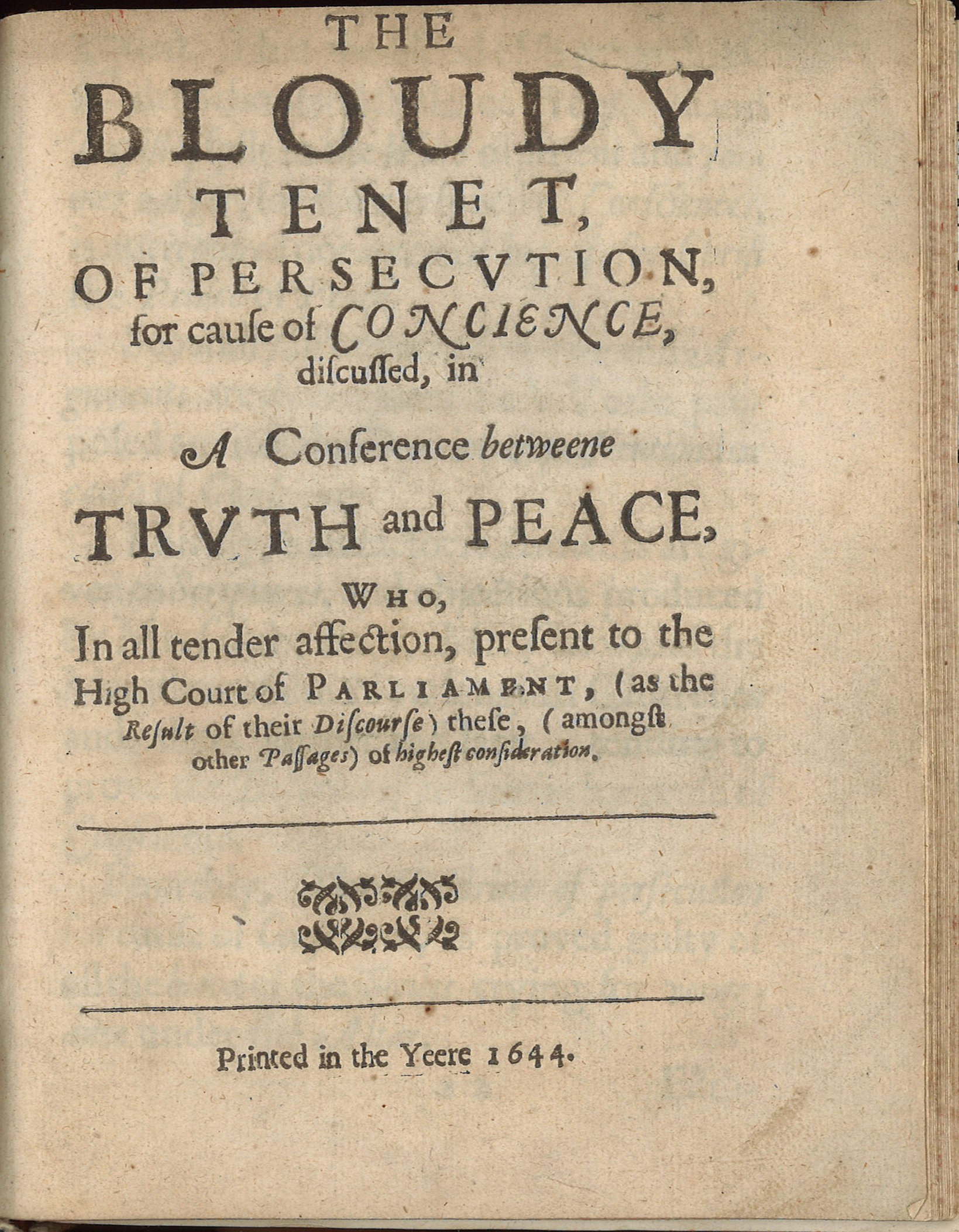
bloudy-tenetThe General and Particular Baptists adopted none of the theological or practical errors of the Anabaptists, but they were somewhat innovative in their approach to public theology. Due to persecutions experienced at the hands of church-run magistrates, they searched the Scriptures and came away with a doctrine that would come to be known as liberty of conscience. Thomas Helwys, a General Baptist, was perhaps the first to write on this subject. Roger Williams, an English migrant to America and a Separatist-turned-Particular Baptist, expounded on Helwys’ earlier work. In his 1644 work entitled The Bloudy Tennent of Persecution, Williams called out civil magistrates for their persecution of the consciences of saints. Nevertheless, he called the saints to expect persecution if they truly be in Christ.

“WHILE I plead the cause of truth and innocence against the bloody doctrine of persecution for cause of conscience, I judge it not unfit to give alarm to myself, and to all men, to prepare to be persecuted or hunted for cause of conscience. Whether you stand charged with ten or but two talents, if you hunt any for cause of conscience, how can you say you follow the Lamb of God, who so abhorred that practice?” (ed. Joseph Early, Jr., Readings in Baptist History, pg. 21).

The Baptist Confession (1644 / 1646)

Liberty of conscience was a universally accepted distinctive of the early English and American Baptists. In The Baptist Confession (1644), the English Particular Baptists made many concessions to the public theology of the continental Reformers as laid out in the Belgic Confession. However, they nuanced it quite a bit. The Dutch Reformers would doubtless wholeheartedly affirm Article XLVIII in The Baptist Confession of 1644. It reads almost verbatim like the Belgic Confession in its insistence that Christians are subject to magistrates:

That a civil Magistracy is an ordinance of God set up by God for the punishment of evil doers, and for the praise of them that do well; and that in all lawful things commanded by them, subjection ought to be given by us in the Lord: and that we are to make supplication and prayer for Kings, and all that are in authority, that under them we may live a peaceable and quiet life in all godliness and honesty.”

However, moving into the next article, there is a slight change of tone from the Belgic Confession to the Baptist Confession. Where The Belgic Confession offers no concession for liberty of conscience, The Baptist Confession highlights it.

“The supreme Magistracy of this Kingdom we believe to be the King and Parliament freely chosen by the Kingdom, and that in all those civil Laws which have been acted by them, or for the present is or shall be ordained, we are bound to yield subjection and obedience unto in the Lord, as conceiving ourselves bound to defend both the persons of those thus chosen, and all civil Laws made by them, with our persons, liberties, and estates, with all that is called ours, although we should suffer never so much from them in not actively submitting to some Ecclesiastical Laws, which might be conceived by them to be their duties to establish which we for the present could not see, nor our consciences could submit unto; yet are we bound to yield our persons to their pleasures” (Article XLIX).

It’s worth noting that, while Particular Baptists at this time saw no place for a civil magistrate to exercise ecclesiastical authority, they do not deny the right of the church described in The Belgic Confession to speak with prophetic authority to civil magistrates. In fact, in the next article, they themselves appeal directly to God for the hearts and the minds of the state to be bent toward them in mercy:

“And if God should provide such a mercy for us, as to incline the Magistrates’ hearts so far to tender our consciences, as that we might be protected by them from wrong, injury, oppression and molestation, which long we formerly have groaned under by the tyranny and oppression of the Prelatical Hierarchy, which God through mercy hath made this present King and Parliament wonderful honorable, as an instrument in his hand, to throw down; and we thereby have had some breathing time, we shall, we hope, look at it as a mercy beyond our expectation, and conceive ourselves further engaged forever to bless God for it” (Article L).

This was a clear appeal not only to God but also to the civil magistrates to show mercy and kindness to them for conscience sake. Yet the Particular Baptists went on to explain that, even if the magistrates did not show mercy but dealt treacherously with them, they were still to submit in all things lawful, yet without violating their consciences. The revision of this Confession in 1646 goes on to expound on this idea of liberty of conscience recognizing it as a duty the state owes to its citizenry. It even goes so far as to dictate to the magistrates what are their duties to men regarding liberty of conscience. As such, we see that the early Particular Baptists did view the use of the prophetic voice as a deterrent for governments that might otherwise violate their liberty of conscience. They did not concede to the notion that the church should not speak to matters of government, only that governments were not free to dictate terms to the church.

______________
In our next article, we will conclude our discussion of public theology in the Reformed confessions by examining developments in The Westminster Confession and The Baptist Confession (1677 / 1689).

A Reformed Baptist Perspective on Public Theology – The Reformed Confessions (Part I)

Read the first three posts here, here, and here.

______________

When discussing the idea of the Two Cities and Two Kingdoms paradigms for understanding public theology, many leave a tremendous gap between Luther and modern scholarship. We would be negligent to do so here, though. For a uniquely Reformed Baptist perspective on these issues to be well informed, one must be aware of the fact that there is more than just a Lutheran perspective of public theology to draw upon. There is also a Reformed tradition, which just so happens to be the tradition from which Baptists sprung.

Luther’s further development of Augustine’s paradigm certainly plays a large role in the development of Calvinistic, Reformed, and Reformed Baptist approaches to public theology. However, Calvin and his predecessors did not adopt Luther’s theology without some contributions of their own. Luther’s views on the subject evolved throughout the course of his life and the life of Saxony. The same could be said of Zwingli in Zurich, Calvin in Geneva, and the Dutch, British, French, German, and American Reformers that would follow in their footsteps.

According to Oliver O’Donovan and Joan Lockwood, Calvin intermingled aspects of the patristics, the scholastics, and Luther in the development of his public theology with ideas and methods he’d received from classical political philosophy as well as humanist literary, historical, and legal scholarship (O’Donovan and Lockwood, From Irenaeus to Grotius, 662). Calvin’s take on public theology took into account not only the collective wisdom of church history and Western Civilization, but it also brought several disciplines to bear on the matter. Thus, it would be highly inappropriate to attempt to transplant Luther’s theory into the Reformed tradition without any consideration of nuance or further development by Calvin and his theological predecessors.

Recognizing the willingness of the Reformers to shift understandings of these matters to meet the ever changing political structures of their times and cultures, it’s important that we as 21st century Westerners seek to discern as best we can the most universal elements of the Reformed take on Public Theology. Perhaps the best place to look to find these universal elements are in the development of the Reformed confessions of faith. For the purposes of this series, we will look at four such confessions that particularly pertain to the Reformed and Reformed Baptists: The Belgic Confession, The Baptist Confession (1644/1646), The Westminster Confession, and The Baptist Confession (1677/1689). As we examine these confessions, we will see how historical considerations over time forced the Reformed to continue to revisit the biblical texts most pertinent to the subject matter at hand and further Reform their views on public theology. Semper Reformanda!

Separation of Church and State

Some would take issue with there even being a chapter on magistrates in the confessions. They argue that there should be a complete separation of church and state neither where the state speaks with authority to the church nor where the church speaks with authority to the state. Sam Waldron has offered a response to such reasoning.

“Does it surprise you that the Confession contains a chapter on the subject ‘Of the Civil Magistrate’? Are you inclined to ask, ‘What does politics have to do with Christ?’ If that is something of your response, may I suggest that you are a victim of a religious background which has retreated from its social responsibilities under a wrong view of the separation of church and state? Such an attitude has virtually denied the sovereignty of God over all areas of life. To restrict Christianity to the ‘spiritual’ realm is, ultimately, to destroy it” (Waldron, A Modern Exposition, 284).

The concept of the separation of church and state was a concept unique with Baptists in England and America. It was framed as a larger concept in which to set the gemstone of liberty of conscience, yet another uniquely Baptist doctrine. This concept was never meant to be taken as a separation of God and state. It is important to note at this juncture that not all Reformed confessions championed these concepts. Of course, we’ll see that quick enough as we examine our first Reformed confession: The Belgic Confession.

The Belgic Confession (1619)

589Reformed confessions have always dealt with the subject of the civil magistrate. Specifically regarding this subject the Reformed confessions are in general agreement that the role of government is to wield the sword granted them by God for the punishment of evil and the promotion of good (cf. Romans 13:1-7). Also, shared among the confessions is the recognition that duty is owed by the governed subjects to their magistrates, those magistrates having been given their office by God. The Belgic Confession goes quite a bit further than this, though.

“And the government’s task is not limited to caring for and watching over the public domain but extends also to upholding the sacred ministry, with a view to removing and destroying all idolatry and false worship of the Antichrist; to promoting the kingdom of Jesus Christ; and to furthering the preaching of the gospel everywhere; to the end that God may be honored and served by everyone, as he requires in his Word” (The Belgic Confession, Article 36).

Thus, the Confession most commonly held by the Dutch Reformed community promotes the use of the magistrate to enforce church discipline and promote the furtherance of the gospel. Without doubt this is seen, at least in seed form, in the practices of Zwingli and Calvin. In fact, it was over this issue that Zwingli’s disciples eventually separated from him birthing what would eventually come to be called the Anabaptist movement in Switzerland. Tellingly, The Belgic Confession takes a clear stance against the Anabaptists, anarchists, and revolutionists in its pronouncements.

“Moreover everyone, regardless of status, condition, or rank, must be subject to the government, and pay taxes, and hold its representatives in honor and respect, and obey them in all things that are not in conflict with God’s Word, praying for them that the Lord may be willing to lead them in all their ways and that we may live a peaceful and quiet life in all piety and decency.

And on this matter we reject the Anabaptists, anarchists, and in general all those who want to reject the authorities and civil officers and to subvert justice by introducing common ownership of goods and corrupting the moral order that God has established among human beings” (Ibid.).

This being the earliest of the Reformed confessions, the Westminster Assembly and the Particular Baptists developed much of their public theology upon it. While an argument can be made that it is the most Reformed position, in that it is most faithful to the views and conduct of Calvin and Zwingli, such an argument does not allow for the application of the Semper Reformanda (always reforming) principle. As circumstances changed in Luther’s and Calvin’s political and cultural situations, their understandings of these matters adapted. The Reformed tradition moving forward into the 17th century also adapted to the changing times, returning again and again to the Scriptures to determine the best approach to new considerations as they arose.

______________
In our next article, we will continue our discussion of public theology in the Reformed confessions by examining developments in some of the English confessions of the 17th century.

CredoCovenant 2.1

If you look to the menu bar, you’ll see that we have added a new page. The following post is the jist of what you’ll find there.

CredoCovenant is a community contribution site for Reformed Baptists with a variety of different backgrounds and interests. We gladly welcome new contributors to our line-up. We have just a few requirements:

1) Contributors must subscribe to the doctrine taught in The Baptist Confession (1689).
2) Contributors must be baptized Christians covenanted to, and in good standing with, a local congregation of believers.
3) Contributors must demonstrate that they can offer something unique to the conversation.

If you or someone you know fits this bill, please feel free to e-mail us at credocov@gmail.com. We’d love to add your voice to our website.

01-hands-typing-on-a-computer

Thinking Critically About Complementarianism

Recently, I’ve finished a 12-part blog series offering, largely, a thoughtful critique on complementarianism. Having been raised as an egalitarian, I had no thought that my inherent disposition toward my role in marriage was ungodly or unbiblical. However, in desiring to have a God-honoring marriage, I spent a lot of time studying the proper role of women and men in marriage, sought advice, read books, etc. I understand and accept that complementarianism is biblically consistent and the God-given design for marriage; however, I still wrestle with some things that complementarians do, generally believe, and sometimes teach.

This blog series largely examines those contestable points from the viewpoint of what Christian egalitarians believe and try to foster in their statement of beliefs, with the hope and intention of promoting more critical thought and precision among complementarians. The latter part of the series offers some very important points that complementarians believe that are absent from egalitarian beliefs, with the hope and intention of also promoting critical thought and self-examination among egalitarians. Finally, the series ends with some lessons that I have learned during my short journey in marriage that may offer some insight and encouragement to other complementarians, mainly women, who are striving to glorify God by fulfilling their own God-given role in marriage.

Part 1: Sliding Into Complementarianism

Part 2: What Do Christian Egalitarians Believe?

Part 3: Egalitarian Beliefs: The Use of Spiritual Gifts

Part 4: Egalitarian Beliefs: Public Recognition

Part 5: Egalitarian Beliefs: Addressing the Sense of Inferiority Among Women

Part 6: Egalitarian Beliefs: Voices in the Home

Part 7: Egalitarian Beliefs: Valuing and Protecting Self in the Marriage

Part 8: Egalitarian Beliefs: Clarifying What We Believe

Part 9: Complementarian Beliefs: Addressing Cultural Influences

Part 10: Complementarian Beliefs: Biblical Consistency

Part 11: Complementarian Beliefs: Tackling the What and Where of the Problem

Part 12: Lessons for the Developing Complementarian Journey


M’Cheyne Bible Reading Plan: May 10

Numbers 19 (NASB, ESV, KJV, HCSB)

biblecoffee2_kjekolPsalms 56&57 (NASB, ESV, KJV, HCSB)

Isaiah 8 (NASB, ESV, KJV, HCSB)

James 2 (NASB, ESV, KJV, HCSB)