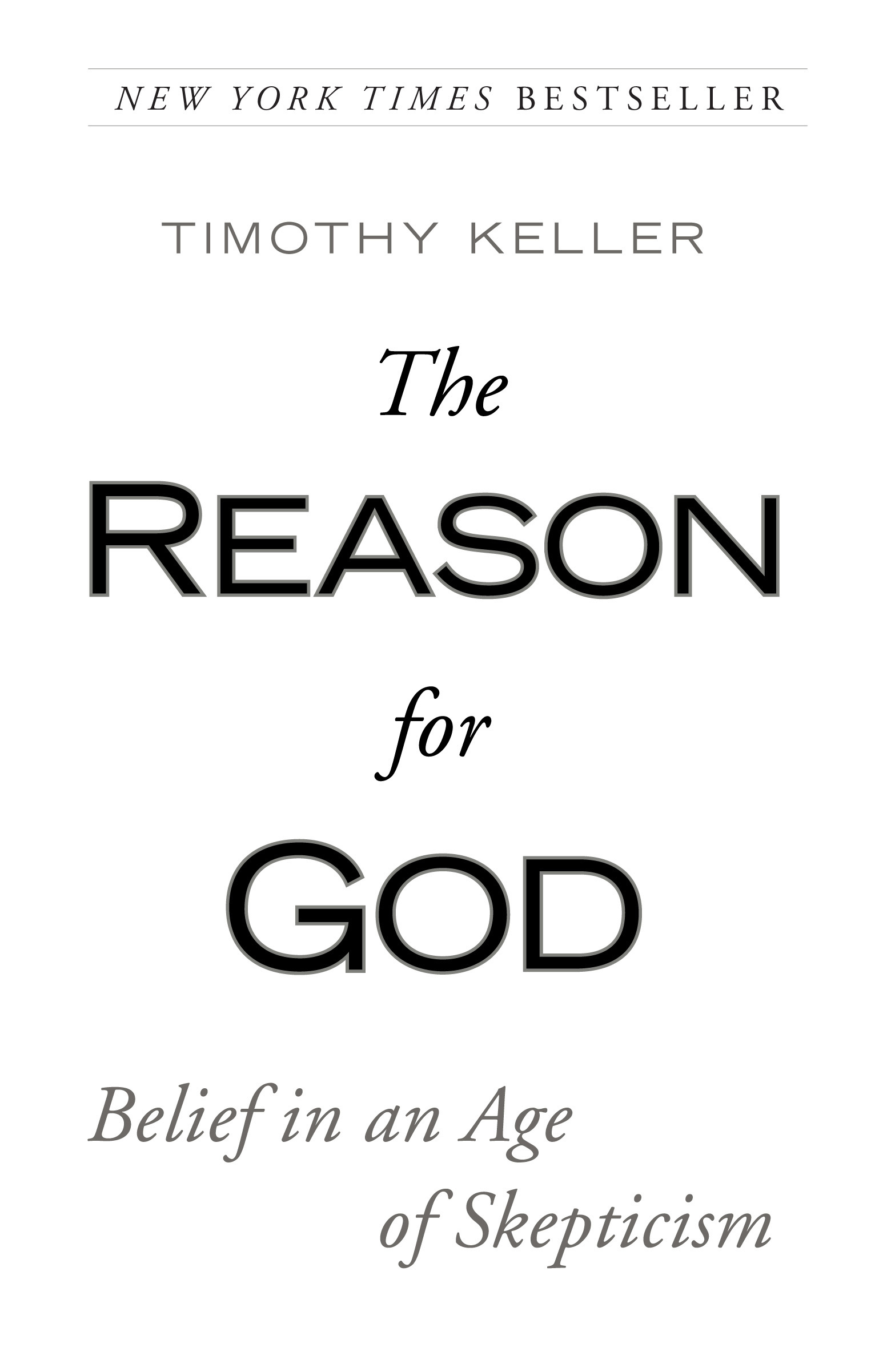
Keller, Timothy. The Reason for God: Belief in an Age of Skepticism. New York: Riverhead Books, 2008. 254pp. $16.00.
 In his 1952 book by the same name, C.S. Lewis attempted to defend what he coined ‘mere’ Christianity. He described Christianity as a house that included Roman Catholics, Eastern Orthodox, and various strands of Protestantism. When a person is first converted, that person is a mere Christian in the great hallway of the house. From that hallway, a mere Christian can and should choose to go into one of the various rooms (denominations). Lewis was not as concerned with getting unbelievers into his particular room as he was with getting them into the great hallway. In keeping with Lewis’ emphasis on converting unbelievers to mere Christianity, Timothy Keller, pastor of Redeemer Presbyterian Church in Manhattan, seeks to meet unbelievers in their doubts and lead them into the great hallway. In Keller’s own words, “I am making a case in this book for the truth of Christianity in general—not for one particular strand of it” (121).
Summary
In The Reason for God, Keller strikes a very pastoral, almost conversational tone. He is not primarily speaking to Christians; his intended audience is made up of doubters. Like C.S. Lewis’ Mere Christianity and Cornelius Van Til’s Why I Believe in God, rather than being an apologetics textbook, The Reason for God presents as a conversation piece for Christians and unbelievers. The main body of the book is broken up into two main parts—Part 1: The Leap of Doubt, and Part 2: The Reasons for Faith.
The Leap of Doubt
In this section, Keller addresses a host of misconceptions about God and Christianity. In the first chapter, he addresses the assumption that exclusivity in religion leads to bigotry by demonstrating that Christianity, while being exclusive, is a religion comprised of members who should themselves have been excluded. Writing Chapter Two, in dealing with the problem of suffering, Keller paints pictures of God and of heaven that are so desirous that, in theory, it retroactively erases all pain experienced this side of death.
Chapter Three is a case for the glory of slavery in the service of a King who became a Slave and died for His subjects. Keller’s goal in the fourth chapter is to point out the inconsistency of committing injustice while claiming the name of Christ. In Chapter Five, he demonstrates the fact that the God of the Bible is not a God primarily comprised of an all-inclusive love, but neither is such a god found in any of the texts of the myriad religions of the word. The seventh and final chapter of Part One demonstrates the folly of trying to interpret God and the Bible through the lens of a modern approach to history and culture.
The Reasons for Faith
After a brief intermission where Keller offers a brief apologetic for his approach to the subject matter, he returns with Part Two: Reasons for Faith. Having briefly dealt with several reasons unbelievers may have to doubt Christianity, he turns to a positive case for faith. Chapter Eight is Keller’s case for the Christian approach to empirical evidences and against evolutionary science’s unsatisfactory attempt at dismissing divine evidences. He points to internal evidences such as moral obligation, in Chapter Nine, as evidence for God’s existence.
With Chapter Ten, Keller attacks the issue of sin and shows the necessity of the cross. Chapter Eleven is devoted to the demonstration of grace’s triumph over self-righteousness. His twelfth chapter is a demonstration of the relational and social implications of the cross. In Chapter Thirteen, he lays out his apology for the resurrection. The fourteenth and final chapter is a brief treatise on the glories of heaven. Keller concludes this work with an epilogue titled: Where Do We Go from Here? In this section, he walks the unbeliever through the process of conversion and incorporation into the body of Christ.
Critical Evaluation
Christians can gain much from reading The Reason for God. One thing that is immediately noticeable is the fact that no one can write on this subject without upsetting some, if not all, parties: believers and unbelievers, liberals and conservatives, evidentialists and presuppositionalists. However, Keller strikes a tone in this book that can be described in no other way than pastoral. While a case may be made that he makes too many concessions, he does not draw lines in the sand and die on hills where it is not dictated by the subject matter. When writing with such pastoral overtones, it can be difficult to toe the line between unbiblical compromise and gross reactionism. Keller is not always successful in toeing this line, but no one could argue that he has not made a valiant effort at doing so.
Furthermore, though Keller is very accessible and pastoral in his writing, it must be noted that he is widely read on the subject matter at hand. He quite obviously reads broadly, quoting from a wide array of Christian and non-Christian authors. The subject is doubtlessly one of great importance to him, one that he does not think worthy of minimal research and much conjecture. Keller’s heart and his effort in The Reason for God is to be commended highly.
However, there are a few concerns that arise in his method of argumentation. Keller approaches the doubt of an unbeliever as something that is ethically neutral. He makes the gross error of equivocating the common with the honorable. Everyone has their doubts. Thus, it must be honorable to put your doubts on display, right? Wrong. If Christians were to understand doubt for what it is: the sinful suppression of truth, they would reject this equivocation and cease treating the doubts of Christians and non-Christians as something to be praised.
At the end of Keller’s “Introduction,” he describes two scenes where Christ dealt with doubt in others. When found in the apostle Thomas, Christ is said to exhort Thomas to believe and to give him the evidence for which he asked. This is an incomplete account of the confrontation. Christ also rebuked his sinful doubt, “do not be unbelieving” (John 20:27; NASB), and compared him in a negative light with those who do not doubt (vs. 29). In the same way, the father of the epileptic boy in Mark 9 obviously understood the sinfulness of persistent doubt when he said, “I do believe; help my unbelief” (vs. 24). The Greek word here rendered “help” is a word meaning “come to the rescue of.” The direness and sinfulness of doubt are not adequately conveyed in Keller’s approach to unbelievers. Rather, he appears content to applaud their honesty, and join them in it, as long as it moves them to the next point in the discussion.
Of further concern is Keller’s doctrinal minimalism. He admits, as does Lewis in Mere Christianity, that he does see a point where every Christian ought to assume a broad-reaching doctrinal and corporate identity. However, his primary concern in the book is to make a case for “the truth of Christianity in general” (121). As such, the question must be asked how soon a new Christian ought to find a local church. Keller addresses this issue only as a byword, and only after much admitted trepidation, in his Epilogue. He affirms that new Christians must find local congregations with which to identify, but all-the-while passively validating their residual disdain for the bride of Christ (246-247).
Conclusion
In The Reason for God, Timothy Keller sets a commendable example for approaching unbelievers. He is always very cautious to breach the tough topics with much gentleness and humility. However, his method is not representative of a proper hamartiology (doctrine of sin). Doubt is not neutral as it relates to sin; it certainly is not commendable. Christians who engage the unbelieving world do them no favors by pretending that it is, whether in word or deed. Readers would do well to imitate Keller’s tone and patience with the unbelievers with which they come into contact. They would do just as well to approach his many concessions with great discernment, careful not to die on non-essential hills, but willing to draw the line in the sand on matters that are unquestionable in God’s Word.
________________________
Pick up The Reason for God today: The Reason for God paperback
by Timothy Keller




 CredoCovenant