A Reformed Baptist Perspective on Public Theology: Augustine’s Two Cities

Read the Introduction here.


______________

Augustine wrote City of God as an apologetic in response to those who were crediting Christians with the downfall of Rome. They argued that Christianity as a religion weakens cultures and makes them susceptible to overthrow by foreign powers. Augustine argued to the contrary that, whereas faithful commitment to the God of Scripture has always brought about flourishing in particular cultures, increased rebellion against Him has always resulted in their downfall. Within these cultures, Augustine recognized that there were two types of citizens: those of the City of God and those of the City of Man (also known as the city of this world or the earthly city).

A Necessary Dichotomy

Augustine distinguished the City of God from the City of Man. These two cities are organized societies with citizens who are respectively distinguished by the standards by which they live. Citizens of the City of Man live by the standard of the flesh, whereas citizens of the City of God live by the Spirit (cf. Galatians 5:13-26). Augustine emphasizes that what ultimately distinguishes the two cities are their loves: “We see then that the two cities were created by two kinds of love: the earthly city was created by self-love reaching the point of contempt for God, the Heavenly City by the love of God carried as far as contempt of self.” (Book 14, Chapter 28).

It’s important to emphasize that, for Augustine, there is no dual citizenship – in other words, each individual member is a member of one city, and one city only. Augustine reiterated Jesus’ teaching that while Christians live in the City of Man, they do not belong to the City of Man (cf. John 18:36). Their presence in the earthly city is like that of strangers sojourning in a foreign country (cf. 1 Peter 1:1-2). The City of Man is not our true home; rather, our citizenship is in heaven (cf. Philippians 3:20) and it is to that Heavenly City that we owe our affections and our ultimate loyalty.

As some have rightly observed, Christians are in a very similar situation to that of the church during the period of the Assyrian Dispersion and the Babylonian Exile. We remain citizens of Zion while we sojourn in a foreign land and seek, in our occupations and conversations, to enable flourishing, both our own and that of those around us. As part of our goal to aid in the flourishing of the land shared by these two competing cities, the City of God necessarily speaks the truth in boldness when addressing the City of Man.

Augustine’s Critique Centered on Virtue

Some have interpreted Augustine’s words as a justification for the withdrawal of Christians (and a Christian worldview) from the civil and political sphere of society, but this would be a misreading of Augustine. Augustine strongly believed that the blessedness of civic life would be enhanced if the majority were to hear and embrace the Christian precepts of justice and moral virtue. Consider the words of Augustine in Book II, Chapter 19 of The City of God:

If ‘the kings of the earth and all nations, princes and all the judges of the earth, young men and maidens, old men and children’ [Psalm 148.11f.], people of every age and each sex; if those to whom John the Baptist spoke, even the tax gatherers and the soldiers [Luke 3.12f.]: if all these together were to hear and embrace the Christian precepts of justice and moral virtue, then would the commonwealth adorn its lands with happiness in this present life and ascend to the summit of life eternal, there to reign in utmost blessedness.

Augustine also emphasized that the City of God and the City of Man are competing, intermingling loyalties within the same culture. It is at this aspect of the City of Man that Augustine’s critique is most pointed.

The City of Man always seeks stability, if for no other reason than to maintain its own power, and as a result, it legislates at the level of the minimal standards needed to preserve society. The City of Man, therefore, emphasizes tolerance of differences (as long as they don’t interfere with the government’s power) in order to avoid conflict. For the City of Man, this passes for peace, albeit distorted by greed and selfishness. The City of Man is dominated by self-love and built around the lowest common denominator in society, which is self-indulgence. Virtue is absent since the citizens of the City of Man love themselves more than others, though good behavior may be enforced by social customs or by coercion by the state. In this environment, the state is necessary to restrain evil. Herein lies the dilemma: the problem is, the government itself is part of the City of Man and is itself dominated by self-love. The State is more interested in self-promotion and power than it is in promoting the good. In the City of Man, the State is nothing less than organized oppression, and maintains its power through violence and threats.

In contrast to the City of Man, the City of God is built around love of God and therefore love of neighbor. Because of this focus on love, all true virtue resides in the City of God. The City of God also seeks peace, though of a different and more profound sort. Whereas the City of Man uses terror to compel good behavior and to protect good people from the wicked, the City of God relies only on penitence, grace, and mercy, not compulsion, to advance its goals. Augustine emphasized that the City of Man cannot accomplish its penultimate ends (i.e. safety, peace, etc.) if its ultimate ends, means, and motivations (i.e. domination, pride, and self-love) are fundamentally disordered. This is a reality that is understood by citizens of the City of God and because of our love for our neighbor, we have a responsibility to speak this truth in boldness to citizens of the City of Man. In this way, the City of God can influence citizens of the City of Man by addressing the moral conscience of the City of Man. In this role, the citizens of the city of God become a prophetic voice to the State – forth-telling the God’s truth as revealed in Scripture.

In the next blog, we will consider how Augustine’s Two Cities has been applied throughout Church history by examining the thoughts of Martin Luther on the subject as well as the modern advocates of Two Kingdoms theology.

A Reformed Baptist Perspective on Public Theology: An Introduction

Disclaimer: The present series is a presentation of the thoughts of two Reformed Baptists (Gabriel Williams and William Leonhart) on the relationship between kingdom and culture. This series is to be taken neither as the view of all Reformed Baptists nor as the view of all contributors to CredoCovenant. Reformed Baptists are a diverse group with a wide variety of perspectives on this issue.

____________________


Paying attention to the news, one will have noticed that 2015 has been a year marked by numerous stories that have deeply affected American cultural life in the present and will doubtless have many ramifications in the future. The following list is a quick rundown of just a few major stories that have gained attention in 2015 (so far) throughout social media.

A cursory examination demonstrates that many of the news stories mentioned above involve matters of social justice and politics. This raises a significant question for Christians to consider: What is the proper Biblical approach regarding matters of social justice and politics? This question is one that addresses fundamental aspects of public theology.

Considerations

Before answering it, we’re compelled to acknowledge the complexity of the question. Its answer demands a discussion on the relationship between the Church and State, the relationship between individual Christians and the institutional Church (i.e. a discussion of ecclesiology), and an honest discussion regarding numerous Biblical passages. Moreover, this discussion will also lead to a discussion on economic theory and political theory.

The purpose of this blog series is to present a biblical approach regarding matters of social justice and politics using Reformed and Baptistic presuppositions and to apply this biblical approach to a number of pressing issues within our American context. Our position on this matter can be summarized by the following ten points:

  1. Christians are truly citizens of the Kingdom of God and we owe our affections and our ultimate loyalty to the Heavenly City where righteousness dwells.
  2. Christians live in this present, evil age and our presence in this earthly city is like that of strangers sojourning in a foreign country.
  3. The Kingdom of God and the kingdom of this present, evil age are competing, conflicting, intermingling loyalties within the same public sphere with antithetical worldviews.
  4. Unbelievers are truly citizens of this earthly city with a nature that is governed by the flesh, rather than the Spirit, and thus have a nature that is antithetical to the Kingdom of God.
  5. Because unbelievers have disordered affections, they cannot have properly ordered penultimate ends (such as peace and justice) and thus, it should not be expected that they will rightly exercise citizenship in the public sphere.
  6. Because this present, evil age is set in opposition to the Kingdom of God, Christians cannot “redeem the culture” or transform the earthly city into the Kingdom of God.
  7. The Kingdom of Grace is already present in the invisible church, while we await the ultimate fulfillment of the Kingdom of God in glory (William Collins, “The Baptist Catechism,” Q.109).
  8. Christians are called to engage the citizens of the earthly city in the public sphere as those who have been transformed by the Spirit and to serve as a prophetic voice to our culture, forth-telling the truth of God as revealed in the Scripture.
  9. Within our American culture, if we desire to speak prophetically to the ruling class of our day, we must do so by going directly to the people, for they are the ruling class in America.
  10. The separation of Church and state means that the state is not permitted to intrude into matters of conscience nor matters of church government.

The Approach

In this blog series, we will examine the biblical warrant for each of these ten points. We will begin by discussing historical perspectives on this topic. The knowledgeable reader will recognize that our ten points are strongly grounded in Augustine’s insights into public theology. It is our contention that any discussion of how the Church interacts with the culture in the public sphere must start by interacting with Augustine’s classic work The City of God.

We will discuss various perspectives from important historical figures (such as Martin Luther, Abraham Kuyper, Herman Dooyeweerd) and from modern voices (such as Dietrich Bonhoeffer, C.S. Lewis, Francis Schaeffer, David VanDrunen, D.G. Hart, and James K. A. Smith). After conducting a historic survey of Christian thought on this issue, we will also conduct a survey of Scripture to examine biblical theology and biblical precedence on this matter. Finally, we will discuss how our position can be applied to various contemporary issues involving social justice and economic justice.

The Desired Tone

Our goal in this series is not first-and-foremost to critique other views on Christian social theory. While we may respectfully disagree with many of our contemporaries in both the theonomist and the modern Two Kingdoms camps, we will place more emphasis on the respect than on the disagreement. We do recognize that we cannot establish one position without discussing its disagreement with other positions. However, we recognize those with whom we disagree as our brothers in Christ.

As such, our goal is to enter the conversation with a positive argument for our position. It is not our goal to engage in a heated debate with a negative argument against the positions of others. We have respectfully chosen to leave that debate for another time and another place. While we do not mean to discourage debate from those who disagree with us, we do ask that you hear us out in full before responding in the comments section. There are several posts to come.

The New Birth in First Peter

With Sovereign Grace Baptist Church in San Angelo, TX., I have had the honor of preaching through the book of 1 Peter. This past week, we got as far as 2:17 in our study. Reflecting on the study thus far, and looking forward to where we are headed, I have come to the conclusion that everything in the first half of 1 Peter flows out of the reality of the new birth (1Pt. 1:3).

Outline:

As a result of the new birth:

1) …we have a new relationship with God (1:1-21).
2) …we have a new relationship with one another (1:22-2:3).
3) …we have a new relationship with unbelievers (2:4-3:17):

a) …unbelieving Jews (2:4-12).
b) …unbelieving civil authorities (2:13-17).
c) …unbelieving masters (2:18-20)

(In all this Christ is our example; 2:21-25)

d) …unbelieving husbands (3:1-6).
e) …unbelieving wives (3:7).

4) …we are to love as brothers (3:8-12).
5) …we will suffer (3:13-17).

Hopefully this serves as a helpful outline for those of you who would like to engage the book of 1 Peter a little deeper. I was almost done with the first chapter of the book before I realized this was what Peter was doing with his argumentation. Let me flesh it out a little further though for those of you who may be a bit skeptical of my approach here.

New Relationship with God

Peter starts by securing our new relationship with God in eternity past through the election of God’s people (1:1-2). Understanding how our new relationship with God is rooted in eternity past gives us great security. He will go one to explain how our relationship with God is also being kept secure in the here and now.

First, he points us to the new birth itself (1:3-9). We are born again to a living hope, an inheritance being kept in heaven for us who are being kept by God Himself. We rejoice in this new standing we have before God as heirs of the promise, even though now we are sojourners in a land where we are persecuted strangers. We have a home, a glorious family awaiting us in heaven. The hope and assurance of that great promise sustains us through our trials.

Second, we have this hope revealed to us this side of the incarnation. We are a privileged generation in that we have these great mysteries revealed to us. The prophets prophesied of the Messiah to come, the things He would suffer, and the glories that would follow, but they did not have as full a revelation as we now have.

Third, as a result of this new birth, this inheritance we have received as sons of God, we have a new relationship with Him. We are no longer children of wrath (Eph. 2:3) and sons of disobedience (Eph. 2:2; 5:6; Col. 3:6). Rather, we are now called children of obedience. As such, our behavior is to reflect what we truly are as a result of having born again into the family of God (1Pt. 1:13-21).

New Relationship with One Another

IMG_8323Also, as a result of our new birth, we have new brothers and sisters. We have brothers and sisters in the flesh, but flesh is like grass. “All flesh is like grass, and all its glory like the flower of grassThe grass withers, and the flower falls off, but the word of the Lord endures forever” (1:24-25a). By contrast, our inheritance and relationships with our new family are imperishable (1:22-25).

Our new relationships with one another yield new behaviors (2:1-3). As a result of our new birth, we now have familial obligations and familial motivations. We seek unity rather than division, and this new motivation effects how we live in fellowship with one another. We put aside devices of discord and cling to the One who builds up the body: Christ Jesus.

New Relationship with Unbelievers

As a result of our new birth, we have been grafted into true Israel (2:4-12). Paul taught that unbelieving Jews in the New Covenant have been broken off so that believing Gentiles might be grafted in (Rom. 11:17-24). This is part of a greater argument Paul made about his unbelieving brothers in the flesh starting in Romans 9. Peter refers to these unbelieving Jews as builders. We know he has unbelieving Jews in mind because he quotes the same verses Paul quotes in his argumentation in Romans 9-11.

We also know that he is referring to unbelieving Jews and Gentiles who are being grafted into true Israel because he applies uniquely Jewish titles to the New Covenant believing community. He describes the church as a temple being built and we are the stones and we are the priests, with Christ as the Capstone / Cornerstone. In fact, Peter calls us a royal priesthood and a holy nation. We ought not to take this to mean that we have replaced Israel, though. We have not. We have merely been grafted into true Israel. As such, true Israel has taken on a new shape.

As a result of the new birth, we also have a new relationship with civil government (2:13-17). Just as I would expect my kids to obey any adults with whom I would leave them, God expects us to honor the authorities He has placed in our lives. To disobey and dishonor the civil authorities God has established in our lives is to disobey and dishonor God.

We also have a new relationship to our masters as a result of the new birth (2:18-20). This has particular application in our day and age where people hold so loosely to their commitments to their employers. In Peter’s day, you entered into a contractual agreement with your master. It was much like joining the military. If a man were to come to a church and say, “I went AWOL from the military, because my sergeant was an unbeliever,” our proper response would be to tell him he needs to return and honor his enlistment. In the same way, Christian employees should not be flippant about jumping from job to job simply because their employers are unbelievers. We need to honor our commitments and show honor to our bosses.

Christ is our example in these things (2:21-25). When He was slandered and reviled, He did not revile in return. He willingly submitted to His persecutors and, as such, He was submitting to the will of God. We do not know the will of God for our lives or what He is orchestrating for our future, so we ought to humble ourselves and submit to the hardships we will receive as a result of our new relationship to the world.

Our new birth does not give us license to divorce or liberty to ill-treat our spouses (3:1-7). Rather, wives are to respect and submit to their unbelieving husbands. Husbands, are likewise to deal with their unbelieving wives in an understanding way and not to domineer them. When I was first introduced to the Doctrines of Grace, I tried to force-feed them to my wife. This is not how wives learn. We need to be patient with them and allow them to sit under the word and be convinced by God, not our forcefulness.

Love for the Brethren

Once again, Peter returns to our familial motivations / obligations (3:8-12). As a result of the new birth, we are to deal with one another with brotherly affections. This will result in certain heart motivations, which will then lead to changes in the way that we behave toward one another.

The Suffering to Follow

If we commit all of these things to memory and allow them to shape us and motivate us in how we walk in this world, we will have hardship. The world hates Christ. As those who are being made over in His image, they will hate us. We are to be ready to give a defense in the face of the trials that come our way. However, we must do so in fear and solemnity, recognizing that we represent our holy Father who is in heaven, and we have a brotherhood who will reap the consequences for our misdeeds in the flesh.

The State of Higher Education

iStock_000008675248XSmall


Recently, I’ve finished a blog series in which I examined the state of college education from a Reformed Christian perspective. The goal of this mini-series was to address how the decline in morality and ethics, along with the abandonment of a Christian worldview of education, has affected the quality of our college education system. This was accomplished by answering two basic questions: (1) How have the noetic effects of sin directly and indirectly impacted the current state and trajectory of American education? (2) What should be the Christian’s response to the current state and trajectory of American education?

As Christians, we know that the discipleship of the mind and the heart are inseparable. In other words, it is impossible to separate morality and education because they both are part of the discipleship process and thus they mutually influence each other. My basic thesis is that the darkening of the American culture (due to its rejection of God’s moral law and a Biblical worldview) has invariably led to the darkening of the American college education system. This post breaks up that series into seven basic parts:


Part I: The Effects of Sin on Higher Education

Part II: Higher Education and the Discipleship of the Mind

Part III: The Autonomous Self and Higher Education

Part IV: Morality and Education

Part V: Naturalism and Education

Part VI: Liberalism and Education

Part VII: The Cost of Higher Education

The Cost of Higher Education

In this blog series, I have been examining the effects of sin on the quality of American college education. In particular, we have addressed the growing lack of mental discipline from students, the promotion of the autonomous self, the promotion of a morally neutral education, the lack of balance in undergraduate natural science education, and the lack of genuine rigor in the liberal arts within the American college education system. The last issue that I want to address is the most obvious issue in college education and, in many ways, is the culmination of many of the topics discussed previously: the unnecessarily high cost of education.

The Higher Education Bubble

A college degree once looked to be the path to prosperity. Like the housing bubble of the 2000s, the higher education bubble is about security and insurance against the future. Both whisper the same seductive promise into the ears of Americans: Do this and you will be safe. It is thought that a student will gain knowledge and seasoning in college that will make him or her more productive and a candidate for a high-paying career. The investment of time and money in knowledge pays through higher productivity and is translated into higher income. Thus, higher education is meant to be the higher-order means to a successful career.

https://mises.org/sites/default/files/styles/slideshow/public/static-page/img/EducationBubble.jpg?itok=nnVrQsJzThe reality is that our core national belief on the value of college education has many of the same irrational thought processes as home ownership. In any economic sector, a true bubble is created when something is highly overvalued and intensely believed. In the 2000s, the prevailing belief among Americans was that housing prices would always go up and no matter what happens in the world, houses were the best investments you could make. The housing bubble has shattered that myth. However, there is still a rather persistent belief among Americans: no matter what happens in the world, education is the best investment you can make. In other words, you will always make more money if you are college educated. Sounds familiar?

Similar to the housing bubble, we can say that there is significant malinvestment in higher education, which has led to the overinflated cost of college education today. According to Bloomberg News, college tuition and fees have increase 1,120% since records began in 1978 and state school tuition is rising even faster – 50% faster at state schools versus private in roughly the last decade. Similar to the housing bubble, this higher education bubble is fueled by easy debt, totaling $1.2 trillion outstanding. In other words, student loan debt is easy to get, but hard to get rid of. The low interest rates for loans (based in part to perceived demand for college degrees) have continued to create a favorable environment for colleges to expand, increasing the debt of major universities. Since the cost of these expansion projects are partially passed on to the students, the higher education bubble continues to inflate.

As mentioned previously, students are willing to tolerate this increase in cost for two basic reasons: (1) high paying jobs will require a college degree and (2) high paying jobs will be plentiful when the student graduates. Both of these assumptions are being challenged today based on the high unemployment rates of recent graduates. The painful reality is that there are many college graduates today that are baby-sitters, sales clerks, telemarketers, and bartenders. In other words, college education for many is a significant malinvestment. The higher education bubble also has had an unintended social cost. Because of the economic constraint placed upon them, these debtors are postponing marriage and childbearing and, in many cases, severely limiting the number of children that they will have.

An even more critical question is whether students will graduate in the first place since only about 40% of full-time students earn a degree within four years. To quote economist Doug French, unfinished college education is as useful as an unfinished house.

Vocation and Higher Education

From what we have discussed above, the essential cause of the higher education bubble is the public’s perceived belief in and value of traditional college education. As discussed in previous blogs, a culture’s perception of value stems directly from their worldview. We have been told in numerous places that college education should be a right that should be guaranteed to every America. This raises an obvious question: should all Americans even go to college? Or more directly, should all current college students be in college?

The reality is that the expansion of college education has opened the door to students who are unqualified based on their lack of interest or lack of an appropriate skill set for college. In doing student advising as a professor, one of the common statements that I hear from students is: “I don’t want to do that type of work.” This statement is usually said with a sense that certain types of work (usually blue-collar jobs) are beneath them. Today, there are few students entering college who desire to be elevator repairers, electrical power line installers, transportation inspectors, boilermakers, and electricians. In other words, we have a large amount of students who are not necessarily interested or gifted enough to do intellectually demanding work, but who refuse to do “menial work”.

It is at this point that a good understanding regarding the Protestant doctrine of vocation is quite helpful. Much discussion in our culture has been given to the dignity of living the life of the mind and pursuing white collar jobs as the careers of the future. In the same breadth, there has been mere lip service given to blue-collar work. This has given the impression that a person only works blue-collar jobs because they are not fortunate enough to obtain better employment. As Christians, we recognize that there is inherent dignity in ALL forms of lawful work that’s beneficial to society. In other words, there is inherent dignity with jobs that require significant manual labor. These blue-collar jobs are legitimate and honorable callings for those who are qualified and trained. This implies that there should be qualitative differences between the various types of higher education that we offer. In other words, there should be distinct differences in mission and in purpose between colleges/universities, technical schools, community colleges, and trade schools.

In developing the multiversity structure for higher education, many current universities are guilty of “mission creep” by attempting to do the job that community colleges, trade schools, and even formal apprenticeships use to do. In my view, this has caused a large disjunction between the real purpose of colleges/universities and the sort of students that they attract. This “mission creep”, coupled with the administrative apparatus needed to handle university expansion, also helps to explain the rising cost of higher education. Moreover, there is a large disjunction between the skills developed in university education and the skills demanded by employers. The truth is that everyone does not need to go to college to be well-educated or to find a good job. The availability of knowledge from the internet (such as MIT OpenCourseWare) suits many students quite well so that they can determine what they are called to do. Furthermore, more American companies are moving towards the apprenticeship model in order to attract qualified potential employees.

The Morality of Debt

There is also a significant moral element to this discussion: is it ethical for 18-19 year old adults to incur $100K of debt? The Scriptures teach us that it’s usually dangerous and unwise for a person to incur large debt (cf. Proverbs 6:1-5; 17:18; 20:16; Romans 13:8) because debt essentially makes us a slave to the one who provides the loan. Moreover, the contractual nature of loans makes them similar to taking oaths. Just as we are commanded not to take oath rashly, we should not enter into financial debt rashly as well.

The unfortunate reality is that many students simply take out loans indiscriminately without counting the necessary costs, which is antithetical to a Christian worldview. This attitude towards debt helps to produce the economic miscalculation that fuels higher education costs. Moreover, a culture in which debt is taken lightly is also a culture in which defaults are inevitable and plentiful. Some college graduates even take the position that defaulting on debt is morally good.

From a Christian worldview, defaulting on student loans is akin to stealing. The 8th commandment requires us to act truthfully, faithfully, and justly in our contractual and business relationships with our fellow man so that we give to all what they deserve (cf. Romans 13:7). As testified by older college graduates, there use to be a time in which a student could pay their tuition in cash by working a summer job or by working while in school. This meant that any loan that was taken out for education was paid for as soon as possible. Thus, Christians today should carefully consider whether having the “college experience” and the illusory prospect of high-paying future employment is worth potentially violating the 8th commandment in the future. This is not only a message to individual students and their parents, but it’s a message to our general culture: if we have an educational system that encourages stealing, then it’s a system that needs to be called into question.

Liberalism and Modern Education

In the previous blog, I gave a critique on the biggest problem facing the standard STEM (science, technology, engineering, and mathematics) education across the country – namely the lack of philosophical self-reflection and training. Because of this, many undergraduate STEM majors graduate with good scientific training, but they overwhelming adopt a worldview of naturalistic materialism as a methodological assumption without thinking through its implications and foundational assumptions. This leads to the unbalanced education of many scientists observed by many commentators. Now in making this critique, it is assumed that the liberal arts wing of the university system is doing its job to add the proper balance to the STEM fields. This is the ideal, but unfortunately, it is not the reality. In this blog, I want to focus my critique on the humanities and liberal arts. In my view, the fifth major issue associated with contemporary education is the devolution of liberal arts studies.

Now, some who are reading this blog may claim that I am presenting a biased view of modern liberal arts education because I am a faculty member in the STEM fields. This complaint is not only observed among STEM faculty, but it is observed across the academy. Consider the commentary from University of Notre Dame Professor Patrick J. Deneen concerning the decline of the liberal arts:

The scandalous state of the modern university can be attributed to various corruptions that have taken root in the disciplines of the humanities. The university was once the locus of humanistic education in the great books; today, one is more likely to find there indoctrination in multiculturalism, disability studies, queer studies, postcolonial studies, a host of other victimization studies, and the usual insistence on the centrality of the categories of race, gender, and class. The humanities today seem to be waning in presence and power in the modern university in large part because of their solipsistic irrelevance, which has predictably increased students’ uninterest in them.

Now there are numerous reasons for Deneen’s conclusion, but I want to focus on two: (1) science and global competition have hallowed out the liberal arts and (2) liberalism has led to self-destructive tendencies within the liberal arts.

The Old Science and the University

When most people today think of science, they usually think of the natural and physical sciences. According to the Oxford English Dictionary, this is a relatively new definition of science, which occurred sometime during the 18th century at the time of the growth of rationalism and the Enlightenment. The “old science” finds its classic definition as “knowledge acquired by study, acquaintance with or mastery of any department of learning.” The old science was pre-modern in origins, mostly religious and cultural, deriving its authority from the faith traditions and cultural practices that one generation sought to pass on to the next. The vestiges of this older tradition still exists on campuses today, such as the Gothic buildings; the titles “professor”, “dean”, and “provost”; and the robes worn at graduation.

For centuries, the humanistic disciplines were at the heart of the university. The “old science” recognized that a unique feature of man was his capacity for liberty – in other words, man was unique for his ability to choose and to consciously order and direct his life. Anchored by a Biblical worldview, it was acknowledged that this liberty was subject to misuse and excess. Thus, to understand ourselves was to understand how to use our liberty well in light of the sinfulness of man. Thus, the liberal arts sought to encourage that hard task of negotiating what was permitted and what was forbidden, what constituted the highest and best use of our freedom, and what actions were immoral and wrong. Hence, to be free (or liberal) was itself an art, something that was learned not by nature or instinct, but by refinement and education.

At the center of the liberal arts were the humanities, the education of how to be a human being. Thus, each new generation was encouraged to consult the great works of our tradition (the vast epics; the classic tragedies and comedies; the reflections of philosophers and theologians; the Word of God; etc.) to teach us what it was to be human. This means that one of the core skills learned in the liberal arts is how to properly analyze worldviews. While the modern sciences were an integral part of the original liberal arts education, they were considered the main avenue towards understanding the natural and created order of which mankind was the crown. This was the original vision of the university and as it can be seen, the humanities were guided by a comprehensive religious vision.

The New Science and the Multiversity

The current dilemma concerning the humanities began in the early modern period (1500-1800s) with the basic argument that a new science was needed to replace the “old science” of the liberal arts. The “new science” is synonymous with the natural and physical science and thus is restricted to those branches of study that relate to the phenomena of the material universe and their laws. Historically, this new science no longer sought to merely understand the world, but to transform it. This impulse gave rise to a scientific, industrial, and technological revolution. The success of the modern scientific revolution in bringing unprecedented prosperity provided the motivation to reject the “old science” with its claims of tradition and culture. This debate also changed the way in which we viewed the philosophy of higher education. Consider the words of Deenen

In the nineteenth century, U.S. institutions of higher learning began to emulate the German universities, dividing themselves into specialized disciplines and placing stress on expertise and the discovery of new knowledge. The religious underpinnings of the university dissolved; the comprehensive vision that religion had afforded the humanities was no longer a guide. What had been the organizing principle for the efforts of the university—the tradition from which the faculty received their calling—was systematically disassembled. In the middle part of the twentieth century, renewed emphasis upon scientific training and technological innovation—spurred especially by massive government investment in the “useful arts and sciences”—further reoriented many of the priorities of the university system.

Thus, the original vision of the university was considered archaic and the multiversity vision was adopted, which was presented in the 1960s as “central to the further industrialization of the nation, to spectacular increases in productivity with affluence following, to the substantial extension of human life, and to worldwide military and scientific supremacy”. This creates new incentives and motivations for the faculty, not to study classic works, but to create new knowledge. Hence, innovation and progress are the virtues of the multiversity and the past was understood to offer little guidance in a world oriented toward future progress. The prominence of the library (the central place of the university in the transmission of culture and tradition) was replaced by the laboratory (the central place of knowledge creation in the multiversity). The core curricula at universities – formed originally out of an understanding of what older generations had come to believe necessary for the formation of fully human beings – were displaced increasingly by either “distribution requirements” or no requirements whatsoever, in the belief that students should be free to establish their course of study according to their own wisdom.

Liberalism and the Liberal Arts

In response to these changes, the humanities began to question their place within the university. Did it make sense any longer to teach young people the challenging lessons of how to use freedom well, when increasingly the scientific world seemed to make those lessons unnecessary? Could an approach based on culture and tradition remain relevant in an age that valued, above all, innovation and progress? How could the humanities prove their worth, in the eyes of administrators and the broader world?

In my view, this is the background behind the transformation of many liberal arts programs. Modern liberal arts are very much characterized by liberation from tradition. Liberal arts faculty could demonstrate their usefulness and progressiveness by showing the backwardness of the classical texts; they could “create knowledge” by showing their own superiority to the authors they studied; and they could display their irrational anti-traditionalism by attacking the very books that formed their discipline. Thus, instead of teaching students how to weigh conflicting views of the world for themselves, too many liberal arts courses (and departments) have simply indoctrinated students into adopting this anti-traditionalism, which is another form of chronological snobbery.

In the 1960s, there was still a desire to read the classic texts (usually for the purposes of critique); today, the classical texts of the humanities have largely been discarded. For example, a recent study have shown that the average English major is not required to take courses on the classic works from Shakespeare and Chaucer. Instead, we now have classes in English departments such as Literature, Food, and the American Racial Diet, Punk Culture: The Aesthetics and Politics of Refusal, The Politics of Hip Hop, Gender, Sexuality, and Literature: Our Cyborgs, Our Selves (for more information on the typical liberal arts curriculum, see this work from Peter Wood and Michael Toscano). After rejecting the objective anchors in the academic canon of classical texts, these fields succumbed to passionate group thinking and self-absorption. The liberal arts have devolved into a free-for-all, as witnessed by the plethora of departments categorized by identity politics.

Our Response

From a Christian perspective, underlying the devolution in the liberal arts was an acceptance of the modern understanding of liberty. For the “old science”, liberty had long been understood to be the achievement of hard discipline – a victory over appetite and desire. In the 20th century, the humanities adopted the modern, scientific understanding, which holds that liberty is constituted by the removal of obstacles, by the overcoming of limits, and by the transformation of the world – whether the world of nature or the nature of humanity itself. Education thus came to be a process of liberation, not the cultivation of self-restraint. Moreover, the postmodernism that is typically associated with the humanities has led many to believe that all of our natural conditions are socially constructed. Thus, if man had any kind of “nature,” then the sole permanent feature was the centrality of the autonomous will and thus the raw assertion of power over any restraint is definitional of mankind (a topic discussed in a previous blog).

The humanities of old (fostered with a Christian worldview) can muster a powerful argument against this tendency. The warning in essence is simple: at the end of the path of liberation lies enslavement. Liberation from all obstacles and self-restraint is illusory because human appetite is insatiable and the world is limited. Without mastery over our desires, we will be eternally driven by them, never satisfied by their attainment. What we are seeing is the excesses of modernity – the flattening of the soul and the theft of transcendent meaning and value. Thus, the only way to reclaim the proper usefulness of the liberal arts is to reclaim the religious underpinnings of liberal education and the comprehensive vision that religion has afforded the humanities. Liberal arts can find its proper place in the academy if it returns to its original intention of studying the true nature of man and serving as a corrective to the philosophical hubris of the philosophy of modern science. A restored liberal education would be an education in the limits that culture and nature impose upon us – an education in living in ways that do not tempt us to live for ourselves. Thus, we would learn a proper understanding of liberty: not as liberation from constraint, but rather, as a capacity to govern ourselves well, living in our Father’s world.

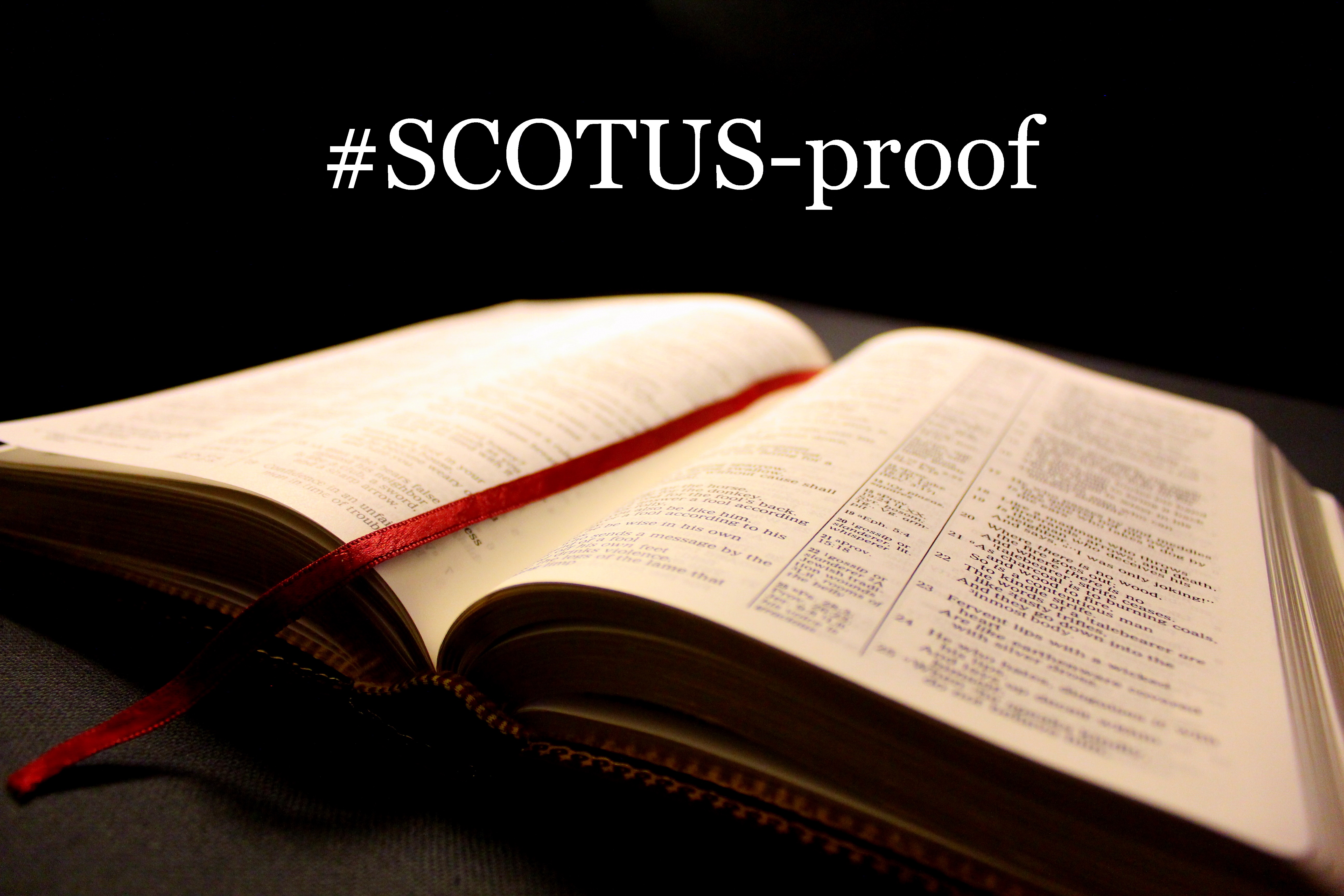
The Document No Man Can Shred

When my daughter sets her mind to something, she’s always devastated when she doesn’t get it. I try to tell her that she should not invest so much hope in the object, but she inevitably sets herself up for disappointment. If we adults are honest, we do it too. I would argue that many of us have done so in recent years. We have placed our hope in men’s words, when really we should be putting our hope in the word of our God in heaven.

The Shredded Constitution

Nothing new to your ears, I’m sure, but the Supreme Court of the United States (SCOTUS) handed down a major decision yesterday. SCOTUS essentially broke contract with the states by interpreting the United States Constitution in such a way that gave them permission to override the sovereignty of the states and the voice of the people who had voted in those states. Now, the states are left with little recourse and few who are willing to do what’s necessary to reverse course, politically.

“It is He who changes the times and the epochs; He removes kings and establishes kings; He gives wisdom to wise men And knowledge to men of understanding” (Dan. 2:21; NASB).

In essence, what SCOTUS did was to shred the constitution indefinitely. All doors are open now, and there are no borders. Power has been centralized in the hands of 5 unelected, rogue individuals who seem dead set on redefining biblical institutions to slap God in the face (Psalm 2). But all is not doom and gloom.

A Constitution to Elevate Religious Freedom

The American Constitution was a document framed in a day and age when most on this continent actually cared what the Bible had to say. It worked as a framework to elevate a largely Christian collective of citizens, much like how a pulpit elevates the word of God. The Constitution was a sort of handmaid to support a nation largely comprised of Christians and carries that baggage with it into our current anti-Christian culture. So it should be no wonder that those who hate Christ and His bride would trample underfoot a document that has for nearly two and a half centuries provided Christians (but all religions really) freedom to live, and speak, and operate according to the dictates of their faith.

The problem for us (Christians) comes when we place our faith in that which elevates us in society over against that which elevates us to our God. As an American and a Texan, I am personally incensed at how this once great document has been shredded by the very court that is tasked with upholding it to the letter. As a Christian, though, I must remind myself that my faith is not founded on that document, but another.

When Religious Freedom Is Taken

In Eastern Europe, there resides a once great nation called Romania. In its glory days, they had a dynasty with great riches and were adored by all. In World War I, they took a neutral stance and were largely unaffected by the war. However, in the days leading up to World War II, they made the unalterable mistake of siding with Hitler and the Nazi regime. When the war started, Hitler placed a puppet government over Romania. When that was overthrown by the Soviets, they placed a puppet government over Romania themselves. That government remained in power until 1989 when it was overthrown in the December Revolution. Romania has limped along ever since.

During the time of Communist power in Romania, religious persecution was rampant, especially for Protestants. A Lutheran pastor by the name of Richard Wurmbrand was imprisoned. He was placed in solitary confinement for much of his imprisonment and regularly subjected to torture. He had no contact with the outside world and did not even know whether or not his wife was still alive. The only comfort he had was his God, and the only access he had to God’s word was the amount that he had committed to memory.

“Your word I have treasured in my heart,

That I may not sin against You” (Ps. 119:11; NASB).

Our Proper Fixation

We spend a lot of time fixating on those things we think will bring us ultimate fulfillment in this life. For me, one of those things is politics. I am opinionated about most things, but especially about politics. This is not a bad hobby to have, but when it becomes a fixation, it can be deadly open_bible_by_rachel_titiriga_-_creative_commonsdangerous. We can start to focus so much on these things and invest so much of our hope and our dreams in these things that they become idols to us. I love the American Constitution, and if I’m not careful, it can become an idol.

What we need today is not to invest so much hope in a man-made document like the Constitution. What we need is to invest our energies in God’s word. We need to be reading it, studying it, sitting under the preaching of it, memorizing it, and meditating on it. And when that day comes when we are locked away with no contact to the outside world and no access to written materials, we can then say that we have the comfort of God, because we’ve stored up His word in our hearts.

We could spend our time storing up a man-made document in our hearts, but what would be the point of that? There will always come a day when such documents will be shredded and trampled underfoot. “The grass withers, the flower fades.” There is one document that we can be sure will always endure, though.

“The grass withers, the flower fades, but the word of our God stands forever” (Isa. 40:8; NASB).

Conclusion

Let us then commit ourselves to that which is lasting, that which is sure, that which will never fail us: God’s word. With the same fervor, let us lay aside our ever-disappointing hopes that we can find any lasting security in men’s words. Our security is found in Christ, and Christ is only to be found in the word of God.

CredoCovenant 2.1

If you look to the menu bar, you’ll see that we have added a new page. The following post is the jist of what you’ll find there.

CredoCovenant is a community contribution site for Reformed Baptists with a variety of different backgrounds and interests. We gladly welcome new contributors to our line-up. We have just a few requirements:

1) Contributors must subscribe to the doctrine taught in The Baptist Confession (1689).
2) Contributors must be baptized Christians covenanted to, and in good standing with, a local congregation of believers.
3) Contributors must demonstrate that they can offer something unique to the conversation.

If you or someone you know fits this bill, please feel free to e-mail us at credocov@gmail.com. We’d love to add your voice to our website.

01-hands-typing-on-a-computer

Naturalism and Education

In this blog series, I have been examining the effect of sin on the quality of higher education. In particular, I have been examining how worldview changes (and their subsequent effects of society) have led to a change in the quality of higher education as well as the mission of higher education. Most of these changes can be described by examining how the presence of sin in our hearts negatively affects and undermines the human mind and intellect (otherwise known as noetic effects of sin). In previous blogs, I addressed general problems with higher education, but in this blog I want to focus my critique on STEM (science, technology, engineering, and mathematics) education. In my view, the fourth major issue associated with contemporary education is the growing neglect of philosophical self-reflection and training in the STEM fields. One important aspect of contemporary education which needs to be recovered is the belief that all college students, including STEM majors, need to receive a thorough philosophical training so that they can understand the proper usefulness and limitations of their academic discipline.

Our Current View of the Philosophy and the Humanities

Historically, one of the pillars of higher education was the study of philosophy and the application of philosophy to the other sciences. However, as rising tuition and mounting student debt makes prospective income a bigger part of choosing a major, disciplines such as philosophy and history are under attack in favor of fields as engineering and business, which are more likely to lead to jobs and salaries that justify the cost of four-year college education. Now, the debate concerning the cost of education will be the subject of another blog, but the usefulness of the humanities is no longer just an academic conversation as only 8 percent of students now major in the humanities, according to the American Academy of Arts and Sciences, down from a peak of more than 17 percent in 1967. Humanities professors contend that what would be lost in eliminating humanities majors is exactly what employers say they really need: the kind of education that teach students how to think, innovate, work in teams, and solve problems. In other words, humanities professors are concerned that we have become shortsighted because we are more concerned with the cost of education rather than the value of education. So far, the humanities are losing the argument.

Now, the debate concerning the cost of education will be the subject of another blog, but it is quite clear that many people have quite a low view of the value of the humanities and the other classical fields of education. In addressing the argument concerning the value of the humanities majors, consider the comment from a non-humanities major

And how exactly are they going to solve problems when they don’t have any skills with which to do so? After all, they have just spent four years reading books by old dead white men and then arguing about it. They have also listened to four years of professors telling them that “the life of the mind” is something that can’t be taken away from you by the soulless vocational professions. Maybe they should just eat their books when they are done with them… maybe then they would have realized that reading old poetry doesn’t really prepare you to be a contributing member of society.

Generally speaking, when STEM majors hear that there are certain critical thinking skills that are not learned within the STEM fields, the response is usually very defensive. Consider the comments in the above article from physical scientists and engineers:

I’m sorry, but this REALLY irritates me.  I’ve got nothing against the humanities, but I really get annoyed by this idea that the ONLY place you can learn critical thinking, communicating, and problem solving is through them.  Yes, a good liberal arts background will help teach you these skills.  But so will a good engineering or science background (and surely other degrees as well which I know less of).  I’ve been working on a multinational science satellite mission for the past decade.  You’re really telling me that because I got an engineering degree, I don’t know how to work with a team, pose complex and creative problems, and think critically about how to solve them?

A Major Flaw in Science Education

From my personal experience, the opinions expressed in the comments section from the above TIME magazine article are generally consistent with how STEM majors view the humanities. Most STEM majors believe that there are many valuable insights that a STEM education can offer to society (and to other fields), but there is relatively little insight offered in the humanities that cannot be gleaned in a standard STEM education. In my view, this has contributed to a very unbalanced science education in America. Today, the prevailing view seems to be that if a STEM major takes their general education courses in psychology, sociology, history, English, and philosophy, then they have learned everything that they really need to know about those fields. It is quite true that STEM majors learn critical thinking abilities, but it is also quite true that STEM majors are usually quite non-reflective on the philosophical basis for the STEM fields. The intellectual ignorance and faulty perspectives on this matter are usually self-inflicted, but it is also true that this ignorance is promoted by the general culture around us. We live in a society in which it appears that moral reality is created by the observer, while things that are “scientifically proven” are considered formally true. To some, this gives the impression that what scientists do deals with reality, whereas what philosophers and others do is speculation.

In my view, the biggest flaw in STEM education today is the lack of philosophical reflection. Working scientists (and science students by implication) usually take for granted a set of basic assumptions that are needed to justify the scientific method: (1) there is an objective reality shared by all rational observers; (2) This objective reality is governed by natural laws; and (3) These natural laws can be discovered by means of systematic observation and experimentation. These are all assumptions that need to justified philosophically and the philosophy of science seeks a deep understanding of what these underlying assumptions mean and whether they are valid.

A cursory examination of the 20th century discussion on the philosophy of science should bring a sense of self-reflection to modern scientists concerning the formal validity of the scientific method. Moreover, a cursory examination of the critiques of the scientific method (i.e. the problem of induction) should produce a sense of humility to modern STEM majors concerning the limitations of the scientific method. Most STEM students are not introduced to the limitations of science until graduate school. Moreover, most STEM majors have been taught that nothing is to be accepted unless it has been “scientifically proved”, and nothing has any claim to be called true unless science acknowledges that claim. Obtaining a deeper background in philosophy will give STEM majors hesitancy before they make vacuous statements such as “it has been scientifically proved”. When STEM majors accept these statements without thinking through the critiques and limitations, it’s only a matter of time before a worldview of naturalistic materialism is accepted as a methodological assumption.

Our Response

Unfortunately, this is the state of science education around the country and the general outlook from STEM students and professionals. It is at this point in which a Christian view of education and knowledge is superior. The Christian worldview informs us that supernatural revelation is the only objective source of truth and this supernatural revelation is given to us through the Bible. Thus, this worldview compels us to address the philosophical grounding and implications of other knowledge claims, including the claims of modern science. This means that a rigorous philosophical education is necessary for each student to have so that he/she can properly assess the difference between that which is formally true and that which is useful. For the case of STEM majors, philosophical training and self-reflection will helps us to know the difference between falsification and verification or the relationship between metaphysics and science, both of which have implications for the working scientist. Thus, for the quality of American education to improve (particularly in the STEM fields), we (i.e. those of us in the academy) need to insist that it is insufficient for any student to leave college without undergoing deep philosophical reflection on the nature and usefulness of their academic discipline.

Band of Brothers: Bound by the Word of God

The following article is my sermon transcript from this past Lord’s Day. I don’t take my transcripts into the pulpit with me; I take an outline based on the transcript. However, this is the jist of the exposition. It seemed appropriate given some recent events on the interwebs that I post it here. For the record, I am not a fan of how things translate from Microsoft Word to WordPress, but I’ll get over it.

Introduction

I am convinced that many of the “one another” passages of Scripture originally had in view only the local church. Still today, even in this age of social media and the blogosphere, I still believe its primary application is for the local church. However, more and more, I am seeing Christians putting their disdain for one another on public display on the internet. We are often haughty, self-promoting, impatient, cynical, and irreverent in the way that we speak to and about our fellow believers on the internet.

I don’t view this as a practical deficiency within the church. I see it primarily as a theological deficiency. It’s a sign that many of us who name the name of Christ and call God our Father do not truly understand the implications for such a claim when we address one another in public forums. We too easily forget the apostle John’s warnings:

“The one who says he is in the Light and yet hates his brother is in the darkness until now” (1Jn. 2:9; NASB).[1]

“But the one who hates his brother is in the darkness and walks in the darkness, and does not know where he is going because the darkness has blinded his eyes” (1Jn. 2:11; NASB).

“Everyone who hates his brother is a murderer; and you know that no murderer has eternal life abiding in him” (1Jn. 3:15; NASB).

“If someone says, ‘I love God,’ and hates his brother, he is a liar; for the one who does not love his brother whom he has seen, cannot love God whom he has not seen” (1Jn. 4:20; NASB).

We must recognize that, when we lack genuine brotherly affection for one another, we are living like pagans. This commends neither us nor our God to a lost and dying world. However, Peter has a different understanding of how and why we ought to treat one another with brotherly love. As Christians, we are expected to have purified ourselves in obedience to truth. As such, we should bear the fruit of that obedience: brotherly love. We bear that fruit because of the seed that has taken root in our hearts: the word of God.


The Fruit of Obedience to the Truth: Brotherly Love

“Having purified your souls in obedience to the truth into a genuine brotherly love, [you] fervently love one another from the heart” (1Peter 1:22; personal translation).[2]

In Obedience to the Truth

Here Peter uses another participle: having purified. He assumes that his readers have already purified themselves. Indeed, this is one of the marks of a true Christian. A true Christian will set himself apart, sanctify himself, and purify himself from all worldliness (Rom. 12:2; 1Cor. 3:18-19). How primarily does he purify himself? By availing himself of the word of God (2Tim. 3:16-17).

“All Scripture is given by inspiration of God, and is profitable for doctrine, for reproof, for correction, for instruction in righteousness, 17 that the man of God may be complete, thoroughly equipped for every good work” (2Tim. 3:16-17).

Notice that Peter says we purify our souls “in obedience to the truth.” The truth being spoken of here is found only in Scripture, the very word of God. We are called to be obedient to Scripture. However, if we are to rightly subject ourselves to the word of God, we must rightly understand what the word of God is teaching us. This requires study. This requires work. This requires commitment and discernment.

The world tells us this dogged commitment to truth cannot coincide with a lifestyle marked by love. I have heard seasoned Christians go so far as to say that John 1:14 gives us a paradox because it describes Christ as “full of grace and truth” (NASB; emphasis added). This idea that love and truth are diametrically opposed to one another has bled even into the church. I would argue, however, that the apostles had no concept of truth existing apart from love or love apart from truth. If I tell my friend I love him, and I know he’s blindly walking toward a cliff, I don’t demonstrate my love for him by withholding truth from him.

Christians can get nitpicky. We can correct people for things that don’t need correcting, especially on social media. When we become overcritical of our friends and family, this could be a sign of an unloving spirit. We can certainly fall into the trap of speaking the truth in an unloving way, but that does not mean that we throw the baby out with the bathwater. Often, to speak the unadulterated truth is the most loving thing we can do.

However, when confronted with the truths of Scripture to the degree that most Reformed Christians are in Western society today, we ought to be the most loving, most caring, most merciful Christians people meet. We spend so much time studying and relishing in the gospel and the great mercies that we’ve been shown by God. Ought we to show mercy to our fellow man as well?

We take a great fire into our bosom when we study the truths of God’s word. Can a man take a fire into his bosom and not be burned? And can we regularly take the refining words of God into our hearts and not be permanently changed? Yet, many of us claim to read the word regularly and affirm the historic doctrines of the faith, but we don’t seem to know the first thing about loving our brothers. We would rather treat the truth of God as an academic endeavor or a reason to debate. We often treat God’s truth as a tool for changing others when we should first be changed by it. We first need to internalize God’s truth and let it purify us.

Brotherly Love

This gets us to the heart of this obedience to truth. We are called to be obedient to the truth not merely for the sake of knowing and loving God more. Rather, as we are purified in obedience to the truth of God, it should cause us to love both Him and one another more.

The truth of God teaches us of our original state holiness and joy in the garden (Eph. 4:24). It further teaches us the value of each human being, in that we’ve each been created in the image of God (Gen. 1:26-27). God’s truth goes on to teach us how we have all fallen short of God’s glory and marred His image in ourselves (Rom. 3:23; 8:29). Finally, we discover from God’s truth how each of us are utterly helpless to save ourselves apart from God’s amazing grace through the gospel (Mk. 10:26-27). This knowledge ought to compel us to have a deeper appreciation for our brothers and sisters in the faith, and to extend a greater amount of mercy toward them, even in their sin (Mt. 5:7).

Furthermore, when we recognize the fact that we are each born into a new family through Christ, our love for one another takes on yet another aspect. We have gone from merely having common life experiences to having a common Father in heaven. We are brothers and sisters in Christ in a very real, very eternal sense. As such, we are bound to one another not merely by some human contract, but by a divinely established familial bond (Mk. 10:28-30).

As brothers and sisters, then, we have obligations to one another. Think of it this way. The only way that earthly brothers or sisters can remove themselves permanently from their siblings is to remove themselves from their parents’ house. As long as we call ourselves children of our Father in heaven, we are likewise bound to our Christian brothers and sisters. This means that we have certain obligations to one another. We’re a family.

This means that, when I see a brother sinning, I not only have an obligation to stop him from sinning. I also have an obligation to do so in a manner that helps him retain as much dignity as possible. A common knee-jerk reaction to sin among Christians is to see a brother headed over a cliff and think it’s our job to give him the final shove. That is not brotherly love. Brotherly love means to reach out to that brother, show him the error of his ways, seek reconciliation, and ultimately to seek restoration (Gal. 6:1-2):

“Brethren, if a man is overtaken in any trespass, you who are spiritual restore such a one in a spirit of gentleness, considering yourself lest you also be tempted. Bear one another’s burdens, and so fulfill the law of Christ” (Gal. 6:1-2).


The Root of Obedience to the Truth: The Gospel

having been born again not with perishable seed but imperishable through the living and eternal word of God. Because,

All flesh is as grass,

And all their glory is as a flower in the grass.

The grass withers,

And the flower falls,

But the word of the Lord abides forever.

And this is the word that was proclaimed to you (1Pt. 1:23-25; personal translation).

We have been born again into an eternal, spiritual family. That which brought about our new birth is likewise eternal and spiritual: the living and eternal word of God. Were we born into this new family through flesh and blood, we would have nothing in which to be confident, for flesh and blood both perish. Rather, “as many as received Him, to them He gave the right to become children of God, to those who believe in His name: who were born, not of blood, nor of the will of the flesh, nor of the will of man, but of God” (John 1:12-13; NKJV).

We are born of an imperishable seed. We are born of God (John 1:13) “through the living and eternal word of God” (vs. 23). In other words, it was through the word of God that God brought about our salvation. The word was the seed that was planted in our hearts’ soil (Mt. 13:1-23 – “Parable of the Sower”). This word, once it takes root and extends deep into the soil of our hearts, reaps in us eternal life!

It’s this word of God that Peter says is living and eternal. He takes this description from Isaiah 40. In Isaiah 40, Isaiah is prophesying about the coming of the Messiah and His forerunner: John the Baptist (vs. 3; cf. Mt. 3:3). Isaiah goes on to prophesy regarding the Messiah:

“The glory of the LORD shall be revealed,

And all flesh shall see it together;

For the mouth of the LORD has spoken.”

The voice said, ‘Cry out!’

And he said, ‘What shall I cry?’

‘All flesh is grass,

And all its loveliness is like the flower of the field.

The grass withers, the flower fades,

Because the breath of the LORD blows upon it;

Surely the people are grass.

The grass withers, the flower fades,

But the word of our God stands forever’” (Isa. 40:5-8).

Isaiah prophesied these words as words of deliverance for the people of God. They had been in exile, and now they were going to see their deliverance. God’s people had seen tremendous warfare and received from the Lord’s hands “double for all her sins” (Isa. 40:2). Now, God speaks comfort to His people, “that her warfare is ended, that her iniquity is pardoned.” Now, we know that this peace to come was Christ Himself, given that this is the passage used to refer to His forerunner in Matthew 3:3. Christ is the glory of the Lord that shall be revealed (Isa. 40:5).

The people of God, then, have just experienced a great trial in their exile to Babylon. They had seen much death and much war. They had experienced a tremendous defeat and been carried away by a foreign people. Looking forward to the Messiah to come, they are now told to set aside any faith they had previously put in flesh that fades, and to trust in the abiding, imperishable word of God.

In like manner, we are told to lay aside any trust that we may have placed in the flesh. Our confidence is not in the flesh, but in Christ. The Jews will not be saved on account of the fact that they share in flesh and blood with Abraham. They will only be saved if they believe like Abraham in the Seed of Abraham, which is Christ (Gal. 3:16, 29):

“Now to Abraham and his Seed were the promises made. He does not say, “And to seeds,” as of many, but as of one, “And to your Seed,” who is Christ” (Gal. 3:16).

“And if you are Christ’s, then you are Abraham’s seed, and heirs according to the promise” (Gal. 3:29).

John the Baptist told the Pharisees and Sadducees, who were trusting in the flesh, “Brood of vipers! Who warned you to flee from the wrath to come? Therefore bear fruits worthy of repentance, and do not think to say to yourselves, ‘We have Abraham as our father.’ For I say to you that God is able to raise up children to Abraham from these stones” (Mt. 3:7-9).

Many today even think they will get to heaven on account of fleshly association. They reason that they were raised in church by godly parents and, thus, they must be good to go. Let us not fool ourselves into thinking that we can ride into heaven on our parents’ faith. We must have faith ourselves, but not in ourselves. We must each put our faith in Christ for our own salvation. We will not get into heaven on the merits of the flesh, whether ours or another’s.

The Lord, through Isaiah, said:

All flesh is as grass,

And all their glory is as a flower in the grass.

The grass withers,

And the flower falls,

But the word of the Lord abides forever” (1Pt. 1:24; personal translation).

We are then to trust in the preached word, not in some genetic heredity. Our inheritance is heavenly, eternal, secure, and abiding. It is as secure and abiding as the very word of God, but it is for those who believe and for those who believe alone. Will there be a great remnant of Jews who will be saved before the return of the Lord and the consummation of all things? Many believe this to be the case. It certainly seems so from my study of Romans 11. However, those Jews who come to salvation in the end will be saved, not on account of their flesh, but on account of their belief in the Lord Jesus Christ.

This is the word that was proclaimed to us: our salvation in Jesus Christ! It’s on account of this word and on account of our belief in this word that we come to be included in this great family of God. It’s because of this word of truth that we have heard and now obey that we are purified and compelled to a fervent brotherly love toward one another.

The word here rendered proclaimed is the verb form for the word εὐαγγέλιον, from which we get our English word evangelism. In essence, it means good proclamation, and it’s where we also get the word gospel (or good news). So then, we know that we have come to be brothers and sisters in Christ through the preaching of the gospel, the truth of God from the word of God.

It’s only through this word that any of us are ever saved. According to Romans 10:

“How then shall they call on Him in whom they have not believed? And how shall they believe in Him of whom they have not heard? And how shall they hear without a preacher? And how shall they preach unless they are sent? As it is written:

‘How beautiful are the feet of those who preach the gospel of peace,

Who bring glad tidings of good things!’” (Rom. 10:14-15).

We must then hear the word of God to be saved. We must hear the gospel. It goes without saying then that, if we want to see others in our lives come to salvation, they too must hear the gospel. How shall they believe on Him of whom they have not heard? And how shall they hear without a preacher? Let us then go forth with boldness and proclaim to our friends, family, coworkers, and neighbors the only word that has any power to save them from their sins.

Conclusion

Those who receive this word and obey it will be purified and set apart into the family of God. Each new convert to the gospel of Jesus Christ is a new brother or sister in our great family. We need to treat them as such. We need to treat one another as such, because that is what we are. We are a family, and as sons and daughters of the God of love, we ought to be the greatest example of love the world has ever seen. So be holy as your Father in heaven is holy (1Pt. 1:16). But also let us love one another, because our Father in heaven is love.

[1]All citations from Holy Scripture from the New King James Version of the Bible, except where otherwise noted.

[2]Personal translations translated from UBS4.