A Little Time With The 1689: Day 132

31259076995_863416495b

Day 132

Of Christ the Mediator.

Chapter 8, Paragraph 1.

and judge of the world:

Scripture Lookup

Acts 17:31

Reflection

“He will come again in glory to judge the living and the dead…” – Nicene Creed

No one likes to be judged. Even the verb “judge” has the connotation of disapproval; rarely do you hear it used in cheerful conversation. When someone says “Don’t judge me!” they are really saying, “Don’t tell me my actions are wrong, since you don’t know my motivations or circumstances, nor do you have any moral high ground to decide my actions are wrong.”

When Jesus comes to judge the world, the cry of “Don’t judge me!” will fall silent. This judge has every right to determine what actions are wrong, for He has ruled what is right and wrong. He knows our motivations, for “the word of God is living and active and sharper than any two-edged sword,… and able to judge the thoughts and intentions of the heart.” (Hebrew 4:12) He knows your circumstances because He decreed that they come to pass. He has the ultimate moral high ground to judge, for He walked this earth, tempted in every way that we are, yet He did not sin.

God chose and ordained His Son, Jesus, to judge the world. And the world will be judged – there is no free pass. No one will be able to stand on their own righteousness before Him, for all have sinned. Yet this righteous Judge, through His mercy and grace, has paid the penalty for sinners who have faith in Him. As His elect, we can look forward to His judging, for His righteousness covers us, and that righteousness is perfectly holy.

Questions to Consider

  • What is your reaction to Jesus as judge?

A Little Time With The 1689: Day 131

2941512342_cabdddf7b6

Day 131

Of Christ the Mediator.

Chapter 8, Paragraph 1.

the heir of all things,

Scripture Lookup

Hebrews 1:2

Reflection

God ordained Jesus, His only begotten Son, to be the heir of all things. All things, not just an earthly kingdom to rule, or governance of a spiritual realm, or even a little planet in the cosmos. Every last particle is to be Christ’s. A man with that much power, and yet we can fully trust Him, for He is good. It is astounding to contemplate.

How much the Father values the Son! “This is my beloved Son, in whom I am well-pleased” is repeated several times in the New Testament. God exalted Christ so highly for His work on our behalf that every knee will bow and every tongue will confess that Jesus is Lord. (Philippians 2:9-11) If the Father finds delight in Jesus, and appoints Him heir over all things, shouldn’t that tell us that Jesus is not someone to overlook in any way? Our world is so flippant about its blasphemy concerning Jesus. It is, sadly, to be expected from them. But shouldn’t the church be zealous for Jesus’ reputation just as the Father is? Yet how often is our savior, the heir of all things, taken for granted by His very own sheep? How often do Christians cheapen His name when they purchase plastic “Jesus” action figures or share visual misrepresentations of Him? Simply because the heir of all things humbled Himself to tabernacle among us does not mean we should be careless in how we refer to Him.

Since Jesus is the heir of all things, He is deserving of the utmost reverence. As His elect, we also ought to be that much more diligent in revering Him, for He shares that inheritance with us. Romans 8:16-17 states: “The Spirit Himself testifies with our spirit that we are children of God,  and if children, heirs also, heirs of God and fellow heirs with Christ, if indeed we suffer with Him so that we may also be glorified with Him.” We are fellow heirs with Christ! We receive the blessings of His inheritance! May we be ever thankful for such a provision, and mindful of it when we are tempted to despair of any “lack” we experience in this life.

Questions to Consider

  • Do you long for Jesus to receive His full inheritance?

A Little Time With The 1689: Day 130

2179171956_bae9d41211

Day 130

Of Christ the Mediator.

Chapter 8, Paragraph 1.

…Head and Savior of his Church

Scripture Lookup

Ephesians 1:22,23

Reflection

Ask people on the street who the head of the church is, and you would probably receive different answers. Some may say the Pope. Some may say their pastor, or elders. Some may point to their deacon board, or general assembly. Those answers would be incorrect. There is only one head of the church, and that is Christ.

Jesus is the only savior of His church. There is salvation in no one else, as Acts 4:12 states. He alone laid down His life for her, that she might live. The Christian owes His very existence as a Christian to Jesus. Even the name, “Jesus”, points to His role as savior of his church: “She will bear a Son; and you shall call His name Jesus, for He will save His people from their sins.” (Matthew 1:21) The church is His; her well-being He takes personally.

Since Jesus is our savior, it naturally follows that He is our Head. He alone is to lead the church. The church should not govern itself after the traditions and opinions of men, but is to follow the laws and directives given to us by Christ through His word. Are we, as His church, striving to follow His lead?

Questions to Consider

  • Do you prefer Jesus as savior or as head, rather than embracing both of His roles in your life?

A Little Time With The 1689: Day 129

11090139803_d7f706e9b2

Day 129

Of Christ the Mediator.

Chapter 8, Paragraph 1.

…and King;…

Scripture Lookup

Psalm 2:6

Luke 1:33

Reflection

Christ is King!

Out of the three offices that God ordained Jesus to fulfill, that of King seems to be the most well-known. While I know of churches titled “Christ the King”, and cards and posters that declare “Jesus is King”, I am hard-pressed to recall any poster extolling Jesus as priest. And with the multitudinous diversity of church names present here in the southern United States, I still have yet to see a church entitled “Christ the Priest”! The truth that Jesus is King can sometimes be so commonly declared that it may seem matter-of-fact to us. But there is nothing trite about Jesus’ reign.

Christians take comfort in knowing Jesus is king. But what is He king of? We know that since Jesus is fully God, He is sovereign over all things. Yet He is king of the elect in a special way. He subdues rebellious sinners and makes them willing subjects, ready to serve Him. As king He determines the laws of His kingdom. Through His perfect kingship, He protects His people, defends His people, and vanquishes His enemies.

Therefore, when we read that Jesus is King, we should not allow the commonality of that phrase to dull our affection for Him. Rather, our praise and allegiance should rise up within us! His rule is just and merciful. We can depend on Him to rule wisely, and need not fear to follow His commands. His protection of us is iron-clad; our enemies are surely doomed. What a majestic and mighty king!

Questions to Consider

  • Have you ever considered how Jesus is king?

A Little Time With The 1689: Day 128

29925794130_0fb285ea20

Day 128

Of Christ the Mediator.

Chapter 8, Paragraph 1.

priest,,…

Scripture Lookup

Hebrews 5:5,6

Reflection

Jesus was ordained by God to fulfill the role of a priest. Not only a priest, but a high priest, chief among all priests. What does Jesus do in His role as a great high priest?

Priests served as mediators between God and His people. In ancient Israel, they constantly offered up sacrifices on behalf of the people. Being men, they understood the frailties and weaknesses of men. Appointed by God, Jesus was not like the priests that sacrificed in the tabernacle and temple in the Old Testament. First of all, He was not of the tribe of Levi. Only descendants of Levi were to be priests. Yet God appointed Him priest according to the order of Melchizedek. The priests that worked in the temple offered up various sacrifices for sin daily; Christ offered Himself. The high priest in the Old Testament offered atonement for the people, but also had to atone for himself. Christ had no need to atone for His sins, because He had none. He willingly atoned for the sins of His people even though there was no obligation for Him to do so. The Levitical priests died and were replaced; Jesus lives forever, holding His priesthood permanently, interceding on behalf of His own.

Christ’s role as high priest as making Him aloof and far away from us. While He is in an exalted position, He is our mediator between us and God. He can sympathize with our weaknesses, because He was tempted in all things as we are, yet without sin. We can boldly come to God through His perfect priestly role. Do not hesitate to avail yourself of Him for grace and mercy!

For it was fitting for us to have such a high priest, holy, innocent, undefiled, separated from sinners and exalted above the heavens; who does not need daily, like those high priests, to offer up sacrifices, first for His own sins and then for the sins of the people, because this He did once for all when He offered up Himself. For the Law appoints men as high priests who are weak, but the word of the oath, which came after the Law, appoints a Son, made perfect forever.

-Hebrews 7:26-28

Questions to Consider

  • Have you ever considered how Jesus is a priest?

A Little Time With The 1689: Day 127

31417963024_a84a021df8

Day 127

Of Christ the Mediator.

Chapter 8, Paragraph 1.

the prophet,

Scripture Lookup

Acts 3:22

Reflection

Jesus was ordained to fulfill many roles. One of those roles is that of prophet. How is Jesus a prophet? He is a prophet in that He brings the Word of God to the people. The gospel of John calls Him “the Word”, and “the Word became flesh and dwelt among us, and we saw His glory, glory as of the only begotten from the Father, full of grace and truth.” (John 1:14) He revealed the will of the Father. (John 6:40) Several times He declared that He spoke not on His own initiative, but on behalf of His father. The Father Himself called people to listen to the words Jesus spoke: “While he was still speaking, a bright cloud overshadowed them, and behold, a voice out of the cloud said, “This is My beloved Son, with whom I am well-pleased; listen to Him!” (Matthew 17:5) It was Jesus that expounded the Scriptures to the disciples on the road to Emmaus. Jesus thus fulfilled the role of prophet, and continues to do so today. (Hebrews 1:1)

Questions to Consider

  • Have you ever considered how Jesus is a prophet?

Lifting My Eyes

8539009694_1df1c63997_c

Right now, my house is a mess.

Legos have become my new flooring. Shrill cries from my 6-week old demand attention. The eldest, responsible for making breakfast, used too little flour in the scones. Not due to a lack of flour, but because he didn’t want to use bleached flour.  Now the morning meal is burnt and inedible. Racing through the house are other children, howling after the newly-fixed stray cat who was supposed to be contained in the guest room. Any instruction Mommy has given to make beds or brush teeth has evaporated from their minds. Quarrels and conflicts bubble up from the corners of the house. The day is escaping me.

Little whispers of doubt rise up and escalate: “What if your homeschooling isn’t good enough? If only you could spend money in joining x, y, and z – then the children could get interaction, education, and you could influence your community! With more stuff, then more people could know us and learn about our church. We could invest more in the church, and the church would grow. After all, all these other churches actually have programs and money to spend, and look how they are growing! Although they have super outgoing, super put together, super hip and with it pastors’ wives. These wives have great hair. I haven’t had a professional haircut in years. I don’t do enough. I am not friendly enough. I don’t rest in Christ enough. I can’t even be a good Christian. No one else thinks like this. Everything will fail.

I. I. I.

There is so much of me in these thoughts. What is the remedy?

Him. Him. Him.

…fixing our eyes on Jesus, the author and perfecter of our faith…

-Hebrews 12:2

“Be thou my vision…”

“Turn your eyes upon Jesus…”

Cling tighter to Christ. His Word is sure. He changes not; His compassions they fail not. He is not fickle. He does not lie. He is not dependent upon me. I can do all things through him who strengthens me – a passage talking about contentment, not self-esteem or fulfilling your dreams. He is able to, and He will complete this good work in you, conforming you to the image of the Son. Cling to Christ!

.Learn much of your own heart; and when you have learned all you can, remember you have seen but a few yards into a pit that is unfathomable. ‘The heart is deceitful above all things, and desperately wicked: who can understand it?’ Jer. xvii. 9  Learn much of Christ. For every look at yourself, take ten looks at Christ. He is altogether lovely. Such infinite majesty, and yet such meekness and grace, and all for sinners, even the chief!

-Robert Murray M’Cheyne

17162722277_ec4a83e0cc_c

Top Five Books on the Five Solas: Introduction (Mathison) – Ligonier

Over at Ligonier, Keith Mathison has begun a series of articles in which he will be detailing the top five books written on each of the Five Solas of the Reformation. Keep you eye out for the rest.

_________________________

A few years ago, I ran across a comic strip in which one of the figures says, “Those who don’t study history are doomed to repeat it. Yet those who do study history are doomed to stand by helplessly while everyone else repeats it.” This comic is a humorous, albeit somewhat cynical, play on the well-known quote by the American philosopher George Santayana (1863–1952), who wrote: “Those who cannot remember the past are condemned to repeat it.” It is a well-known and widely used quote because there is much truth in it.

The truth that Santayana grasped is abundantly illustrated in the history of the modern evangelical church. We are a people who have forgotten our roots, and in many cases we really don’t seem to care. The church exists in a world of rapidly changing technology, a world in which almost everyone has been assimilated into the incessant chatter of social media and real-time updates on everything from world politics to what your friend had for breakfast this morning. If we are to be relevant, we too must be a people of the new and the now. Or so we think. Read more…

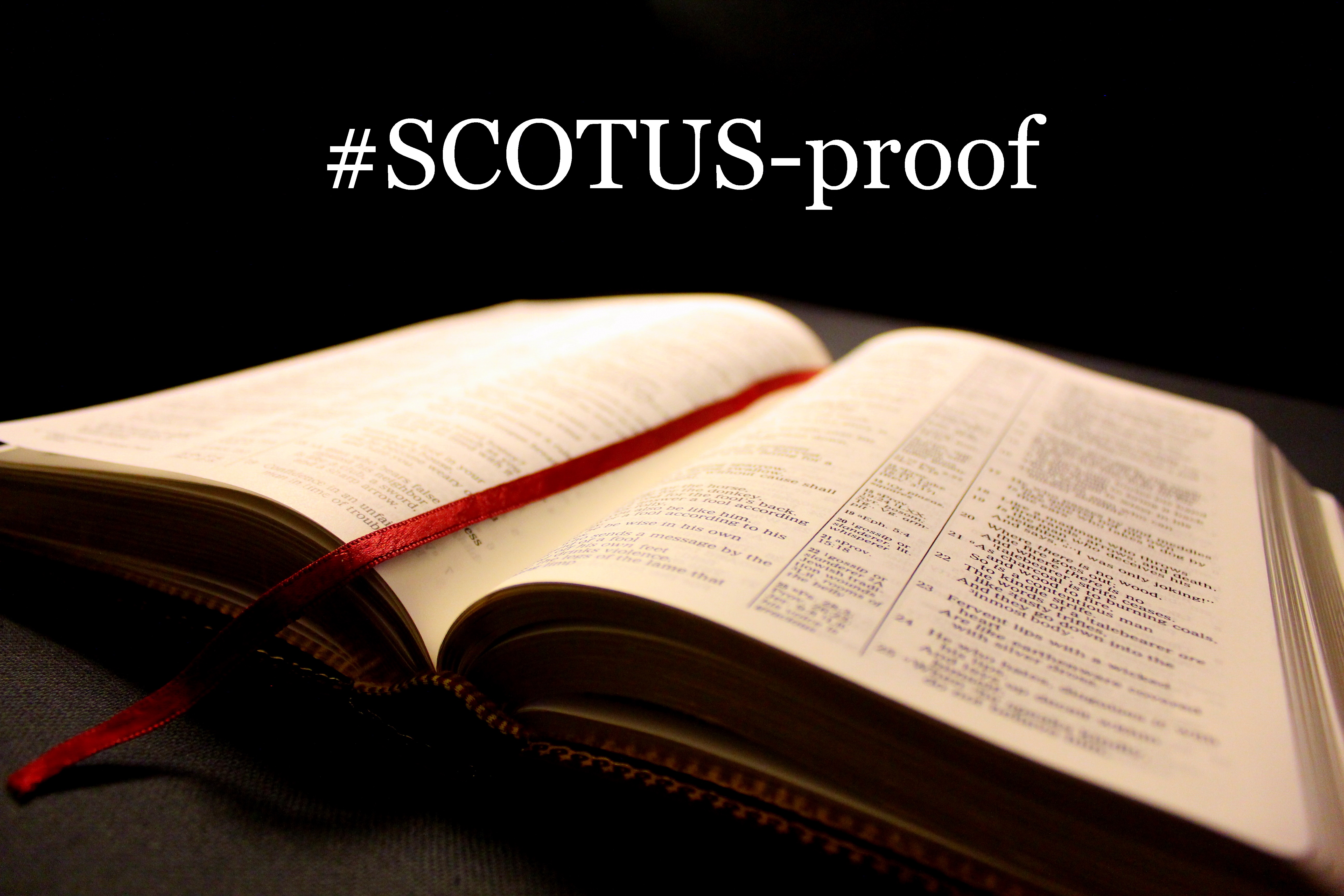
The Document No Man Can Shred

When my daughter sets her mind to something, she’s always devastated when she doesn’t get it. I try to tell her that she should not invest so much hope in the object, but she inevitably sets herself up for disappointment. If we adults are honest, we do it too. I would argue that many of us have done so in recent years. We have placed our hope in men’s words, when really we should be putting our hope in the word of our God in heaven.

The Shredded Constitution

Nothing new to your ears, I’m sure, but the Supreme Court of the United States (SCOTUS) handed down a major decision yesterday. SCOTUS essentially broke contract with the states by interpreting the United States Constitution in such a way that gave them permission to override the sovereignty of the states and the voice of the people who had voted in those states. Now, the states are left with little recourse and few who are willing to do what’s necessary to reverse course, politically.

“It is He who changes the times and the epochs; He removes kings and establishes kings; He gives wisdom to wise men And knowledge to men of understanding” (Dan. 2:21; NASB).

In essence, what SCOTUS did was to shred the constitution indefinitely. All doors are open now, and there are no borders. Power has been centralized in the hands of 5 unelected, rogue individuals who seem dead set on redefining biblical institutions to slap God in the face (Psalm 2). But all is not doom and gloom.

A Constitution to Elevate Religious Freedom

The American Constitution was a document framed in a day and age when most on this continent actually cared what the Bible had to say. It worked as a framework to elevate a largely Christian collective of citizens, much like how a pulpit elevates the word of God. The Constitution was a sort of handmaid to support a nation largely comprised of Christians and carries that baggage with it into our current anti-Christian culture. So it should be no wonder that those who hate Christ and His bride would trample underfoot a document that has for nearly two and a half centuries provided Christians (but all religions really) freedom to live, and speak, and operate according to the dictates of their faith.

The problem for us (Christians) comes when we place our faith in that which elevates us in society over against that which elevates us to our God. As an American and a Texan, I am personally incensed at how this once great document has been shredded by the very court that is tasked with upholding it to the letter. As a Christian, though, I must remind myself that my faith is not founded on that document, but another.

When Religious Freedom Is Taken

In Eastern Europe, there resides a once great nation called Romania. In its glory days, they had a dynasty with great riches and were adored by all. In World War I, they took a neutral stance and were largely unaffected by the war. However, in the days leading up to World War II, they made the unalterable mistake of siding with Hitler and the Nazi regime. When the war started, Hitler placed a puppet government over Romania. When that was overthrown by the Soviets, they placed a puppet government over Romania themselves. That government remained in power until 1989 when it was overthrown in the December Revolution. Romania has limped along ever since.

During the time of Communist power in Romania, religious persecution was rampant, especially for Protestants. A Lutheran pastor by the name of Richard Wurmbrand was imprisoned. He was placed in solitary confinement for much of his imprisonment and regularly subjected to torture. He had no contact with the outside world and did not even know whether or not his wife was still alive. The only comfort he had was his God, and the only access he had to God’s word was the amount that he had committed to memory.

“Your word I have treasured in my heart,

That I may not sin against You” (Ps. 119:11; NASB).

Our Proper Fixation

We spend a lot of time fixating on those things we think will bring us ultimate fulfillment in this life. For me, one of those things is politics. I am opinionated about most things, but especially about politics. This is not a bad hobby to have, but when it becomes a fixation, it can be deadly open_bible_by_rachel_titiriga_-_creative_commonsdangerous. We can start to focus so much on these things and invest so much of our hope and our dreams in these things that they become idols to us. I love the American Constitution, and if I’m not careful, it can become an idol.

What we need today is not to invest so much hope in a man-made document like the Constitution. What we need is to invest our energies in God’s word. We need to be reading it, studying it, sitting under the preaching of it, memorizing it, and meditating on it. And when that day comes when we are locked away with no contact to the outside world and no access to written materials, we can then say that we have the comfort of God, because we’ve stored up His word in our hearts.

We could spend our time storing up a man-made document in our hearts, but what would be the point of that? There will always come a day when such documents will be shredded and trampled underfoot. “The grass withers, the flower fades.” There is one document that we can be sure will always endure, though.

“The grass withers, the flower fades, but the word of our God stands forever” (Isa. 40:8; NASB).

Conclusion

Let us then commit ourselves to that which is lasting, that which is sure, that which will never fail us: God’s word. With the same fervor, let us lay aside our ever-disappointing hopes that we can find any lasting security in men’s words. Our security is found in Christ, and Christ is only to be found in the word of God.

LBCF of 1677/1689 – Chapter Eight, Of Christ the Mediator

1. It pleased God, in His eternal purpose, to choose and ordain the Lord Jesus, his only begotten Son, according to the covenant made between them both, to be the mediator between God and man; the prophet, priest, and king; head and saviour of the church, the heir of all things, and judge of the world; unto whom he did from all eternity give a people to be his seed and to be by him in time redeemed, called, justified, sanctified, and glorified.
( Isaiah 42:1; 1 Peter 1:19, 20; Acts 3:22; Hebrews 5:5, 6; Psalms 2:6; Luke 1:33; Ephesians 1:22, 23; Hebrews 1:2; Acts 17:31; Isaiah 53:10; John 17:6; Romans 8:30 )

2. The Son of God, the second person in the Holy Trinity, being very and eternal God, the brightness of the Father’s glory, of one substance and equal with him who made the world, who upholdeth and governeth all things he hath made, did, when the fullness of time was come, take upon him man’s nature, with all the essential properties and common infirmities thereof, yet without sin; being conceived by the Holy Spirit in the womb of the Virgin Mary, the Holy Spirit coming down upon her: and the power of the Most High overshadowing her; and so was made of a woman of the tribe of Judah, of the seed of Abraham and David according to the Scriptures; so that two whole, perfect, and distinct natures were inseparably joined together in one person, without conversion, composition, or confusion; which person is very God and very man, yet one Christ, the only mediator between God and man.
( John 1:14; Galatians 4;4; Romans 8:3; Hebrews 2:14, 16, 17; Hebrews 4:15; Matthew 1:22, 23; Luke 1:27, 31, 35; Romans 9:5; 1 Timothy 2:5 )

3. The Lord Jesus, in his human nature thus united to the divine, in the person of the Son, was sanctified and anointed with the Holy Spirit above measure, having in Him all the treasures of wisdom and knowledge; in whom it pleased the Father that all fullness should dwell, to the end that being holy, harmless, undefiled, and full of grace and truth, he might be throughly furnished to execute the office of mediator and surety; which office he took not upon himself, but was thereunto called by his Father; who also put all power and judgement in his hand, and gave him commandment to execute the same.
( Psalms 45:7; Acts 10:38; John 3:34; Colossians 2:3; Colossians 1:19; Hebrews 7:26; John 1:14; Hebrews 7:22; Hebrews 5:5; John 5:22, 27; Matthew 28:18; Acts 2:36 )

4. This office the Lord Jesus did most willingly undertake, which that he might discharge he was made under the law, and did perfectly fulfil it, and underwent the punishment due to us, which we should have borne and suffered, being made sin and a curse for us; enduring most grievous sorrows in his soul, and most painful sufferings in his body; was crucified, and died, and remained in the state of the dead, yet saw no corruption: on the third day he arose from the dead with the same body in which he suffered, with which he also ascended into heaven, and there sitteth at the right hand of his Father making intercession, and shall return to judge men and angels at the end of the world.
( Psalms 40:7, 8; Hebrews 10:5-10; John 10:18; Gal 4:4; Matthew 3:15; Galatians 3:13; Isaiah 53:6; 1 Peter 3:18; 2 Corinthians 5:21; Matthew 26:37, 38; Luke 22:44; Matthew 27:46; Acts 13:37; 1 Corinthians 15:3, 4; John 20:25, 27; Mark 16:19; Acts 1:9-11; Romans 8:34; Hebrews 9:24; Acts 10:42; Romans 14:9, 10; Acts 1:11; 2 Peter 2:4 )

5. The Lord Jesus, by his perfect obedience and sacrifice of himself, which he through the eternal Spirit once offered up unto God, hath fully satisfied the justice of God, procured reconciliation, and purchased an everlasting inheritance in the kingdom of heaven, for all those whom the Father hath given unto Him.
( Hebrews 9:14; Hebrews 10:14; Romans 3:25, 26; John 17:2; Hebrews 9:15 )

6. Although the price of redemption was not actually paid by Christ till after his incarnation, yet the virtue, efficacy, and benefit thereof were communicated to the elect in all ages, successively from the beginning of the world, in and by those promises, types, and sacrifices wherein he was revealed, and signified to be the seed which should bruise the serpent’s head; and the Lamb slain from the foundation of the world, being the same yesterday, and to-day and for ever.
( 1 Corinthians 4:10; Hebrews 4:2; 1 Peter 1:10, 11; Revelation 13:8; Hebrews 13:8 )

7. Christ, in the work of mediation, acteth according to both natures, by each nature doing that which is proper to itself; yet by reason of the unity of the person, that which is proper to one nature is sometimes in Scripture, attributed to the person denominated by the other nature.
( John 3:13; Acts 20:28 )

8. To all those for whom Christ hath obtained eternal redemption, he doth certainly and effectually apply and communicate the same, making intercession for them; uniting them to himself by his Spirit, revealing unto them, in and by his Word, the mystery of salvation, persuading them to believe and obey, governing their hearts by his Word and Spirit, and overcoming all their enemies by his almighty power and wisdom, in such manner and ways as are most consonant to his wonderful and unsearchable dispensation; and all of free and absolute grace, without any condition foreseen in them to procure it.
( John 6:37; John 10:15, 16; John 17:9; Romans 5:10; John 17:6; Ephesians 1:9; 1 John 5:20; Romans 8:9, 14; Psalms 110:1; 1 Corinthians 15:25, 26; John 3:8; Ephesians 1:8 )

9. This office of mediator between God and man is proper only to Christ, who is the prophet, priest, and king of the church of God; and may not be either in whole, or any part thereof, transferred from him to any other.
( 1 Timothy 2:5 )

10. This number and order of offices is necessary; for in respect of our ignorance, we stand in need of his prophetical office; and in respect of our alienation from God, and imperfection of the best of our services, we need his priestly office to reconcile us and present us acceptable unto God; and in respect to our averseness and utter inability to return to God, and for our rescue and security from our spiritual adversaries, we need his kingly office to convince, subdue, draw, uphold, deliver, and preserve us to his heavenly kingdom.
( John 1:18; Colossians 1:21; Galatians 5:17; John 16:8; Psalms 110:3; Luke 1:74, 75 )