A Reformed Baptist Perspective on Public Theology – The Incarnate Lord (Part I)

I realize it’s been a while since our last post on Public Theology. That’s because it was agreed ahead of time that I’d do this next series and, with two full-time jobs and a young family, anything from me will be slow coming. Enough about me, though. You can read the last post in this series here, or just pick up in your reading below. Enjoy.

Introduction

In the last two posts in our series on public theology, we examined the approaches to public theology employed by two notable prophets: John the Baptist and Amos. There are many approaches to the relationship between the Old Testament and the New Testament. Some argue for more radical discontinuity between the two epochs than others. Regardless of what approach we take to entering this discussion, Reformed Baptists must not deny the the existence of discontinuity between them.

For instance, Reformed Baptists overwhelmingly affirm the cessation of the theocratic relationship between God and the ethnic, geographically-identified nation of Israel (see The Baptist Confession, 19.4). With the cessation of this relationship, Gentiles were grafted into the covenant community of God and men ceased worshipping God “on this mountain or that mountain,” worshipping Him instead in truth and in spirit (John 4:19-24). This was certainly a massive shift. God’s people went from a covenant nation comprised of both believers and unbelievers primarily of one particular ethnicity and nationality to covenant communities (churches) comprised only of believers (a credocovenant relationship) from all ethnic groups and nations. The question is whether this shift simultaneously represented a shift in approach to public theology. Certainly, it must have.

In the remainder of our posts, we will attempt to determine the nature and extent of the shift in public theology that occurred between the Old Testament and the New Testament. In the next two posts, we will look to our incarnate Lord and His approach to public theology while on this earth. Particularly, we will examine His approach to public theology during the period known as His incarnation.

First, we must recognize the fact that Christ, in the New Testament, is distinguished from His forerunners. He was different from the prophets who preceded Him.

God, after He spoke long ago to the fathers in the prophets in many portions and in many ways, in these last days has spoken to us in His Son, whom He appointed heir of all things, through whom also He made the world (Hebrews 1:1-2; NASB).

Though Christ was different from the prophets that preceded Him, we also recognize that Christ came as the antitypical Prophet, Priest, and King. By this, we mean that the prophets, priests, and kings of Israel were types of the Christ to come. They foreshadowed Him in the roles they filled within the nation of Israel. As such, the roles to which they were called, and the laws governing those roles, point to the role Christ was to play. Hence, the author of Hebrews writes, “God. . . in these last days has spoken to us in His Son.”

This assertion is of paramount importance. The God of Israel, the immutable God of the Holy Scriptures, the God who spoke through the prophets of old, is the same God who spoke to us through His Son Jesus Christ. We must assume, then, that there must be some great continuity between the prophets and the Prophet. In the next two posts, we will examine both: the continuity and the discontinuity.

A Reformed Baptist Perspective on Public Theology – The Reformed Confessions (Part II)

Read the first four posts here, herehere, and here.

______________

In the last post, we examined the approach of the framers of The Belgic Confession to public theology, specifically as it regards civil government. In this article and the next, we will shift our attention from the Continental Reformation to the English Reformation. Without further introduction, let us begin with the earliest of the English confessions we will consider: The Baptist Confession (1644 / 1646).

Not Anabaptists

The considerations that would lead to further development of the public theology laid out in The Belgic Confession came sooner for the early English Baptists than for others. In 1644, a group of Baptists came together in London to publish a new confession of faith. This Confession was meant to be a source of unity for the churches in question, but it also had a secondary purpose. On the European continent, Anabaptism had spread since the time of Zwingli. The early Anabaptists, especially those who were initially among Zwingli’s disciples, were very thoughtful, orthodox, and studious in their approach to theological systematization. However, as the years passed and persecution ensured that Anabaptists had less and less ecclesiastical resources at their disposal, they began to become more extreme in their stances against government and to develop heretical and heterodox views on key doctrines.

As persecution arose for Reformed pastors and theologians at different points of British history, the Reformed would often flee to the continent. Continental Europe, especially in Switzerland and the Dutch provinces, was understood to be more favorable toward the Reformation. In their sojourn on the continent, many Reformed pastors were made aware of the errors of these later Anabaptists. As a result, when Baptists began to emerge in England out of the Separatist movement, they were viewed with an eye of suspicion and slandered as Anabaptists. For this reason, they saw fit to entitle their first confession: London Baptist Confession of Faith, A.D. 1644: The CONFESSION OF FAITH, Of those CHURCHES which are commonly (though falsely) called ANABAPTISTS.

Liberty of Conscience

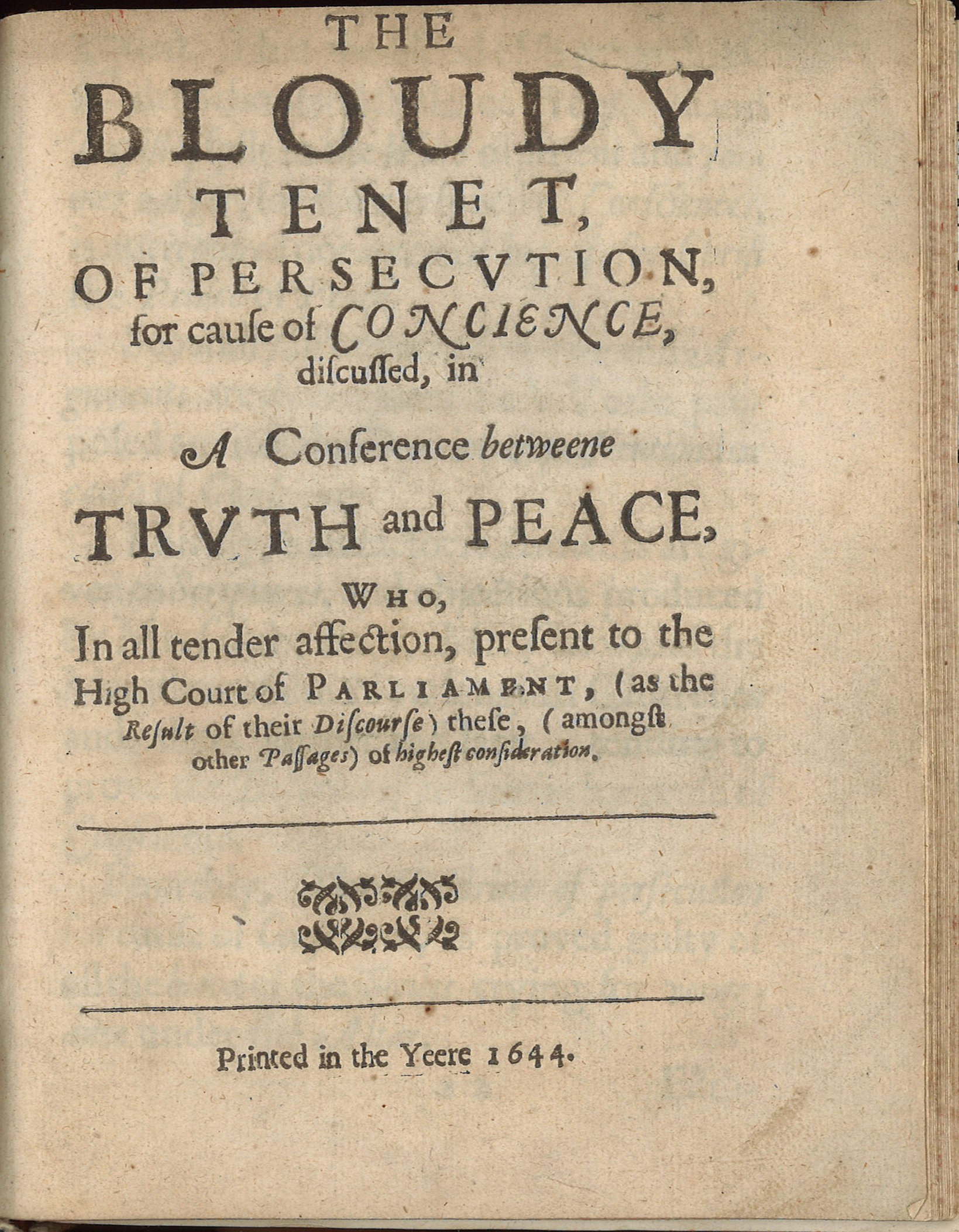
bloudy-tenetThe General and Particular Baptists adopted none of the theological or practical errors of the Anabaptists, but they were somewhat innovative in their approach to public theology. Due to persecutions experienced at the hands of church-run magistrates, they searched the Scriptures and came away with a doctrine that would come to be known as liberty of conscience. Thomas Helwys, a General Baptist, was perhaps the first to write on this subject. Roger Williams, an English migrant to America and a Separatist-turned-Particular Baptist, expounded on Helwys’ earlier work. In his 1644 work entitled The Bloudy Tennent of Persecution, Williams called out civil magistrates for their persecution of the consciences of saints. Nevertheless, he called the saints to expect persecution if they truly be in Christ.

“WHILE I plead the cause of truth and innocence against the bloody doctrine of persecution for cause of conscience, I judge it not unfit to give alarm to myself, and to all men, to prepare to be persecuted or hunted for cause of conscience. Whether you stand charged with ten or but two talents, if you hunt any for cause of conscience, how can you say you follow the Lamb of God, who so abhorred that practice?” (ed. Joseph Early, Jr., Readings in Baptist History, pg. 21).

The Baptist Confession (1644 / 1646)

Liberty of conscience was a universally accepted distinctive of the early English and American Baptists. In The Baptist Confession (1644), the English Particular Baptists made many concessions to the public theology of the continental Reformers as laid out in the Belgic Confession. However, they nuanced it quite a bit. The Dutch Reformers would doubtless wholeheartedly affirm Article XLVIII in The Baptist Confession of 1644. It reads almost verbatim like the Belgic Confession in its insistence that Christians are subject to magistrates:

That a civil Magistracy is an ordinance of God set up by God for the punishment of evil doers, and for the praise of them that do well; and that in all lawful things commanded by them, subjection ought to be given by us in the Lord: and that we are to make supplication and prayer for Kings, and all that are in authority, that under them we may live a peaceable and quiet life in all godliness and honesty.”

However, moving into the next article, there is a slight change of tone from the Belgic Confession to the Baptist Confession. Where The Belgic Confession offers no concession for liberty of conscience, The Baptist Confession highlights it.

“The supreme Magistracy of this Kingdom we believe to be the King and Parliament freely chosen by the Kingdom, and that in all those civil Laws which have been acted by them, or for the present is or shall be ordained, we are bound to yield subjection and obedience unto in the Lord, as conceiving ourselves bound to defend both the persons of those thus chosen, and all civil Laws made by them, with our persons, liberties, and estates, with all that is called ours, although we should suffer never so much from them in not actively submitting to some Ecclesiastical Laws, which might be conceived by them to be their duties to establish which we for the present could not see, nor our consciences could submit unto; yet are we bound to yield our persons to their pleasures” (Article XLIX).

It’s worth noting that, while Particular Baptists at this time saw no place for a civil magistrate to exercise ecclesiastical authority, they do not deny the right of the church described in The Belgic Confession to speak with prophetic authority to civil magistrates. In fact, in the next article, they themselves appeal directly to God for the hearts and the minds of the state to be bent toward them in mercy:

“And if God should provide such a mercy for us, as to incline the Magistrates’ hearts so far to tender our consciences, as that we might be protected by them from wrong, injury, oppression and molestation, which long we formerly have groaned under by the tyranny and oppression of the Prelatical Hierarchy, which God through mercy hath made this present King and Parliament wonderful honorable, as an instrument in his hand, to throw down; and we thereby have had some breathing time, we shall, we hope, look at it as a mercy beyond our expectation, and conceive ourselves further engaged forever to bless God for it” (Article L).

This was a clear appeal not only to God but also to the civil magistrates to show mercy and kindness to them for conscience sake. Yet the Particular Baptists went on to explain that, even if the magistrates did not show mercy but dealt treacherously with them, they were still to submit in all things lawful, yet without violating their consciences. The revision of this Confession in 1646 goes on to expound on this idea of liberty of conscience recognizing it as a duty the state owes to its citizenry. It even goes so far as to dictate to the magistrates what are their duties to men regarding liberty of conscience. As such, we see that the early Particular Baptists did view the use of the prophetic voice as a deterrent for governments that might otherwise violate their liberty of conscience. They did not concede to the notion that the church should not speak to matters of government, only that governments were not free to dictate terms to the church.

______________
In our next article, we will conclude our discussion of public theology in the Reformed confessions by examining developments in The Westminster Confession and The Baptist Confession (1677 / 1689).
Why Mark Jones Is Right… and Wrong

Jones-Mark-HigherRes

Mark Jones

Let me be the first (perhaps not) Baptist to admit that Mark Jones was spot on in many regards in his post “A Plea for Realism”:Are Presbyterians Christians? It seems to me that Mark Jones is simply calling for a little intellectual honesty from us Baptists. Well, allow me to humor him.

I certainly agree that, if we do not allow unbaptized believers to take communion, that should include those who have been “baptized” in a way that we believe to be unbiblical and, thus, no baptism at all. If a paedobaptist came to my church who refused to be baptized post-confession due to having been sprinkled as an infant, we would not allow him to be a member, so why would we allow him to take communion? Baptism, in every Christian tradition, has historically preceded communion. Baptism preceding communion is both a historical and a biblical view. On this point, most Baptists and Presbyterians agree.

Therefore, for me to dissuade my Presbyterian friends from taking communion in my local church, I am not saying they are not Christians so much as that they have not followed biblical mandate in regard to the order of the sacraments. That is, baptism precedes communion. On this point, they would obviously disagree with me, because they hold to a different understanding of baptism. However, for Baptists to cave on this issue and allow for unbaptized Presbyterians (and that’s what we think they are) to take communion, we would be going against our confession’s definition of true baptism.

However, we are not alone in this stance. Presbyterians must take issue with at least some Baptists taking communion in their churches. Just this week, I listened to a somewhat refreshing episode of Reformed Forum in which Jim Cassidy admitted that Baptist parents are in sin who do not baptize their infants in keeping with a Presbyterian view of baptism. I think this is the only consistent Presbyterian view and, as such, I don’t see how Baptist parents can take communion in Presbyterian churches, unless Presbyterians encourage people in open, unrepentant sin to take communion.

ctc-album300Either way, both traditions have an issue when it comes to what Jones calls “catholicity” and baptism. Neither one of us can deny that we see the other as being disobedient to our Lord’s ordinance of baptism. Are Baptists inconsistent to call their Presbyterian friends Christians? Not quite as inconsistent, I would argue, as those Presbyterian churches that allow consistently Baptist parents to take communion.

So, perhaps the proper way to respond to our Presbyterian friends when they try to corner us on these issues is not to bend over backward to try to be ecumenical. Perhaps, the best response is to affirm them where they are correct, but demonstrate how they have to answer the same questions regarding their sacramentology. None of us are immune. At a certain level, each believe the other (credos and paedos) is disobedient at a certain level, and that must stand as a guard to the communion table at some point.

See also Tom Hicks’ response to Jones’ article. Michael Haykin has also chimed in, and Jones has offered his critique of Haykins’ response here.

CredoCovenant 2.0

EA-2.0We are now actively and publicly recruiting new contributors to the blog. We’re looking for all kinds of bloggers with different backgrounds and life experiences. We will be privately contacting some solo-bloggers from around the web (those who openly publish their contact info), but if you read this and know someone who meets the criteria, let us know.


Criteria:

  1. Must subscribe to the 1689 London Baptist Confession of Faith.
  2. Must attend a confessionally Reformed church (if you are able).
  3. Must have previous blogging experience or be able to submit previously written material via e-mail for our consideration.
  4. Must be a member in good standing in a local church.
  5. Must bring something unique to the CredoCovenant dynamic.

We are also open to hearing from our readers how we might improve our website. Feel free to contact us at credocov@gmail.com to be considered as a contributor.

CCF Episodes 13-14, 25-28: Covenant Theology by Nehemiah Coxe

Grab Covenant Theology: From Adam to Christ by Nehemiah Coxe and John Owen and read along with the CredoCovenant Fellowship as we engage its major themes from a Reformed Baptist perspective:


coxeowen2

Covenant Theology: From Adam to Christ

by Nehemiah Coxe and John Owen

CCF Episode Twenty-Eight: Concluding Our Discussion of Covenant Theology

CredoCovPodcastMaster

In this episode, JD and Billy sit down with Junior “The Big Dippa” Duran and Rene Del Rio to conclude their discussion of Covenant Theology: From Adam to Christ by Nehemiah Coxe and John Owen.

MP3 Download | stream:

Subscribe to future podcasts and leave us a review on iTunes: RSS | iTunes  

The book we read…coxeowen2

Covenant Theology: From Adam to Christ by Nehemiah Coxe and John Owen

We’d love your participation. Contact us with your comments and questions about the books contents:

Christian Liberty According to the 1689


CredoCovPodcastMaster

Grab your copy of The Baptist Confession and join JD and Billy as they discuss Christian liberty from a Reformed Baptist perspective.

Subscribe to future podcasts and leave us a review on iTunes: RSS | iTunes  

The book we mentioned:

BaptistConfessionLeather1689


The Baptist Confession & The Baptist Catechism
edited by James Renihan

We’d love your participation. Contact us with your comments and questions about the confession’s contents:

Covenant Theology: From Adam to Christ by Nehemiah Coxe and John Owen (hardcover)

coxeowen2Covenant Theology: From Adam to Christ by Nehemiah Coxe and John Owen; ed. Ronald D. Miller, James M. Renihan, and Francisco Orozco

388 pages

Publisher: Reformed Baptist Academic Press; (October 1, 2005)

Language: English

ISBN-10: 0976003937

ISBN-13: 978-0976003939


Summary:

“Covenant Theology: From Adam to Christ is a reprint of two seventeenth century theologians, Nehemiah Coxe and John Owen. It amply displays the fact that seventeenth century Particular Baptists fit within the broader Covenant Theology of that day.”


Book Reviews:

Founders Journal – Eddie Goodwin

“Hercules had his labors. Alexander the Great faced the Gordian knot. And for a growing number of Baptists today, there is the great challenge of explaining precisely how one can be committed to both Reformed covenant theology and credo Baptistic convictions. Thankfully, a ready reply is available in a new compilation work from Reformed Baptist Academic Press entitled, Covenant Theology from Adam to Christ.Read more…


The Dogmatic Reformer – William Sandell

Listen to Our Discussions of This Book

Listen to Our Discussions of This Book

“Covenant Theology is the core doctrine of the Reformed faith, whether Presbyterians or (traditional) Baptists.  The understandings of the covenants is the primary distinction between the two groups.  Both sides agree in the Covenant of Works, which is that God made a Covenant with Adam in the Garden.  If Adam obeyed than he (and his posterity) would have gained eternal life.  Adam failed, so we needed a new representative.  We need one who could fulfill that covenant for us, since the curse of sin prevented any of us from perfect obedience ourselves.  That is what both sides call the Covenant of Grace.  Jesus fulfills that role as our federal head and representative.  It was not just his death on the cross, but his active obedience that allow us to gain eternal life.  His righteous life is imputed (credited) to us and is looked upon as if we had done it.” Read more…


Amazon Review – Douglas VanderMeulen

“For many thoughtful Christians, to seriously embrace Covenantal theology means that ipso facto you should also embrace infant baptism. For many the two are inseparably linked. Or to put it another way, many believe that Baptist theology and Covenantal theology are mutually exclusive when the latter is held in a biblically consistent manner. But the book ‘Covenant Theology from Adam to Christ’ by the 17th century Baptist, Nehemiah Coxe’s challenges this assumption via sound exegetical analysis of the key passages on covenants and their signs in both Old and New Testaments. Please don’t misunderstand, this is not another book trying to prove believer’s baptism. It is an exegetical work developing and explaining the covenantal structure of the Bible and God’s promise of salvation.” Read more…

CCF Episode Twenty-Four: Christian Liberty According to the 1689 (Part Two)

CredoCovPodcastMaster

In this episode, JD and Billy sit down to discuss Christian Liberty in light of The Baptist Confession. Featuring music from Nora Bayes

MP3 Download | stream:

For further study on the history of alcohol in America and the history of the use of grape juice in communion listen to this sermon delivered by Arden Hodgins.

Subscribe to future podcasts and leave us a review on iTunes: RSS | iTunes  

For further study:

BaptistConfessionLeather1689


The Baptist Confession & The Baptist Catechism
edited by James Renihan

We’d love your participation. Contact us with your comments and questions about the confession’s contents:

CCF Episode Twenty-Two: The Trueman Show

In conjunction with The Confessing Baptist, JD and Billy sit down with Dr. Rev. Carl Trueman to discuss his book The Creedal Imperative. Featuring music from Shai Linne and Redeemer INdy.

image


For further discussion of The Creedal Imperative, check out these episodes and my book review from earlier in 2014.

MP3 Download | stream:

Subscribe to future podcast: RSS | iTunes [official page pending]

The book we discussed:

Creedal Imperative

The Creedal Imperative Paperback
by Carl R. Trueman

We’d love your participation. Contact us with your comments and questions about the book’s contents: