50 Shades of Christ: The Other Side of a Much Needed Dialogue

On last Thursday’s episode of The Briefing and in this article Al Mohler, president of The Southern Baptist Theological Seminary, made a much needed call for empathy regarding the Ferguson debacle. This call for empathy has been forefront in much of what I have read from bloggers, though it has been more implicit than explicit. In the wake of protests and riots following the tragic death of Michael Brown, African-Americans of all stripes have taken to their keypads. They have offered their unique perspectives on the issue and encourage empathy for a large group within the black community that sees Ferguson as indicative of a greater problem with law enforcement in many communities. Here and here are just a few from the Reformed blogosphere. I would recommend that our readers take the time to read them, as they are truly eye-opening.

Taking Dr. Mohler seriously that we ought to empathize with others and assuming that he’s talking to all Christians, not just majority-culture Christians, I am compelled to give my unique perspective for what it’s worth. It is my desire to be empathetic, as Dr. Mohler has urged. At the same time, I would like to aid my African-American friends in their efforts to be empathetic as well. I want this to be a dialogue, not just a monologue. I also recognize this is not a very popular subject for a Caucasian male to address. That is why this article was peer reviewed by friends of other races before I published it. Please, bear with me.

Background

When I was in seventh grade, I remember having a life-changing conversation with a friend of mine. I had made a very insensitive comment, as I am wont to do from time to time. This time it had to do with race relations. My friend quickly pulled me to the side and with tears explained to me the negative effects that racism had had on his life.

James was the product of an interracial marriage. His dad was Irish / Native-America and his mother had immigrated from Mexico. Consequently, some people thought he was either Arabic or Indian. He told me how people had teased him, calling him a camel jockey and a towel head. From that night forward, I have fought sinful urges to tolerate racism in myself or others. A moment of honesty: I have not always been completely successful. I don’t deny that I have made some rather absent-minded, insensitive statements from time to time.

As I got older the light of nature began to reveal to me things that were only further confirmed when I came to Christ. When I would hear white people speak negatively of other races, I would become extremely uncomfortable. Over time, I also came to be increasingly uncomfortable with the idea that one ought to find a special identity with one’s own race. Notions such as “my people” and “our people” came to be just as repulsive as any other type of racism.

The Bible and Partiality

Perhaps the book in Scripture that had the most effect on me as a young man, and especially after I came to Christ, was the book of James. Some have referred to James as the Proverbs of the New Testament. It is full of pithy precepts and imperatives, one of which is the prohibition of partiality:

“My brethren, do not hold your faith in our glorious Lord Jesus Christ with an attitude of personal favoritism. . . If, however, you are fulfilling the royal law according to the Scripture, ‘You shall love your neighbor as yourself,’ you are doing well. But if you show partiality, you are committing sin and are convicted by the law as transgressors” (James 2:1, 8-9; NASB).

In the immediate context James uses the example of partiality toward the rich as an example of how one might show favoritism within the body. The precepts he outlines are much farther reaching than just how we deal with the rich, though. Partiality of any kind ought to be condemned. When men and women leave all to follow Christ, we need to recognize the fact that we are their earthly inheritance (Mark 10:21, 28-31). Thus, to shun them for any reason, be it wealth, race, disability, etc., is to cease to function as the church ought to function.

As a Christian man seeking to apply these principles, I find it highly inappropriate to identify myself in church life as “a white man.” I am an image bearer, and I am to love all image bearers alike. To gravitate toward people who share with me in skin color to the exclusion of others would be contrary to everything I am as a new man in Christ (Ephesians 2:13-16). If the words “my people” were ever to flow from my lips, you could be quite positive that I would be referring to the whole body of Christ, not merely some people who share my skin pigmentation. Were I to use a term such as “white church,” you can bet that it would have an extremely negative connotation.

For all of the above reasons, I am at a loss for how godly pastors and bloggers who I respect would resort to using such terms so freely, African-American pastors and bloggers who claim they are for tearing down racial dividing walls. I don’t understand why, when I see many predominantly white churches bending over backwards to become more “multicultural,” it seems to be just a given that we accept the existence of “black” churches, Korean churches, Hispanic churches, etc. (the language consideration aside), without expecting them to strive for the same diversity. I hate the idea that there would be any church that would have any predominating identity other than Christ. To be honest it sickens me. At best it’s sub-Christian.

Multi-Culturalism

Then again, I have not been the most outspoken proponent of the modern multi-cultural movement in the American church. The call has gone out that predominantly white churches ought to be particularly intentional about seeking to look less “white” and more like the community. Here’s the problem: in order for churches to strive toward such ends, they must compete with churches in their communities that have a long history of gearing their ministry methods toward serving one race.

For instance, say you have a large Vietnamese culture in your community. You could take extra pains to teach your people conversational Vietnamese, hire Vietnamese staff members, seek to raise up or extend a call to potential Vietnamese elders, print out Sunday bulletins in Vietnamese, etc. At the end of the day, you are still at a disadvantage in competing with the Vietnamese church down the road and, in taking so many strides toward catering toward one people group, you have excluded all others. You have not become all things to all people; rather, you have become one thing to one group of people. Even worse, you have made your agenda the deciding factor, rather than the Holy Spirit, on who you hire, raise up in ministry, and even target with the gospel. Who are we to usurp the role of the Spirit in these matters?

See, the question for me is not whether you take added pains to accommodate for a select group of potential membership candidates in your area based on race and ethnicity. Rather, the question is, When you have new members who are not like you, how do you respond? How do you respond when the poor come into your meetings? How do you respond when the disabled come into your meetings? How do you respond when the white man, the black woman, the Vietnamese family, or the Hispanic couple walk through your doors? Do you give first place to any particular group, or do you wait and see who the Spirit will exalt?

Don’t get me wrong. I agree that the precepts of the gospel should result in a more pan-cultural face in local churches. I believe it has in the church where I serve. We are a very diverse group of people, and it can all be attributed to the primacy of the gospel in our body life. However, I worry that some who have made it their aim to see a more intentional approach to multi-culturalism in the church might be taking their own particular applications of these principles and equating them with the gospel itself. As such, they add to the gospel an added burden that simply is not there, making it no gospel at all. They have made multi-culturalism primary over the gospel while claiming it is subservient to the same gospel.

It seems clear to me both from the Bible and from experience that, if we simply conduct ourselves according to the principles outlined for us in Scripture, these things should iron themselves out in body life. R.C. Sproul put it best in a recent Twitter Q&A. When asked, “How important is racial diversity in the LOCAL church? What is the best approach to developing diversity?” Sproul responded, “Let the church be the church in all that she does.” Let’s be slow to judge the bride of Christ when the sin of partiality could very well exist primarily in the surrounding community and other more race-centric churches in the area.

Conclusion

The biggest hindrance to accomplishing the goals outlined by the multi-cultural church movement is multi-culturalism itself. As long as we have pastors who monolithically refer to their ethnic groups as “my people,” as long as it is socially acceptable to have such things as “black churches,” “Hispanic churches,” “Romanian churches,” etc., as long as we seek to be multi-cultural, letting racial dividing walls persist even within one local church, we will never see true peace among God’s people. Such rhetoric only serves to deepen the very real racial divide in the Western church. For those of you who have yet to hear this position on this issue in the church, I hope I have been of assistance. I hope this monologue can now become more of a dialogue, and I hope that we can all take strides toward the ends Dr. Mohler outlined and lead with empathy.

Brave New World by Aldous Huxley

brvnwwrld

Brave New World by Aldous Huxley

Paperback: 384 pages

Publisher: Harper Perennial Modern Classics; Reprint edition (July 5, 2005)

Language: English

ISBN-10: 0060776099

ISBN-13: 978-0060776091


Summary:

Aldous Huxley is rightly considered a prophetic genius and one of the most important literary and philosophical voices of the 20th Century, and Brave New World is his masterpiece. From the author of The Doors of Perception, Island, and countless other works of fiction, non-fiction, philosophy, and poetry, comes this powerful work of speculative fiction that has enthralled and terrified readers for generations. Brave New World remains absolutely relevant to this day as both a cautionary dystopian tale in the vein of the George Orwell classic 1984, and as thought-provoking, thoroughly satisfying entertainment.


Reviews:

The Guardian – Aiman.A

Listen to Our Discussions of This Book (Coming Soon!)

Listen to Our Discussions of This Book (Coming Soon!)

“Brave New World is a classic – it is a dystopian novel similar in theme to George Orwell’s Nineteen Eighty-Four. I was recommended to read this book, by my cousin, as I enjoy dystopian novels. Brave New World revolves around the idea of totalitarianism and is set in a futuristic world where a combination of science and pleasure form a rather feudalistic society. This idea of totalitarianism is achieved through test tube babies, and hypnotism, resulting in a pre-ordained caste system consisting of intelligent humans suited to the highest positions and conversely, serf-like beings genetically programmed to carry out menial works. In this world of Alphas, Betas, Gammas, Deltas and the unfortunate Epsilons, exists drug-induced happiness, caused by what is known as soma. Here, “everyone belongs to everyone else” emphasising the system of forced promiscuity, brainwashed into the people from the moment of birth. At the core of this book is the horrific idea of eugenics and despite being written several decades ago, its message remains valid for our generation.” Read more…


The Independent – Fay Weldon

“I first read Brave New World in 1949. I was a frivolous 18-year old studying economics at St Andrews. There had always been favourite books. I’d grown up with Tolkien’s The Hobbit, moved on to the homoeroticism of EF Benson’s David Blaise, then to the bodice-rippers of Georgette Heyer and the fierce socialist indignation of Upton Sinclair in The Octopus.” Read more…

Christian Liberty According to the 1689


CredoCovPodcastMaster

Grab your copy of The Baptist Confession and join JD and Billy as they discuss Christian liberty from a Reformed Baptist perspective.

Subscribe to future podcasts and leave us a review on iTunes: RSS | iTunes  

The book we mentioned:

BaptistConfessionLeather1689


The Baptist Confession & The Baptist Catechism
edited by James Renihan

We’d love your participation. Contact us with your comments and questions about the confession’s contents:

The Communist Manifesto by Karl Marx and Frederick Engels

untitledThe Communist Manifesto by Karl Marx and Frederick Engels

Paperback: 304 pages

Publisher: Penguin Classics (August 27, 2002)

Language: English

ISBN-10: 0140447571

ISBN-13: 978-0140447576


Summary

“Originally published on the eve of the 1848 European revolutions, The Communist Manifesto is a condensed and incisive account of the worldview Marx and Engels developed during their hectic intellectual and political collaboration. Formulating the principles of dialectical materialism, they believed that labor creates wealth, hence capitalism is exploitive and antithetical to freedom.

This new edition includes an extensive introduction by Gareth Stedman Jones, Britain’s leading expert on Marx and Marxism, providing a complete course for students of The Communist Manifesto, and demonstrating not only the historical importance of the text, but also its place in the world today.”


Reviews

The Communist Manifesto – Monthly Review Press

“First published in London in 1848, The Communist Manifesto is one of the most important books of all time: a document which helped to define the emerging socialist movement, altered the course of world history, and is universally acknowledged to be a cornerstone of modern social thought.” read more…


Book Review: The Communist Manifesto – Francis Beckett

Listen to Our Discussions of This Book

Listen to Our Discussion of This Book

“No philosopher’s reputation has plummeted in my lifetime as dramatically as that of Karl Marx. As late as the 1970s, it was still fashionable to claim an ideology deriving from Marx. Ambitious young politicians like John Reid and Alan Milburn called themselves socialists and even Marxists as comfortably as they later called themselves New Labour.” read more…


The Communist Manifesto – Roger Spalding

The Communist Manifesto was a product of the social, economic and political turmoil that characterised Europe before 1850. Both of its authors, Marx and Engels, were touched by elements of this turmoil. Karl Marx, born in 1818, came from the Rhineland, an area occupied by the French during the Napoleonic Wars. During this period the French abolished feudal restrictions, introduced religious toleration and secularised the state. Many, like Marx’s father, benefited from this liberal regime. When, after Napoleon’s defeat, the Rhineland passed under Prussian control, Hirschel Marx, Karl’s father, abandoned Judaism for Christianity to retain the right to practise as a lawyer. Friedrich Engels, born in 1820, came from a family of German industrialists: he had, therefore, first-hand knowledge of the effects of rapid industrialisation. In 1842 Engels moved to Manchester to work at the family cotton mill. This took him to the heart of the world’s first industrial nation.” read more…


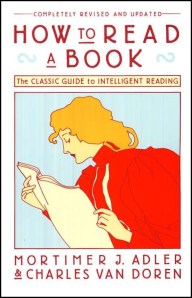
How to Read a Book by Mortimer Adler and Charles Van Doren (paperback)

How_To_Read_A_BookHow to Read a Book by Mortimer Adler and Charles Van Doren

Paperback: 426 pages

Publisher: Touchstone; Revised edition (August 15, 1972)

Language: English

ISBN-10: 0671212095

ISBN-13: 978-0671212094


Summary:

With half a million copies in print, How to Read a Book is the best and most successful guide to reading comprehension for the general reader, completely rewritten and updated with new material.

Originally published in 1940, this book is a rare phenomenon, a living classic that introduces and elucidates the various levels of reading and how to achieve them—from elementary reading, through systematic skimming and inspectional reading, to speed reading. Readers will learn when and how to “judge a book by its cover,” and also how to X-ray it, read critically, and extract the author’s message from the text.

Also included is instruction in the different techniques that work best for reading particular genres, such as practical books, imaginative literature, plays, poetry, history, science and mathematics, philosophy and social science works.

Finally, the authors offer a recommended reading list and supply reading tests you can use measure your own progress in reading skills, comprehension, and speed.


Book Reviews:

How to Read a Book – Jeremy Anderberg

“1. Open book.

2. Read words.

3. Close book.

4. Move on to next book.

Reading a book seems like a pretty straightforward task, doesn’t it? And in some cases, it is. If you’re reading purely for entertainment or leisure, it certainly can be that easy. There’s another kind of reading, though, in which we at least attempt to glean something of value from the book in our hands (whether in paper or tablet form). In that instance, you might be surprised to learn that it’s not as simple as opening the book and reading the words.” read more…


How to Read a Book: The Rules for Analytical Reading – Justin Taylor

Listen to Our Discussions of This Book

Listen to Our Discussions of This Book

“Last night I pulled off my shelf Mortimer Adler’s classic, How to Read a Book. It’s been several years since I worked through the book, but a review of the underlining and written notes testify to how much it influenced me. I’ll share in a separate post a particular section that has marked me indelibly.” read more…


How to Read a Book – Bob Passantino

“When I first read the title of Mortimer Adler’s How to Read a Book, I wondered what book I needed to read to learn how to read How to Read a Book! All kidding aside, far from teaching basic reading skills, Adler was, instead, interested in helping people learn how to get the most out of what they read and how to know in advance how helpful a given book will be. As book review editor, I regularly follow Adler’s advice.” read more…

The Creedal Imperative by Carl Trueman (paperback)

Creedal ImperativeThe Creedal Imperative by Carl Trueman

Paperback: 208 pages

Publisher: Crossway; (September 30, 2012)

Language: English

ISBN-10: 1433521903

ISBN-13: 978-1433521904


Summary:

What if “No creed but the Bible” is unbiblical?

The role of confessions and creeds is the subject of debate within evangelicalism today as many resonate with the call to return to Christianity’s ancient roots. Advocating for a balanced perspective, Carl Trueman offers an analysis of why creeds and confessions are necessary, how they have developed over time, and how they can function in the church of today and tomorrow.


Reviews:

CredoCovenant Review – Billy Leonhart

“How might creedal and confessional commitments jeopardize the protestant commitment to Sola Scriptura? Are such commitments not tantamount to the elevation of tradition to the level of, if not above, Scripture itself? Will not such commitments in essence render the church irrelevant in this modern age? Whatever happened to ‘no creed but the Bible’? Carl Trueman, Professor of Church History at Westminster Theological Seminary (Philadelphia, PA.), seeks to answer these questions and more in The Creedal Imperative. In this book, Trueman argues that ‘creeds and confessions are, in fact, necessary for the well-being of the church’ (20).” Read more…

Listen to Our Discussions of This Book

Listen to Our Discussions of This Book

IX Marks Review – Peter Hess

“In The Creedal Imperative, Carl Trueman argues that, if a church hopes to ‘follow the pattern of the sound words’ that has been entrusted to it (2 Tim. 1:13), that church requires a robust confessionalism.” Read more…


The Aquila Report – Aimee Byrd

“Apparently, this book is too cool for a subtitle. Carl Trueman has a market on cool by rebelling against cool. Especially skinny jeans. But I digress. I’m thinking something like, ‘The Indicatives are Imperative.’ But that’s just me. Does your church catechize or teach with creeds? Sure it does. Trueman makes the case that all churches and all people have a creed, whether they admit it or not. ‘No creed but the Bible’ just doesn’t exist, and is a creed in itself (maybe that’s a good subtitle).” Read more…


The Blog (Founders) – Tom Hicks

“With Christianity on the wane in Western culture, some leaders have urged Christians to deemphasize secondary doctrines in order to stand united on gospel essentials.  Our numbers are too small, they say, for Christians to continue nit picking at each other on long disputed matters of theology.  Let me suggest, however, that doctrinal minimalism is the wrong approach, especially at this time.  While all true Christians should stand united for the advancement of Christ’s kingdom and against the rising specter of secularism, this is not the time to sideline secondary doctrines of the faith.  Now, more than ever, we need robust, thoroughly biblical expressions of Christianity.  We need an encyclopedically confessional faith.” Read more…


Covenant Theology: From Adam to Christ by Nehemiah Coxe and John Owen (hardcover)

coxeowen2Covenant Theology: From Adam to Christ by Nehemiah Coxe and John Owen; ed. Ronald D. Miller, James M. Renihan, and Francisco Orozco

388 pages

Publisher: Reformed Baptist Academic Press; (October 1, 2005)

Language: English

ISBN-10: 0976003937

ISBN-13: 978-0976003939


Summary:

“Covenant Theology: From Adam to Christ is a reprint of two seventeenth century theologians, Nehemiah Coxe and John Owen. It amply displays the fact that seventeenth century Particular Baptists fit within the broader Covenant Theology of that day.”


Book Reviews:

Founders Journal – Eddie Goodwin

“Hercules had his labors. Alexander the Great faced the Gordian knot. And for a growing number of Baptists today, there is the great challenge of explaining precisely how one can be committed to both Reformed covenant theology and credo Baptistic convictions. Thankfully, a ready reply is available in a new compilation work from Reformed Baptist Academic Press entitled, Covenant Theology from Adam to Christ.Read more…


The Dogmatic Reformer – William Sandell

Listen to Our Discussions of This Book

Listen to Our Discussions of This Book

“Covenant Theology is the core doctrine of the Reformed faith, whether Presbyterians or (traditional) Baptists.  The understandings of the covenants is the primary distinction between the two groups.  Both sides agree in the Covenant of Works, which is that God made a Covenant with Adam in the Garden.  If Adam obeyed than he (and his posterity) would have gained eternal life.  Adam failed, so we needed a new representative.  We need one who could fulfill that covenant for us, since the curse of sin prevented any of us from perfect obedience ourselves.  That is what both sides call the Covenant of Grace.  Jesus fulfills that role as our federal head and representative.  It was not just his death on the cross, but his active obedience that allow us to gain eternal life.  His righteous life is imputed (credited) to us and is looked upon as if we had done it.” Read more…


Amazon Review – Douglas VanderMeulen

“For many thoughtful Christians, to seriously embrace Covenantal theology means that ipso facto you should also embrace infant baptism. For many the two are inseparably linked. Or to put it another way, many believe that Baptist theology and Covenantal theology are mutually exclusive when the latter is held in a biblically consistent manner. But the book ‘Covenant Theology from Adam to Christ’ by the 17th century Baptist, Nehemiah Coxe’s challenges this assumption via sound exegetical analysis of the key passages on covenants and their signs in both Old and New Testaments. Please don’t misunderstand, this is not another book trying to prove believer’s baptism. It is an exegetical work developing and explaining the covenantal structure of the Bible and God’s promise of salvation.” Read more…

CCF Episode Twenty-Seven: The Covenant of Circumcision

CredoCovPodcastMaster

In this episode, JD and Billy sit down with Junior “The Big Dippa” Duran and Rene Del Rio to discuss Chapters Five, Six, and Seven of Covenant Theology: From Adam to Christ by Nehemiah Coxe and John Owen. Featuring music from ALERT312.

MP3 Download | stream:

Subscribe to future podcasts and leave us a review on iTunes: RSS | iTunes  

The book we’re currently reading…coxeowen2

Covenant Theology: From Adam to Christ by Nehemiah Coxe and John Owen

We’d love your participation. Contact us with your comments and questions about the books contents:

CCF Episode Twenty-Six: The Abrahamic Covenant

CredoCovPodcastMaster

In this episode, Billy and JD sit down with Junior “The Big Dippa” Duran and Rene Del Rio to discuss Chapter Four of Covenant Theology: From Adam to Christ by Nehemiah Coxe and John Owen. Featuring music from Brandon Rhyder.

MP3 Download | stream:


Subscribe to future podcasts and leave us a review on iTunes: RSS | iTunes  

The book we’re currently reading…coxeowen2

Covenant Theology: From Adam to Christ by Nehemiah Coxe and John Owen

We’d love your participation. Contact us with your comments and questions about the books contents:

CCF Episode Twenty-Five: Typology and the Line of Seth

CredoCovPodcastMaster

In this episode, Billy and JD sit down with Junior “The Big Dippa” Duran and Rene Del Rio to discuss Chapter Three of Covenant Theology: From Adam to Christ by Nehemiah Coxe and John Owen. Featuring music from Evangel.

MP3 Download | stream:

Subscribe to future podcasts and leave us a review on iTunes: RSS | iTunes  

The book we’re currently reading…coxeowen2

Covenant Theology: From Adam to Christ by Nehemiah Coxe and John Owen

We’d love your participation. Contact us with your comments and questions about the books contents: